In short
The flame-faced ruler of the Dark Dimension is introduced through Lee's script and Ditko's art in the back feature of Strange Tales #126, November 1964. The story, "The Domain of the Dread Dormammu!", takes Doctor Strange into the Dark Dimension, where he meets the tyrant for the first time. Clea debuts in the same issue, and the confrontation continues in #127. Grade drives everything for this Silver Age key.
Few Silver Age villains arrive with as little warning as Dormammu. Readers of the Doctor Strange feature had spent more than a year with one-off mystical threats and a scheming rival, and then a single issue of Strange Tales opened a door onto a realm of flame, floating architecture and a ruler whose face is a mask of fire. This guide stays with that one issue: what it contains, who made it, what to check on a copy and which neighboring numbers get mistaken for it.
Every credit, title and cover date below was checked against published reference pages for the series. Where the record names only Lee and Ditko, this guide names only Lee and Ditko, and the buying advice is analysis of how copies of 1960s books behave, not a claim about any particular sale.

What Strange Tales #126 actually is
Strange Tales #126 carries a cover date of November 1964. At that point the magazine was a split book: Doctor Strange was a back-of-the-book feature that shared the pages with a headliner, and it would stay that way until Nick Fury took over the other half with #135 in August 1965. That context matters to a collector, because the Dormammu debut is not a stand-alone Doctor Strange comic. It is one story inside a mixed magazine whose cover is built to sell the other feature.
The Doctor Strange story in the issue is titled "The Domain of the Dread Dormammu!" and the sequel in #127 is titled "Duel With the Dread Dormammu!" Both are credited to Stan Lee as writer and Steve Ditko as artist, the same pairing that had launched the sorcerer in #110 in July 1963. The reference record that names the story titles does not list a separate penciler, inker or letterer for the pair of issues, so this guide does not either. If you need those lines for a catalog entry, check the indicia and credits printed on your own copy.
Two characters debut here. Dormammu is the headline, but Clea, the Dark Dimension inhabitant who later becomes one of the most important figures in Doctor Strange's life, is introduced in the same issue. Her family tie to Dormammu is not spelled out at this stage; the niece relationship was revealed later. That is a useful detail when you describe the book: #126 is the debut of both, and it is not the issue that establishes how they are related.
How Dormammu is introduced
The setup is straightforward and visual. Doctor Strange, already established as Earth's defender against mystical threats, is drawn into the Dark Dimension, a realm that does not follow the geometry of the street-level New York that Ditko drew in the Spider-Man book at the same time. In that realm he meets Clea and then Dormammu himself. The tyrant is not presented as a man in a costume. He is a ruler of a whole dimension, and the story treats him as a power that cannot be beaten by the tricks that worked on earlier foes.
The issue is the opening chapter of a duel, not a self-contained tale. It ends with the confrontation unresolved, which is why the story carries into #127. The two-part encounter also brings in the Mindless Ones, the shambling giants of the Dark Dimension, but the names that sell a copy of #126 are Dormammu and Clea.
What readers saw on the page was the thing that made the feature stand apart from the rest of the Marvel line in late 1964. Ditko's Dark Dimension is drawn with floating shapes, impossible perspectives and a color palette built around fire and shadow. Dormammu's head is a flaming mask rather than a face with hair, a design choice that reads instantly on a tiny back-feature panel and that Marvel has kept ever since. Describing the issue in a listing as "the Ditko dimension debut" is accurate and more useful to a buyer than a generic "key villain" tag.
Who created Dormammu, and how
The creation story is documented through Lee's own recollection, quoted by comics historian Mike Conroy: Lee said he invented the name first and then had to come up with a character to go with it. Ditko then supplied the look. The name belongs to Lee's account and the visual design to Ditko, whose rendering gave the villain a face unlike any other in the line.
For a collector, the practical takeaway is that the book is a Lee and Ditko co-credit in every standard reference, and that Ditko is the creator whose style defines the issue. This is also why the page for Steve Ditko matters to anyone building a Silver Age run, and why Stan Lee is listed beside him rather than ahead of him on the Doctor Strange material.
The editorial moment explains the rest. Ditko was also drawing The Amazing Spider-Man in 1964, so the same artist was producing the most grounded and the most surreal pages in the Marvel line at the same time. In #126 the surreal side takes a step into an entirely new setting. The Doctor Strange feature had run since July 1963, and the Dormammu story is the point where it stops being a series of isolated mystical cases and starts to look like a serial with a central opponent.
Why #126 is a key issue
A key issue is a number that the market keeps returning to because something enduring started in it. By that test #126 is easy to defend. Dormammu became the principal antagonist of the Doctor Strange mythos, and the story that began in #126 opens the longest sustained run of Doctor Strange adventures from Lee and Ditko. From April 1965 to July 1966 the feature carried a fifteen-issue Dormammu storyline, from #131 to #146, and in those same years Ditko's cosmic arc brought in Eternity. Ditko's last issue on the feature was #146, dated July 1966, scripted by Denny O'Neil, with Dormammu again on the page.
The character was also carried forward by later writers in ways that keep demand alive. Umar, revealed as Dormammu's sister, appears as a central reveal in #150 (November 1966), the issue where the feature also gained its own cover logo. In 1973 Steve Englehart used Dormammu as part of the Avengers and Defenders crossover. In 1981 Chris Claremont wrote him in Thor Annual #9. Each of those uses points the reader back toward the original debut, and that pull is what holds the value of #126 across decades.
The audience for the debut is wide: fans of the sorcerer's comics, fans of Ditko's art, and readers who arrive through screen adaptations and go looking for the printed debut. This guide quotes no price, because the useful frame is relative: #126 sits close to #110, which introduced the hero himself, in the hierarchy of the title.
Numbers that get confused with #126
Because the Dormammu story spans more than one number, several neighboring issues attract the wrong label. The list below separates them.
- Strange Tales #110 (July 1963): the debut of Doctor Strange. Not Dormammu, and a different key entirely. The guide to that issue sits at this page.
- Strange Tales #111 (August 1963): this issue, with the story "Black Magic", carries the earliest mention of Dormammu's name, spoken by another character before he is seen. A mention is not an appearance, and a seller who writes "first Dormammu" on a #111 listing is stretching the term.
- Strange Tales #127 (December 1964): the second chapter, "Duel With the Dread Dormammu!" It matters for the story and it has a market of its own, but the debut is the previous number.
- Strange Tales #146 (July 1966): the last Ditko art on the feature, with an O'Neil script and a lost duel between Dormammu and Eternity. A strong later key, not a first appearance.
- Strange Tales #150 (November 1966): the reveal of Umar as Dormammu's sister. Again a later key.
The same caution applies to the word "origin." Neither #126 nor #127 tells a backstory for Dormammu. The family dimension arrives with the #150 reveal of his sister, and later series add their own layers. When a listing says "Dormammu origin," it is describing something other than #126.
Do you collect this series?
Track what you own, what you are missing and what your collection is worth. 7-day trial.
Start my trial →
Reprints and collected editions
Many readers meet Dormammu in a collected edition before they ever look at a back-issue box. The material from #126 and #127 has been reprinted in Marvel's collected editions of the early Doctor Strange feature, such as the Masterworks volumes. A reprint is for reading and display, not for holding an original.
Facsimile and replica editions deserve a short warning in this area. A reprint that reproduces the cover and the ads can look convincing in a photograph, and the printed marks that separate it from the original, such as an altered indicia, a different paper stock, and a barcode or a modern price box, are visible only in hand or in a sharp scan. The site's guide to reprints and look-alike editions of Doctor Strange covers how to tell a facsimile from a period copy, and it is worth reading before you commit to a listing that arrives with only two or three images.
Inspecting a copy before you commit
A 1964 newsstand comic is a fragile object, and a split-book issue like #126 has particular trouble spots. These are the points to examine, in an order that saves time.
- The cover itself. Look at the color around the logo and at the edges for fading, rubbing and color-breaking creases. Dark colors show spine wear and white-line creasing quickly, so a single clear photograph of the front is not enough. Ask for the back cover too.
- The spine. Count the stress lines. A copy with a flat, tight spine and no splitting along the staples is a different object from one with repeated lifting and a loose cover.
- The pages. Silver Age newsprint turns brown over time, and the usual shorthand of off-white or tan is only a start. What you want to rule out are brittle edges that chip when the book is turned, and tears at the margin.
- Restoration. Color touch, tape, glue, pressing and spine repair can all be present on a copy that looks excellent from a distance. Third-party graders note restoration on the label, and an exemplar with such a label is a legitimate object, but it belongs in a different price conversation from an unrestored copy of the same grade.
- The label. If the book is in a certified holder, read the label for the issue number, the cover date, the grade and any notation, and match the serial number to the grader's public lookup before you pay. A raw copy should come with sharp scans of the cover, the spine and the centerfold.
The site's Doctor Strange grading guide goes deeper on how these defects translate into numerical grades.
Method: how to value without a number
This page does not quote prices because they move, and a figure typed into a guide is stale by the time it is read. The method that works is comparative. Gather recent sales of this exact number at one grade in one type of holder, discard the two extremes, then look at how far graded and raw copies sit apart. Then compare #126 with #110 and #127 in the same grade band, so you know whether the market is paying for the character, for the artist or for the number.
Screen adaptations raise attention in waves that can fade, while demand based on the story and the art tends to be steadier. Plan around the second kind.
The appearances after #126 that matter most
Once you own the debut, the next purchases follow the story. These are the numbers with the strongest case, each verified against the published record of the character.
- Strange Tales #127 (December 1964), the conclusion of the opening duel, by Lee and Ditko.
- Strange Tales #146 (July 1966), the final Ditko issue on the feature, scripted by Denny O'Neil, where Dormammu fights Eternity and loses.
- Strange Tales #150 (November 1966), where Umar is revealed as Dormammu's sister.
- The Avengers #118 and The Defenders #11 (December 1973), the closing chapters of the Avengers and Defenders crossover written by Steve Englehart, in which Dormammu and Loki manipulate the two teams.
- Thor Annual #9 (1981), "The Great Game!", the Chris Claremont story that sets the tyrant in a cosmic contest alongside Thor's world.
For a wider map of the character across eras, the guide to the story of Dormammu follows the publication history in sequence, while this page stays with the single number. If you are assembling a complete Doctor Strange shelf, the key issues for the sorcerer shows where #126 fits among the other titles you will want.
Frequently asked questions
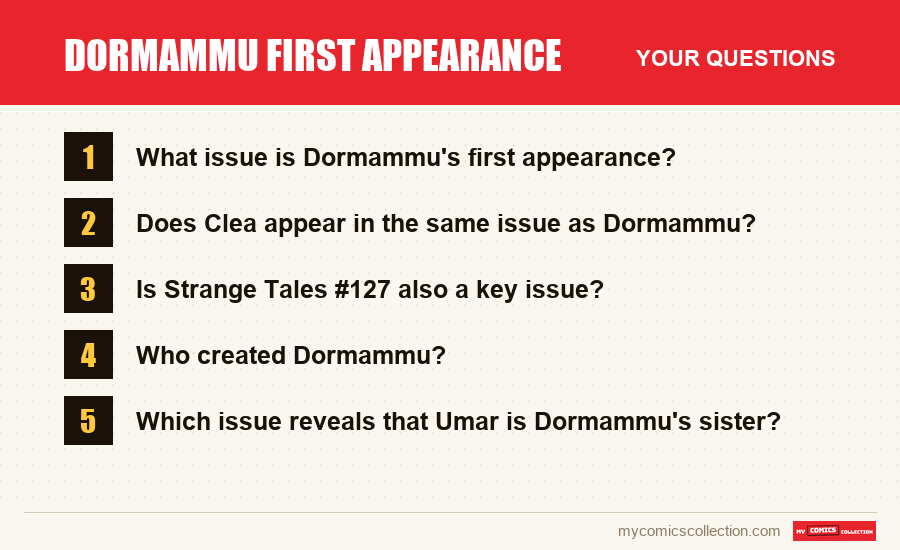
Dormammu first appears in Strange Tales #126, cover dated November 1964, in the Doctor Strange story "The Domain of the Dread Dormammu!" by Stan Lee and Steve Ditko. The storyline continues in #127. An earlier issue, #111 (August 1963), only mentions his name through another character, so it does not count as an appearance.
Yes. Clea is introduced in Strange Tales #126, the same issue as Dormammu. Her family tie to him as his niece was not revealed until later, so the debut issue should be described as the arrival of both characters without that relationship established.
It is the second chapter, "Duel With the Dread Dormammu!", dated December 1964, and it is a reasonable companion purchase. The market treats the debut number as the main key, so a copy of #127 is best understood as the story continuation, not as the appearance that defines the character.
Stan Lee and Steve Ditko are the credited creators. Lee has said he invented the name before he had a character for it, and Ditko designed the flaming-headed look and the surreal Dark Dimension setting. In practice the visual identity of the character comes from Ditko's art in the Doctor Strange feature.
That reveal appears in Strange Tales #150, dated November 1966, which is also where the sorcerer's half of the magazine got a logo of its own on the cover. It is a later key that collectors pair with the debut, but it is not part of the #126 story, which gives Dormammu no backstory at all.
Holding a copy of Strange Tales #126 or #127? Enter the issue and your condition to see how the market treats it.
Estimate my comic