
The original Strange Tales #110 (July 1963), Doctor Strange's first appearance, is a Silver Age comic identifiable by its 12-cent cover price, the absence of a UPC barcode, and its Silver Age newsprint interior. A CGC 9.6 copy sold for $150,000 at Heritage Auctions on April 7, 2024. Our eBay estimator does not index the Strange Tales or Doctor Strange series: no median from that tool is cited in this guide.
Doctor Strange was created by Stan Lee and Steve Ditko in Strange Tales #110, published June 30, 1963, cover-dated July 1963. The series was then a multi-story Marvel anthology: the cover, by Jack Kirby and Dick Ayers, features the Human Torch: Doctor Strange does not appear on it. His 5-page story, titled "Doctor Strange: Master of Black Magic!", is tucked near the back of the issue. It nonetheless introduces Stephen Strange, the Ancient One, Nightmare, and Wong (not named until issue #119). This is a Silver Age key in every sense: limited print run, yellowing newsprint, and copies in very high grade are exceptionally rare.
This guide sticks exclusively to the verifiable: auction records documented by Heritage Auctions and specialist sources. Our eBay estimator returns no median for the Strange Tales or Doctor Strange series (outside tool scope): where no reliable figure exists, we stay qualitative.
The editions of Strange Tales #110: four versions not to confuse
Since 1963, the content of Strange Tales #110 has been reproduced in several official Marvel editions. Knowing them is essential before buying an ungraded or uncertified copy.
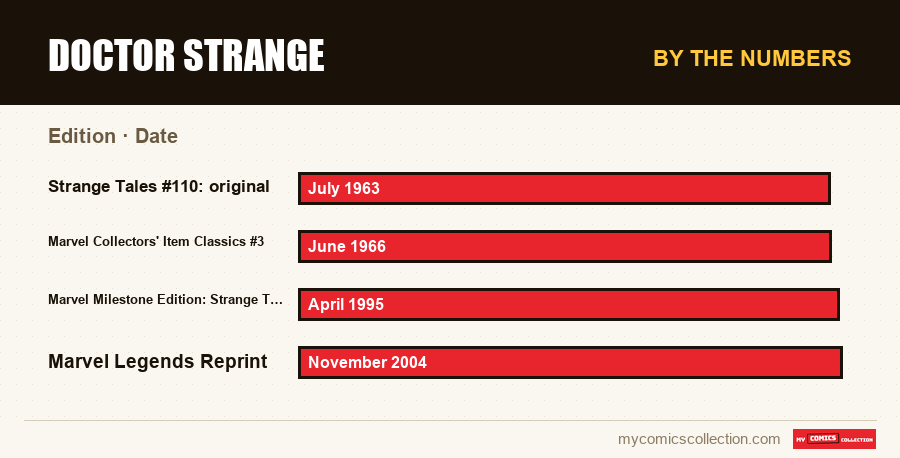
| Edition | Date | Visual identifiers | Format / cover price |
|---|---|---|---|
| Strange Tales #110: original | July 1963 | 12 cents · no UPC barcode · yellowed newsprint | 36-page standard format |
| Marvel Collectors' Item Classics #3 | June 1966 | 25 cents · cover reproduces original covers · 68-page giant format | First U.S. reprint of the Doctor Strange story |
| Marvel Milestone Edition: Strange Tales #110 | April 1995 | Silver ink border on cover · $2.95 US / $4.00 CA · updated indicia | Collects ST #110, 111, 114, and 115 |
| Marvel Legends Reprint | November 2004 | Glossy cover · newsprint interior · Doctor Strange action figure packaging | Sold exclusively with the Marvel Legends figure |
| Marvel Facsimile Edition | Modern | UPC barcode 759606042210 00111 · "Facsimile Edition" on cover · contemporary price | Updated indicia (current editor Marie Javins) |
Sources: worldwide comics database, Worthpoint, Key Collector Comics, sellmycomicbooks.com.
How to identify the 1963 original
Five checkpoints allow you to distinguish the Silver Age original from any reprint, without even opening the issue:
1. The cover price. The original shows 12 cents in the upper left corner. Any edition showing 25 cents, $2.95, or a contemporary price is a reprint. This is the fastest first filter.
2. No UPC barcode. Marvel did not introduce UPC barcodes on its covers until 1974. Any copy of Strange Tales #110 carrying a barcode on the back cover or front cover is definitively a reprint. The 1963 original has none.
3. Paper quality. Silver Age newsprint yellows over time through oxidation: a structural feature of the era, not a flaw. A glossy or bright white interior immediately signals an edition published after at least 1990.
4. The indicia. The original's indicia names Vista Publications, Inc. as printer. The 1995 Milestone and modern Facsimile editions update this indicia with current Marvel legal data: a difference visible immediately on the last page.
5. The silver border. The 1995 Marvel Milestone Edition is identifiable by a silver ink border on the cover: the signature mark of the 1990s Milestone program. No other edition carries this feature.
Real market value of Strange Tales #110 (documented records)
Strange Tales #110 is one of the rarest Silver Age Marvel keys. The CGC census listed roughly 775 certified copies without restoration: comparable to Hulk #1 (779 copies), which illustrates the issue's limited original distribution. Scarcity increases sharply above CGC 7.0, and grades 9.0 and higher are exceptional.
| CGC grade | Documented sale | Source / date |
|---|---|---|
| CGC 9.6 NM+ | $150,000 | Heritage Auctions, April 7, 2024 |
| CGC 9.4 NM | $55,200 | 2020 (MCU peak) |
| CGC 9.2 NM- | $42,500 | 2022 |
| CGC 8.5 VF+ | $19,000 | 2022 |
| CGC 8.0 VF | $15,600 | 2022 |
| CGC 6.0 FN | $3,100 | 2020 |
| CGC 5.0 VG/FN | $7,700 | 2022 |
Sources: Heritage Auctions, sellmycomicbooks.com, comicbookinvest.com. This site's eBay estimator does not cover the Strange Tales series: no median is available.
Why these reprints exist, and why they have value at their own scale
Marvel reprinted the content of Strange Tales #110 as early as 1966, in Marvel Collectors' Item Classics #3: the first American reprint of Doctor Strange's first appearance. At the time, Silver Age comics were not preserved as investments: reprints met demand from readers who had missed the originals. The 1995 Milestone Edition targeted Copper Age collectors who wanted the historic content without paying the original's market price. The modern Facsimile Edition caters to MCU-era fans.
These reprints do not carry the value of the original, but they have their own legitimacy in a thematic collection. Marvel Collectors' Item Classics #3 (1966) is itself a Silver Age issue with its own secondary market value. Vigilance is only required when buying a copy presented or priced as the original: especially in the absence of CGC or CBCS certification.
The MCU's impact on demand
The release of Doctor Strange (2016, Benedict Cumberbatch) drove measurable demand for Strange Tales #110: the film earned $677.8 million worldwide. Doctor Strange in the Multiverse of Madness (2022) surpassed $955.8 million, consolidating the character's mainstream profile. The $150,000 record set in April 2024 reflects this long-term dynamic: the 1963 original concentrates almost all the collectible value, while reprints serve as an entry point for newer collectors.
Frequently Asked Questions
It shows the period cover price, has no UPC barcode and its interior is on yellowed Silver Age newsprint. Its indicia names Vista Publications, Inc. as printer.
Marvel Collectors' Item Classics #3 (1966), the Marvel Milestone Edition (1995), the Marvel Legends Reprint (2004, sold with a figure) and the modern Marvel Facsimile Edition.
By its silver border on the cover, the distinctive sign of the Milestone program, and by its updated indicia. It contains Strange Tales #110, 111, 114 and 115.
They do not have the original's value, but they have their own legitimacy in a thematic collection. Marvel Collectors' Item Classics #3 is itself a Silver Age issue with its own market value.
When buying a copy presented or invoiced as an original, especially without CGC or CBCS certification. The five checkpoints (price, barcode, paper, indicia, border) let you sort quickly.
Own a Doctor Strange comic? Get a free valuation with our tool based on real eBay sales to find its low, median, and high value.