Doom All-On-One #1 is a one-shot announced by Marvel on June 29, 2026 and scheduled for October 2026, written by Al Ewing and drawn by Alessandro Cappuccio. Its premise: fifty full-page splashes in landscape orientation, in which Doom takes on the entire Marvel universe in hell, during one of his challenges to Mephisto for his mother's soul. Announced cover price $7.99, 64 pages, variant covers by Greg Capullo and InHyuk Lee. It does not arrive alone: the same October 2026 solicitation lines up at least five titles where Doom is at the center or in the title. It is the symptom of an editorial mechanism, not of chance: Avengers: Doomsday comes out on December 18, 2026. This article explains that mechanism, what it produces on the market, and how to sort through it.
As of October 1st, 2026, a reader who walks into a specialty bookstore to "buy a Doctor Doom comic" faces a problem that did not exist three years earlier: there are too many. Not too many in quality, too many in number. The same month offers a large-format one-shot, the second issue of a five-part miniseries, the fifth of a ten-part maxi-series, another crossover one-shot with a tech hero, and the conclusion of an event of which Doom is the indirect cause. None of these five objects is identical to the others in function, lifespan or future scarcity. Nothing on the cover says so.
This situation is not a scheduling accident. It is the normal shape a publisher's catalog takes when one of its characters is about to occupy a worldwide movie screen. Avengers: Doomsday comes out on December 18, 2026, with the monarch of Latveria as central antagonist, and Avengers: Secret Wars follows on December 17, 2027. Between these two dates, the printed output around the character will stay high. Knowing why, and knowing how to read that output, is worth more than buying everything or ignoring everything.
This article does two things. It first describes the mechanism of editorial amplification, which is documentable and whose market effects are predictable in broad strokes. It then treats the October title itself, Doom All-On-One #1, separating what is confirmed by the publisher from what is supposition.
The lay of the land: what October 2026 contains
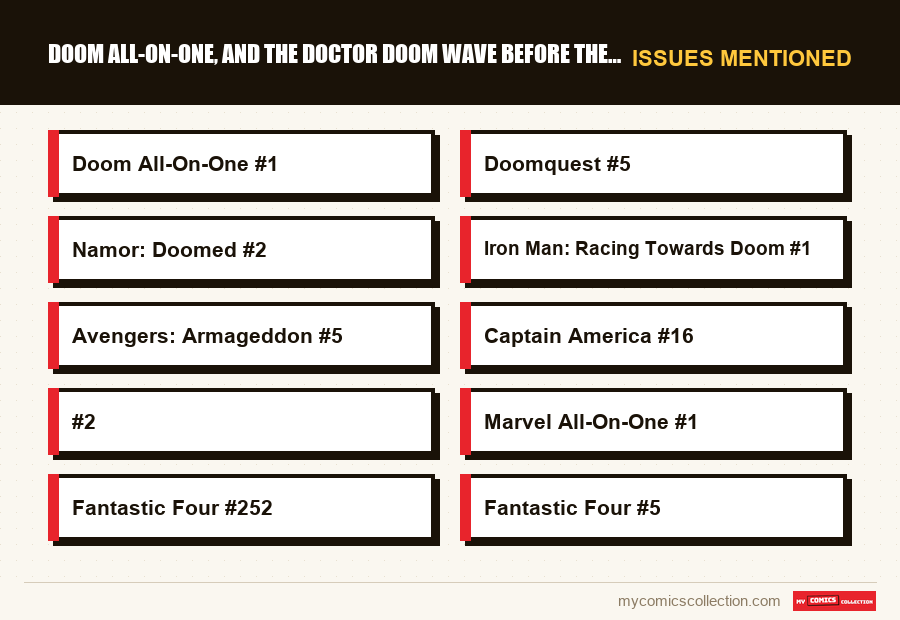
Let us start with the facts, as the publisher published them in its October 2026 solicitation. Here are that month's titles where Doom appears in the title, in the central plot, or in the cause of the plot.
- Doom All-On-One #1, one-shot, Al Ewing on script and Alessandro Cappuccio on art, 64 pages, $7.99.
- Doomquest #5 (of 10), Ryan North on script and Francesco Mobili on art, 32 pages, $4.99. A time-travel maxi-series in which Doom occupies Susan Storm's body at the moment Galactus arrives on Earth.
- Black Panther / Namor: Doomed #2 (of 5), Ethan S. Parker and Griffin Sheridan on script, Stefano Nesi on art, 32 pages, $3.99. The two kings go down to hell to face Doom.
- Iron Man: Racing Towards Doom #1, one-shot, Ethan Sacks on script and Greg Land on art, 32 pages, $4.99. Doom intervenes there as a Latverian menace in an auto racing setting.
- Avengers: Armageddon #5 (of 5), last issue, Chip Zdarsky on script, and Captain America #16 by the same writer with Valerio Schiti on art, both at $4.99. These two titles deal with the fallout of a battle for the throne of hell, that is, the same infernal setting as the previous three.
Five to six titles in four weeks, three of which rest on the same setting: that is the raw data. To gauge what it represents, you have to compare it to what a character of this rank usually gets: one regular series, sometimes two, and a part in a collective event. We are far above that. The hub devoted to the character details his editorial history over sixty years; no year has known this density.
The mechanism: why a publisher increases output before an adaptation
The lazy answer is to say the publisher "profits" from the film. It is true but insufficient, because it explains neither the shape the output takes nor its timing. Four reasons overlap, and each produces a different type of object.
First reason: production lead time forces early anticipation. A comic is announced to bookstores about three months before reaching the shelf, and it is written and drawn well before that announcement. Doom All-On-One was publicly announced on June 29, 2026 for an October release, and its artist was then speaking of work already done. If a publisher wants a title on the shelf in December, when the film comes out, the decision is made in spring. Direct consequence: the wave is not triggered by the film's success, it is triggered by the film's date. It will exist regardless of the film's reception, because it is printed beforehand.
Second reason: bookstore orders are firm. In this circuit, a retailer orders copies before having any reading feedback. He therefore orders on the basis of what he expects of demand, and a name that will be displayed on movie posters is reassuring. For the publisher, a title carrying that name in its heading orders better than an equivalent title with a neutral name. Hence the appearance of keywords in the titles themselves: Doomquest, Doomed, Racing Towards Doom, All-On-One. It is not cynicism, it is commercial legibility, but it has a consequence for the collector: the presence of the word in the title says nothing about the character's weight in the story.
Third reason: catalog is needed for the following years. A film generates reading demand that does not stop on release day, and that demand is satisfied mainly in collections, not in single issues. To sell collections in 2027 and 2028, you must have printed issues in 2026. The current wave therefore manufactures the raw material of tomorrow's reprints. It is the most often forgotten point, and the most decisive on value: a story destined to be republished in collected form has a durably capped scarcity, since anyone will be able to read it without seeking the original issue.
Fourth reason: occupying space. With two films in two years, the publisher must maintain a continuous presence for twenty-four months. A single series is not enough: it has a rhythm, pauses, arcs that end. A constellation of short titles, on the other hand, renews itself every four weeks and gives the impression of permanent news. That is why the wave is made up mostly of one-shots and miniseries, and not of new regular series.
What the multiplication does to the market: what rises, what does not
This is the part that is rarely summarized correctly. An editorial wave and a price rise are not the same thing, and they do not touch the same objects. There is even an inverse relationship between the two, which must be stated clearly.
New output does not rise, because new output is the response to demand. A one-shot printed on the occasion of a film is printed according to the anticipation of that film. The more the film is awaited, the higher the orders, the higher the print run. The object therefore arrives on the shelf in exactly the state the market dislikes: abundant, recent, and held by people who bought it new knowing it was a potential collectible. Comics printed during the years of heavy speculation are the clearest historical illustration: issues produced in very large quantities to meet a craze remained, thirty years later, easy to find and cheap.
What rises is what can no longer be produced. The scarcity of an old comic is irreversible: you cannot reprint a 1962 print run in its original format. When demand increases, it meets a supply that is a closed stock, slowly shrinking since every damaged copy disappears for good. That is why attention paid to a character translates into tension on his old issues and not on his new ones. Our pages devoted to the character's key issues catalog these old titles and the documented reasons for their status.
Between the two, a poorly understood middle zone: stories that become references. Some modern comics gain value, but almost never for the reason their initial buyer imagined. They gain it because a secondary character first appears there and is taken up elsewhere, because a costume or concept is introduced there and becomes canonical, or because the story establishes itself as the reference version of an episode of the character's life. None of these three conditions is knowable on release day. All take years to manifest.
Last effect, the least visible and yet the most penalizing for a collector: the wave dilutes attention and fragments series. When six titles come out in a month, a reader's budget is spread thin, nobody follows everything, and miniseries that were started end in indifference. Three months later, many collections hold miniseries at three issues out of five. It is not a spectacular financial loss, but it is a dead loss, because an incomplete miniseries is worth practically nothing and cannot be read.
Sorting through the output: a six-question method
The method that follows does not claim to point out the right issue. It serves to classify a wave's objects by function, which is enough to decide. Apply it in order: each question is answered with the object in hand or with the announcement before your eyes, without needing an opinion about the market.
Is the story closed, or is it a fragment?
A one-shot is read entirely and owned entirely: it is a complete object, whose reading value is immediate and whose collecting creates no debt. A #2 of 5 is a fragment: buying it commits you to four other purchases over four months, and doing nothing with that commitment produces an unusable object. It is the most important distinction in the whole list, and the one that covers hide best. In October 2026, two titles are complete one-shots, two are fragments in the middle of an ongoing series.
Is the character the subject, or the backdrop?
Read the announcement to the end rather than its title. A story where Doom takes on the whole universe puts him at the center of every page. A story where he appears as a "Latverian menace" in a plot devoted to another hero uses him as a plot engine. Both can be excellent to read, but only the first is a comic of the character in the sense a collector of that character means it.
Is there something new in this issue?
First appearance of a character, first use of a concept, first version of an armor, death or succession. These elements are the only documented causes of lasting appreciation of a modern comic, and they are sometimes announced in advance. A pure confrontation story, however spectacular, by construction contains no first. That does not disqualify it: it makes it a reading object rather than a catalog object.
Will this story be republished, and in what form?
A five-issue arc will almost certainly be collected within twelve months. A one-shot in an unusual format much less easily, because a landscape format reproduces poorly in a standard-format collection. When a story exists in a collection, the original issue loses its reading monopoly and keeps only an object value. It is an underused and very predictive criterion.
How many covers exist, and which is the reference?
On a wave title, three to ten different covers frequently coexist. The first printing's main cover is the one the market will identify as the standard copy in ten years. Low-ratio variants trade more, but they require knowing exactly what you are buying and they assume a buyer who knows that logic. For a first purchase in a wave, the main cover is the choice that requires no expertise.
Are you buying it before or after December 18, 2026?
The question is not rhetorical. Before the film's release, the wave's titles are on the shelf at cover price, available, and with no resale history. After, they are in the secondary circuit, with a consultable sales history and a price that has formed. Buying before costs the listed price and calls for a blind choice; buying after costs a possible premium and gives information. There is no universal right answer, but there is one wrong method: buying before believing you are buying information.
The October 2026 title: what is confirmed
Let us now apply the grid to the title that gives this article its name.
Doom All-On-One #1
Announced on June 29, 2026. A 64-page one-shot at $7.99, built on fifty full-page splashes in landscape orientation. The starting point is an old and established element of the character's mythology: the challenge he periodically throws at the demon Mephisto to obtain the release of his mother's soul. The story recounts, according to the publisher, his most relentless attempt, during which he takes on the entire Marvel universe in hell. The writer described the assignment he received in very direct terms: fifty pages of Doom versus everyone, in widescreen action. Variant covers by Greg Capullo and InHyuk Lee announced.
Two honest clarifications on the date. The June 2026 announcement indicated October 7; release listings then indicate October 14, 2026. This one-week slip is commonplace and consistent with a known constraint: the publisher reserved October 7 for the launch of another line, with no other release that day. As of October 1st, 2026, the date to remember is therefore October 14, but it is the only point of this sheet on which public sources differ.
The format: a precise lineage, and what it implies
The full landscape format is not an invention of 2026, and its genealogy sheds light on what this issue is trying to do.
The immediate precedent is Marvel All-On-One #1, released in 2025, written by Ryan North and drawn by Ed McGuinness: fifty pages of the same principle, with the Thing of the Fantastic Four in place of Doom. The October 2026 title is therefore the second of what looks like a recurring format rather than an isolated experiment. For a collector, this is useful information both ways: a format that repeats loses its exceptional character, but it gains legibility, since it becomes an identifiable collection.
The more distant lineage is Fantastic Four #252, released in 1983 under the pen and pencil of John Byrne, which told an incursion into the Negative Zone entirely in pages turned ninety degrees. This issue is cited as a reference by both stakeholders of the 2026 project. It has a particular status in Doom's history by association, since it belongs to a series of which Doom has been the founding adversary since Fantastic Four #5 in 1962, an issue that our dedicated page documents in detail.
The practical implication of the format deserves stating, because it is counterintuitive. A landscape-orientation comic is read by turning the object, which means handling it more than a standard comic. For a copy you want to keep in good condition, that is a real risk factor for the spine and corners. If you plan both to read and to preserve this issue, logic calls for two copies, or one copy and acceptance of a reading condition.
What nobody can know today
As of October 1st, 2026, no copy of this issue is in circulation, no sale has taken place, and no market value exists. Anyone who announced a future value to you would be making it up, and that is true of all the wave's titles.
Three unknowns will weigh more than everything else. The first is the film itself: a well-received film sustains reading demand for two or three years, a poorly received one extinguishes it in a few weeks, and comics printed before release suffer that outcome without being able to adapt to it. The second is whether or not there is a reprint: if a wave title sells out quickly and is reprinted, it signals real demand, and the mechanics of successive printings then become the criterion to master. The third is narrative posterity: nothing today indicates which of these stories will be cited in five years as an important piece of the character.
One thing can be said without risk. During the twenty-four months between the two films, output will stay high, then it will fall back. Historically, the most favorable moment for a patient buyer is neither before the release, nor during, but six to eighteen months after, when the copies bought in hope of a gain all resurface at once on the secondary market. This window is known, documented, and almost nobody uses it, because it requires waiting while everyone else buys.
Following a wave in your collection, concretely
An editorial wave poses an organization problem that regular series do not: the objects have no common numbering, no common rhythm, no common lifespan. Three reflexes are enough not to lose anything.
Record the function, not just the title. In the app, note for each purchase whether it is a closed story or a fragment, and in the latter case how many issues are still to come. It is that information, not the series name, that will tell you in January what you are missing.
Create the miniseries from the first issue bought. A series of five issues spread over five months is exactly the case where memory fails. Release tracking exists for this, and it is all the more useful since these titles have no existence on the shelf beyond their release week.
Log the cover and the printing on the day of purchase. On a title with ten covers, the information is obvious when you hold the object and impossible to find six months later. If you then want to know where you stand, an estimate of your whole collection is only worth it if these details were entered correctly at the start.
For those who want to go further in the logic of reading rather than that of the market, the character's reading order and the film-related selection cover the older material, the one that existed before the wave and will outlast it.
The verdict, in two sentences
If you want to read fifty pages of drawn battle in large format by an artist trying it for the first time, buy Doom All-On-One #1 in main cover, on release day, and read it: it is the only use of this issue whose return is certain.
If you buy it hoping the October wave will produce the rare piece of 2036, know that you are betting against the very mechanism that made it exist: this object is on the shelf because demand is anticipated, therefore it is printed accordingly, therefore it will not be scarce. Scarcity, in this story, is on the side of the issues the publisher can no longer manufacture.