Where to start with Doctor Doom? From origins (Fantastic Four #5, Books of Doom) to cosmic sagas (Secret Wars 1984 and 2015), through magic (Triumph and Torment) and modern runs (Infamous Iron Man, Cantwell), we offer a clear reading order to discover the monarch of Latveria, from the most founding to the most recent.
From origins to modern runs, Doom's history spans decades. Here is a reading route to discover the monarch of Latveria in the correct order. Decryption.
As always in this guide, only verified information is stated; Reading suggestions are ours. This order is a proposition, not an absolute rule: Fatalis can be discovered in multiple ways.
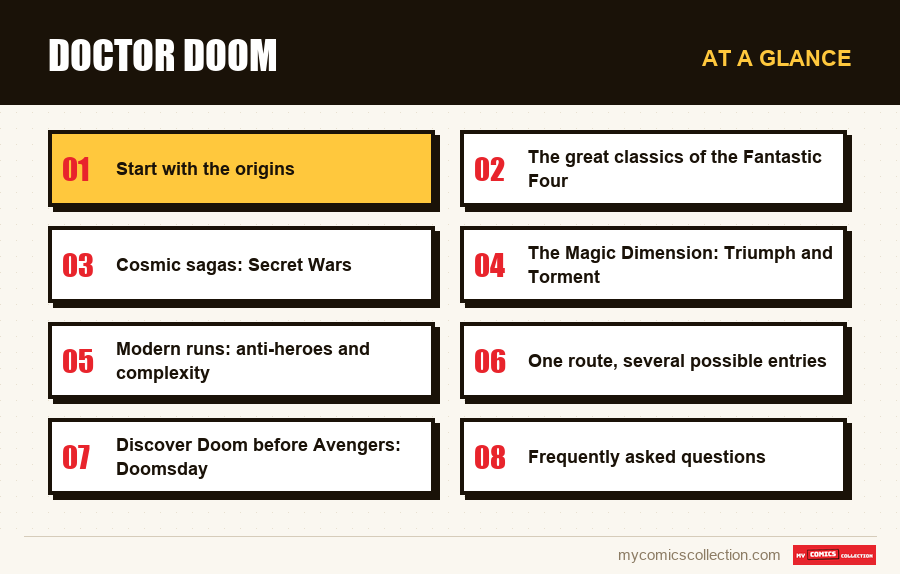
Start with the origins
To discover Doctor Doom, the most logical thing is to start with its origins. The character's first appearance, in Fantastic Four #5 (1962), constitutes the natural starting point: this is where Doom makes his debut, as an enemy of the Fantastic Four. To delve deeper into his origins, Fantastic Four Annual #2 (1964) reveals the genesis of the character, his past and the events that forged the monarch of Latveria. These seminal issues lay the essential groundwork: who Doom is, where he comes from, and what motivates his rivalry with Reed Richards. Starting with these stories allows you to understand the character from its foundations, before exploring its later developments.
For a modern and in-depth version of the origins, the mini-series Books of Doom (2006), by Ed Brubaker, offers a complete story tracing the journey of Doom, from his childhood to his rise to power. This work constitutes an excellent contemporary, accessible and coherent gateway, ideal for those wishing to understand the character without going back to the comics of the 1960s. Starting with the origins, whether classic or modern, is the best way to approach Fatalis: this allows you to grasp the foundations of the character before exploring its richness. For the reader, these founding stories are indispensable, laying the foundations for everything that follows. The Fatalis hub brings together our guides to explore the character's origins.
The great classics of the Fantastic Four
Once the origins are understood, the next step is to explore the great classic stories featuring Doom facing the Fantastic Four. The Monarch of Latveria forged his legend battling Marvel's First Family, through stories that defined his rivalry with Reed Richards and his status as the team's greatest enemy. These classics, from the great eras of the Fantastic Four, illustrate the fundamental dynamics of the character: his obsession with Reed, his schemes, and his quest for domination. Exploring these stories helps us understand why Doom is inseparable from the Fantastic Four, and how this rivalry has shaped the character over the decades.
These Fantastic Four classics form the heart of the Doom story. It is in these stories that the character developed all his richness, alternating the roles of formidable villain and complex adversary. For the reader, these stories are essential: they show Doom in its fundamental context, that of the sworn enemy of the Fantastic Four. This stage of reading allows us to appreciate the depth of the rivalry between the monarch of Latveria and Reed Richards, one of the richest in Marvel. After the origins, these classics are the natural continuation of the journey, offering an in-depth understanding of the character in his most iconic environment. The Doom hub brings our guides together to explore the rivalry of Doom and Reed Richards.
Cosmic sagas: Secret Wars
The reading journey of Fatalis necessarily passes through the cosmic sagas, first and foremost Secret Wars. The original 1984 saga, by Jim Shooter, places the monarch of Latveria at the center of a clash on a cosmic scale, where he seizes almost divine power. This work marks a major milestone, revealing the scale of Fatalis' ambitions and potential. The 2015 Secret Wars saga, by Jonathan Hickman, extends and sublimates this dimension, with the version God Emperor Doom, where Doom becomes the god of Battleworld. These cosmic sagas are essential to understanding the character in his most grandiose dimension, that of a being capable of achieving disproportionate power.
These cosmic sagas illustrate Doom's maximum potential. They show that the monarch of Latveria is not only the enemy of the Fantastic Four, but a figure capable of rivaling the highest powers in the Marvel Universe. For the reader, these stories are peaks of the character's mythology, to be discovered after the classics. The 2015 saga, in particular, is essential, as it illuminates the link with Avengers: Doomsday and the divine dimension of Doom. These cosmic sagas constitute a key stage of the reading journey, revealing the breadth of the character. The Doom hub brings together our guides for exploring God Emperor Doom and Battleworld.
The Magic Dimension: Triumph and Torment
To discover the mystical dimension of Fatalis, a work is essential: Triumph and Torment (1989), by Roger Stern and Mike Mignola. This tale, where the monarch of Latveria teams up with Doctor Strange, explores his mastery of magic and his quest to free his mother's soul. This work, considered one of the most striking dedicated to Fatalis, reveals an essential facet of the character: the sorcerer-scientist, heir to family magic, driven by filial duty. Integrating Triumph and Torment into your reading journey allows you to understand the magical dimension of Fatalis, often less known than his technological genius, but just as important for understanding the richness of the character.
This magical work brings a particular depth to the understanding of Doom. By revealing his practice of witchcraft and his emotional quest, Triumph and Torment humanizes the character and enriches his mythology. For the reader, this story is an essential complement to the classics and cosmic sagas, offering insight into the mystical dimension of the Latverian monarch. This stage of the reading journey allows us to appreciate all the complexity of Doom, at once scientist, sorcerer and devoted son. Triumph and Torment is an essential work for those who wish to understand the character in all his facets. The Doom Hub brings together our guides to explore the magic of Doom.
Collecting this series?
Track what you own, what you are missing and what your collection is worth. 7 day trial.
Start my trial →Modern runs: anti-heroes and complexity
The reading journey of Doom ends with the modern runs, which explored its anti-hero dimension and its moral complexity. Infamous Iron Man (2016), by Brian Michael Bendis, shows the monarch of Latveria taking on the role of Iron Man in search of redemption. Christopher Cantwell's run (2019), dedicated to the character, presents him wrongly accused and in search of meaning, in a story that delves into his psychology. These modern works reveal a Fatalis capable of doubts and vulnerability, far from the one-dimensional villain. They constitute the culmination of the reading journey, offering a contemporary and nuanced vision of the character, to be discovered after having assimilated its foundations.
These modern runs crown the discovery of Fatalis. By exploring his anti-hero dimension, they show all the moral richness of the character, capable of evolving and revealing himself from unexpected angles. For the reader, these works are fascinating, providing a current perspective on the Latverian monarch. They ideally close the reading journey, showing Fatalis in its most complex and nuanced form. After the origins, the classics, the cosmic sagas and magic, the modern runs offer a synthesis of the richness of the character. This complete journey allows you to discover Fatalis in all its depth, from the villainous founder to the contemporary anti-hero. The Doom hub brings together our guides to explore the character's modern runs.
One route, several possible entries
This reading order is only one suggestion among others. If starting with the origins offers a logical progression, Fatalis can be discovered in multiple ways, depending on everyone's preferences. Some readers will prefer to start with an accessible modern work, like Books of Doom or Cantwell's Run, before moving back to the classics. Others will enter through the cosmic sagas, seduced by the grandiose dimension of the character. The main thing is to find the entry point that corresponds to your desires, because the richness of Fatalis allows multiple routes. This flexibility is a strength: the Latverian monarch offers so many facets that there is no single right way to discover him.
This diversity of possible entries reflects the richness of the character. Fatalis, present in decades of varied stories, lends itself to numerous reading paths, from the most chronological to the most thematic. For the reader, this freedom is precious: it allows the character to be approached according to their interests, whether it be their rivalry with the Fantastic Four, their cosmic, magical or moral dimension. Whatever the starting point chosen, the important thing is to delve into the world of the Latverian monarch and explore its many facets. This reading route, proposed from the founder to the modern, is only a gateway to the inexhaustible wealth of Fatalis. The Fatalis hub brings together our guides to explore all aspects of the character.
Discover Doom before Avengers: Doomsday
This reading journey takes on a particular resonance as we approach Avengers: Doomsday. The film, which places Doctor Doom at the forefront of the Marvel Cinematic Universe, arouses new curiosity for the character, including among spectators who discover him. For these newcomers, as for readers wishing to delve deeper, delving into the comics before the film's release allows them to approach Doomsday with an informed perspective. Understanding Doom's origins, her rivalry with the Fantastic Four, her cosmic sagas, and her moral complexity greatly enriches the film experience. This reading route is therefore an ideal preparation, offering the keys to fully appreciate the Latverian monarch on screen.
This dimension of anticipation gives additional meaning to the reading journey. Discovering the great stories of Fatalis before Doomsday means giving yourself the means to recognize the references, to understand the issues and to appreciate the richness of the character brought to the screen. In particular, 2015's Secret Wars saga, starring God Emperor Doom, directly illuminates the dimension the film could explore. For the reader as for the future spectator, this reading journey is an invitation to explore the universe of Doom before it dominated Marvel cinema. This preparation, both pleasant and enriching, allows you to approach Doomsday with full knowledge, having discovered the full depth of the monarch of Latveria. The Doom Hub brings together our guides to explore the character ahead of the film.
Frequently asked questions
By its origins: Fantastic Four #5 (1962), its first appearance, and Fantastic Four Annual #2 (1964), which reveals its genesis. For a modern and accessible version, the mini-series Books of Doom (2006) by Ed Brubaker retraces his journey in a complete and coherent manner.
It is not obligatory. Starting with the origins offers a logical progression, but Fatalis can be discovered in multiple ways. Some prefer to start with an accessible modern work, like Books of Doom or Cantwell's run, before going back to the classics.
The two Secret Wars: that of 1984 (Jim Shooter), where Doom seizes almost divine power, and that of 2015 (Jonathan Hickman), with God Emperor Doom, where he becomes the god of Battleworld. The 2015 saga is essential, especially for its link with Avengers: Doomsday.
Triumph and Torment (1989), by Roger Stern and Mike Mignola, where Doom teams up with Doctor Strange and seeks to free his mother's soul. It is the reference work on the mystical dimension of the character, often less known than his technological genius.
Infamous Iron Man (2016) by Brian Michael Bendis, where Doom becomes Iron Man in search of redemption, and Christopher Cantwell's run (2019), which presents him wrongly accused and in search of meaning. These works reveal the anti-hero dimension of the character.
Want to know the value of your Doom comics? Estimate it for free with our tool based on current eBay listings.