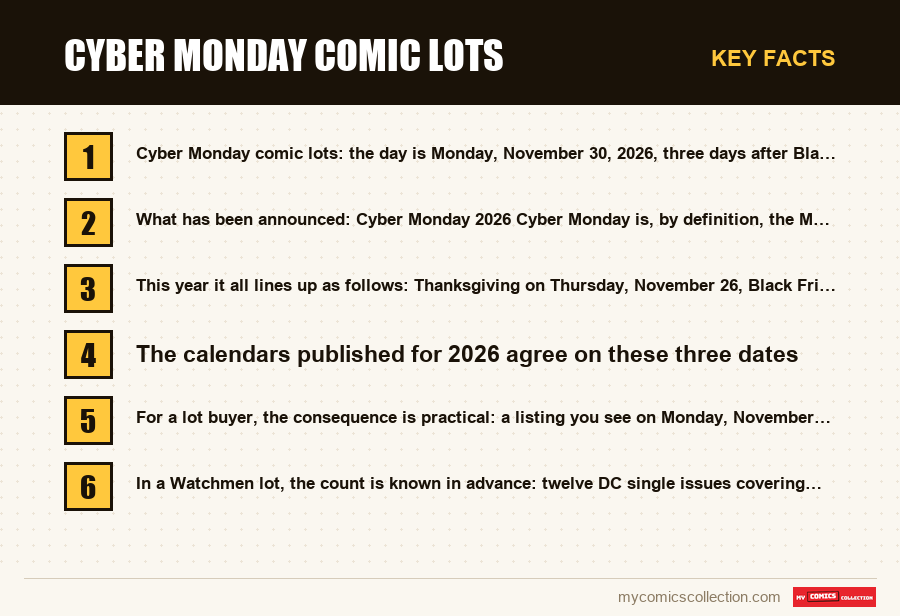
Cyber Monday comic lots: the day is Monday, November 30, 2026, three days after Black Friday on Friday the 27th. It is the online shopping day, and so the day of comic lots sold from photos. Do not judge a lot by its price per issue: count the issues actually present, read every spine, separate originals from reprints, then factor in shipping and return terms before you confirm. Those are the pitfalls to check before buying.
The lot is the format where the buyer sees the least: a stack photographed from the side, a one-line description, a single price. It can also be the most interesting format, because a seller who does not detail what is on offer sometimes lets good issues slip through. This article gives four steps for sorting Cyber Monday lots, with examples drawn from series whose issues, dates and reprints are documented.
Every example in this article rests on issue numbers, years and credits that were checked; how to sort a lot is our own analysis, and no protected page or dialogue is copied into it.
What has been announced: Cyber Monday 2026
Cyber Monday is, by definition, the Monday after Thanksgiving in the United States. This year it all lines up as follows: Thanksgiving on Thursday, November 26, Black Friday on Friday the 27th, Cyber Monday on Monday the 30th. The calendars published for 2026 agree on these three dates.
No specific offer on comic lots is announced in this article, and we are not inventing any: each seller sets their own terms. The press simply notes that some retailers extend their promotions past Monday, into early December, with end dates that differ from one player to another. For a lot buyer, the consequence is practical: a listing you see on Monday, November 30 may well still be up on Tuesday, and the time spent checking it is not time wasted.
An online lot stacks up three sources of uncertainty: the number of issues, their identity (original or reprint) and their condition. The four steps that follow deal with those uncertainties in order, from the easiest to check to the most subtle.
Point 1: Count the issues and spot the missing ones
The first check is arithmetic. A lot titled "complete series" must contain every issue of the series, and the buyer's job is to know how many there are. In a Watchmen lot, the count is known in advance: twelve DC single issues covering September 1986 to October 1987, written by Alan Moore, drawn by Dave Gibbons and colored by John Higgins. A lot advertising "complete Watchmen" therefore holds twelve single issues, not eleven and not thirteen. If it lists ten and asks you to believe that "the ending is included," two issues are missing.
Precision matters in the other direction too: the hardcover collected edition, which gathers the twelve issues and came out at the end of 1987, is not the single-issue series. A photo of a collected edition cover in a lot of "Watchmen comics" says nothing about whether the original single issues are present. The guide to fakes and reprints of Watchmen details the markers for telling the printings apart.
For every lot, draw up two lists: the issues named in the description and the issues you can actually read on the photos. The two must match. When the description says "about 40 issues" or "many key issues," that is a non-answer. Ask for the exact list, by title, issue number and series year, and refuse to buy without it if the stakes go beyond picking up a box to dig through.
Gaps hide in three ways. The seller counts duplicate copies as different issues. Or they count an issue from the relaunched series as an issue of the original series, which happens whenever a title has several volumes. Or they include a special or an annual without saying so, which pushes the total up without completing the run. In all three cases, the detailed list settles the question.
Point 2: Read the lot's photos, issue by issue
An overview photo proves nothing. A stack photographed from the side shows the top spines and hides everything else; a stack photographed from above shows only the top cover. For a serious lot, ask for one photo per issue or, failing that, a fanned-out photo that lets you read each cover, plus close-ups of the spines.
The case of X-Men #1, published in 1991, written by Chris Claremont with Jim Lee drawing it, shows why. This issue exists in five versions: four covers, each spotlighting a different character, and a fifth, a gatefold, which joins the four images into one continuous view. Every version contains the same story, with a different centerfold. A lot that advertises "X-Men 1 (1991)" without showing the cover does not tell you which of the five versions you are buying, and collectors do not treat them as interchangeable. Ask for the cover photo and the one of the spine.
In a lot of ten issues, this ambiguity can multiply: which printing, which variant, which newsstand or direct edition. So insist that the photos show, for each issue, the whole cover legibly and the barcode area. On a 1990s comic, that is where the difference between two objects that look identical from a distance is decided.
Finally, be wary of catalog photos. An image pulled from an illustration database or a publisher's site is not a photo of the copy being sold. A listing with only that kind of image tells you nothing about the lot's condition. If the image is perfect, sharp, without a single reflection or table shadow, ask for a photo taken by the seller with a written note, for example the day of the sale on a piece of paper placed next to the comic.
Point 3: Separate originals from reprints within the lot
A well-photographed lot can still mix objects of different natures. Marvel brought out The Incredible Hulk #181 (1974, Len Wein and Herb Trimpe) as a facsimile in 2019, then as a new printing in 2023. The company also published facsimiles of Giant-Size X-Men #1 (1975, Len Wein and Dave Cockrum), in 2019 and again in 2023. On the DC side, the facsimile of The Batman Adventures #12 (1993, with Kelley Puckett, Mike Parobeck and Rick Burchett) came out on March 12, 2025, offered with a foil cover, a blank cover and a "Super Powers" variant centered on Batgirl.
These three reprints are serious products, but they look like their models. In a lot of "Marvel and DC key issues," it takes just one facsimile to change the value of the whole, and the seller does not always know. What to note: the indicia year, the barcode, any facsimile notice on the cover, the grain of the paper. The guide to identifying an original edition or a reprint describes these markers in detail.
There are older reprints too: a Marvel Milestone collection, for example, reprinted The Incredible Hulk #181 in the late 1990s. A reprint of this kind is not a fake, but a lot that presents it as an original misleads, whether through carelessness or otherwise.
The simplest test to apply to a lot is to ask the seller, for three issues at random, for the year shown in the indicia. A seller who looks and answers in two minutes has checked what they are selling. A seller who answers that "everything is original" without having looked has checked nothing, and that answer says more about the lot than any discount.
Do you collect this series?
Track what you own, what you are missing and what your collection is worth. 7-day trial.
Start my trial →
Point 4: Assess the lot's condition, shipping and returns
A lot's condition is the average of its parts, and it is the worst piece that weighs the most. A lot of twenty issues of which eighteen are in good shape and two are badly damaged is not a lot in good condition; it is a lot in which two issues drag down the value. Ask the seller to flag explicitly the issues that have a defect, and read the photos of the spines, which best tell the story of how much a copy has been read. The article on comics kept in poor condition details what can be saved and what cannot.
Weight is a hidden cost specific to lots. A few dozen comics weigh several kilos, and tracked, insured shipping is priced accordingly, especially internationally. Count the shipping before comparing two lots, and check that the packaging really protects: a lot shipped in an oversized box, with no padding, arrives with crushed corners, whatever its starting condition.
Returns deserve a careful read. In Europe, the fourteen-day right of withdrawal covers distance sales from a business to a consumer, and it does not apply between two individuals. A lot bought from an individual is therefore, unless the seller commits otherwise, a final sale. Read the return policy before paying, and keep a copy of the listing, the photos and the messages: in case of a disagreement over condition or contents, they are your evidence. The article on comic lots: traps and opportunities goes back over what these listings hide and what they offer.
Finally, decide in advance what value you give to each issue in the lot, not counting those whose condition is doubtful. Divide the total price, shipping included, by the number of issues that are actually useful for your collection. If the result is higher than what you would pay for those same issues individually, the lot is not a deal, whatever day of the week it is.
What this changes for a collector
A lot is a bet on what you cannot see, and the method consists of shrinking the share of what you cannot see. Count, read, identify, price: those four moves turn a vague listing into an informed purchase, and they apply as well on November 30 as on any other day.
For a seasoned collector, the lot answers a targeted need: filling a gap in a series or tracking down a specific issue. In both cases, the want list outranks the impulse: note the missing issues in your series, with the target edition and printing, and keep only the lots that really contain them. An attractive lot that fills no gap on your list is a storage expense before it is a collecting expense.
Duplicates are the other topic. A lot of forty issues often contains issues you already own: decide before buying what you will do with them, resale, trade or donation, and allow time to sort them. A lot too rich in duplicates costs time, which is also a cost.
Preservation starts on arrival. Take the issues out of the box, slip them into suitable bags with a backing board, and store them flat or upright, without pressing them. The preservation guide details the steps; remember that a lot should not sit in its shipping box, because humidity and the pressure of the issues on top damage the ones underneath.
Lastly, in your inventory, for every issue you enter, note the lot's source, the purchase date, the price paid per issue and the condition found on receipt. If the condition found differs from the listing, you will have the date and the photos to discuss it with the seller within the deadlines.
What is still to be confirmed
As of November 21, 2026, these points cannot be confirmed, and we therefore do not claim them:
- The content of the offers on comic lots: no specific promotion is announced, and each seller decides their own.
- The length of the promotions: some retailers extend their offers beyond Monday, November 30, with varying end dates.
- Each seller's return terms, which depend on their status and their policy.
- Delivery times between now and the holidays, depending on the carrier and the country.
The date of Monday, November 30, 2026, for its part, follows from the Thanksgiving calendar, Thursday, November 26 this year.
Frequently asked questions
It is Monday, November 30, 2026, right after the Thanksgiving weekend (Thursday the 26th) and Black Friday (Friday the 27th). Some retailers let their promotions run into December, with no common deadline: a listing you see on Monday may therefore still be up the next day, which leaves you time to put your questions to the seller before paying.
Count the issues in the series and compare them with the seller's list. Watchmen, for example, runs twelve issues published from September 1986 to October 1987: a lot of ten is not complete. Ask for the list by issue number, and check that the collected edition is not being presented in place of the single issues.
Because the same issue sometimes exists in several versions. X-Men #1 (1991) exists in five versions: four distinct covers and one gatefold version. Without the photo of the cover and the barcode area, there is no way to know which one is being sold, or which printing.
Yes, and it is common: a seller clearing out an attic does not always tell an original from a recent reproduction. The 1974 and 1975 issues cited above also circulate as modern facsimiles, as does the 1993 DC issue. Ask for the indicia year on a few issues in the lot: it tells a reprint from an original in two minutes.
There is no automatic right: the fourteen-day right of withdrawal in Europe covers sales from a business to a consumer. Between individuals, the purchase is final unless the seller commits otherwise. Read the return policy before paying and keep the listing, the photos and the messages as evidence.
A lot has just arrived and you want to pin down the issues that really matter before you shelve it?
Estimate my comic