Watchmen #1 (September 1986, DC Comics) is one of the most-reprinted Copper Age issues in history: the TPB has gone back to press more than 24 times, DC is releasing a full run of facsimile editions starting September 2026 for the 40th anniversary, and the original issue itself had multiple printings beginning in 1986. With 631 copies graded 9.8 on the CGC census (none higher), identifying a genuine first print raw copy remains an essential skill, and active eBay listings stay very thin (under 10 for issue #1), making any single-point median unreliable for buying decisions.
Watchmen, the 12-issue maxiseries by Alan Moore (writer), Dave Gibbons (artist) and John Higgins (colorist), launched in September 1986 from DC Comics. It is a Copper Age work: there is no Silver Age or Bronze Age issue of this series, whose publication starts precisely in 1986. It won the 1988 Hugo Award in the Other Forms category and remains one of the best-selling graphic novels in the English language.
This guide focuses on a practical question: how to recognize a first print of #1 among the many versions that followed. Every figure below is verifiable; where data is unavailable, we say "indicative" rather than invent anything.
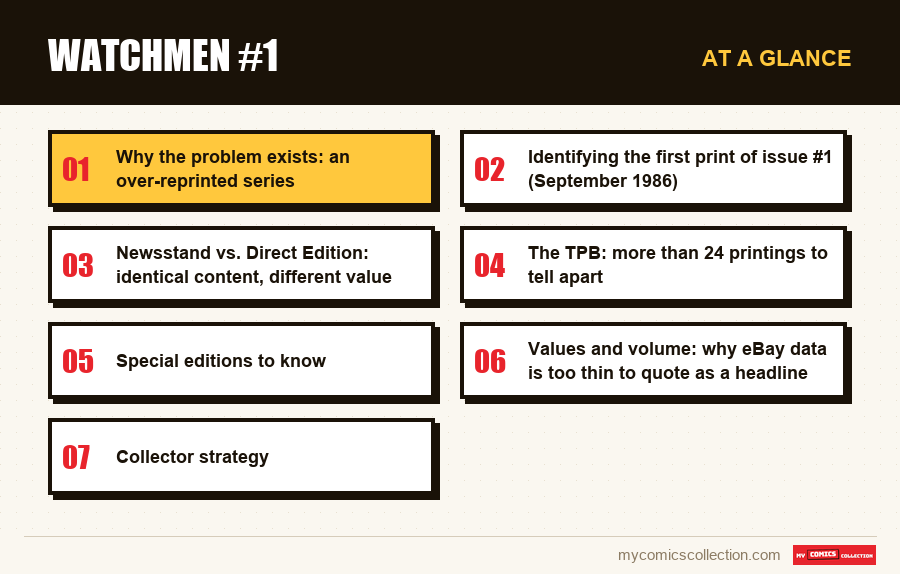
Why the problem exists: an over-reprinted series
The commercial success of Watchmen pushed DC to reprint it at an unusual pace. A second printing of #1 appeared as early as 1986. From 1987 onward, the TPB became the dominant format, reaching over 24 printings according to a worldwide comics database. More recently, Dollar Comics editions (2019, $1.00) and a new printing of #1 made the issue even more accessible. The result: a copy with an identical-looking cover can belong to very different generations, and carry very different collector value.
Identifying the first print of issue #1 (September 1986)
Here are the verifiable markers to look for:
| Criterion | First print (1st printing, 1986) | Reprints |
|---|---|---|
| Cover price | $1.50 | Variable; Dollar Comics 2019 = $1.00; facsimile 2026 = $3.99 |
| Cover date | September 1986 | Later dates or printing statement in indicia |
| Indicia | No mention of "Second Printing" or higher | Explicitly states the printing number ("Second Printing", etc.) |
| Barcode (newsstand edition) | UPC barcode on cover | Same for reprint newsstands; DC bullet logo replaces barcode on Direct Editions |
| Interior paper | High-quality Baxter paper, vivid colors | Varies by printing run |
Basic rule: open the indicia (the small legal notice at the bottom of the first or second page). A first print carries no printing statement. If you read "Second Printing" or any higher number, it is a reprint, regardless of how the cover looks.
Newsstand vs. Direct Edition: identical content, different value
For the 1986-1987 issues, DC produced two simultaneous versions:
- Newsstand: UPC barcode on the cover. These were sold at general retailers, often read and discarded, making high-grade copies statistically scarcer.
- Direct Edition (specialty shops): The barcode area is replaced by artwork or the DC logo. These copies were bought by collectors who generally stored them better.
The content is identical. Value? Newsstand copies in high CGC grade tend to command a premium at auction, because their survival in NM condition is statistically rarer. CGC has officially recognized this distinction on labels since 2020.
The TPB: more than 24 printings to tell apart
The original 1987 TPB (DC, $14.95, 448 pages) is itself a collectible: provided it is the first printing. Identification markers:
- Cover price: $14.95 (later printings carry different prices).
- Number line ending in "1" on the copyright page: the standard book method for signaling a first print.
- No barcode on early editions.
- The TPB cover looks nearly identical across dozens of printings (yellow background, bloodied smiley face); without reading the indicia, it is impossible to distinguish a first print at a glance.
A first-printing 1987 TPB in solid condition can trade for $50 to $150+ depending on grade; later printings are worth only a few dollars in the secondhand market.
Special editions to know
- Graphitti Hardcover (1988): a limited slipcased hardcover produced by Graphitti Designs, including 48 pages of bonus material (original proposal, concept art). A distinct collectible, separate from the standard TPB.
- Absolute Watchmen (2005, DC): oversized slipcased hardcover with colors restored by John Higgins himself. Identifiable by its 2005 copyright date and larger format.
- Dollar Comics / New Printing (2019): low-cost reprints at $1.00, clearly identified by their price and cover labeling. No collector value.
- Facsimile Editions (from September 2026): DC is reprinting all 12 original issues as monthly facsimiles at $3.99 each for the 40th anniversary: a way to read the series in its original format without touching a 1986 copy. These will carry a "Facsimile Edition" label on the cover.
Values and volume: why eBay data is too thin to quote as a headline
Our estimator finds fewer than 10 active listings for #1 on eBay.fr + eBay.com (June 2026). That is structurally too few to cite a median as a reliable reference price. The reason is well understood: because the series is massively available in cheap TPB form, collectors who just want to read it do so rather than buying raw single issues: keeping raw listing volume very low.
For graded copy values, the most solid data comes from the CGC census: with 631 copies at grade 9.8 and none above, the 2024 Overstreet guide values issue #1 at $95 in NM- (9.2). In high-grade CGC 9.8, documented sales at Heritage Auctions and private transactions place first-print copies significantly higher, but trading volume remains modest compared to other Copper Age keys.
Collector strategy
- Always check the indicia before buying a raw #1: it is the only certain way to verify the printing.
- Prefer CGC for significant purchases: a CGC label identifies the printing, the variant (newsstand or direct), and confirms the absence of restoration. It is the only objective guarantee in a market flooded with reprints.
- To read the series: the TPB or the 2026 facsimile editions are the rational choice. Original raw issues are for collecting, not reading.
- For a collectible TPB: insist on a number line ending in "1" on the copyright page.
Own an issue of Watchmen and want to know if it has value? Get a free valuation with our tool based on real eBay sales.
Frequently Asked Questions
Open the indicia, the small legal area at the bottom of the first or second page: a first printing mentions no printing number. If you read Second Printing or any mention of a later printing, it is a reprint. The cover price and the September 1986 date are other markers.
The content is identical. The newsstand edition carries a UPC barcode on the cover and was sold in supermarkets, often read and thrown away, which makes it scarcer in high grade. The Direct Edition replaces the barcode with an illustration or the DC logo. CGC has officially recognized this distinction on its labels since 2020.
The original 1987 TPB (DC, 448 pages) is recognized by its cover price, a number line ending in 1 on the copyright page and the absence of a barcode. The cover is almost identical across dozens of printings: without reading the indicia, it is impossible to tell by sight.
The Graphitti Hardcover (1988), a limited slipcased edition with 48 bonus pages, Absolute Watchmen (2005), an oversized hardcover with colors restored by John Higgins himself, the 2019 Dollar Comics or New Printing editions, with no collector value, and the facsimile editions planned from September 2026.
Because the series is widely available in cheap TPB, and listings for the original #1 are few. For the value of graded copies, the strongest data comes from the CGC census: 631 copies at grade 9.8 and none above. For an important purchase, a CGC label identifies the printing and the variant.