This is the moment of truth every collector dreads: you open a box, a crate, or a long-forgotten attic, and you discover dozens, sometimes hundreds of comics in a painful state. Yellowed paper, warped covers, brown spots, musty smell -- the damage seems total.
This is the moment of truth every collector dreads: you open a box, a crate, or a long-forgotten attic, and you discover dozens, sometimes hundreds of comics in a painful state. Yellowed paper, warped covers, brown spots, musty smell -- the damage seems total. Before throwing everything away or resigning yourself to a total loss, there are essential questions to ask and concrete steps to take. All may not be lost.
This guide is here to help you honestly assess the extent of the damage, understand what can and cannot be salvaged, apply the right treatment techniques, and most importantly, set up the conditions to prevent it from happening again. Whether you have been collecting for 30 years or just inherited your uncle's collection, this is for you.
Diagnosing the type of damage: the most important step
Not all damage is created equal. Some is superficial with no real impact on value or readability. Other damage is deep, irreversible, and condemns the comic to a very low grade on the grading scale. Before any attempt at "recovery," you need to identify precisely what you are dealing with.
Paper yellowing (oxidation)
Yellowing is the number one enemy of vintage comics. It is caused by paper oxidation, accelerated by UV light, heat, humidity, and acids present in the paper itself -- particularly in comics printed before the 1990s, which used poor-quality paper loaded with lignin. There are two types of yellowing:
- Surface yellowing (tanning): Pages are uniformly golden or cream-colored. The paper remains firm and text is readable. This is the natural aging of acidic paper.
- Oxidative browning (brittleness): The paper becomes brittle, fragile, dark orange or brown. Touching the pages risks crumbling them. This advanced stage is virtually irreversible.
For surface yellowing, certain stabilization techniques can slow the progression, but nothing truly "whitens" the paper. For browning with brittleness, the comic is at end of life and all handling should be minimal.
Moisture and mold damage
Moisture is particularly destructive because it acts on multiple levels simultaneously: it causes paper to swell, facilitates mold growth, causes "foxing" stains (those characteristic small brown spots), and can stick pages together if comics were stored together in a very humid environment.
Signs to identify:
- Foxing stains: small round rust-brown spots, often scattered across the page. Characteristic of past moisture exposure.
- Waviness: pages are wavy, the cover is bowed. May indicate past or active moisture exposure.
- Active mold: presence of white, gray, or green filaments on the paper or cover. This is urgent and potentially contagious to the rest of your collection.
- Stuck pages: two or more pages adhering to each other. Attempting to separate them by force will cause tears.
Creases and mechanical marks
These are the most common types of damage and paradoxically the most variable. A light crease on the corner of a cover ("corner crease") does not have the same impact as a central fold running through all the pages. Creases are generally caused by poor handling, flat storage without rigid support, or inadequate transport.
- Corner crease: folded corner, often without breaking the color layer.
- Spine roll: the spine of the comic is curved, causing pages to fan out slightly.
- Spine splits: the spine cracks open, often at the staples. Very detrimental to grading.
- Centerfold crease: a horizontal fold runs through all pages at the center. Often caused by storage under pressure.
Stains and ink or writing marks
Food stains, water stains, glue, ballpoint pen annotations, or pencil marks -- each has a different impact on value and recoverability. Pencil marks can sometimes be erased without leaving a trace. Water stains create characteristic rings. Ink annotations are generally permanent.
Golden rule: Never attempt an intervention if you are not certain of the outcome. A damaged comic is always worth more than a damaged AND poorly treated comic. Some clumsy "recovery" attempts cause more damage than the original issues.
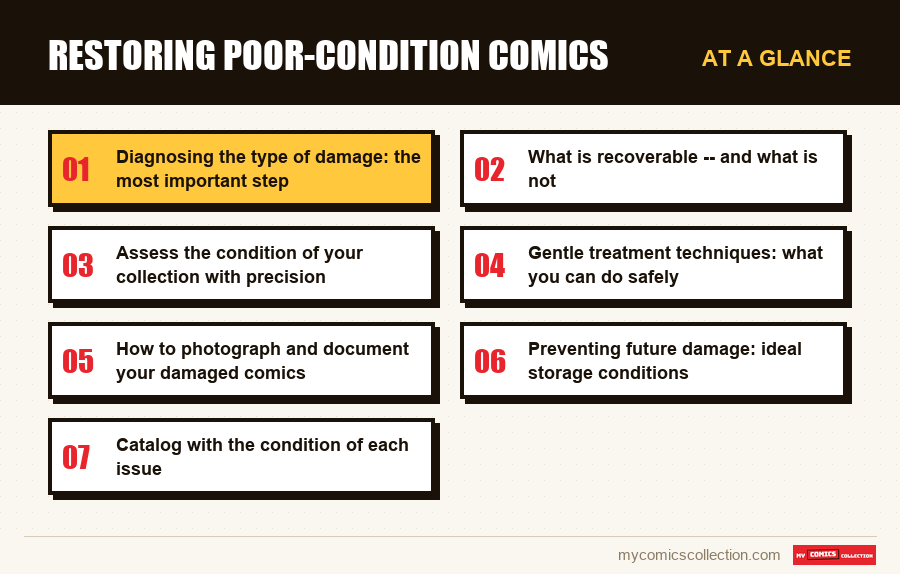
What is recoverable -- and what is not
Let's be honest: the vast majority of organic damage (advanced yellowing, deep mold, brittle paper) is irreversible. Paper is a living material that degrades chemically over time, and no amateur treatment can reverse this process. However, some mechanical problems can be improved.
What you can improve yourself
- Light corner creases: A slightly folded corner without color breaking can be reduced by placing the comic flat under significant weight for 24-48 hours, between sheets of acid-free absorbent paper.
- Moderate spine roll: Same technique -- gentle and progressive pressure on a flat surface. Wood or glass work well as a "press."
- Surface dirt: Dust is removed with a soft, dry brush using small sweeping motions. Never rub.
- Graphite pencil marks: A very soft precision eraser (plastic eraser for fragile paper) can erase light annotations. Proceed with very short strokes, without pressure.
- Light odors: Silica gel in an airtight box, drying time, gentle airing. Light tobacco or mildew smells can dissipate with time.
What requires a professional
If you have high-value comics (key issues, first appearances, Silver Age or Golden Age comics), certain interventions should be entrusted to professional restorers specializing in paper. They can:
- Deacidify paper to slow yellowing (magnesium methylate bath or spray)
- Separate stuck pages under a microscope with controlled humidification
- Treat mold with appropriate antifungal agents
- Reattach cover fragments
Critical warning: Any restoration detected by CGC results in a "Restored" label (purple) that stigmatizes the comic and significantly reduces its market value. A comic graded 6.0 "clean" is always worth more than a comic graded 8.0 "Restored" on the serious collector market.
What is permanently lost
- Browning and brittle paper (advanced brittleness)
- Torn pages or pages with missing pieces
- Deep mold that has penetrated through the paper
- Deep ink, marker, or water stains on covers
- Comics that have suffered prolonged exposure to fire or smoke
Assess the condition of your collection with precision
My Comics Collection lets you record the exact condition of each issue -- condition grade, photos, notes -- so you know exactly what you have and what it is worth.
Start for free →7-day trial.
Gentle treatment techniques: what you can do safely
There are a few interventions you can carry out yourself with caution, provided you fully understand the limits of each technique and accept that results are always uncertain.
Isolate damaged comics from the rest of the collection
Top priority: if you detect active mold, immediately isolate the affected copies in an airtight bag. Mold spores are airborne and can contaminate your entire collection. Do not handle them without gloves.
Properly dry damp comics
If a comic is still damp or has recently been exposed to water, gently open it (do not force stuck pages apart) and let it air-dry flat, without direct heat. Slip sheets of acid-free absorbent paper between the pages to speed drying. Never use a hair dryer or direct heat source.
Straighten creases with a gentle press
Place the comic between two clean wooden boards (or two thick books), slip slightly moistened paper (not soaked) on each side to soften the paper, then add weight gradually. Leave under pressure for 48 to 72 hours. This technique works reasonably well on recent creases but poorly on old folds deeply set into the paper.
Clean the cover with extreme caution
For surface dirt on a glossy cover, a slightly damp microfiber cloth (distilled water only) can gently clean non-embedded grime. For interior matte paper or pages, never use moisture. A soft-bristled dry brush remains your best tool.
Disinfect light mold (surface only)
For superficial and dry mold traces on a cover, a cotton swab lightly dampened with 70% isopropyl alcohol can neutralize the spores. Proceed with extreme caution in a single motion, without rubbing. This intervention can affect print colors -- always test on a barely visible edge first.
Collecting this series?
Track what you own, what you are missing and what your collection is worth. 7 day trial.
Start my trial →Grading despite everything: can you send a damaged comic to CGC?
The short answer is yes -- CGC grades all comics regardless of their condition. The scale goes from Poor (P) 0.5 to Mint (M) 9.9, and even a comic in very poor condition can receive certification. The question is whether it is financially and strategically worthwhile.
Sending a damaged comic to CGC can make sense in the following cases:
- Rare or historically important comics: An Amazing Fantasy #15 (first appearance of Spider-Man) in P 1.0 condition is still worth several thousand euros. Certification proves authenticity and protects the copy in its slab.
- First appearances of major characters: Even in poor condition, a certified key issue is easier to sell than a "raw" copy whose condition is debatable.
- Golden Age or Early Silver Age comics: Copies from this era are inherently rare. Even damaged, they have documentary collection value.
On the other hand, sending a 1990s-2000s comic in poor condition to CGC generally makes no economic sense. The cost of certification (starting at $30-50 per issue) often exceeds the market value of a copy graded 3.0 or 4.0.
CGC condition levels and their practical meaning
- 9.8 -- Near Mint/Mint: Near-perfect, modern collection standard
- 9.4 -- Near Mint: Very good condition, minor flaws visible under magnification
- 8.0 -- Very Fine: A few small visible flaws, very presentable
- 6.0 -- Fine: Used, visible wear but complete and readable
- 4.0 -- Very Good: Obvious flaws, cover intact
- 2.0 -- Good: Heavy wear, complete but damaged
- 0.5 -- Poor: Severely damaged but identifiable
How to photograph and document your damaged comics
Before doing anything, take photos. This step is often overlooked but it is crucial for several reasons: it allows you to evaluate the evolution of condition after treatment, to document the "before" state for a potential sale, and to build an archive of your collection even in its current state.
To properly photograph a damaged comic:
- White or neutral gray background to highlight defects
- Indirect natural light (no direct flash that "flattens" details)
- Photograph the entire front cover, back cover, all four corners, and specific defects in close-up
- Photograph the interior if you suspect internal problems
- Note the date and conditions of discovery
These photos are then invaluable for cataloging the actual condition of each copy in your collection manager. An accurate catalog with photos and condition notes is an essential tool for any serious collector.
Preventing future damage: ideal storage conditions
The best recovery is one you never have to do. Once your comics have been treated as well as possible, the goal is to create storage conditions that preserve the current state -- whether perfect or already degraded -- for years and decades to come.
Bags and backing boards
Each comic should be placed in a protective bag with a backing board. Archival-quality bags are made of polyethylene or acid-free polypropylene (never PVC, which releases corrosive gases). Backing boards should be acid-free and buffered (look for "acid free" and "buffered" labels). Replace bags and boards every 10 to 15 years.
Long boxes and short boxes
Storage boxes should also be acid-free. Avoid ordinary cardboard that transfers its acidity to comics. Store comics upright, without over-compressing them (they should stand straight without falling, but without excessive side pressure). Never stack large quantities of comics flat -- the weight on top crushes the copies at the bottom.
Temperature and humidity
The ideal conditions for storing comics are:
- Temperature: between 15C and 20C (59-68F), stable (avoid significant fluctuations)
- Relative humidity: between 35% and 50% (below that, paper becomes brittle; above, mold risk increases)
- UV light: zero direct exposure. UV dramatically accelerates oxidation
- Air circulation: good natural ventilation to prevent condensation zones
A 15-euro hygrometer in your storage room can save you from costly disasters. If humidity is too high, silica gel packets inside boxes absorb the excess. In case of extreme dryness (intense heating in winter), a room humidifier is recommended.
Light and heat
Attics and basements are the two most destructive places for comics, yet they are the two places where they are most often stored. An attic easily reaches 50-60C (120-140F) in summer -- a temperature that exponentially accelerates oxidation. A basement is often humid and prone to leaks. The ideal room is interior, temperature-controlled, dry, and without windows exposed to direct sunlight.
Calculate what poor storage conditions have already cost you. An Amazing Spider-Man #300 in 9.8 condition is worth around 1,200 euros today. In 6.0, it is worth about 150 euros. The difference is often storage.
FAQ -- Your questions about recovering damaged comics
Catalog with the condition of each issue
My Comics Collection lets you record the precise condition of each comic, add photos, condition notes, and track the value of your collection even when some copies have seen better days.
Create my free catalog →No charge during trial -- get started in 60 seconds.