It's one of the most common scenes in the life of a comic book collector. You come home from a convention, file away your new acquisitions in your longbox, and there, you see it. That issue you just bought for $8 is already there, tucked between two others, maybe for months.
It's one of the most common scenes in the life of a comic book collector. You come home from a convention, file away your new acquisitions in your longbox, and there, you see it. That issue you just bought for $8 is already there, tucked between two others, maybe for months. Duplicate.
If you've been collecting comics for more than six months, you know this feeling. If you're just starting your collection, pay close attention to what follows: duplicates are the most common and most costly mistake in comic book collecting, and they are entirely avoidable with the right tools.
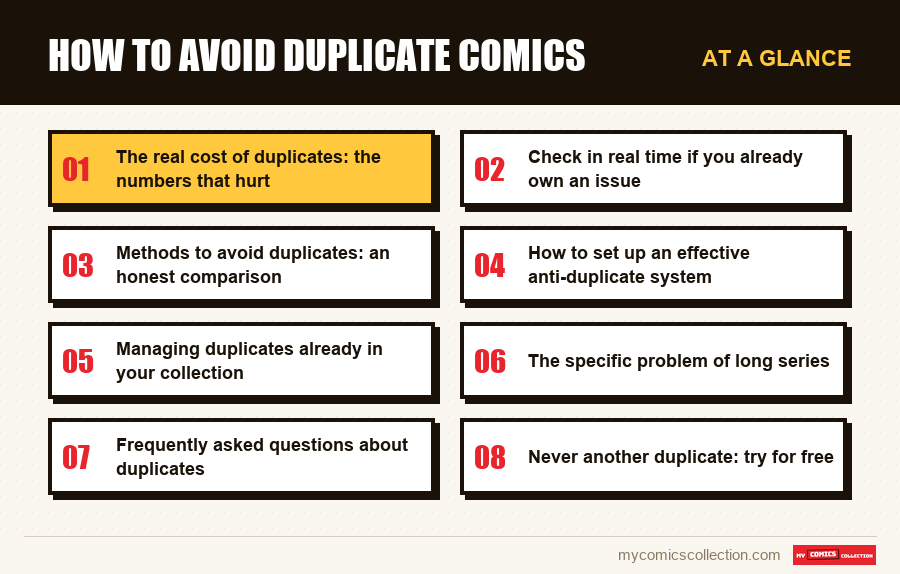
The real cost of duplicates: the numbers that hurt
Before talking about solutions, let's measure the scale of the problem. Duplicates are not a trivial detail, they represent a significant financial drain for nearly all collectors who don't use a tracking tool.
These numbers may seem abstract. Let's make it concrete: a collector who spends $400 per year on comics and accumulates 15% duplicates loses $60 per year. Over 5 years, that's $300, enough to buy several serious key issues, or fully fund 3 CGC submissions.
And it's not just the direct financial loss that matters. Duplicates take up space in your longboxes. They create confusion in your inventory. And most importantly, every duplicate purchased represents an issue you actually need that you could have bought with that money.
Why do duplicates happen so often?
A duplicate is not a sign of carelessness or stupidity. It's the logical consequence of how comics are bought and accumulated.
Long runs are the main cause
Who can remember by heart that they own issues 1 through 23, 27, 31 through 45, 48, 52, 56 through 78 of Amazing Spider-Man? Nobody. Even with an excellent memory, the gaps in a 300+ issue run are impossible to memorize accurately. At a convention, you come across an issue that seems like one you're missing, and you buy it. Mistake.
Bulk purchases amplify the problem
When you buy a lot of 50 comics, there's a good chance some are already in your collection. Without checking beforehand, you accept the lot as a whole, and the duplicates automatically slip in. Lots are fantastic sources of comics, but also fantastic sources of duplicates.
Buying from multiple places creates confusion
You buy at specialty shops, on eBay, at conventions, on marketplace sites, at garage sales. Each channel adds comics to your collection without you always having your complete list in mind. The fragmentation of purchase sources multiplies the risk.
The excitement of buying overrides caution
At a convention, the atmosphere, the excitement, the sense of urgency ("if I don't grab it now, someone else will") push you to buy quickly without checking. This emotional pressure is real and hard to fight without an immediate reference tool.
The most painful case: buying a duplicate of a valuable comic, paying $25 twice for the same issue because you didn't remember already having it. That's $25 lost outright. Multiply that by a few occurrences over the year, and the total becomes significant.
Check in real time if you already own an issue
With My Comics Collection, open your smartphone at a convention and check in 2 seconds if that issue is already in your collection. The end of duplicates, right now.
Try for free7-day trial
Methods to avoid duplicates: an honest comparison
There are several methods to avoid duplicates, with widely varying effectiveness. Here's an honest comparison of each.
Method 1, Memory
Relying on memory to remember every comic you own. Works for small collections (fewer than 50-100 issues) or very specialized collections focused on a short series.
Beyond 100 comics, memory becomes systematically unreliable. Impossible to maintain for 200+ issue runs or multiple simultaneous series.
Verdict: insufficient beyond 100 comicsMethod 2, Paper list
Keeping a notebook or sheet where you write down every comic purchased. The good old analog collector's method. Works in theory, if you update the list after every purchase, if you always have it with you, and if you systematically check it before buying.
In practice, the paper list gets left at home during conventions, is rarely updated in real time, and becomes illegible after a few months of changes. It doesn't scale for bulk purchases (100 issues to add manually).
Verdict: better than nothing, but impracticalMethod 3, Spreadsheet (Excel, Google Sheets)
More structured than a paper notebook. You can organize by series, do quick searches, and sync via the cloud. Many collectors go through this intermediate stage.
Problems: data entry is tedious (title, issue number, condition, price to enter manually for each comic), the mobile interface isn't designed for quick use at conventions, and complex spreadsheets become hard to maintain. No automatic duplicate alerts.
Verdict: functional but time-consumingMethod 4, Dedicated app with duplicate detection
An application designed specifically for comic book collectors, accessible on your smartphone in real time, with automatic duplicate detection, quick search by title and issue number, and cloud sync. It's the most effective solution, and the simplest to use daily.
You're at a convention in front of an issue that interests you? You open the app, type the title and issue number, and in 2 seconds you know if you already have it. No other method offers this speed.
Verdict: the definitive solutionHow to set up an effective anti-duplicate system
Here's the concrete process to never buy a duplicate again, regardless of the current state of your collection.
Catalog your existing collection (once and for all)
This is the initial step, often the longest. Open your longboxes and catalog each comic in your application. For a collection of 200-300 issues, plan on 2 to 3 hours total. For a large collection, do it series by series over several weeks. Once this step is done, the system works automatically.
Adopt the "catalog before shelving" rule
Every new comic purchased must be added to your catalog before being stored in the longbox. Not after, not the next day, immediately. It takes 30 seconds per comic and turns your catalog into an always-current reference.
Check before every purchase, not after
At conventions, at the shop, on eBay, before buying, check. Checking after the purchase is useless if you can't return the comic. Checking before the purchase saves you money. Make this systematic check a habit, even for issues you "are sure" you don't have.
Handle bulk purchases specifically
Before buying a lot, ask for the complete list of issues and compare with your catalog. If you don't have time to do this full check, ask the seller to hold the lot or wait for you. Buying a lot without prior verification means accepting guaranteed duplicates.
Collecting this series?
Track what you own, what you are missing and what your collection is worth. 7 day trial.
Start my trial →Managing duplicates already in your collection
If you're reading this article with an already sizeable collection, you probably have duplicates waiting. Here's how to identify and manage them intelligently.
Step 1: The collection audit
By cataloging your existing collection (an essential step), your application will automatically identify duplicates. You'll have your complete list of duplicate issues, sometimes an unpleasant surprise, but at least you know.
Step 2: Assess the value of your duplicates
Not all duplicates should be handled the same way. For each identified duplicate, check its current market value. A duplicate of Amazing Spider-Man #300 in VF deserves to be carefully resold on eBay. A duplicate of Spidey #45 (1990, worth $2) can be given away directly.
What to do with your duplicates based on their value
- Value > $20: resell on eBay or specialized comics marketplaces, with careful presentation and photos
- Value $5-$20: resell in comics collector Facebook groups, quickly and with no fees
- Value $2-$5: offer at conventions in a "make an offer" bin or give to collector friends
- Value < $2: donate to charities, libraries, or leave in a "free book box"
- Key issue duplicate: keep it as a reading copy and keep the best one in your collection
The special case: intentional duplicates
Note: not all double copies are mistakes. There are situations where having two copies of the same issue is a deliberate and justified choice:
- One copy in very good condition for the collection, another in lesser condition for reading
- A different cover variant (cover A and cover B, for example)
- An original copy and one to get signed at a convention
- A copy for a friend who is starting their collection and whom you want to gift it to
In these cases, mark the copy as "intentional duplicate" in your catalog so you don't confuse it with an accidental duplicate.
The specific problem of long series
Duplicates are 3 times more frequent on series with more than 100 issues than on mini-series or short series. It's mathematical: the longer the run, the harder it is to memorize the missing issues versus those you already own.
The major Marvel and DC series most affected:
- Amazing Spider-Man: 800+ issues in the first series
- Uncanny X-Men: 544 issues
- Batman: 700+ issues in the first series
- Detective Comics: 1,000+ issues
- Action Comics: 1,000+ issues
- The Amazing Spider-Man (2022): series still ongoing
If you collect any of these series, using a tracking tool is not optional, it's an absolute necessity. Without a digital catalog, duplicates are inevitable on these long runs.
Frequently asked questions about duplicates
Never another duplicate: try for free
My Comics Collection automatically detects duplicates in your collection, lets you check any issue in seconds before you buy, and gives you a complete view of your inventory in real time. Hundreds of collectors have already saved their duplicate budget. It's your turn.
Start duplicate-freeNo charge during the trial, setup in 5 minutes