In short
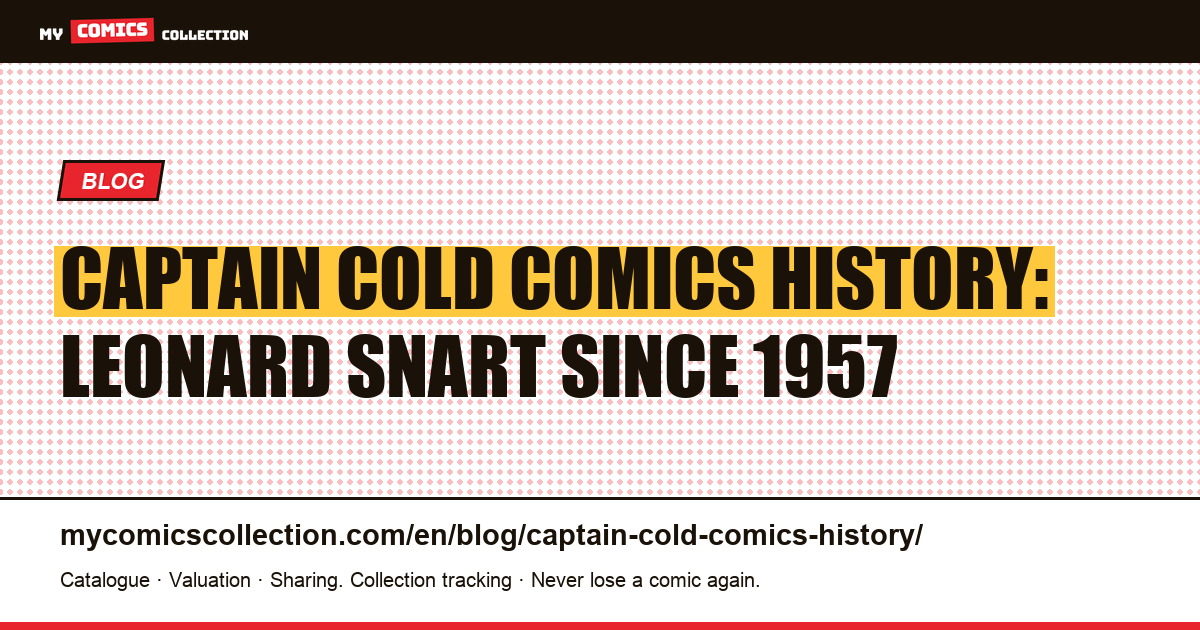
Captain Cold is Leonard Snart, created by John Broome and Carmine Infantino in Showcase #8 (1957) as a thief who builds a freeze gun to stop the Flash. His path runs through the Rogues, a gang he comes to lead; the Wally West years, where he joins that crew; Geoff Johns's The Flash vol. 2 #182 (2002), built on his sister's murder; Final Crisis: Rogues' Revenge (2008); and Forever Evil (2013 to 2014), where he loses and rebuilds his weapon.
Few Flash villains change as much by staying the same. Leonard Snart keeps the same gun, the same parka, and the same code across nearly seven decades, yet the stories around him move from a lone gimmick criminal to the most trusted voice in a gang of professionals. For a collector, that slow rise is the point: his important issues are scattered across volumes, event miniseries, and annuals rather than gathered in one run.
Every credit and cover year for Snart below was matched to a catalog entry before it went in, and unconfirmed inkers or months are simply absent; how each turn changes him is our interpretation, with no art or dialogue copied.
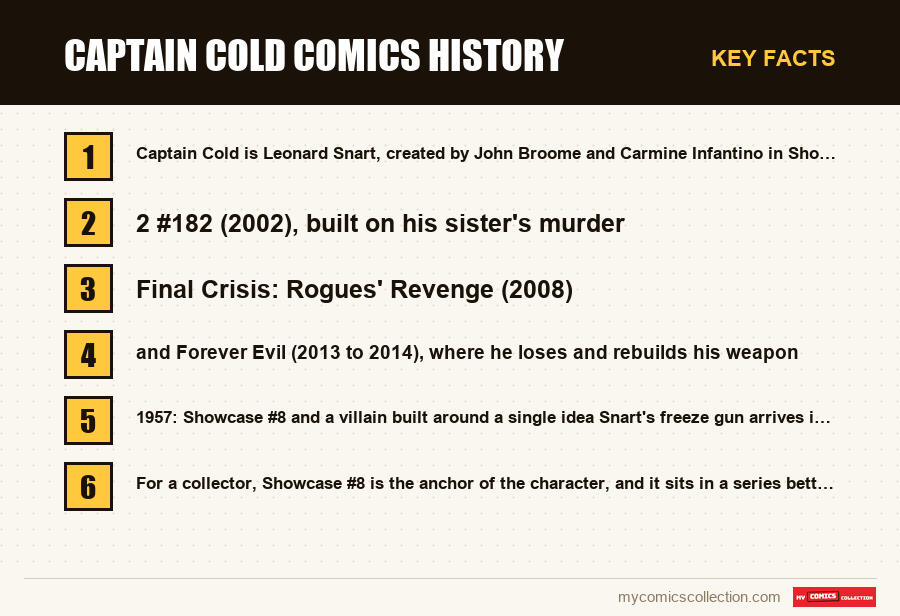
1957: Showcase #8 and a villain built around a single idea
Snart's freeze gun arrives in Showcase #8, dated 1957, from writer John Broome and artist Carmine Infantino. Broome and Infantino use the issue to give Barry Allen's Flash an opponent whose power is the opposite of speed. In the original telling, Snart reads an article theorizing that the energy emissions of a cyclotron could interfere with the Flash's speed, and he breaks into a lab to charge his gun. A guard surprises him, he pulls the trigger by accident, and the weapon turns out to have changed into something he never expected; he then takes the name Captain Cold.
Two features of this debut shape everything that follows. First, the gimmick is a handheld object rather than an inborn power, so it can be taken away, damaged, upgraded, or rebuilt, and later writers use all four possibilities. Second, Snart is a thief by trade. He does not want to rule anything. That modest ambition lets later authors write him as a professional with standards.
For a collector, Showcase #8 is the anchor of the character, and it sits in a series better known for other debuts, which is why a profile of the creators is useful context. The page on Carmine Infantino places the issue inside the artist's wider output.
The 1960s: a Flash series that makes room for a gang
When the Flash gets his own series in 1959, the numbering continues from the old Flash Comics run and begins at #105. That series stays with Barry Allen until it ends at #350 in 1985, and Snart is one of its recurring antagonists across those years. In those pages he wants to marry Iris West after seeing her at the prison, and later he competes with Heat Wave over a newscaster during a crime spree.
The decisive step for the larger story comes with The Flash #155 (1965), the first appearance of the Rogues as a group, again by Broome and Infantino. The group is the idea that lets Snart outgrow his debut: a bad guy alone is a single fight, but a crew of enemies who share a hobby of beating the Flash is a standing institution. The name Rogues spreads through the Silver Age, and Cold ends up as the one who gives that institution its tone.
What matters for a reader tracing Snart is the template: from this period on, he is the steady center of a group of unstable colleagues. The Flash universe guide maps the surrounding cast.
1985 to 1986: Crisis, and a bounty hunter with a sister
After Barry Allen's death during Crisis on Infinite Earths (1985 to 1986), Cold changes jobs. He becomes a bounty hunter, working with his sister Lisa, the Golden Glider. It is a small reinvention, but it is the point where the family begins to matter. Lisa is not a background detail; much of what makes Snart sympathetic in later decades depends on this link, and the 2002 issue that makes it central is easier to understand once you know it was planted in the 1980s.
This is also the point where the series itself changes hands. The first Flash series ends at #350, and a new volume with Wally West launches in June 1987. For anyone building a Cold run, the numbering break is the first trap: the character crosses a volume boundary in the middle of his own growth, and the 1987 relaunch starts again at #1.
The Wally West years: soul lost, soul restored, crew joined
In the second Flash volume, Wally West is the hero, and Cold moves from solitary enemy toward ally of convenience. In the Underworld Unleashed event, he loses his soul to the demon Neron, and Wally restores it. He then joins Wally's Rogues, a crew that comes together around a jailbreak tied to Grodd, staged to distract the Flash. The sequence is worth noticing: the Rogues as a real team grow out of a crisis they did not plan, and Snart moves from member to leader. The page on Gorilla Grodd's key issues covers the ape villain who triggers that alliance.
This period supplies a character grammar rather than a landmark issue: Cold holds the gang together and treats his word as binding. The volume that carries this development runs from 1987 and reaches #230 in 2006, resuming at #231 in 2007 and ending at #247, so the whole arc sits inside one very long numbering sequence.
2000 to 2005: Geoff Johns and the issue that opens the character
Writer Geoff Johns takes over the monthly Flash book at #164 in 2000 and stays through #225. Scott Kolins draws issues in that run, among them #197 (2003). Within that stretch sits the issue that matters most for a modern reader of Cold: The Flash vol. 2 #182, from 2002, later gathered in The Flash: Rogues with #177 to #181. Chillblaine murders Snart's sister Lisa, the Golden Glider, and Cold declares himself the man who mastered absolute zero.
Cold hunts Chillblaine down, tortures him, and kills him by freezing his outer layer of skin, and the point of the issue is the cost. Until then Snart is a thief with a code; in #182 the code collides with grief, and the gap between what he says he is and what he does becomes visible. Later writers return to that gap, so this issue is the one to read before any other Cold story from the next decades.
2006 to 2008: One Year Later, Salvation Run, Rogues' Revenge
The mid-2000s push Snart toward harsher territory. In One Year Later (2006), Cold, Weather Wizard, Heat Wave, Mirror Master, and Abra Kadabra kill Bart Allen. It is a dark turn for a crew often read as mischievous, and later stories treat it as a weight the group carries. In Salvation Run (2007 to 2008), Cold appears among the villains exiled to another world.
The key story of this stretch is Final Crisis: Rogues' Revenge (2008), a three-issue miniseries now collected among Geoff Johns's Flash books. The Rogues reject Libra's offer, they kill Inertia, and they keep playing the criminal game on their own terms. The father thread matters most for Snart: he declines to kill his abusive father himself and has Heat Wave do it. The scene says something exact about the character. He keeps a boundary for his own hands while accepting its result, and that ambiguity is why he remains difficult to label as either villain or antihero.
Do you collect this series?
Track what you own, what you are missing and what your collection is worth. 7-day trial.
Start my trial →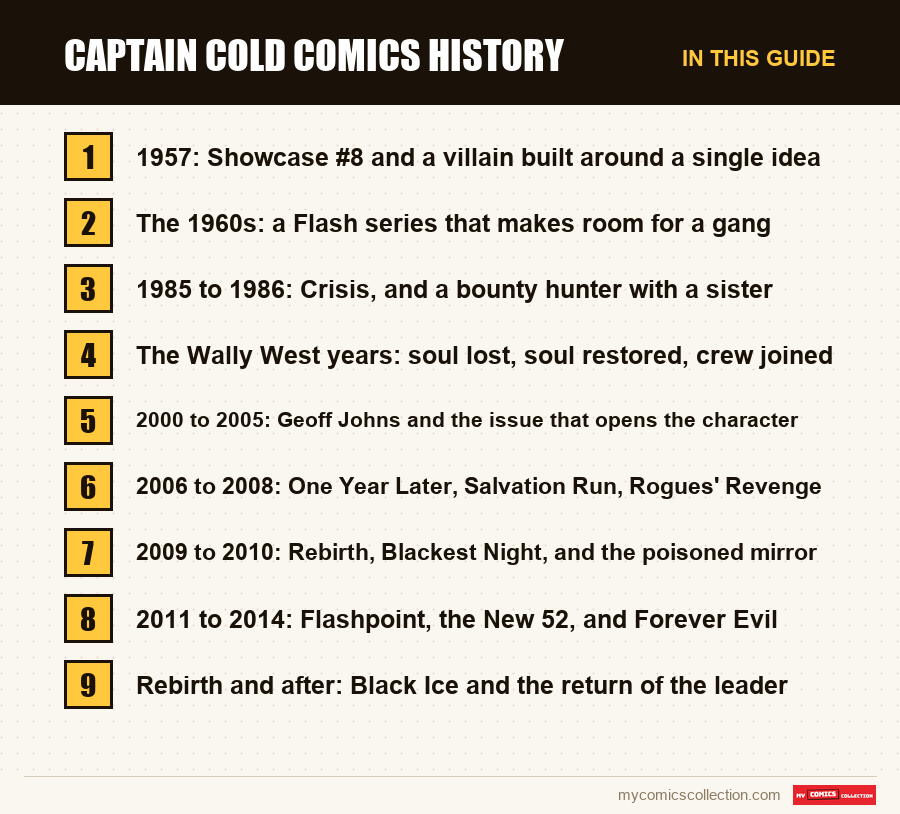
2009 to 2010: Rebirth, Blackest Night, and the poisoned mirror
Barry Allen's return in The Flash: Rebirth (six issues, 2009 to 2010) brings Cold back into the hero's orbit. He reads about Barry's return in #1, and by #6 the Rogues have a break glass contingency held in reserve for exactly that day. The contingency pays off in The Flash vol. 3 #5 (2010), where the mirror at the center of that plan is revealed as a slow-acting poison.
In between comes Blackest Night: The Flash (three issues, ending in February 2010). Cold and his crew prepare to fight their reanimated dead, he freezes the Black Lantern version of his sister in a block of ice, and he kills Owen Mercer by throwing him into a pit with his Black Lantern father. Sibling loss becomes literal here, because Lisa has died and returns as a Black Lantern, so the family thread begun in the 1980s resurfaces as horror rather than sentiment. The same period shows an alternate timeline thread worth knowing: The Flash vol. 3 #1 (2010) presents Commander Cold, the leader of the Renegades, as another version of the character.
2011 to 2014: Flashpoint, the New 52, and Forever Evil
The 2011 Flashpoint event gives Snart a different version in Flashpoint: Citizen Cold #1 to #3 (June to August 2011), a three-issue story set in the altered timeline, with Mirror Master leading the Rogues there. After the reboot, the New 52 reimagines him. He is younger; his sister Lisa is dying of cancer; and he has ice-based powers from experiments, then breaks the rules of the old game by trying to kill the Flash. That version appears in The Flash vol. 4 #6 (2012) and #7 (2012), and Annual #1 shows the Rogues beaten with help from the Flash and the Pied Piper.
The biggest event for him in this period is Forever Evil (September 2013 to May 2014), whose seven-issue core series is by Geoff Johns and David Finch. The Rogues refuse to join the Crime Syndicate of Earth-3, which sends Deathstorm and Power Ring against them. Power Ring attacks Cold, who freezes the ring bearer's hand, and Deathstorm then extracts his freezing powers from his DNA. In #4, Snart rebuilds his cold gun in just over half an hour from parts stolen at an electronics shop, a detail that restates the character's core: his power is his craftsmanship. Brian Buccellato's six issues of Forever Evil: Rogues Rebellion, drawn by Patrick Zircher and Scott Hepburn, cut Snart off from the gang once Deathstorm and Power Ring are done with him, and he heads for Lisa's hospital. Afterward, Cold is pardoned by the U.S. government and becomes a member of the Justice League alongside Luthor.
The crossover also offers a mirror: in Justice League vol. 2 #26, an Earth-3 Leonard Snart is an honest officer partnered with Mick Rory.
Rebirth and after: Black Ice and the return of the leader
When the Rebirth relaunch begins, with The Flash vol. 5 starting in August 2016 written throughout by Joshua Williamson, Cold returns in stages. He appears briefly in #3, telling the Rogues to leave Central City for a while; #15 brings the first full-length Rogues appearance of the run, though those Rogues turn out to be Mirror Master constructs. In #16 his freeze gun is combined with anti-Speed Force technology from Black Hole, and #17 names the result the Black Ice Gun and ends with Snart ready to take over Iron Heights. The arc restores him as a leader with a plan rather than a victim of events.
In vol. 5 #85 (January 2020), he creates a snowstorm over Central City, a reminder that his scale can still grow. Away from the monthly book, Absolute Flash #1 (2025) offers an alternate timeline version who leads the Rogues and carries an experimental freeze gun made by Project Olympus, which shows the character is still used as a basic building block of any new Flash universe.
The key issues across his history
- Showcase #8 (1957): the debut of Leonard Snart and his freeze gun, by John Broome and Carmine Infantino.
- The Flash #155 (1965): the Rogues appear together as a group for the first time, by Broome and Infantino.
- The Flash vol. 2 #182 (2002): Chillblaine kills the Golden Glider, and Snart takes his revenge.
- Final Crisis: Rogues' Revenge #1 to #3 (2008): the Rogues turn down Libra, and Heat Wave kills Cold's father in his place.
- Blackest Night: The Flash #1 to #3 (ending 2010): Snart ices his sister's Black Lantern corpse and kills Owen Mercer.
- Forever Evil #4 (2013 to 2014 event, Johns and Finch): stripped of his DNA powers, Snart builds a new cold gun from store parts.
- The Flash vol. 5 #15 to #17 (Rebirth era): the Rogues return under Cold, ending with the Black Ice Gun.
How to follow Captain Cold in a collection
Start with the issue that opens the character, The Flash vol. 2 #182, then go back to Showcase #8 to see how far the figure has come. From there, chase the event books instead of one title: Final Crisis: Rogues' Revenge, Blackest Night: The Flash, and Forever Evil hold much of the strongest Snart material.
Numbering is the main trap. The first series runs #105 to #350, the second restarts at #1 in 1987, and later volumes carry their own #1s, with the Rebirth volume later renumbered to legacy numbers. When you track a copy, note the volume as well as the number. The Flash collection guide explains the sequence, and the best Flash runs list helps place a Cold issue within the larger runs around it.
Frequently asked questions
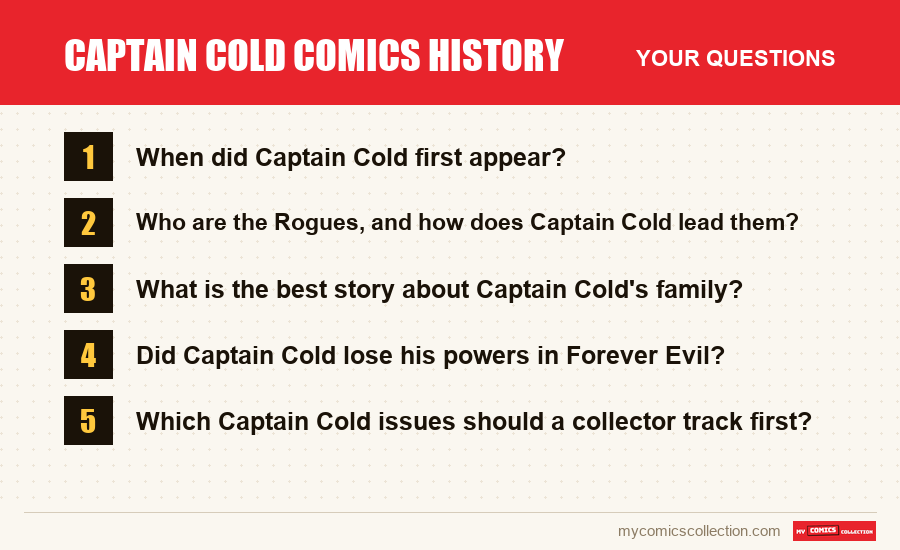
Leonard Snart makes his debut in Showcase #8, cover-dated 1957, created by John Broome and Carmine Infantino. He is a thief who builds a cold-producing weapon to stop the Flash, and an accidental shot while charging it in a cyclotron lab gives the gun its new effect before he takes the name Captain Cold.
The Rogues are a group of Flash enemies who first gather in The Flash #155 (1965). Cold is declared their leader over time, and in the Wally West years he joins a crew that forms around a Gorilla Grodd jailbreak meant to distract the hero. His authority rests on a strict code of conduct rather than on power.
The strongest family story is The Flash vol. 2 #182 (2002), in which Chillblaine murders his sister Lisa and Snart hunts the killer down. His father is the center of Final Crisis: Rogues' Revenge (2008), where Cold declines to kill him personally and has Heat Wave do it.
Yes. In Forever Evil (2013 to 2014), Deathstorm extracts Cold's freezing powers from his DNA after the Rogues refuse to join the Crime Syndicate. Snart then rebuilds his cold gun in just over half an hour, and he is later pardoned and joins the Justice League.
Begin with Showcase #8 (1957) for the debut and The Flash vol. 2 #182 (2002) for the character study. Then add Final Crisis: Rogues' Revenge #1 to #3 (2008) and Forever Evil #1 to #7. Record the volume next to each number, since the Flash has been renumbered several times.
If you hold a Silver Age Flash issue or an early Rogues appearance, find out what your copy is worth before you decide how to keep it.
Estimate my comic