
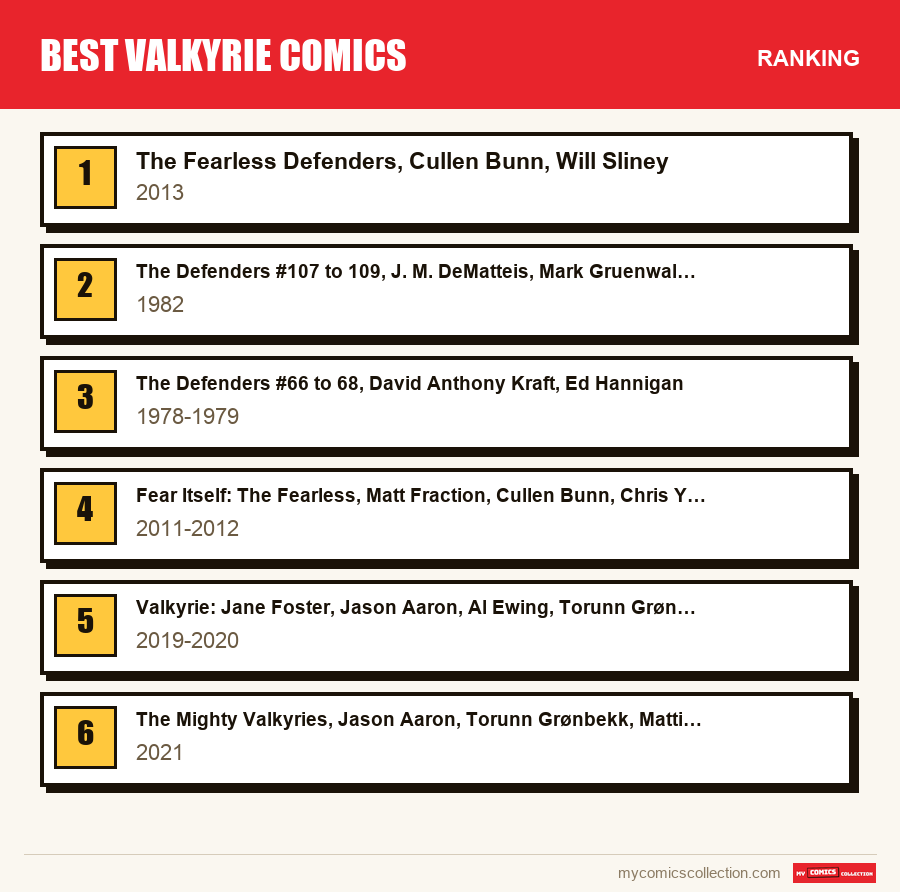
To find the best Valkyrie comics and know where to start, begin with The Fearless Defenders (2013) by Cullen Bunn and Will Sliney, where Brunnhilde leads her own team, then go back to Defenders #107 to 109 (1982), which give her back her real body. Round it out with Fear Itself: The Fearless (2011-2012) and, for Jane Foster's Valkyrie, Valkyrie: Jane Foster (2019-2020). The name debuts in The Avengers #83 (December 1970), but Brunnhilde's warrior first appears in The Defenders #4 (February 1973).
Looking for "the" Marvel Valkyrie means looking for several people behind a single costume: a sorceress in disguise, a young woman with borrowed powers, a mortal inhabited by the spirit of an Asgardian warrior, and, much later, a doctor who takes up the title. This ranking keeps the stories where Valkyrie truly holds the center, tells you each time which one it is, and leaves out the tales where she merely passes through a team.
As always in this guide, only verified facts (creators, issue numbers, dates) are stated as fact; the analysis is our own, with no reproduction of artwork or protected dialogue.
Her first appearance
You have to tell three births apart, because the name, the body, and the spirit don't arrive together. The name first: The Avengers #83, cover-dated December 1970, by Roy Thomas and John Buscema, with Tom Palmer on inks. The Enchantress takes the form of a Valkyrie to lead the Lady Liberators, a group of superpowered women set against the male Avengers. Her identity is uncovered and her plan fails, so this is not Brunnhilde yet, only a disguise.
The second birth is that of Samantha Parrington, who receives the Valkyrie's powers in The Incredible Hulk #142, dated August 1971, by Roy Thomas, Herb Trimpe, and John Severin. The third is the one that matters for this guide: in The Defenders #4, dated February 1973, Steve Englehart and Sal Buscema bring Valkyrie into the team. She wears the appearance of Barbara Norriss, a mortal whom the Enchantress endowed with the mind, looks, and powers of Brunnhilde, leader of the Valkyries of Asgard.
This three-step origin explains why the first stories devoted to the character revolve around a question of identity: who owns the body, and what remains of the Asgardian warrior inside an Earth woman? The 1978 and 1982 stories below settle exactly that question. To place these issues within the team's life, our page on the first issue of Defenders gives the background of the 1972 series.
1: The Fearless Defenders, Cullen Bunn, Will Sliney (2013)
The series runs from February to December 2013: twelve issues, plus a crossover tie-in, #4AU. Cullen Bunn writes the whole run, Will Sliney draws most of it, Phil Jimenez handles #4AU, and Stephanie Hans handles #7. Valkyrie leads a team of women recruited on Earth, with Misty Knight as a top-billed teammate, against Caroline Le Fey and her Doom Maidens.
What this series brings: a leadership role for a character who had mostly lived as a team member. Annabelle Riggs, an archaeologist who accidentally awakens Viking warriors, ends up bound to Valkyrie as the issues go on, and Danielle Moonstar is among the core members of the team. The tone blends mythological adventure with female camaraderie.
It suits readers who don't feel like digging through the 1970s: the story stands on its own. How to read it: in the order of the two collected volumes, issues 1 to 6 and then 7 to 12. If you like atmospheric art, stop at #7 by Stephanie Hans.
2: The Defenders #107 to 109, J. M. DeMatteis, Mark Gruenwald, Don Perlin (1982)
This three-issue arc, dated May to July 1982, resolves the identity problem raised in 1973. Barbara Norriss's body is killed, which frees Valkyrie's spirit from its mortal host. Doctor Strange then helps her recover her true body, held by the Enchantress, and Valkyrie sends Amora back into the soul crystal before returning to Earth with the Defenders.
What this arc brings: the end of a borrowed life and a character who can finally act in her real body. It also gives Valkyrie a personal payback against the woman who had locked her into a foreign identity. The writers are J. M. DeMatteis and Mark Gruenwald, and Don Perlin draws it.
It will speak most to someone who already follows the Defenders and wonders why Valkyrie changes status in the early 1980s. How to read it: after the 1978 arc (see below), in a collected edition of the period's Defenders rather than in single issues. Our ranking of the best Defenders runs helps you spot the volumes that collect them.
3: The Defenders #66 to 68, David Anthony Kraft, Ed Hannigan (1978-1979)
Three issues, from December 1978 to February 1979, built around Valkyrie. Ollerus, who covets Valhalla and defies Hela, drags the Defenders into his war. Valkyrie returns to Asgard and finds her true immortal body, but the spirit inside it is that of Barbara Norriss, which opens a conflict between the two women. David Anthony Kraft writes these issues, and Ed Hannigan is among the artists.
What this arc brings: a confrontation between Brunnhilde and the person whose body she borrowed, with stakes that go beyond the duel. It will please those who like to see gods squabbling over the realm of the dead in earnest. How to read it: at the start of your Bronze Age reading, before the 1982 arc that is its logical conclusion.
These issues assume you already know the group of Doctor Strange, Hulk, and Namor. If you know the team from the TV series, our comparison with the comics spells out what changes.
4: Fear Itself: The Fearless, Matt Fraction, Cullen Bunn, Chris Yost, Mark Bagley, Paul Pelletier (2011-2012)
Twelve issues published every two weeks starting in late 2011, written by Matt Fraction, Cullen Bunn, and Chris Yost, and drawn by Mark Bagley and Paul Pelletier. The through-line is the hunt for the eight hammers that fell to Earth during Fear Itself: Valkyrie tries to recover them to save the world, while Sin tries to burn it.
What this series brings: a pivotal moment where Valkyrie gives up eating Idunn's apples, becomes mortal, and considers dying to banish the Worthy. It is also where Asgard's All-Mother, the trio of Freyja, Gaea, and Idunn, entrusts her with building a new group of Valkyries recruited from the women of Earth, which directly sets up The Fearless Defenders.
Who it's for: the Fear Itself reader who wants to see what the event left behind. How to read it: after the main Fear Itself story, as a twelve-issue block, before the 2013 series. Neighboring reads are mapped out in our Thor reading guide.
Do you collect this series?
Track what you own, what you are missing and what your collection is worth. 7-day trial.
Start my trial →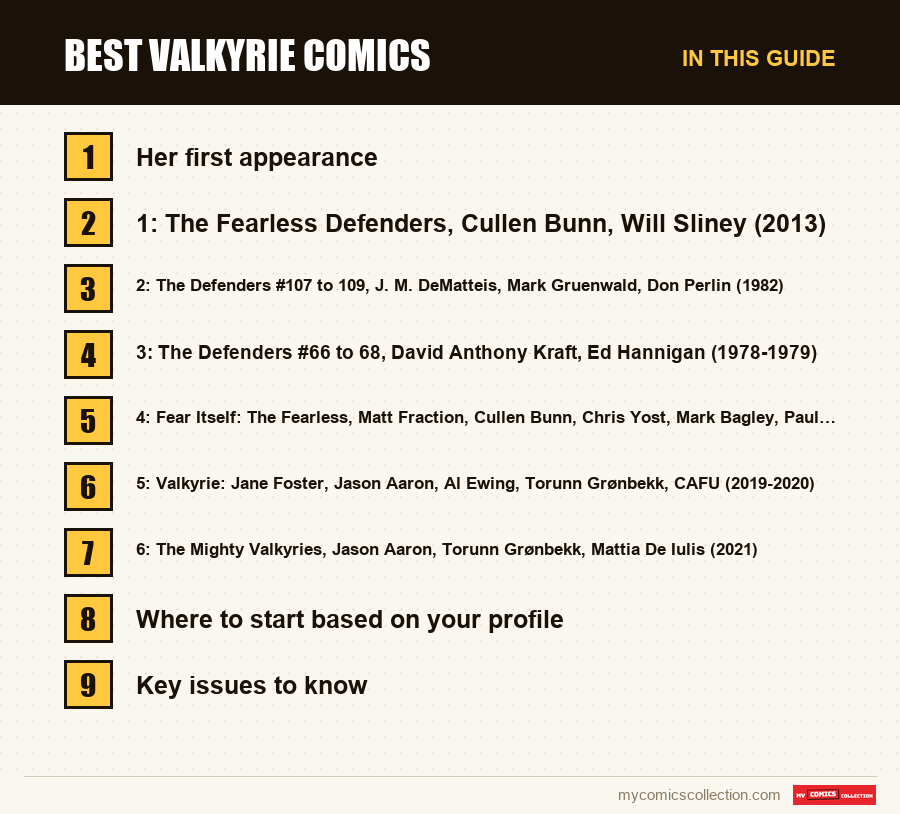
5: Valkyrie: Jane Foster, Jason Aaron, Al Ewing, Torunn Grønbekk, CAFU (2019-2020)
Ten issues, launched in the summer of 2019. Jason Aaron and Al Ewing co-write the first seven, then Torunn Grønbekk joins Jason Aaron for the last three. CAFU draws most of the series, with other artists stepping in for a few issues. The central character is not Brunnhilde: it is Jane Foster, who becomes the new Valkyrie at the end of The War of the Realms (2019), after wielding Thor's hammer for a time.
What this series brings: a different relationship to the title. Brunnhilde received a body and a name through an Enchantress spell; Jane Foster reaches the title by another road, that of Thor's hammer and then the war of the Ten Realms. Who it's for: the reader who knows Jane Foster from Jason Aaron's Thor run and wants to follow her after the hammer. How to read it: after The War of the Realms, not before. Our page on Jason Aaron and the Al Ewing profile help you place each of the writers.
6: The Mighty Valkyries, Jason Aaron, Torunn Grønbekk, Mattia De Iulis (2021)
Five issues, the first of which came out in April 2021, written by Jason Aaron and Torunn Grønbekk and drawn by Mattia De Iulis. The miniseries follows Return of the Valkyries, a story tied to King in Black. Jane Foster leads the Valkyries born from that story, and Loki sends her to hunt a beast prowling around the souls of Midgard.
What this series brings: an extension of the title more than a Brunnhilde story, which is why it sits at the end of the list. Who it's for: readers of the Jane Foster series who want to know what becomes of the Valkyrie name after her. How to read it: right after the 2019-2020 series and the story tied to King in Black.
Where to start based on your profile
You're discovering the character and want a finished story: pick The Fearless Defenders, twelve issues that open with no prior knowledge needed. You read the Defenders and like identity stories: read issues 66 to 68, then 107 to 109, which go together. You follow Marvel events: add Fear Itself: The Fearless between the event and the 2013 series. You come from Thor's Jane Foster: open Valkyrie: Jane Foster, then The Mighty Valkyries.
If you collect the original single issues, keep in mind that the 1978 and 1982 copies turn up in widely varying condition, so you have to read each listing carefully. If you prefer trade paperbacks, this entire ranking exists in collected volumes, and the Thor hub helps place each title relative to the world of Asgard. To gauge the sorcerer's role in the 1982 arc, the Doctor Strange page gives the context.
Key issues to know
This list is a way to find your bearings: no price appears in it. To value a copy, only use completed sales of the same issue in the same grade, and ignore listings that say nothing about the edition.
- The Avengers #83 (December 1970): the Enchantress borrows the name Valkyrie as a disguise; Roy Thomas writes, John Buscema draws.
- The Incredible Hulk #142 (August 1971): Samantha Parrington receives the Valkyrie's powers.
- The Defenders #4 (February 1973): Valkyrie joins the Defenders; Steve Englehart writes, Sal Buscema draws.
- The Defenders #66 to 68 (1978-1979): the arc that makes her identity the central subject.
- The Defenders #107 to 109 (1982): she regains her body and frees herself from the Enchantress.
- Doctor Strange, Sorcerer Supreme #3 (1989): Strange brings her back in the body of Sian Bowen, written by Peter B. Gillis and penciled by Richard Case.
- Fear Itself: The Fearless #1 (2011): Valkyrie gives up immortality to hunt the hammers.
- The Fearless Defenders #1 (February 2013): the team of Cullen Bunn and Will Sliney comes together.
- Valkyrie: Jane Foster #1 (2019): the opening of the series by Jason Aaron, Al Ewing, and CAFU.
For each of these issues, compare editions before you pay: first printings, reprints, and collected editions are not equal, and physical condition matters more than the date.
Frequently asked questions
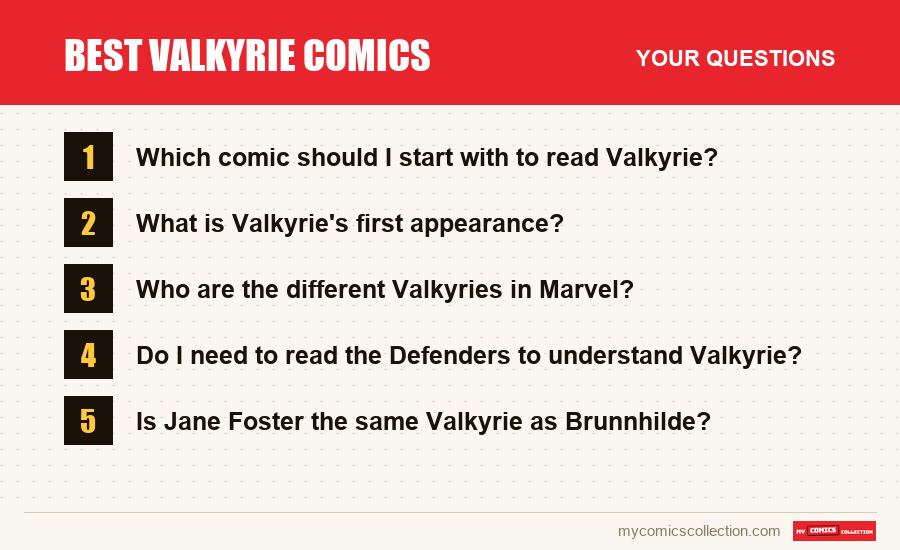
Start with The Fearless Defenders (2013), by Cullen Bunn and Will Sliney: twelve issues that read with no prior knowledge and give Brunnhilde a team-leader role. If you prefer Bronze Age stories, read Defenders #66 to 68 and then #107 to 109 next.
It depends on what you call Valkyrie. The name appears in The Avengers #83 (December 1970), worn by the disguised Enchantress. The Valkyrie who will become Brunnhilde joins the Defenders in The Defenders #4 (February 1973), by Steve Englehart and Sal Buscema.
Valkyrie is a title carried by several women. The Enchantress used it as a disguise, Samantha Parrington receives its powers in The Incredible Hulk #142, Barbara Norriss carries Brunnhilde's mind, and Jane Foster becomes Valkyrie at the end of The War of the Realms (2019).
Not to read her, but to understand her identity story. The Defenders arc in issues #66 to 68 (1978-1979) and the one in issues 107 to 109 (1982) explain her borrowed body. Modern series, like The Fearless Defenders, assume little prior knowledge.
No, they are two distinct characters who carry the same title. Brunnhilde is the Asgardian warrior of the Defenders and of The Fearless Defenders; Jane Foster becomes Valkyrie at the end of The War of the Realms and stars in Valkyrie: Jane Foster (2019-2020).
Do you own a single issue of Defenders or Fearless Defenders and aren't sure of its condition? Get it appraised before you sell or insure it.
Appraise my comic