
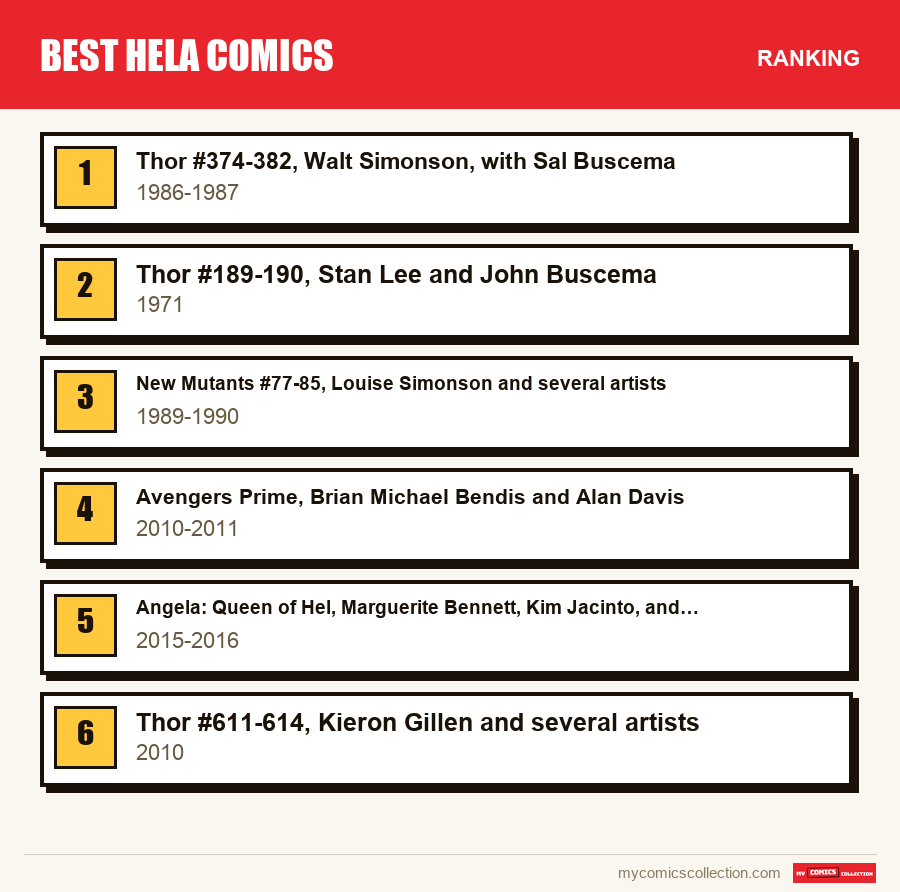
To read the best Hela comics, begin with the curse she casts on Thor in Thor #374 to #382 (1986-1987), by Walt Simonson, then go back to her duel with Odin in Thor #189-190 (1971). Her first appearance is Journey into Mystery #102, cover-dated March 1964, by Stan Lee and Jack Kirby. Avengers Prime (2010-2011) offers a modern, self-contained version.
Hela rules over Asgard's realm of the dead, and her role in the comics has less to do with how often she appears than with the nature of those appearances: she arrives when death has to weigh on the story. Those who discovered her in the movie Thor: Ragnarok often look for the equivalent on paper, and the answer is more scattered than you might think, because she has no regular series that follows her from start to finish. This selection therefore keeps the stories where she truly counts, and says plainly which ones she shares the spotlight in.
As always in this guide, only verified information (creators, issue numbers, dates) is stated as fact; the analysis is our own, with no reproduction of protected artwork or dialogue.
Her first appearance
Issue #102 of Journey into Mystery, cover-dated March 1964, gives birth to Hela: Stan Lee writes it, Jack Kirby draws her. She adapts the Norse goddess Hel, sovereign of the dead, to the Marvel universe, and keeps her role: the one you do not beat by force, since she rules over the end of all things. This issue is the source of everything that follows, but do not expect a saga from it: it is a starting point, not a story as dense as those on the list below.
She returns in 1968 with The Mighty Thor #150, whose March 1968 cover, by Jack Kirby, makes her the star. Archive enthusiasts will appreciate these two milestones of the Lee-Kirby era, while today's reader will prefer to start further along the timeline. Our page on Jack Kirby places those years within the artist's body of work.
For the reader hesitating to go back that far, a useful landmark: the stories in this guide do not require knowing the 1960s to be understood. Each one recalls the essentials of the situation, and Hela's figure is recognized right away by her role as sovereign of death, whether she is opposing Thor, Angela, or the young mutants.
1: Thor #374-382, Walt Simonson, with Sal Buscema (1986-1987)
This is the most recommendable story for getting into the character. Hela curses Thor there: his bones become fragile and no longer heal once broken, and death is denied to him. The curse appears in issue #374, in 1986, and Thor tries to protect himself from it by forging armor in a Pittsburgh foundry. In issue #382, cover-dated August 1987, Thor reaches Hel and forces Hela to lift the curse. Walt Simonson writes, with Sal Buscema on pencils in these issues.
This arc is for every reader, including those discovering Thor: the setting is clear, the threat is personal, and the ending is firm. It reads in a trade paperback in publication order, and it takes on its full meaning if you have skimmed, even quickly, the preceding issues of Simonson's run. To place this cycle in the writer's bibliography, the page Walt Simonson: where to start offers a path.
A word on the reading: the arc stretches over nine issues and alternates chapters of pure adventure, in the foundries and the realms of the giants, with darker scenes around death. If you read it in a trade paperback, do not try to isolate the episodes where Hela appears: the curse only carries weight if you follow Thor through the ordeal it imposes on him, from the forge all the way to Hel.
2: Thor #189-190, Stan Lee and John Buscema (1971)
Two issues, June and July 1971, where Hela comes to claim Thor's life, right after the Infinity cycle. She targets Thor, and Odin sends him back to Earth in the guise of Donald Blake, an identity over which she has no hold. In the second episode, Odin goes as far as killing Hela, before having to agree to bring her back, since death would otherwise cease to exist in the universe. Stan Lee writes, John Buscema draws.
The interest of this two-parter is that it sets a strong rule: Hela cannot be eliminated without death disappearing from the universe. Who is it for? Readers who want a short Bronze Age story with no prerequisites. It also shows an Odin in a harsh light, which contrasts with the image of a serene king, and it explains why Hela returns from one story to the next.
3: New Mutants #77-85, Louise Simonson and several artists (1989-1990)
In this sequence, Hela sends the Valkyries against the dwarves of Asgard and against the New Mutants, who have come to the realm of the gods. A magical barrier splits the team, then the young heroes manage to reach Odin's chambers, which they save, and foil the goddess's plans. The episode ends when the uru sword is destroyed. Louise Simonson writes; the pencils pass from one artist to another, including Rich Buckler, Rick Leonardi, and Bret Blevins.
This is not a Thor story, and that is what makes it precious: Hela faces mutant teenagers there, not gods. It is for the reader who likes crossovers between teams; it requires some idea of the group, which our page on the best New Mutants runs helps you place. Thor readers will find there an offbeat counterpoint to the gravity of the other entries.
4: Avengers Prime, Brian Michael Bendis and Alan Davis (2010-2011)
This five-issue miniseries extends the Siege event. Thor, Captain America, and Iron Man, estranged, are drawn into the twisted Nine Realms, where Hela is the main adversary. In the second episode, Thor seizes the Twilight Sword to restore the realms to their former state; in the fifth, he gathers an army to set against the goddess. Brian Michael Bendis writes, Alan Davis draws, with Mark Farmer on inks.
It is the clearest modern entry in this selection: five issues, a closed storyline, a trio of characters the general public knows. It will please readers who came from the movie, because the goddess is a large-scale threat there. You can read it without knowing Siege, even though knowing that context helps in grasping the rift between the three heroes. The Brian Michael Bendis hub places this series among his other work.
Do you collect this series?
Track what you own, what you are missing and what your collection is worth. 7-day trial.
Start my trial →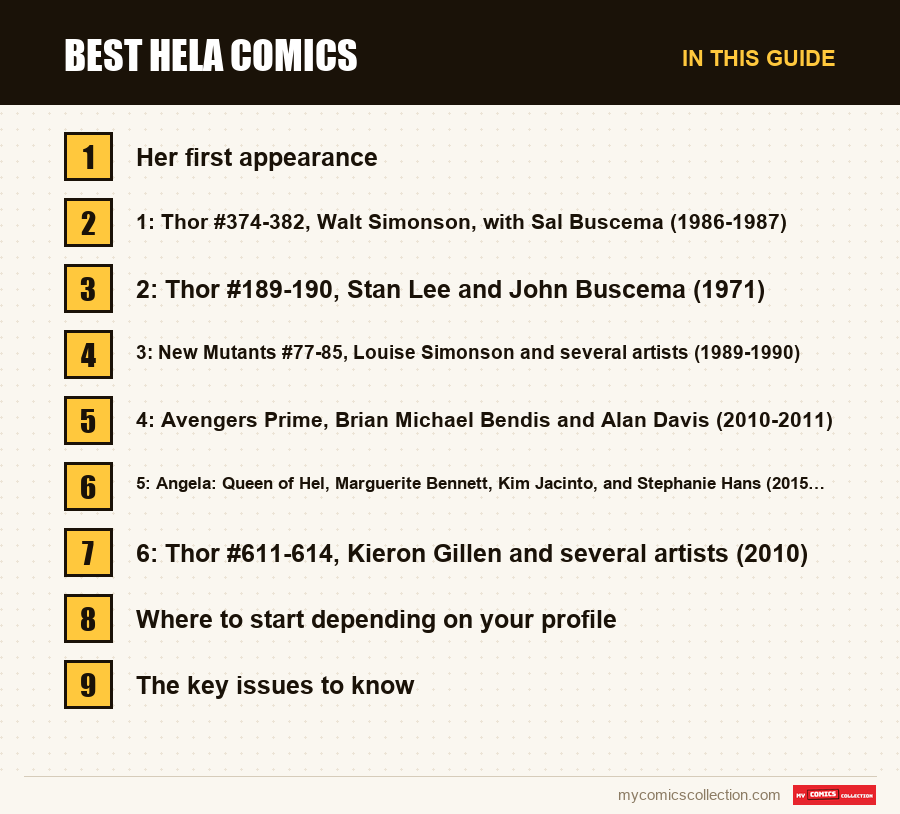
5: Angela: Queen of Hel, Marguerite Bennett, Kim Jacinto, and Stephanie Hans (2015-2016)
Seven issues, which pick up where Angela: Asgard's Assassin leaves off. Angela goes down to Hel to free Sera, and Hela, the sitting queen, has to defend her crown against the one who wants to seize it. Marguerite Bennett writes; Kim Jacinto draws the present-day fights and Stephanie Hans paints, in each issue, a nested tale about Angela's life.
Here, Hela is not the heroine of the story: she plays the part of the contested sovereign, and the protagonist remains Angela. This read suits anyone who wants to see the goddess from a less expected angle, that of a queen defending a throne, and it pairs well with reading Asgard's Assassin for context. It is more accessible in a trade paperback than the older entries, and Hans's art is an argument in itself.
6: Thor #611-614, Kieron Gillen and several artists (2010)
These issues follow the aftermath of Siege. Loki strikes an arrangement that gives Hela a portion of his underground domain, the Disir attack, and Hela loses an arm there before Thor and Tyr help banish the assailants. In these issues, the story belongs to Thor and Loki; Hela is a partner of circumstance, useful to a plan that exceeds her. Kieron Gillen writes this cycle.
We rank it last precisely for that reason: it is for the reader who already knows Hela and wants to see her at work in a context of shifting alliances, not for the one looking for a story where she dominates. It reads after Avengers Prime, with which it shares a backdrop. The Kieron Gillen hub lets you continue with the rest of his work on Asgard.
A reading caution: in these issues, the goddess serves the plot more than she drives it, which explains the modest rank of this entry. If your goal is to understand the logic of her power, reread the two previous entries afterward, where death is the very subject of the story.
Where to start depending on your profile
You come from the movie Thor: Ragnarok: read Avengers Prime, which offers a large-scale adversary in five issues, then move on to Thor #374-382. You want the heart of the character: start with Simonson's curse. You prefer short classics: Thor #189-190 reads in two issues. You like teams of young heroes: choose New Mutants #77-85. You want Hela from another angle: take Angela: Queen of Hel.
If you keep only one rule, keep this one: read the stories where Hela is the adversary first, then those where she is a lever. Mythology fans will complete the picture with the ranking of the best Thor arcs, which places these episodes within the whole series.
To build a small Hela shelf with the least effort, proceed in stages: a trade paperback of the Simonson issues, the 1971 two-parter in a collected edition or reprint, then the Avengers Prime miniseries. Save the original single issues of the 1960s for the end of the shelf, once you know whether the goddess holds your interest over time.
The key issues to know
The reference key is Journey into Mystery #102 (March 1964), Hela's first appearance. Around it, The Mighty Thor #150 (March 1968), with a cover by Jack Kirby, marks the goddess's entry into the series; Thor #189 (June 1971) and #190 (July 1971) fix her duel with Odin; Thor #374 (1986) sets up the curse that Thor #382 (August 1987) lifts; New Mutants #80 (October 1989) carries the Valkyries' attack; Avengers Prime #1 (2010) launches the miniseries.
The sorting method is simple: the first appearance drives demand, the turning-point issues make the reading, and recent stories are easier to find in a trade paperback. Set the condition of your copy against completed sales, check that it is the original printing rather than a reprint, and reread the printing notice before drawing any conclusion. The value of a 1964 copy depends first on its condition and the available supply, not on the movie adaptation.
Frequently asked questions
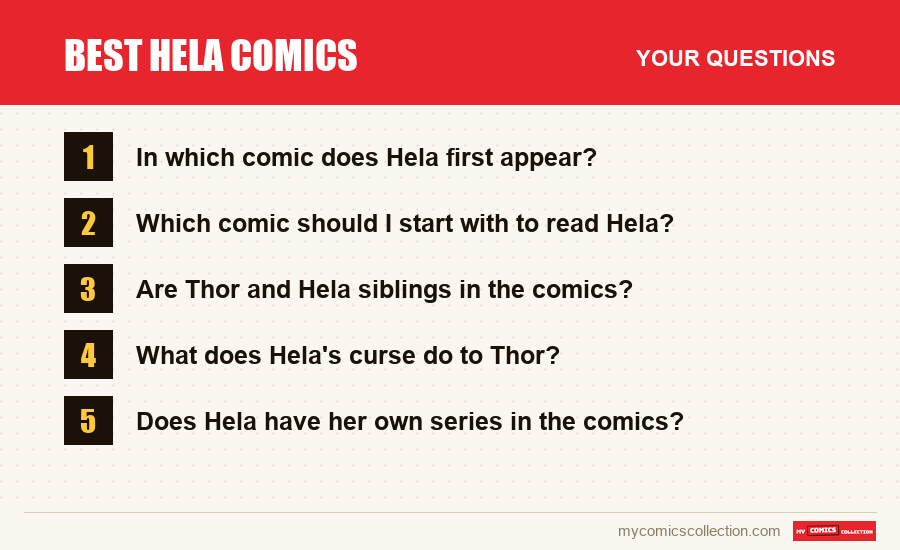
It is Journey into Mystery #102, cover-dated March 1964, that introduces her to the public. She takes shape there under the hands of Stan Lee and Jack Kirby, based on Hel, the Norse goddess who rules over the dead. She then reappears in the Thor series in 1968.
Start with Thor #374 to #382 (1986-1987), by Walt Simonson, where she curses Thor, or with Avengers Prime (2010-2011), more recent and self-contained. Both read in trade paperback, with no major prerequisites, and they show the goddess as the main adversary.
No, that kinship is specific to the movie Thor: Ragnarok (2017). On paper, Hela governs the realm of the dead, opposes Thor as well as Odin, and is linked to Loki and to Norse mythology, without being described as the sister of the god of thunder.
In Thor #374 (1986), the curse makes Thor's bones fragile and unable to heal once broken, and takes away his ability to die. In issue #382, cover-dated August 1987, Thor reaches Hel and forces Hela to lift it.
She appears mostly in the Thor, New Mutants, or Angela series, rather than in a series that follows her from start to finish. To see her at the center, read Avengers Prime or Angela: Queen of Hel, where she is the contested queen.
Do you own a Hela key issue, like Journey into Mystery #102? Estimate it with the free tool.
Estimate my comic