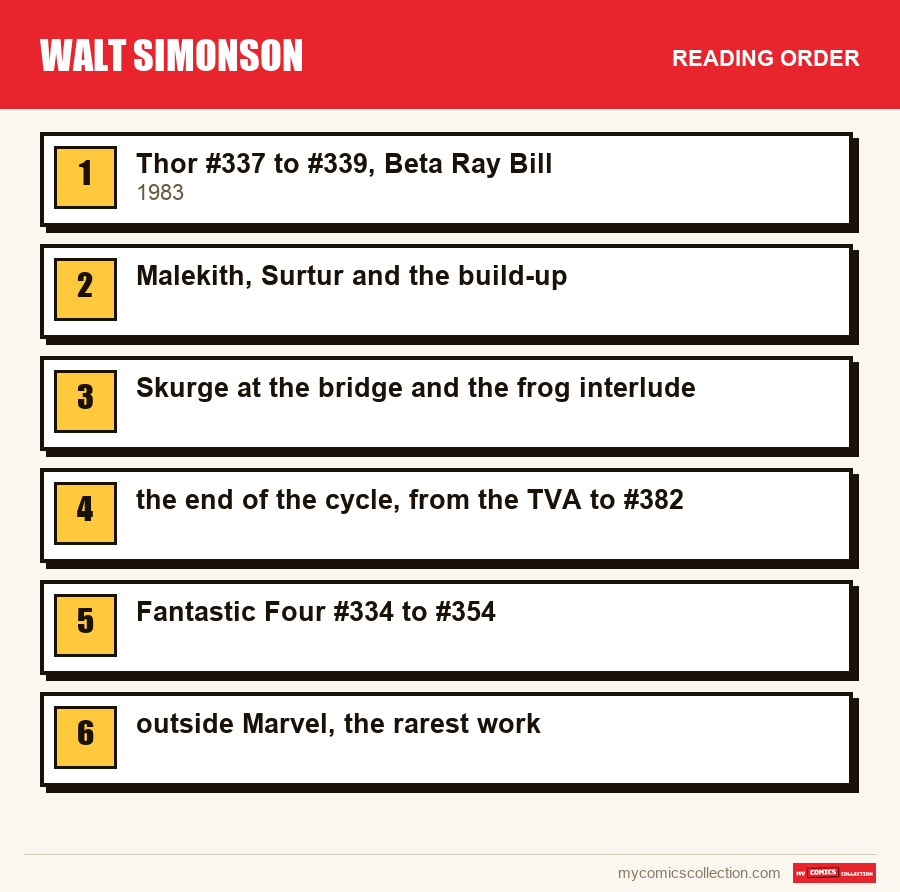
To read Walt Simonson, start with Thor #337 to #339 (1983), where Beta Ray Bill lifts the hammer, then follow the saga of Malekith and Surtur, the story of Skurge at the bridge and the end of the cycle at #382. Move on to Fantastic Four #334 to #354, then to the work outside Marvel. Six steps, from the most direct to the rarest.
Walt Simonson is famous for one unique stretch of Thor, but the body of work spans the science fiction of the 1970s, DC series and personal projects. This guide offers a reading order and does not retell a career: the goal is to say what to open first, and what can wait.
As always in this guide, only verified information (creators, issue numbers, dates) is stated as fact; the analysis is ours, with no reproduction of protected pages or dialogue.
Why this path starts with Thor
Among the creators who left a mark on a character, Walt Simonson holds a place apart: on Thor, between 1983 and 1987, the same creator writes, draws and inks most of a monthly series for more than forty issues. That consistency explains why reading this period is both the most recommended and the easiest to begin. All of Simonson's other works are shorter, more scattered or harder to find.
The path therefore follows a simple slope: an opening arc that reads alone, three steps that extend the same cycle, a detour through another Marvel series, then a riskier step outside Marvel. To place this period within the whole series, the best context remains the ranking of Thor runs, which puts this period in first place.
Step 1: Thor #337 to #339, Beta Ray Bill (1983)
Issue #337, dated November 1983, opens the cycle. An alien with a skeletal face, champion of a people in exile, lifts Thor's hammer and receives the powers of the god of thunder. The conflict that follows, between two warriors who are each right in their own way, lasts three issues and ends with an unadorned epilogue. The start of this cycle has a dedicated article, Thor #337, which details the creative team and the editions.
These three issues make the best introduction for a practical reason: they do not depend on what came before. The reader meets a newcomer as much as an old hand, and Simonson explains what is needed in a few pages. The visitor's weapon, Stormbreaker, is born in a dwarf forge during this arc, and that detail sums up the spirit of the series: a mythological world handled with a sense of craft.
Recommended format: a collected edition reprinting the first issues of the cycle. The single issue #337 is sought after and calls for caution about condition, because the paper of the period ages badly.
Step 2: Malekith, Surtur and the build-up
After Beta Ray Bill, the series widens its horizon. Malekith, the dark elf, makes his first appearance in #344 and returns often in the following years. The saga of Surtur, a fire giant who wants to set Asgard ablaze, then fills several issues and mixes Thor, Odin and assorted allies in a conflict that changes the balance of the realm. The pace is broader than in the previous step, but the plot stays readable.
This second tier is for the reader who enjoyed the opening arc and wants to know whether the series holds up over time. It does, notably because Simonson sets up the recurring motifs very early: the blacksmith dwarfs, the nature of the weapons, the idea that the hammer chooses. To get oriented among the many arcs that follow, the Thor reading guide gives a complete order, of which the Simonson portion is a subset.
Recommended format: collected editions in order. Each step here assumes reading several issues in a row, which makes a lone single issue unsatisfying.
Step 3: Skurge at the bridge and the frog interlude
Issue #362 is the one most often cited when this period comes up. Skurge, the executioner of Asgard, holds a bridge alone against an army of the dead. The story reads without knowing the saga around it, so simple is its subject: a supporting character, an act of courage. It is the best demonstration of what Simonson does when the story tightens.
A few issues later, the series treats itself to a lighter detour: Thor is turned into a frog for an adventure with the flavor of a fable. The tone seems out of step with what precedes, but it belongs to the same logic, which is to treat Norse mythology with freedom. These episodes are useful breathers before what follows, which demands more attention.
Recommended format: collected edition. If you want a single issue for yourself, #362 is the most symbolic and the most coveted of the period.
Step 4: the end of the cycle, from the TVA to #382
The end of the period reads better with the earlier steps in mind. Issue #372 introduces the Time Variance Authority, an administration charged with policing timelines, which has enjoyed a long afterlife since. Simonson writes the cycle through #382, but Sal Buscema draws the last stretch starting at #368, which changes the line without changing the voice of the story.
This step is more demanding: it closes plots sown thirty issues earlier and asks you to remember them. For readers who discover Thor through Loki, the Loki hub offers other ways into the same mythology. Buscema's work on these issues is detailed in the major Thor artists.
Recommended format: collected edition or omnibus, because the ending only makes sense with the rest. Isolated single issues from this part lose almost all their meaning without the earlier numbers.
Do you collect this series?
Track what you own, what you're missing and what your collection is worth. 7-day trial.
Start my trial →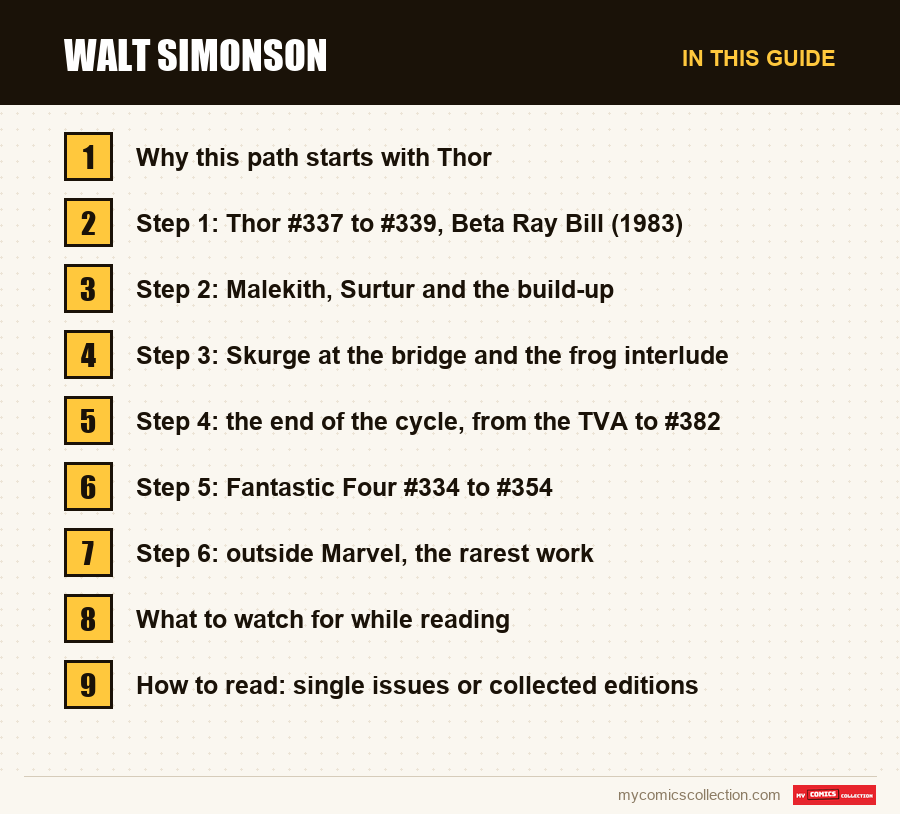
Step 5: Fantastic Four #334 to #354
After Thor, Simonson takes on another founding Marvel series: written and drawn by the creator at the turn of the 1990s, it runs about twenty issues, from #334 to #354. Time travel plays a central role, with an appearance of the TVA and a version of Doctor Doom wearing a renewed armor. The contrast with Thor is sharp: the pace is more nervous, the stakes more intimate, the family at the center.
This step is useful for measuring the distance between two styles of writing. It is also easier to fit into a series collection, since the issues are contiguous and the title remains widely followed. To see how this period fits into the whole, consult the ranking of Fantastic Four runs, where it is among the most underrated.
Recommended format: single issues or collected edition; the numbers are common and pose no particular difficulty of access.
Step 6: outside Marvel, the rarest work
The last step gathers works that do not resemble Thor. Manhunter, with Archie Goodwin, in Detective Comics in 1973 and 1974, is a short, concise series, much appreciated by fans of the medium's history. The Star Slammers, Simonson's personal space opera, first appeared in 1983 in a Marvel album. Orion, at DC in the 2000s, takes up a Jack Kirby character, and Ragnarok, at IDW since 2014, builds a Norse world of Simonson's own.
These titles take more searching, because their availability varies by country and by publisher. They are for the reader who has already enjoyed the earlier steps and wants to gauge the creator's consistency in other genres. None is an entry point: read them after Thor, not before.
Recommended format: collected editions, when they exist. The Manhunter single issues are old and harder to find in good condition.
What to watch for while reading
A reader discovering these issues gains by watching three things. First the sound effects: John Workman, who letters #337, places them right in the panel, to the point that they become part of the drawing. Then the layout, where Simonson alternates very busy pages with large, almost silent compositions. Finally the way supporting characters, Skurge, Bill or Eitri, get an arc of their own instead of serving as a backdrop for Thor.
This attention changes the reading. It also explains why Buscema's more classical work looks different at the end of the cycle: the storytelling remains Simonson's, but the page no longer has the same look. To measure that gap without hunting for copies, compare two pages from a collected edition, one from #350 and one from #375.
How to read: single issues or collected editions
To read Simonson, collected editions are the right choice: the Thor cycle runs forty-six issues and benefits from being read without interruption. For collecting, two approaches coexist. One targets the landmark issues: Thor #337, #344, #362, #372. The other tries for the complete run from #337 to #382, a solution that takes time and a budget you will control by comparing listings over the weeks.
A tip on checking: the paper of these single issues, printed in the early 1980s, yellows and weakens easily. When browsing listings, demand photos of the spine and the inside front cover before closing a deal. If you prefer to read at lower risk, take a collected edition and keep the single issues for the numbers that really strike you.
Finally, a word on reading order between series: you can slot step 5 between steps 2 and 3 without harm, since the Fantastic Four form an independent set. However, do not skip #362: the step that follows is better understood with it.
Recap: the recommended order
- Thor #337 to #339 (1983), the arrival of Beta Ray Bill.
- Thor, from Malekith (#344) to the Surtur saga.
- Thor #362, Skurge at the bridge, then the frog episode.
- Thor #372 (the TVA) through #382, with Sal Buscema on art.
- Fantastic Four #334 to #354, in the early 1990s.
- Outside Marvel: Manhunter, The Star Slammers, Orion and Ragnarok.
Frequently asked questions
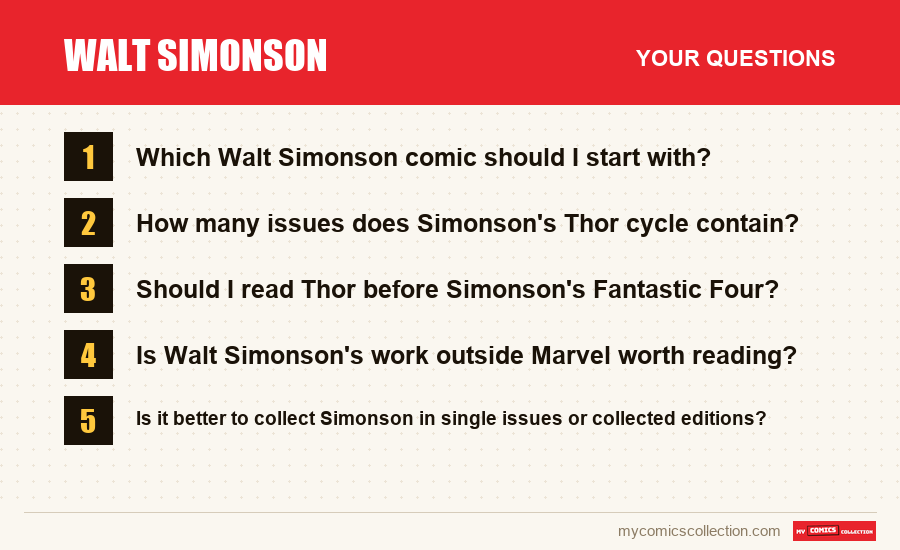
Start with Thor #337 to #339, published from November 1983. These three issues introduce Beta Ray Bill, form a complete arc and require no knowledge of earlier issues. It is the most cited entry point and the cheapest in reading effort.
From #337 to #382, which makes forty-six issues. Simonson draws the first ones, then hands the art to Sal Buscema from #368 while continuing to write. A multi-volume collected edition or an omnibus lets you read the rest without interruption.
It is recommended, though not required. Fantastic Four #334 to #354 read on their own, but the TVA, introduced in Thor #372, makes more sense once you know it. Reading the Thor cycle first gives better context for the ideas Simonson picks up afterward.
Yes, but at the end of the path. Manhunter, The Star Slammers, Orion and Ragnarok show a creator writing and drawing in other genres. These series are rarer and harder to find, so it is better to approach them after reading the Thor issues.
Collected editions for reading, because the cycle is long and deserves a continuous read. Original single issues suit the landmark numbers like #337 or #362. Always examine the condition of the paper, which ages badly on printings from the early 1980s.
Do you own an early 1980s Thor or a 1990s Fantastic Four by Simonson? Have it estimated before going further down the path.
Estimate my comic