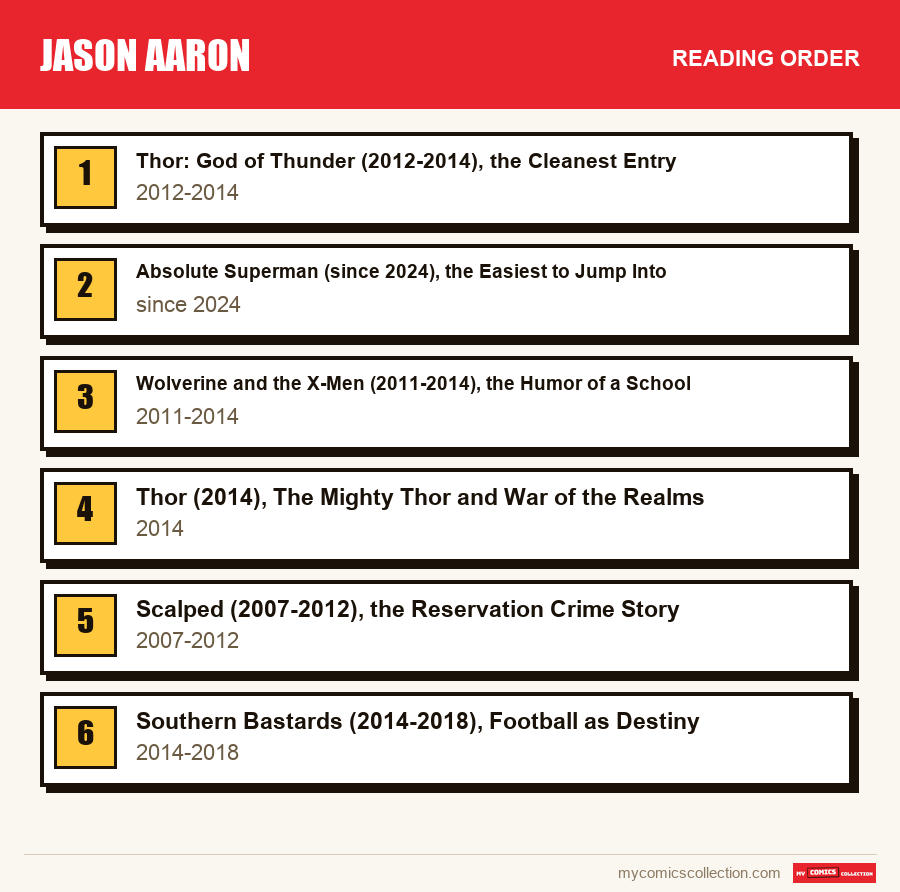
To read Jason Aaron in the right order, open Thor: God of Thunder (2012-2014) with Esad Ribić, a saga that stands on its own. Continue with Absolute Superman (since 2024), then Wolverine and the X-Men (2011-2014). Next move to the Jane Foster Thor books and War of the Realms (2019). Save the adult works for last: Scalped (2007-2012), then Southern Bastards (2014-2018), which need no prerequisites but are much rougher.
Jason Aaron's catalog splits into ten years at Marvel, creator-owned series at Vertigo and Image, and, since 2024, a reinvented Superman. Look for a place to start and you run into overlapping numbering, relaunches and events. Six steps are enough to cover everything: the first is the easiest to get into, the last the roughest, and each one states the background it requires.
As always in this guide, only verified information (creators, issues, dates) is stated as fact; the analysis is ours, with no reproduction of artwork or protected dialogue.
Our sorting criterion comes down to one idea: measure what each block asks of the reader beforehand. Jason Aaron's stories have a particular trait: they often open on a god killer, a school or an Indian reservation, and the reader understands right away where they are headed. But a Thor saga spread over seven years assumes a chronology, whereas a closed series of sixty issues reads with no prior knowledge. The route below respects that difference.
Step 1: Thor: God of Thunder (2012-2014), the Cleanest Entry
Thor: God of Thunder appears starting in November 2012, with Esad Ribić on art for the first arcs. The story follows Gorr, an alien whose faith was betrayed by the gods and who sets out to exterminate them, hence the nickname the God Butcher. Jason Aaron came up with the idea of telling the hunt across three eras: a young Thor in the Viking age, the Avengers-era Thor, then an aged king of Asgard, alone against what remains. The three threads meet at the end of the first movement.
Why start here: the first part, God Butcher (issues 1 to 5), is followed by Godbomb (issues 6 to 11), and these eleven issues form a set that demands no prior reading. You don't need to know the Avengers or the films to follow Gorr. The later arcs of the series (up to issue 25) are less unanimous and can wait.
On the collecting side, the original 2012 issues are easy to find in bargain bins, and the first issue exists with alternate covers that must be told apart carefully from an ordinary printing. If you simply want to read, a collected edition of the first eleven issues saves you from hunting single issues. To place this cycle in the long history of the thunder god, see our Thor reading guide.
Step 2: Absolute Superman (since 2024), the Easiest to Jump Into
Rafa Sandoval draws Absolute Superman, launched on November 6, 2024 within the Absolute line published by DC. Jason Aaron rebuilds the hero from scratch: a Kal-El raised on Krypton, with no Kansas farm or adoptive family, who arrives on Earth in a society where corporations make the rules. The story is ongoing, which changes how you collect: you buy at the pace of publication, or you wait for the collected editions.
The series comes second because it requires no knowledge of Superman and reads from the first issue. It also offers a glimpse of what the writer can do with a character ninety years old: change the starting point rather than tell one more adventure. The six cycles are described one by one, with their boundaries, in our reading guide devoted to this series.
A series launched less than two years ago has no established value yet. What will move it: the real length of the run, the number of reprints of the first issue, and the place the Absolute line takes at DC. None of the three is known today, so read before you speculate.
Step 3: Wolverine and the X-Men (2011-2014), the Humor of a School
Schism fractured the X-Men, and Wolverine leaves to open a mutant school of his own, named after Jean Grey. Wolverine and the X-Men #1 came out in 2011, with Chris Bachalo as the main artist. The tone is that of a school comedy in which a gruff killer has to manage a budget, improbable teachers and students with runaway imaginations. Bachalo fills the panels with visual gags, and Jason Aaron turns out a chatty, fast-moving series that allows itself strange digressions.
This step asks for a little more background than the previous ones, since it plays with mutant heritage: Kitty Pryde as headmistress, Quentin Quire as a rebellious student, and a rival school thriving nearby. A reader who has never opened an X-Men book will still be carried by the setting and the tone more than by continuity. The series runs about forty issues, which remains reasonable for a full run.
Our ranking of the best Wolverine runs puts the character's other periods in perspective. Aaron had written Wolverine: Weapon X as early as 2009, but that pre-school series is darker and in a different register. Treat it as a supplement for claw fans, not as an entry point.
Step 4: Thor (2014), The Mighty Thor and War of the Realms
After Original Sin, a 2014 event Jason Aaron took part in, Thor finds himself unworthy of Mjolnir. The hammer passes to a new wielder, Jane Foster, whom readers knew as a nurse and friend of the god. Thor (2014), drawn by Russell Dauterman, later becomes The Mighty Thor, and the saga stretches to the big finale of War of the Realms in 2019, where Malekith invades the Ten Realms. Unworthy Thor, a 2016 miniseries with Olivier Coipel, tells in the meantime what becomes of the fallen Thor.
This block is heavier than the first three: it inherits the events of God of Thunder, it crosses with Jane Foster's story and it ends on a war of the realms with many tie-in series. Read steps 1 then 4 in that order, and set aside the War of the Realms tie-ins until the main series has won you over. The exact number of issues in this block varies with the legacy numbering each source adopts: check the table of contents of a collected edition rather than a stray total.
To collect this cycle, Dauterman's covers are what resell best in listings, and a series with two numbering systems (the volume 4 of Thor, then Marvel's renumberings) means you must check the exact title before buying. The other Thor cycles have their place in our best Thor arcs.
Step 5: Scalped (2007-2012), the Reservation Crime Story
Scalped is Jason Aaron's great creator-owned series: sixty issues at Vertigo, published from 2007 to 2012, drawn by R. M. Guéra. The action takes place on the Prairie Rose Indian reservation. Dashiell Bad Horse, a young man back after years away, is in fact an FBI agent undercover with Lincoln Red Crow, the head of the casino and the tribal police. The title announces the violence: this is a noir novel where nobody comes out clean.
The series is step 5 because it targets an adult audience and has nothing of the celebration of superheroes. It assumes no reading, though: everything reads from issue 1. The difficulty is moral, not narrative. The pace is slow, the characters sink deeper; Guéra draws an arid setting, and Jock's covers remain reference points for illustration fans.
The Other Side, a five-issue miniseries published at Vertigo in 2006 with Cameron Stewart, gives you a shorter taste: two soldiers, one American and one Vietnamese, face each other during the Vietnam War. It is a good test if you hesitate before the sixty issues of Scalped. As single issues, Scalped can be completed without much trouble, since it never saw the rush that high-print-run series did. The collected volumes are the simplest route.
Do you collect this series?
Track what you own, what you're missing and what your collection is worth. 7-day trial.
Start my trial →
Step 6: Southern Bastards (2014-2018), Football as Destiny
Southern Bastards is published at Image from 2014 with Jason Latour on art, and ends after twenty issues. The action takes place in the fictional Craw County, Alabama, where the high school football team, the Runnin' Rebs, rules an entire town. Earl Tubb, a man back to clear out his father's house, collides with Coach Euless Boss, who governs the region as much as the field.
Why last: the tone is brutal and the subject, a rural South where sport serves as a cover for power, is better savored after Scalped. The reader arrives here already knowing Jason Aaron's taste for local systems of power, which Scalped laid out with a different geography. Southern Bastards lets you check what you think of this way of telling stories, in fewer issues.
The series is short, well framed, and can be read at any point of the route. We put it at the end because it extends Scalped rather than introducing it. On the collecting market, the twenty single issues and their collected editions circulate easily: it is a reading purchase well before it is a gamble.
How to read: single issues or collected editions
Tight sagas read better in collected editions: Thor: God of Thunder, Wolverine and the X-Men and the two adult series run without interruption, and a volume spares you from checking issue order. Single issues make sense for the first issue of each series, for the covers by Dauterman, Ribić and Bachalo, or if you collect the original format.
One point of caution concerns Thor: the numbering of an ongoing series changes when Marvel relaunches or renumbers. Faced with a lot of Thor, first note the volume and year printed on the cover, then cross-check with the site catalog. For Absolute Superman, which is ongoing, it is better to wait for a full new release of an arc before diving into the collected editions, or to buy month by month.
What these series are worth as collectibles
A classic and a recent title are not valued the same way. For closed series like Scalped or Southern Bastards, the rating rests on completeness and condition: a set with no gaps sells better than a run of stray issues. For Thor: God of Thunder, the first issue and its variants draw the attention. As for Absolute Superman, its reference price is yet to be established: everything will depend on the title's longevity and on reprints of the first issue.
Valuation method: note three completed sales of comparable issues, discard the highest and the lowest listing, and compare the median with the price of the next grade up. Don't confuse a certified issue with an uncertified copy, and always note the cover: Ribić, Dauterman and Guéra do not draw the same demand. The site's free estimate gives a first reference point.
Recap: the recommended order
- Step 1: Thor: God of Thunder, issues 1 to 11 (2012-2013).
- Step 2: Absolute Superman, from issue 1 (2024), ongoing series.
- Step 3: Wolverine and the X-Men (2011-2014), with Chris Bachalo.
- Step 4: Thor (2014), The Mighty Thor, then War of the Realms (2019).
- Step 5: Scalped (2007-2012), sixty issues with R. M. Guéra.
- Step 6: Southern Bastards (2014-2018), twenty issues with Jason Latour.
If time is short, keep two milestones: Thor: God of Thunder for mythological Marvel, Scalped for the writer in the open. Between the two, Absolute Superman bridges to current events.
Frequently asked questions
Start with Thor: God of Thunder, issues 1 to 11, drawn by Esad Ribić. These eleven issues form a complete story around Gorr, the God Butcher, and require no prior reading. If you prefer an ongoing series, Absolute Superman, since November 2024, is the second-easiest entry.
Yes, at least the Thor (2014) and The Mighty Thor cycle with Russell Dauterman. War of the Realms, in 2019, concludes a story begun over several years, with Jane Foster and Malekith. Without that detour, the invasion of the Ten Realms loses part of its dramatic weight.
Yes. Scalped is a closed series of sixty issues published at Vertigo from 2007 to 2012, with R. M. Guéra. It belongs to no superhero universe and can be read first, as long as you accept a noir tone, raw violence and a slow pace.
It isn't mandatory, since the two stories have no link. We suggest reading them in that order because Southern Bastards, twenty issues at Image with Jason Latour, is shorter and takes up the theme of local power with a different geography: the football of an Alabama county.
Not necessarily. The 2011 series, drawn mostly by Chris Bachalo, follows the founding of a school and can be understood without long preparation. Knowing Kitty Pryde, Quentin Quire and the context of Schism enriches the reading, but the school comedy carries the story even for a newcomer.
Did you find a Jason Aaron Thor or a complete Scalped run in your boxes? Get a first estimate.
Estimate my comic