
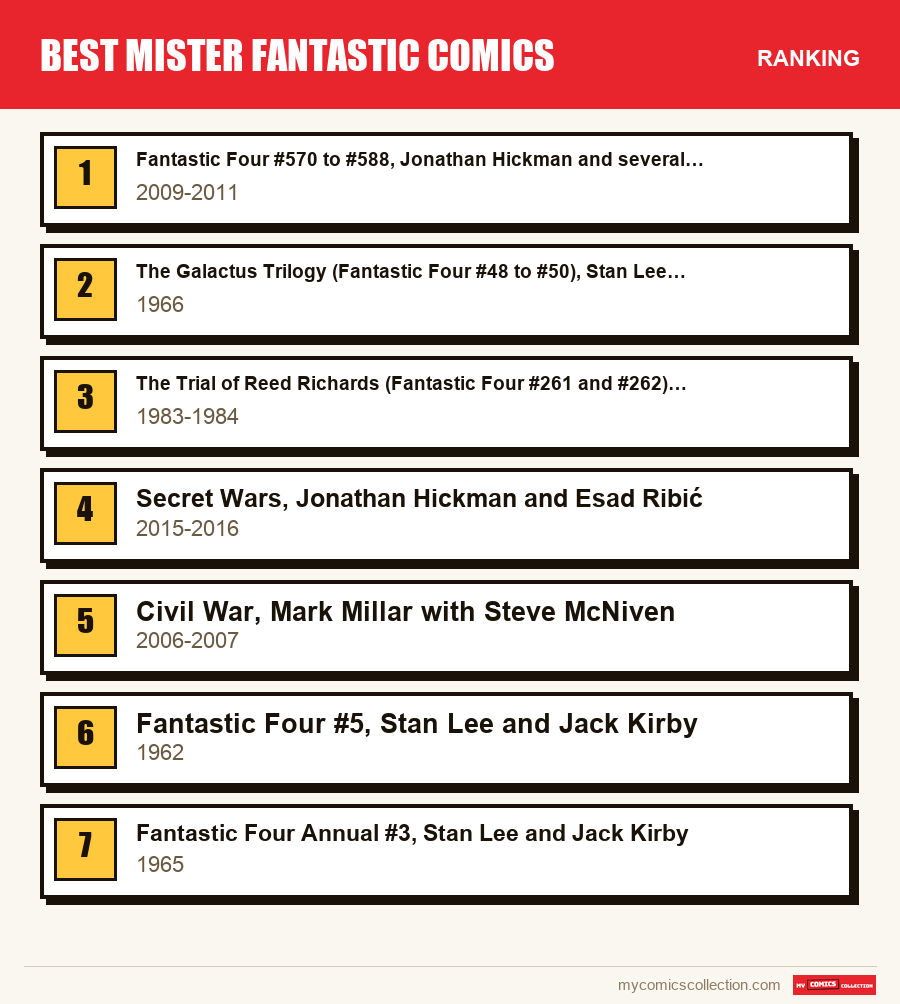
To find the best Mister Fantastic comics and where to start with Reed Richards, read Hickman first: his Fantastic Four run (#570 to #588, 2009-2011) makes the hero's intellect the engine of the plot. Then go back to the Galactus Trilogy by Stan Lee and Jack Kirby (#48 to #50, 1966) and to John Byrne's trial story (#261 and #262). Finish with Secret Wars (2015-2016) and Civil War (2006-2007), where he is pushed to the wall.
Reed Richards is a special case among Marvel heroes: his main power is understanding, and his biggest failures come from believing he can solve everything. His best stories set that gift against an adversary, a court, a political crisis or his own family. This guide ranks seven of them, with what each adds to the character, who it is for and the reading order.
As always in this guide, only verified facts (creators, issue numbers, dates) are stated as fact; the analysis is our own, with no reproduction of protected pages or dialogue.
His first appearance
Reed Richards debuts in Fantastic Four #1, cover-dated November 1961. Stan Lee writes and Jack Kirby draws: it is the issue that launches the series and, with it, what is commonly called the Marvel Age. Reed is the team's leader, a scientist whose body stretches after a space flight.
His marriage to Sue Storm comes in Fantastic Four Annual #3, dated July 1965. That detail shapes how you read him: before it, Reed is a gang leader; after it, he is a husband and then a father, and the best stories that follow weigh his hunger for knowledge against his duty to his family.
1: Fantastic Four #570 to #588, Jonathan Hickman and several artists (2009-2011)
This is the best modern entry point, and the most ambitious. Jonathan Hickman writes the whole run, which stretches from Fantastic Four #570 (October 2009) to #588 (February 2011); the art is shared among several artists, including Dale Eaglesham and Neil Edwards at the start, Steve Epting for much of the end, then Nick Dragotta and Mark Brooks on the final issue.
What the run gives Reed is a simple, grave idea: his urge to solve everything. In the "Solve Everything" arc, he discovers a place where alternate versions of himself gather as a council. The mainstream Reed stands apart from the others because he refuses to sacrifice his family to carry out the project. It is a portrait of genius, with everything seductive and dangerous about it, and it is the sharpest reading of what makes the character unique.
The run ends with the death of the Human Torch in issue #587, published in January 2011, and with the series' final issue, #588, from February 2011. For your collection, note that these two single issues close one series and set up another. For the Doom rivalry that Hickman feeds throughout his run, see the article on Hickman, the Fantastic Four and Doom.
This run is for the adult, patient reader who likes plots that unfold over many issues. Read it in order, from #570 to #588, without skipping a link in the chain.
2: The Galactus Trilogy (Fantastic Four #48 to #50), Stan Lee, Jack Kirby and Joe Sinnott (1966)
The three single issues published between March and May 1966 bring together Stan Lee on text, Jack Kirby on pencils and Joe Sinnott on inks. Galactus makes his first appearance there, and Earth finds itself threatened by a being who feeds on planets. Reed leads the response: he directs the team, organizes the defense and, in the final part, uses the Ultimate Nullifier against Galactus.
The trilogy gives Reed a cosmic-scale test. It is no longer a duel against a mad scientist but a face-off where reasoning and composure count for more than strength. The hero shows himself as both strategist and bluffer, which foreshadows the Reed whose limits Hickman would expose more than forty years later.
It is for any reader who wants to understand why the series left its mark on its era. Read the three issues consecutively, preferably in a collected edition; issue #48 is also the first appearance of Galactus, which makes it a collecting landmark. See also our analysis of the Fantastic Four key issues.
3: The Trial of Reed Richards (Fantastic Four #261 and #262), John Byrne (1983-1984)
John Byrne writes and draws these two issues, published in 1983-1984, the second dated January 1984. Reed is abducted by aliens and then tried before a galactic tribunal for having spared Galactus during his last attempt to devour Earth. The Shi'ar Lilandra and Gladiator are among those taking part in the trial.
This story gives the character a moral trial. Reed saved a destroyer of worlds, and the question is whether he must answer for it to those the creature threatened. The outcome plays out in issue #262, considered one of the highlights of Byrne's time on the series.
It is for the reader who has read the 1966 trilogy and wants to gauge its consequences. Read it afterward, because its weight rests on what the reader already knows about Galactus. The author's career is detailed in our John Byrne guide.
4: Secret Wars, Jonathan Hickman and Esad Ribić (2015-2016)
Jonathan Hickman writes this event and Esad Ribić draws it. The final issue, Secret Wars #9, is a showdown between Reed and Doom: Reed recreates entire universes with the help of the Molecule Man, Valeria and Franklin, while Doom fails to regain the godlike powers he had been using until then. The limited series does not make Reed its central character in every issue, but it reserves the resolution for him.
The contribution to the character is considerable: from a scientist who tries to solve problems, Reed becomes the one who rebuilds. He places himself at the center of a refounded universe, and his family with him. It is the natural conclusion to the 2009 to 2011 run, since Hickman takes up his obsessions on another terrain.
This story is for the reader who already knows Hickman's run and wants to see how he extends it. It is not a first read: the event assumes a context that becomes clear through issues #570 to #588. For its link to the film Doomsday, see the article on Secret Wars and Doomsday.
Do you collect this series?
Track what you own, what you are missing and what your collection is worth. 7-day trial.
Start my trial →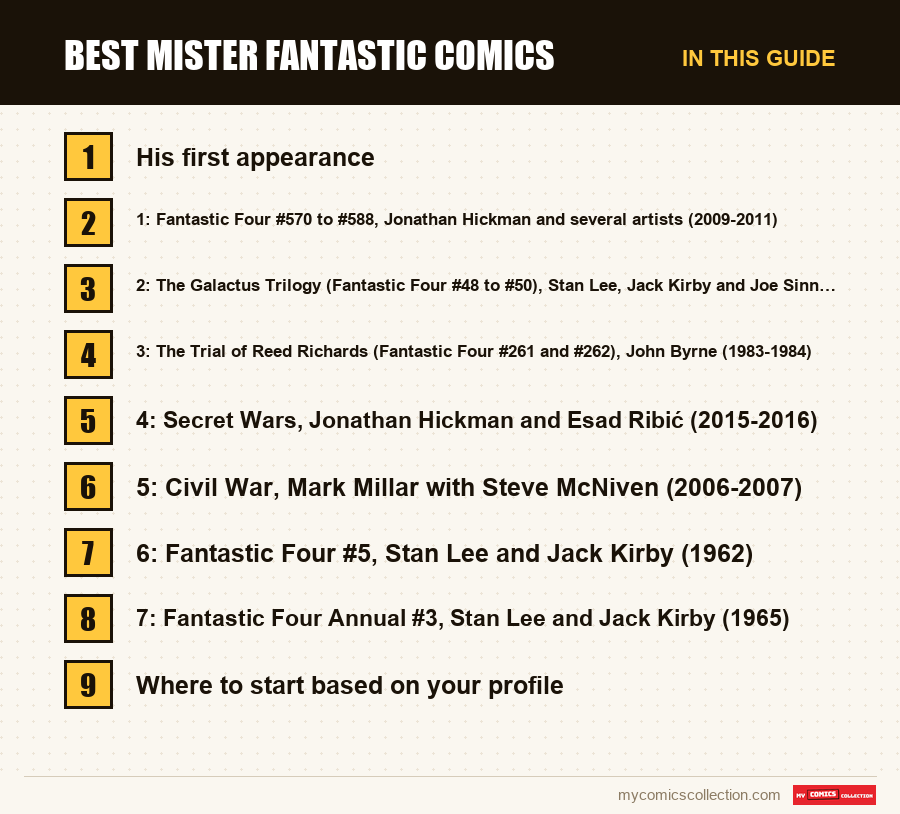
5: Civil War, Mark Millar with Steve McNiven (2006-2007)
Seven issues, with Mark Millar on script and Steve McNiven on art. Reed is one of the leaders of the pro-registration camp, alongside Tony Stark, and he helps build a prison in the Negative Zone to hold those who refuse the law. The idea is uncomfortable: the man who wanted to protect the future becomes the one who locks people up.
What the story adds is a portrait of Reed as a man of calculation, convinced the numbers prove him right. It is for the reader drawn to the idea of a fallible hero, including one who does not know the Fantastic Four: you can read it for the politics of superheroes as much as for the character.
Note that this is an ensemble story, where Reed shares the spotlight with several figures. Read it after Hickman's run to catch the echo. To place the event's single issues, see the Civil War key issues.
6: Fantastic Four #5, Stan Lee and Jack Kirby (1962)
Fantastic Four #5, cover-dated July 1962, is the entrance of Doctor Doom. Lee writes, Kirby draws. The story ties Reed to the man who would become his most enduring rival. For Reed, it is a dark mirror: a scientist as brilliant as he is, who decided not to hold back.
What it adds is the ground on which the whole rivalry will be played out. Origin-story readers and first-appearance hunters get their money's worth. It reads quickly and rewards a second look after Secret Wars. The article on this issue details its role as a landmark for enthusiasts.
7: Fantastic Four Annual #3, Stan Lee and Jack Kirby (1965)
Dated July 1965, this annual issue is the one with the wedding of Reed and Sue Storm. Stan Lee writes, Jack Kirby draws. The story marks a turning point in the character's life: the team becomes a family, and the series becomes a story about what that means.
It is for those interested in the emotional side of the series and for the Silver Age fan. Read it after the Galactus Trilogy, since it assumes the reader already knows the bonds among the four heroes. Sue's life is covered in the guide to the best Invisible Woman comics, and Johnny's in the one on the Human Torch.
Where to start based on your profile
If you want the contemporary Reed, open Hickman's run, from Fantastic Four #570 to #588, then continue with Secret Wars. You will have a complete arc, from ambition to resolution.
If you prefer the classics, read the 1966 trilogy, the 1965 wedding, then "The Trial of Reed Richards." You will see the character go from gang leader to family man, then to the accused.
If you follow the series in order, start from the reading guide and slot these landmarks in at the right dates. If you collect, favor the founding issues: the 1961 #1, the 1962 #5 and the 1965 Annual #3.
The key issues to know
Here are the single issues that mark out Reed Richards' history. Values are not listed here; to price a single issue, compare recent sales of comparable copies rather than relying on one isolated listing.
- Fantastic Four #1 (1961): first appearance of Reed Richards, by Lee and Kirby.
- Fantastic Four #5 (1962): Doom enters the series.
- Fantastic Four Annual #3 (1965): the wedding to Sue Storm.
- Fantastic Four #48 to #50 (1966): the Galactus Trilogy.
- Fantastic Four #262 (1984): Reed's trial, by Byrne.
- Civil War (2006-2007): Reed in the registration camp.
- Fantastic Four #587 and #588 (2011): the death of the Human Torch and the series' last issue.
- Secret Wars #9 (2015-2016): Reed and Doom at the resolution.
An older single issue is judged by its cover, its spine and its pages; a recent one, by its corners and its printing notice. Check which series you are looking at: several volumes have carried the title Fantastic Four, and issues #570 to #588 belong to Hickman's run.
Frequently asked questions
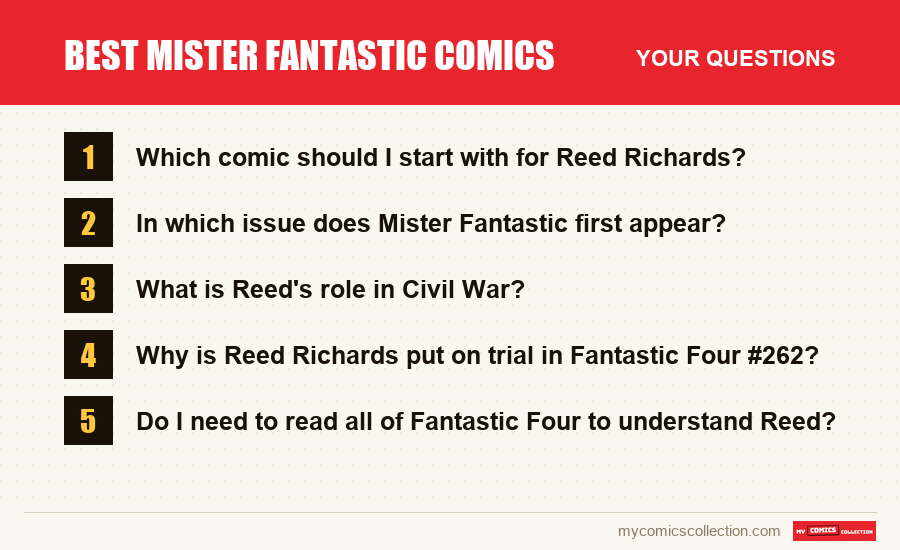
Jonathan Hickman's run, from Fantastic Four #570 to #588 (2009-2011), is the right starting point. It reads without prior knowledge and stages the idea that defines Reed: wanting to solve everything. If you prefer a classic, the Galactus Trilogy (#48 to #50, 1966) offers a complete story by Stan Lee and Jack Kirby.
In Fantastic Four #1, cover-dated November 1961, by the Lee and Kirby duo. The character is the team's leader there. His marriage to Sue Storm comes later, in Fantastic Four Annual #3, dated July 1965.
Reed is one of the leaders of the pro-registration camp, with Tony Stark. He helps create a prison in the Negative Zone for heroes who refuse the law. The limited series has seven issues, published in 2006-2007.
Because he spared Galactus during his last attempt to devour Earth, which gets him tried by a galactic tribunal. John Byrne writes and draws the story, published in 1983-1984 in issues #261 and #262. It reads better after the 1966 Galactus Trilogy.
No. Seven stories are enough to draw his portrait, from 1962 to 2016. Pick a modern entry point, like Hickman's run, then work back to the classics by Lee, Kirby and Byrne. The series reading guide will help you place each step.
Do you own a 1960s issue of Fantastic Four or a single issue from Hickman's run? Have its condition and value appraised.
Appraise my comic