
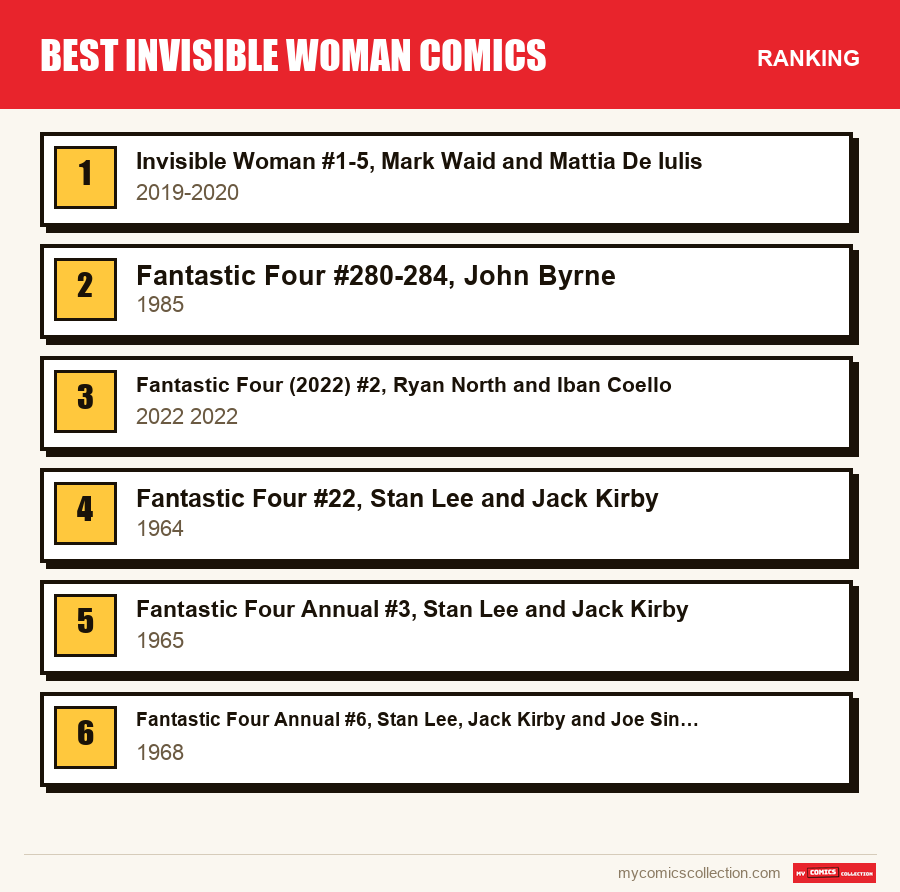
To find the best Invisible Woman comics, start with the miniseries Invisible Woman (five issues, 2019-2020) by Mark Waid and Mattia De Iulis, then read Fantastic Four #280 to 284 (1985) by John Byrne. Susan Storm bursts onto the scene as Invisible Girl in the opening of Fantastic Four (late 1961), conceived by Stan Lee and Jack Kirby; she takes the name Invisible Woman in issue #284.
Sue Storm is the character whose name best tells the story of her evolution: twenty-four years separate the invisible "girl" of 1961 from the invisible "woman" of 1985, and her powers changed in nature in between. Here is a ranking of six stories where Sue plays the central role, with what each one brings, who it suits and how to read it.
As always in this guide, only verified facts (creators, issue numbers, dates) are stated as fact; the analysis is our own, with no reproduction of protected art or dialogue.
Her first appearance
Susan Storm debuts with the series itself, in Fantastic Four #1: the cover reads November 1961, with Lee on the script and Kirby on the pages. She is one of the four passengers of an experimental rocket struck by cosmic rays, along with Reed Richards, her brother Johnny and Ben Grimm. Her power is then invisibility, and the name she goes by is Invisible Girl. The founding issue is dissected in the page on the first appearance of the Fantastic Four.
The name changes in issue #284, dated November 1985, written and drawn by John Byrne: Sue adopts the name Invisible Woman there, which she keeps afterward. The thread between the two dates runs through a wedding (1965) and a birth (1968), which this guide covers in its entries. So hold on to this landmark: Invisible Girl before issue #284, Invisible Woman from then on, which helps you identify an issue and read a catalog listing.
This name change is not cosmetic. In 1961, Lee and Kirby give her invisibility as her only power, and force fields don't appear until issue #22; Byrne, twenty years later, puts her confidence and the versatility of her abilities up front. Reading Sue means following a rebalancing that each generation of creators has pursued in its own way, and the ranking below follows reading interest rather than publication order: the recent entries serve as a way in, the 1960s issues as a deeper dive for anyone who wants to go back to the sources.
1: Invisible Woman #1-5, Mark Waid and Mattia De Iulis (2019-2020)
This miniseries opens the most direct path to the character. Five issues, the first out in July 2019 and the last dated January 2020, collected in the trade paperback Partners in Crime. Mark Waid writes, Mattia De Iulis draws, Adam Hughes does the covers. The trade paperback Partners in Crime gathers all five issues, which saves you from hunting down single issues one by one if you are reading mainly for the story. Far from the team, Sue runs an espionage mission for S.H.I.E.L.D. here.
The story suits the reader who wants a central character, with no prior knowledge of forty years of history. It reads in the trade paperback, in issue order, and its short format makes it a good test: if you like the character in this solo version, the next entries will lead you to her sources. The appeal is seeing Sue carry an entire plot by relying on her own skills rather than the team's.
2: Fantastic Four #280-284, John Byrne (1985)
This is the character's turning point. Over five issues from 1985, July to November, John Byrne pits Sue against Malice, a dark personality that is born in issue #280, under the influence of Psycho-Man's manipulations. The story concludes in issue #284, where Sue takes the name Invisible Woman. Byrne writes, draws and handles the whole period, which stretches from issue #232 to issue #293.
This read suits the reader who wants the moment the heroine stops being a teammate and becomes one of the pivots of the series. It reads without prerequisites inside Byrne's run, but better with a few earlier issues under your belt to know the ties between Sue and Reed. Plan to start at issue #280 and keep going through #284 without skipping an issue: the arc is continuous, and the name change only carries weight if you have followed what precedes it. To gauge where these issues sit in his body of work, read John Byrne: where to start.
3: Fantastic Four (2022) #2, Ryan North and Iban Coello (2022)
In this series launched in November 2022, the second issue follows Reed and Sue in a diner, then in an adventure revolving around Doombots, those robots in the image of Doctor Doom. The text is presented from Sue's point of view, as a letter addressed to Jennifer Walters, a former member of the team. Ryan North writes, Iban Coello draws the series launch.
It suits the reader who wants a recent, light and readable way in: the issue is self-contained, and it shows Sue as the voice of the couple and the team more than as a fighter. It is a complementary read to the 2019 miniseries, which stresses action. The first issues of the series, incidentally, rotate the featured characters: issue #1 is turned toward Ben Grimm and Alicia Masters, issue #2 toward Reed and Sue, issue #3 toward the Human Torch, before the team comes together in issue #4. Reading all four in a row gives a complete picture of the modern team.
4: Fantastic Four #22, Stan Lee and Jack Kirby (1964)
Issue #22, cover-dated January 1964, features the Mole Man and marks a milestone for Sue: she learns to make other objects invisible, to produce force fields and to fire psionic blasts. In this story, it is a force field placed around a trigger button that holds back the villain's trap. Stan Lee writes, Jack Kirby draws.
This issue speaks to the Silver Age collector as much as to anyone looking for where Sue's power comes from. The issue reads without knowing the earlier ones, and the presence of the Mole Man makes it a transitional episode: the threat is classic, but Sue's power comes out of it transformed. Its main value is as a marker that the power that defines Sue today was not the one from the beginning. Our page on the key issues of the Silver Age Fantastic Four places it within the Lee and Kirby period.
Do you collect this series?
Track what you own, what you are missing and what your collection is worth. 7-day trial.
Start my trial →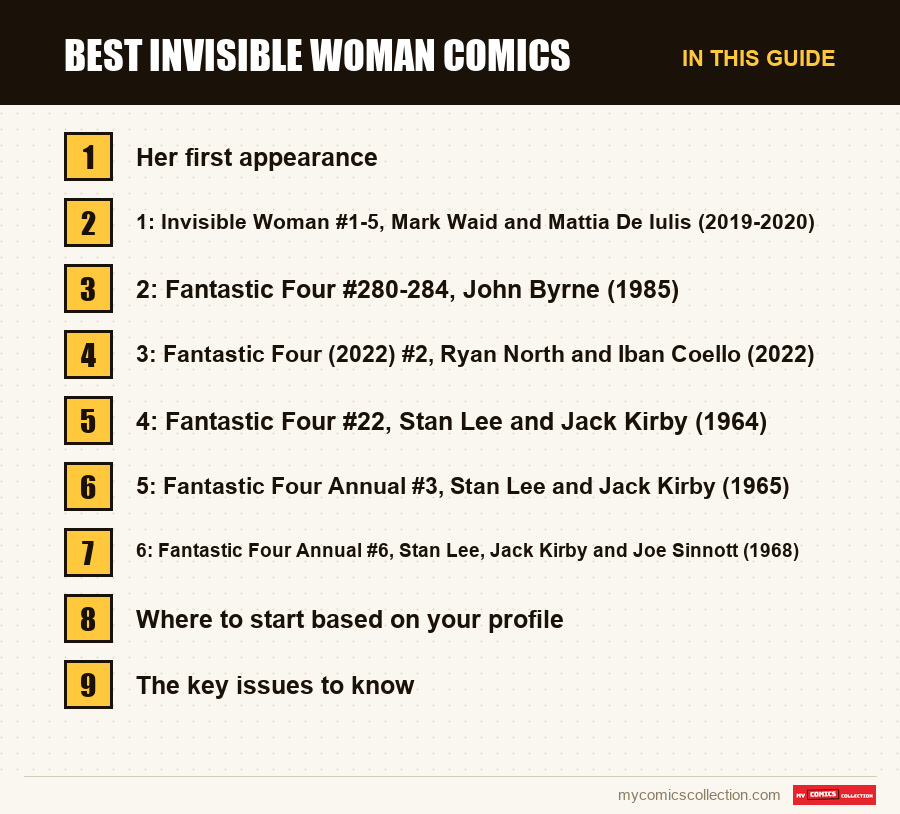
5: Fantastic Four Annual #3, Stan Lee and Jack Kirby (1965)
The 1965 annual stages the wedding of Reed Richards and Sue Storm. Stan Lee writes, Jack Kirby draws. The wedding plan had been announced several issues earlier, and the issue brings in many guests from the Marvel world, while Doctor Doom tries to ruin the ceremony. It makes Sue Richards a married character, which matters for the whole rest of her trajectory. The ceremony gathers many characters of the Marvel universe around the newlyweds, which makes it a celebration issue as much as a couple's story, and a good indicator of how Lee and Kirby handle their events.
It suits the reader who likes Silver Age events and the annuals collector. The story is self-contained and requires no follow-up. Annuals and their own numbering are explained in key annuals and specials.
6: Fantastic Four Annual #6, Stan Lee, Jack Kirby and Joe Sinnott (1968)
This annual, cover-dated November 1968, tells of the birth of Reed and Sue's child, who will later be named Franklin. Stan Lee writes, Jack Kirby draws and Joe Sinnott inks. The issue also introduces Annihilus and his cosmic control rod, an adversary who will return in the series.
This entry suits the reader interested in the Richards family and the one chasing Annihilus's debut. It is self-contained and does not require detailed knowledge of the team. To follow the child as he grows into a character, our page on Valeria Richards and Doctor Doom extends the family line.
Where to start based on your profile
You want a character at the center and a short story: read Invisible Woman (2019-2020) in the trade paperback. You are looking for the pivotal moment: take Fantastic Four #280 to 284. You like a recent read with no prerequisites: open issue #2 of the 2022 series. You collect the Silver Age: aim for issue #22 and annuals #3 and #6.
If you are discovering the Fantastic Four through Sue, a simple order works: the 2019 miniseries for the hook, Byrne's run for depth, then the Lee and Kirby sources. To widen out to the whole team, our page on the key modern Fantastic Four issues offers a broader path.
One last case: you come from the movies and want to know what Sue does on the page. Start with the 2019 miniseries, which puts her at the heart of the story, then issue #2 of the 2022 series, which shows her as half of a couple. These two reads take little time and give you two faces of the character before diving into the Silver Age.
The key issues to know
For the character's identity, remember Fantastic Four #1 (November 1961), Fantastic Four #22 (January 1964) for the broadening of her powers, Fantastic Four #280 (1985) for the appearance of Malice and Fantastic Four #284 (November 1985) for the name Invisible Woman. Annuals #3 (1965) and #6 (November 1968) fix the wedding and the birth, the latter also containing the introduction of Annihilus.
On the modern side, Invisible Woman #1 (2019) is the entry point to the recent collection. In every case, check the cover date, determine the original print run and the reprints, then cross-check several completed sales before judging a listing. For 1965, the condition of the paper and the staples decides; for 2019, it is identifying the right variant.
Two precautions specific to these titles. The annuals have their own numbering, separate from the monthly series: Annual #3 is not issue #3 of Fantastic Four, and the mix-up costs you at purchase. Annual #6 has also been reissued as a facsimile: check the printing notice and the cover date before concluding that you are holding a 1968 copy.
Frequently asked questions
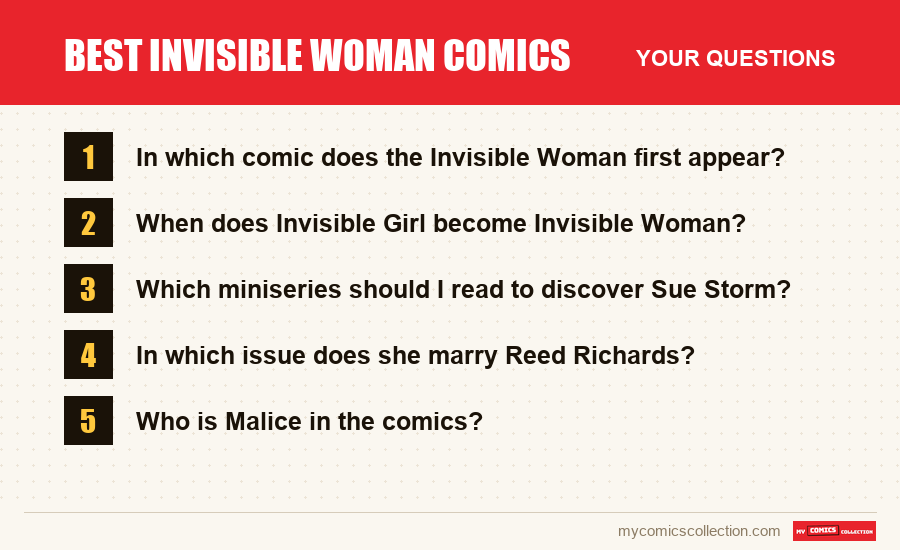
In Fantastic Four #1, published with a November 1961 cover date by Lee and Kirby. Susan Storm is one of the four rocket passengers exposed to cosmic rays there, and goes by the name Invisible Girl. Her power is then limited to invisibility, and it takes until issue #22, from January 1964, to see force fields appear.
In Fantastic Four #284, cover-dated November 1985, written and drawn by John Byrne. Sue adopts the name Invisible Woman there and keeps it afterward. The earlier issues, from 1961 to 1985, use the name Invisible Girl. For a catalog listing, this landmark lets you date an issue at a glance.
Take Invisible Woman, five issues written by Mark Waid and drawn by Mattia De Iulis, from 2019 to 2020, with covers by Adam Hughes. The trade paperback is titled Partners in Crime. It follows Sue as a S.H.I.E.L.D. secret agent and reads with no prerequisites.
Annual #3 of Fantastic Four, published in 1965, with Lee on the script and Kirby on the art. Doctor Doom tries to disrupt the ceremony there. Annual #6 from 1968 then tells of the birth of their child, and it also introduces Annihilus.
Malice is a dark personality of Sue's, born in Fantastic Four #280, in 1985, from the pen of John Byrne. She comes out of Psycho-Man's manipulations, and the arc closes in issue #284, where Sue becomes Invisible Woman. Reading issues #280 to 284 in a row is enough to understand the story.
Do you own a Fantastic Four from the Byrne era or an annual from the 1960s? Get it appraised before you shelve it.
Appraise my comic