Mirror Master is a name worn by two men, and the best Mirror Master comics to start with depend on which one you want. For Evan McCulloch, the Scottish mercenary, open The Flash vol. 2 #212 (2004), by Geoff Johns and Steve Cummings, which tells his past. For Sam Scudder, the Silver Age thief, read the Broome and Infantino duo in The Flash single issues #105, #136 and #146. Add The Flash vol. 2 #133 (1998) to see McCulloch face Wally West.
In the Flash's rogues gallery, Mirror Master is the hardest to pin down, because the name changes hands. A convict who learns to wield mirrors in the 1950s, then a Scottish hitman who inherits his gear thirty years later: two psychologies, two eras, two families of stories. This guide separates them, ranks seven stories, and says for each one who it is for and how to approach it.
As always in this guide, only verified information (creators, issues, dates) is stated as fact; the analysis is our own, with no reproduction of protected art or dialogue.
Two Mirror Masters, one gallery
Before choosing a story, fix the distinction that structures everything else. Scudder is the Silver Age: Broome and Infantino invent him in The Flash #105, whose cover carries the year 1959. Evan McCulloch is the modern Mirror Master: he is born in Animal Man #8, cover-dated February 1989, by Grant Morrison and Chas Truog, and takes over his predecessor's costume and gadgets.
The Scudder stories read like colorful crime capers in which a mirror thief challenges Barry Allen. McCulloch's are aimed at a reader looking for a darker profile, shaped by an orphanage past and a mercenary career, who gets mixed up with the Rogues of the Wally West era. When a summary says "Mirror Master" without further detail, always check the era of the series: before 1989, it is Scudder; after, most often, McCulloch.
His first appearance
Sam Scudder appears in The Flash #105, whose cover carries the date February-March 1959. The story is titled "Master of Mirrors!": John Broome writes it, Carmine Infantino pencils it and Joe Giella inks it. The starting idea is simple and effective: a convict discovers that a badly painted mirror holds and projects three-dimensional images, and turns it into a burglar's weapon.
Evan McCulloch, for his part, appears in Animal Man #8, "Mirror Moves," cover-dated February 1989. Grant Morrison writes, Chas Truog draws and Doug Hazlewood inks. It is not an issue of Flash: he enters the lightning mythology through another door, which surprises the collector who expects to find him in the scarlet hero's series.
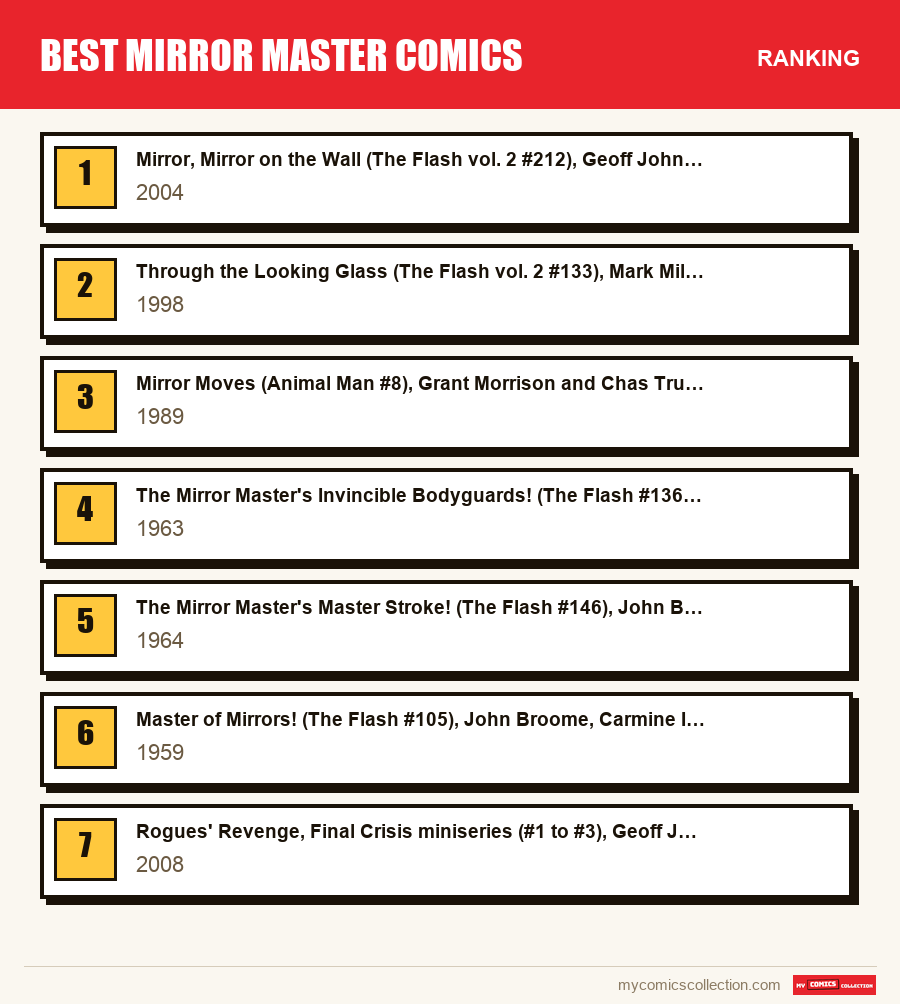
1: Mirror, Mirror on the Wall (The Flash vol. 2 #212), Geoff Johns and Steve Cummings (2004)
This is the best entry point for McCulloch, and the reason lies in its setup: one issue, one narrator, one central character. Geoff Johns writes, Steve Cummings draws and Wayne Faucher inks. Federal agents, sent by the Trickster, try to recover Mirror Master's costume and gadgets; he traps them one by one in the mirror dimension and, meanwhile, recalls his life.
What the issue brings to the character is considerable. We follow a child from a Scottish orphanage who kills a brutal schoolmate, then an adult recruited by a government agency as a mercenary, who receives the original Mirror Master's equipment to give a supervillain face to his missions. The story ends with his return among the Rogues. In twenty-two pages, McCulloch stops being a costume and becomes someone.
No prerequisites: this single issue is enough to size up McCulloch, whatever your familiarity with the series. How to read it? Alone, first, then follow up with the 1998 and 2008 stories. This issue is markedly darker than Scudder's adventures, a point to keep in mind for a young reader.
2: Through the Looking Glass (The Flash vol. 2 #133), Mark Millar and Grant Morrison, Paul Ryan (1998)
Cover-dated January 1998, this issue pits McCulloch directly against Wally West. Mark Millar and Grant Morrison co-write the script, Paul Ryan pencils and John Nyberg inks. Mirror Master traps Linda Park in an inverted dimension, and Wally has eleven minutes to reach her by crossing a series of obstacles: a prism, a double of himself made of mirror, a replica of Keystone City.
The story's strength is its readability. It is a race against the clock, built like a puzzle: Mirror Master is the architect of a course there, not a mere gunman, and Wally has to read the trap before crossing it. The issue concludes with the criminal locked in a cell without light, which gives a clear picture of what the series thinks of mirror powers: no light, no reflection.
It is for the reader who already knows the character from issue #212 and wants to see him at work against the Flash of the day. One detail for the collection: the signature of Morrison, the character's creator, finds his hero again nine years after Animal Man. The page on Grant Morrison lists his other work.
3: Mirror Moves (Animal Man #8), Grant Morrison and Chas Truog (1989)
Going back to McCulloch's source means reading this February 1989 issue, drawn by Chas Truog and inked by Doug Hazlewood. Mirror Master appears there as an adversary, in a series whose hero is nothing like a super-speedster. The mismatch is precisely what makes the object interesting: the character is conceived outside the Flash universe, before the Rogues claim him.
This story is mostly for the reader who has followed Grant Morrison since his early American work. It does not replace issue #212 for understanding McCulloch, who has no biography yet: read it afterward, as an origin curiosity.
For the collector, the distinction is useful: this first appearance belongs to the Animal Man series, not to The Flash. A buyer looking for "the first appearance of Mirror Master" must therefore specify which one, or risk confusing the two eras.
4: The Mirror Master's Invincible Bodyguards! (The Flash #136), John Broome, Carmine Infantino and Joe Giella (1963)
Cover-dated May 1963, this issue gives Scudder the role of the story's main villain: he breaks out of prison to commit big heists, aiming to climb the rankings of a prison newspaper. Broome writes, Infantino pencils, Giella inks; the cover is penciled by Infantino and inked by Murphy Anderson, under the editorial direction of Julius Schwartz. The single issue contains a second Barry Allen story, unrelated to Mirror Master, as was the series' custom.
What this story brings is a vision of Scudder in top form: a vain criminal, concerned about his reputation among his peers, in an era when the series villain did not need a trauma to exist. The mainspring, a prestige competition between inmates, gives the villain a vanity that darker stories do not exploit.
It is for the Silver Age fan and reads after the 1959 source. To place it within the series, see the analysis of the Flash in the Silver Age.
Do you collect this series?
Track what you own, what you are missing and what your collection is worth. 7-day trial.
Start my trial →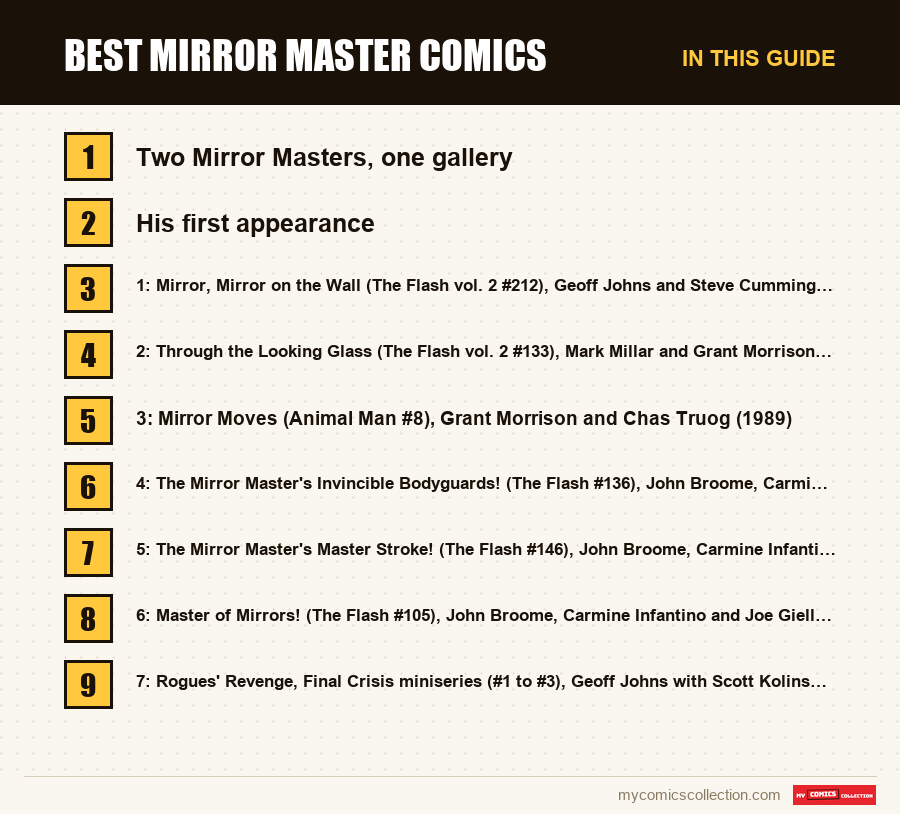
5: The Mirror Master's Master Stroke! (The Flash #146), John Broome, Carmine Infantino and Joe Giella (1964)
In this issue cover-dated August 1964, Mirror Master takes on the Flash with a ruse worthy of its title: the issue's teaser text announces that he steals his legs and, with them, his speed. John Broome signs the story, Carmine Infantino the pencils and Joe Giella the inks, under the direction of Julius Schwartz. The cover is penciled by Infantino and inked by Murphy Anderson.
The interest lies in seeing an adversary turn against the hero the very thing that defines him. Rather than a battle, it is a reversal of situation that resembles a logic problem: how does a runner without legs stop a thief? The issue's second story, written by Gardner Fox, is a separate adventure, unconnected to Mirror Master.
It suits whoever enjoyed issue #136 and wants a second example of how Broome put his villains to work. Read it right after. If the Silver Age appeals to you, the portrait of the Flash's creators places Broome and Infantino in the history of the series.
6: Master of Mirrors! (The Flash #105), John Broome, Carmine Infantino and Joe Giella (1959)
Scudder's source reads in a few minutes and has lost none of its clarity. A convict discovers a strange property of a badly painted mirror, and instantly understands what a thief can do with it. This narrative efficiency, a discovery, a weapon, a stage name, is typical of the early Silver Age at DC, where a single idea was enough to found a character.
It ranks sixth because reading it assumes a taste for the history of the genre: the story delivers the character's invention and Infantino's art, not the psychological depth modern writers will give McCulloch. It is for the collector of first appearances and the historian of the medium.
A neighboring single issue, The Flash #109, cover-dated October-November 1959, contains "Return of the Mirror Master!", by the same Broome, Infantino and Giella: Scudder escapes from prison and launches into a series of crimes. The two single issues form a coherent pair for whoever wants to follow the character's beginnings.
7: Rogues' Revenge, Final Crisis miniseries (#1 to #3), Geoff Johns with Scott Kolins (2008)
Three single issues are all Johns, on script, and Kolins, on art, need to graft this miniseries onto the Final Crisis event. Implicated in the death of Bart Allen, the Rogues seek to disappear; Libra summons them to his secret society, they decline, and it is the thirst for revenge that sets them in motion again. Mirror Master, in the Evan McCulloch version, is part of the band, but he is not the protagonist: it is an ensemble story.
It ranks last for that reason. It shows McCulloch integrated into the Rogues, in their role as professionals who refuse to bend to a cause, but the character shares the billing with his accomplices. It therefore reads as a conclusion, after you have understood who he is thanks to issue #212.
It is for whoever wants to see the Rogues as a team, and who likes events readable in one evening. For the leader of the gang, the guide to the best Captain Cold comics gives the stories where he takes center stage.
Where to start based on your profile
If you are looking for the contemporary Mirror Master, open The Flash vol. 2 #212, then read issue #133, then the 2008 miniseries. You will have the biography, the duel and the ensemble in three steps.
If you prefer the Silver Age, read The Flash #105, #109, #136 and #146 in that order: four issues by Broome and Infantino, four facets of Scudder, from invention to cunning.
If you follow the Flash in order, start from the Flash reading guide and slot these landmarks into the right eras. If you collect, distinguish the two characters from the outset: Scudder's first appearance is in The Flash #105, McCulloch's in Animal Man #8.
Key issues to know
Here are the single issues that mark Mirror Master's history. No price is quoted here: compare several recent sales of equivalent copies before estimating yours.
- The Flash #105 (1959): first appearance of Sam Scudder, by Broome and Infantino.
- The Flash #109 (1959): "Return of the Mirror Master!", his comeback as the lead villain.
- The Flash #136 (1963) and #146 (1964): two stories where Scudder plays the main adversary.
- Animal Man #8 (1989): first appearance of Evan McCulloch, by Morrison and Truog.
- The Flash vol. 2 #133 (1998): the duel against time, by Millar, Morrison and Ryan.
- The Flash vol. 2 #212 (2004): his past, told by Johns and Cummings.
- Blackest Night: The Flash #1 (February 2010): Scudder returns there as a Black Lantern.
The buying method is the same for both eras. For the Silver Age, examine the cover, the spine and the completeness of the pages; for a modern single issue, look at the corners and the printing notice. Before any purchase, check the series and the numbering: the list above crosses volume 1 and volume 2 of The Flash.
To follow the series as a whole, the page of Flash key issues places these single issues within the major eras.
Frequently asked questions
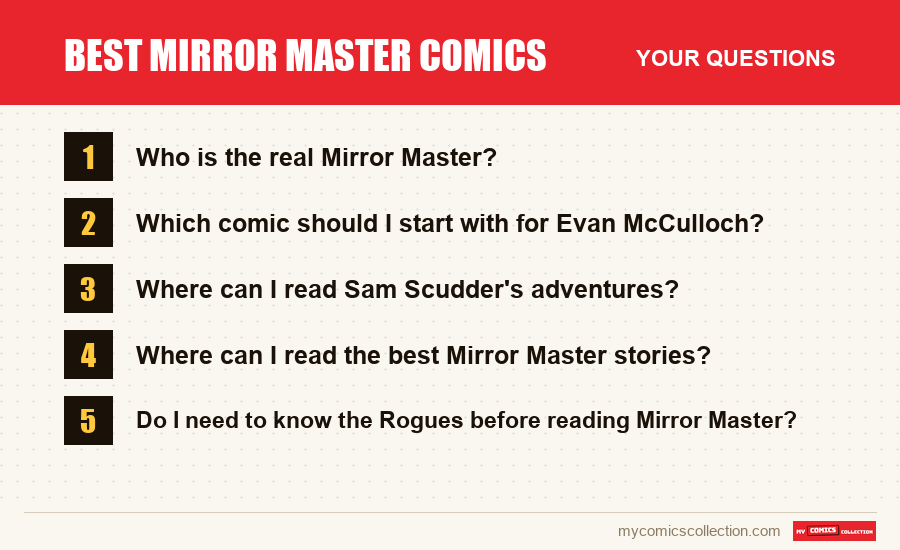
Both are, in different eras. Sam Scudder is the original Mirror Master, created by John Broome and Carmine Infantino in The Flash #105 in 1959. Evan McCulloch is his successor, created by Grant Morrison and Chas Truog in Animal Man #8 in 1989. Each has his own stories, and reading them separately avoids a lot of confusion.
Start with The Flash vol. 2 #212, by Geoff Johns and Steve Cummings (2004). The issue follows McCulloch alone, traces his childhood in a Scottish orphanage and his recruitment as a mercenary, and reads with no prerequisites. Continue with issue #133 from 1998, then with the miniseries Final Crisis: Rogues' Revenge.
In the original The Flash series, for example in issues #105 and #109 (1959), #136 (1963) and #146 (1964), all by John Broome and Carmine Infantino with Joe Giella on inks. These are short stories, published with a second story in the same single issue, which makes for a quick read.
They are spread between The Flash, Animal Man for McCulloch's initial appearance, and events like Final Crisis: Rogues' Revenge. You therefore have to follow a path of selected issues rather than a single collection, as this ranking suggests.
No, for issues #212 and #133, which focus on the character. It is useful, however, to know the gang before the 2008 miniseries, where Mirror Master shares the billing with his accomplices. The guide to Captain Cold, leader of the Rogues, is then a natural companion.
Do you own a Silver Age issue of The Flash or a first appearance of Mirror Master? Get its condition and value estimated.
Estimate my comic