
The best Booster Gold comics start with Booster Gold #1 (February 1986), where Dan Jurgens created him. For where to start, open the 2007 series' first arc by Geoff Johns and Jeff Katz, then go back to issue #1 of 1986, move on to Keith Giffen, J.M. DeMatteis and Kevin Maguire's Justice League (1987), then the comedy Formerly Known as the Justice League (2003) and Time Masters: Vanishing Point (2010).
Booster Gold is the exact opposite of the hero who saves the world out of a sense of calling: a man from the future who steals gadgets from a museum to become a celebrity in the present. That starting idea, funny and a little cynical, took twenty years to find its real subject, which is time travel in the service of a hero nobody takes seriously. Seven reads, from 1986 to 2011, trace that path.
As always in this guide, we only state verified information (creators, issue numbers, dates); the analysis is ours, with no reproduction of protected artwork or dialogue.
His first appearance
Booster Gold debuts in Booster Gold #1, cover-dated February 1986, written and drawn by Dan Jurgens. He bursts onto the scene right after Crisis on Infinite Earths, while the publisher was rebuilding its universe; Jurgens, for his part, wanted to apply to a crimefighter the reflex of champions who cash in an Olympic medal for endorsement deals. His hero comes from the future and uses what he stole there to build a career in the present.
Issue #1 is the obvious entry point for a collector. Michael Jon Carter, joined by the robot Skeets in his later adventures, is an unapologetic opportunist here, and the 1986 series, which runs 25 issues, plays the card of celebrity satire rather than that of epic. The condition of issue #1 matters more than the price of the moment: an intact spine and sharp corners are worth more than any reprint from the same era.
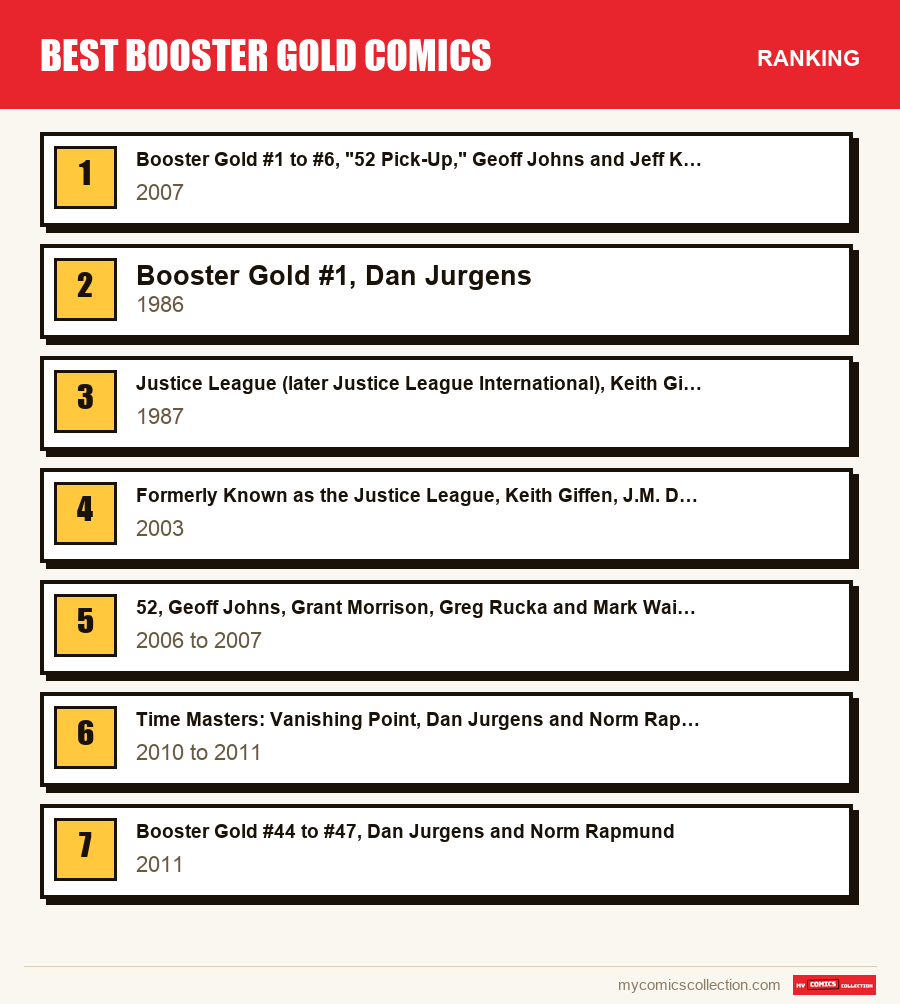
1: Booster Gold #1 to #6, "52 Pick-Up," Geoff Johns and Jeff Katz, with Dan Jurgens and Norm Rapmund (2007)
This is the best way in. In the wake of 52, DC handed Johns and Katz a new series whose opening arc, "52 Pick-Up," sets up the mission that defines the character: protecting the timeline from those who would change it. Booster becomes a hero who saves history without anyone knowing, which at last gives meaning to his need for recognition.
Johns and Katz leave the series after twelve issues, and Dan Jurgens stays on with Norm Rapmund. A complete beginner can dive in: one piece of information is enough, namely that Booster is a second-tier hero who arrived from the future. Read the six issues together; the later arcs, including the one the collection titled Blue and Gold gathers around the duo with Ted Kord, then become more enjoyable.
2: Booster Gold #1, Dan Jurgens (1986)
This issue is the source, and it reads in a few minutes. Jurgens lays out the essentials: the museum of the future, the temptation of easy fame, the false bravery and the real fragility of the character. The deliberately light tone makes you smile today as much for its ideas as for the art style of the era, but it explains why readers agreed to follow such a self-interested hero.
Go after it if you want to grasp the hero's genesis, or if you are hunting for the benchmark copy for your shelf. To read it in good conditions, treat issue #1 as a prologue and then move on to the 2007 series, which has the advantage of taking up its principles and giving them a purpose. If you want to keep going with the 1986 series, keep in mind that it runs 25 issues and that its tone stays closer to comedy than to adventure.
3: Justice League (later Justice League International), Keith Giffen, J.M. DeMatteis and Kevin Maguire (1987)
The series begins with an issue #1 dated May 1987, for which Keith Giffen supplies the plot and layouts, J.M. DeMatteis the script, Kevin Maguire the art and Terry Austin the inks. The assembled team is offbeat: you meet second-tier heroes, among them Blue Beetle (Ted Kord), and Booster Gold joins the group shortly after its launch. Office comedy, budgets and everyone's touchiness become the subject, and Booster is one of its engines.
The series then takes the title Justice League International starting with issue #7. It suits anyone who wants to see Booster in his natural element, surrounded by characters who can barely stand him. To measure what this period gave his on-screen companion, read our feature on Ted Kord on the 1987 team.
4: Formerly Known as the Justice League, Keith Giffen, J.M. DeMatteis and Kevin Maguire (2003)
Six issues of pure comedy, reuniting the creative team of the 1987 series sixteen years later. Maxwell Lord recruits former members of the team, including Blue Beetle and Booster Gold, as well as Elongated Man and Fire, to found the "Super Buddies" in Queens. The result is an affectionate parody of their own history, in which everyone stays true to their original character.
A six-issue sequel followed in JLA: Classified. This read is for anyone who has already tasted the 1987 tone and wants it back. It also works as a light way into the whole group, since the references are explained half-aloud.
Do you collect this series?
Track what you own, what you are missing and what your collection is worth. 7-day trial.
Start my trial →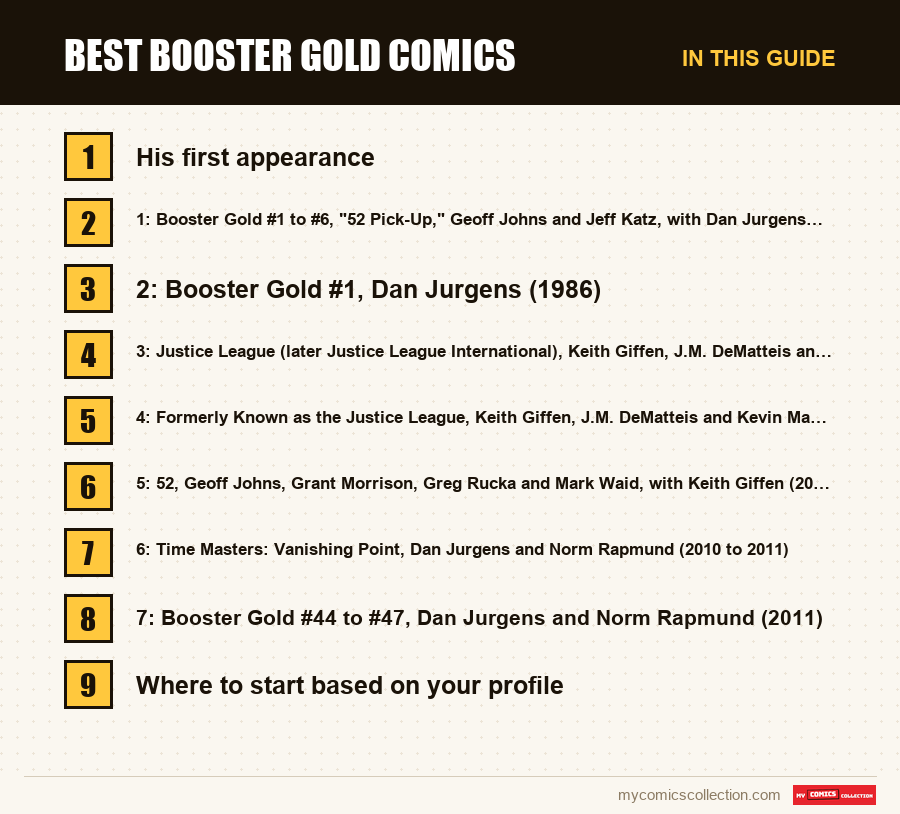
5: 52, Geoff Johns, Grant Morrison, Greg Rucka and Mark Waid, with Keith Giffen (2006 to 2007)
A year-long weekly written by four authors, 52 is where Booster Gold stops being a comedy character. His companion Skeets malfunctions, and Booster finds notes in Rip Hunter's hideout, which sets the stage for his 2007 series. The character's role here is not that of a central hero but of one narrative thread among several, which is why we do not place it higher.
This read is for the reader looking for the transition between the old and the new Booster. Since it is an ensemble story of fifty-two issues, do not read it solely for him; reread the episodes that concern him first, then return to the 2007 series for what follows.
6: Time Masters: Vanishing Point, Dan Jurgens and Norm Rapmund (2010 to 2011)
A six-issue miniseries by Dan Jurgens with Norm Rapmund, tied into the stories about the search for Bruce Wayne. It follows Rip Hunter, whose Vanishing Point base is destroyed, and Booster shares the billing with him. Note that the character is absent from the last issue, which focuses on other figures.
This miniseries will interest the reader who has already read the 2007 series and wants to follow its time-travel stakes. It is less accessible than an arc of the regular series: the context of the period, with Bruce Wayne lost in time, is assumed to be better known. Read it after the first three entries of this ranking.
7: Booster Gold #44 to #47, Dan Jurgens and Norm Rapmund (2011)
The last arc of the 2007 series, these issues cross over with the Flashpoint event: Booster is one of the few characters who remembers the original timeline. Dan Jurgens, returning to the title, and Norm Rapmund wrap up a four-year run by giving it an ending consistent with its themes.
They are for the loyal reader who followed the series and wants the closure. Without that foundation, they lose much of their force. For the event's context, our article on the key issues of Flashpoint will help you place these issues in the bigger picture.
One last practical tip for building your stack: the 2007 series went through several creative teams, Johns and Katz for the opening, then Dan Jurgens and Norm Rapmund, and the tone shifts from one arc to the next. If you buy in volumes, check the list of issues reprinted on the back of each collection, because the collection titled Blue and Gold does not follow strict publication order and some issues, like issue #0, are reprinted separately in it.
Where to start based on your profile
To discover the character with no prerequisites, take the 2007 series and its first six issues: the mission, the tone and the supporting cast are set up clearly. If team humor appeals to you, go straight to the 1987 Justice League and then to Formerly Known as the Justice League: you will see Booster alongside Blue Beetle, and our article on the duo of Ted Kord and Booster Gold develops that relationship.
For the DC universe reader who already knows the major stages, the right sequence runs from 52 to the 2007 series, then to Time Masters and the Flashpoint arc. The collector in a hurry will turn to issue #1 of 1986 and to issue #1 of the 1987 Justice League, the two anchor pieces of the bibliography. To place the team series in time, our history of the Justice League gives the landmarks.
The key issues to know
The first appearance is Booster Gold #1 (February 1986). Issue #1 of Justice League (May 1987) establishes the team in which the character finds his place, and issue #1 of the 2007 series opens the era in which he becomes protector of time. Issues #44 to #47 of that same series, in 2011, tie the character to Flashpoint.
To rank these issues, the method is the same as for any second-tier character: put the birth first, then the relaunches that change his function, and finally the event tie-ins. This hierarchy suits a hero whose bibliography is spread across several decades and several creative teams. To put this period in its editorial context, the feature on Crisis on Infinite Earths describes the overhaul of which Booster is a product.
Frequently asked questions
Booster Gold first appears in Booster Gold #1, cover-dated February 1986. The character was created by Dan Jurgens, who writes and draws that issue. The 1986 series runs 25 issues, and the hero was fresh out of the overhaul of Crisis on Infinite Earths.
Start with Booster Gold (2007), whose first six issues, "52 Pick-Up," are by Geoff Johns and Jeff Katz with Dan Jurgens and Norm Rapmund. They set up the character's mission without requiring prior knowledge. The 1986 series and the 1987 Justice League come next for the origins.
Yes: he joins the team relaunched in 1987 by Keith Giffen, J.M. DeMatteis and Kevin Maguire, whose issue #1 is dated May 1987. The series becomes Justice League International starting with issue #7. There he shares the billing with Blue Beetle (Ted Kord) and several second-tier heroes.
It is not essential, because the 2007 series can be followed without that foundation. But 52 (2006 to 2007), written by Geoff Johns, Grant Morrison, Greg Rucka and Mark Waid, shows Skeets malfunctioning and Booster discovering notes in Rip Hunter's hideout, which gives what follows more depth.
Choose Formerly Known as the Justice League (2003), six issues by Keith Giffen, J.M. DeMatteis and Kevin Maguire, in which Booster Gold and Blue Beetle are recruited by Maxwell Lord to form the Super Buddies. The sequel, published in JLA: Classified, extends that vein for six more issues.
Do you have a copy of Booster Gold #1 or of the 1987 Justice League? Have its condition assessed before deciding whether to keep it or sell it.
Estimate my comic