
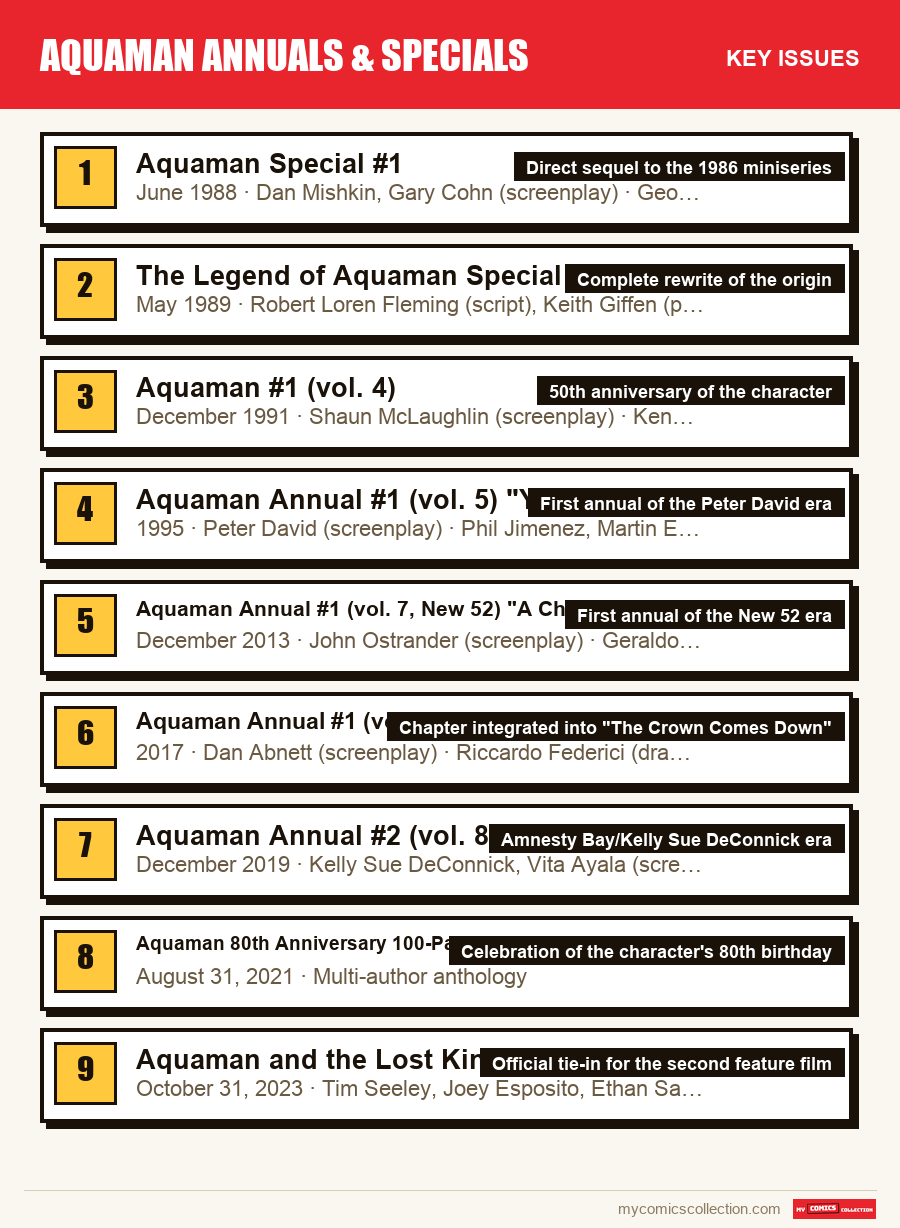
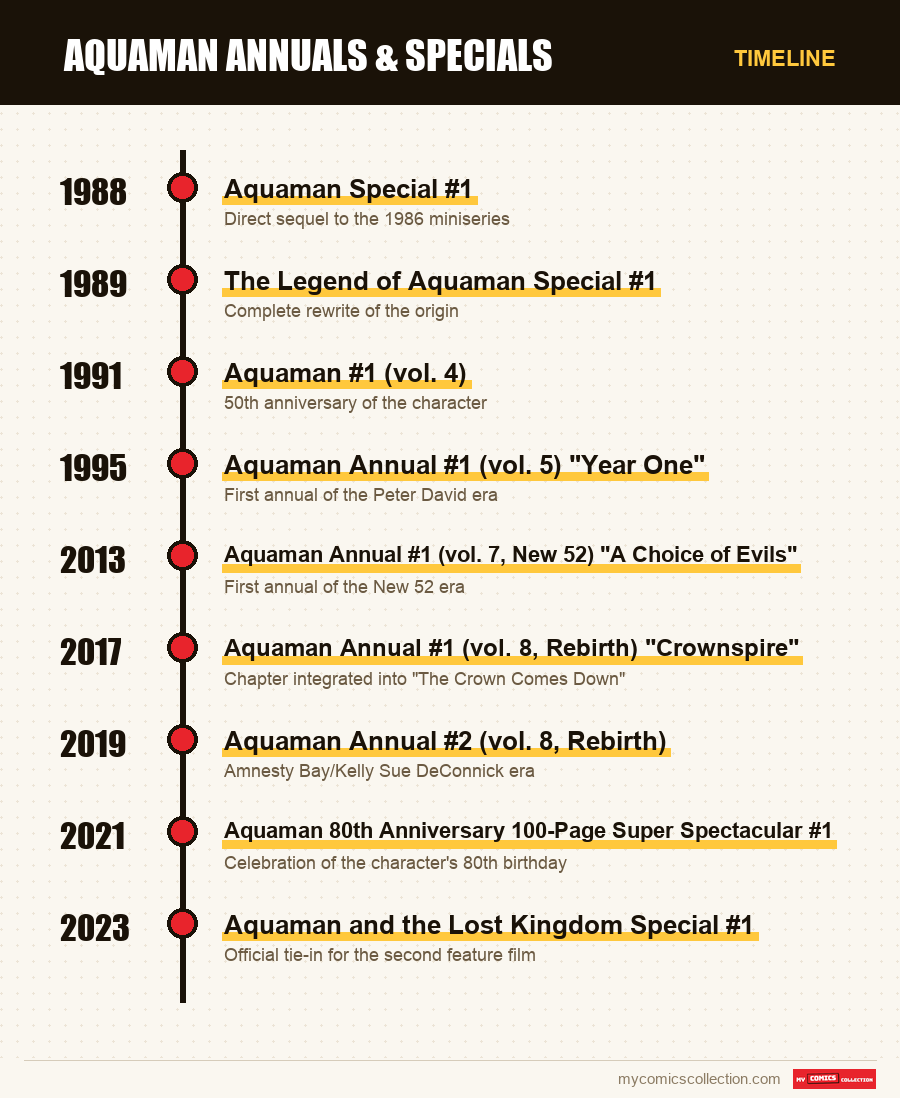
Unlike characters like Batman or Spider-Man, Aquaman has never had an uninterrupted flow of annuals: its production of special editions is spread out in waves, following the relaunches of its parent series (1962, 1986, 1989, 1991, 1994, 2011, 2016) and editorial anniversaries. The most sought after pieces are Aquaman Special #1 (1988), The Legend of Aquaman Special #1 (1989) which rewrites its origin, the four Aquaman Annual of the Peter David era (1995-1998), the Aquaman Annual #1 New 52 (2013) and Aquaman Annual #1 Rebirth (2017) attached to the arc "The Crown Comes Down". These are niche prints, less speculated than the regular series, but dense in narrative content and often underrated compared to their importance in the continuity of The King of the Seas.
Aquaman occupies a special place in the DC Universe: founding hero of the Justice League, star of his own series since 1962, but rarely treated with the same editorial lavishness as Superman or Batman when it comes to special issues. As a result, its annuals and specials form a tight, almost confidential corpus, where each release generally has a real narrative justification rather than a simple commercial pretext. This is precisely what makes it an interesting hunting ground for a collector looking for pieces that are both affordable and significant.
This guide lists the Aquaman Annuals and Specials which really matter in the continuity of the character: those which redefine his origin, which introduce elements of lore still used today, or which accompany major editorial turning points such as the return to classic costume after the era of the harpoon hand, or the Rebirth relaunch. For each, we detail the publication date, the creative team, the release context and what makes it a piece to watch: without putting forward the slightest odds figure which would not be verifiable, the volatility of the niche comics market making any fixed estimate quickly obsolete.
If you're looking to value a specific item you own or covet, the site's valuation tool is based on current eBay listings and remains the most reliable reference for an up-to-date price, rather than a static price guide.
A dotted editorial history: why Aquaman has so few annuals
The first volume of Aquaman (1962-1978, DC) never benefited from an annual during its original publication, unlike flagship titles of the same era which systematically received their giant summer issue from the mid-1960s. It was only from the end of the 1980s, when DC sought to revitalize the character after the cancellation of his regular series in 1978 and several attempts aborted relaunch, that the Sea King begins to receive one-shots and specials thought of as franchise relaunches rather than simple summer supplements. It is in this context that appears Aquaman Special #1 in June 1988, written by Dan Mishkin and Gary Cohn with art by George Freeman and Mark Pacella. This issue is a direct continuation of the mini-series Aquaman of 1986 by Neal Pozner and Craig Hamilton, who introduced the famous blue camouflage suit worn alternately with the classic orange and green jersey. Less than a year later, DC is pushing the rebuilding exercise further with The Legend of Aquaman Special #1 (May 1989), written by Robert Loren Fleming with a plot by Keith Giffen, with Curt Swan on pencils: a one-shot that completely rewrites the character's origin and introduces the mythology of the "Mark of Kordax" still referenced in modern stories.
The 1990s marked the true golden age of Aquaman annuals, driven by two successive relaunches of the parent series: volume 4 (1991-1992) then volume 5 (1994-2001) under the pen of Peter David. Issue #1 of Volume 4, released in December 1991 for the character's 50th editorial anniversary, is storyd by Shaun McLaughlin with art by Ken Hooper and Bob Dvorak, and a cover by Kevin Maguire and Joe Rubinstein: a name familiar to collectors of Giffen/DeMatteis' Justice League "Bwahaha." Then, in 1995, DC launched a wave of “Year One” themed annuals across its entire line-up, and Peter David took the opportunity to deliver four little-known Aquaman origin stories, drawn by a collective including Phil Jimenez, Martin Egeland and Jim Calafiore, in a 60-page issue billed at $3.50: a generous format, well beyond the standard 22 pages of a monthly comic at the time.
After this prosperous period, Aquaman annuals became rare again. We have to wait for the New 52 relaunch to see a return Aquaman Annual #1 in December 2013, written by John Ostrander with Geraldo Borges and Ruy Jose on the drawings, with a cover by Paul Pelletier and Danny Miki. Then Rebirth in turn brings its share of supplements: a Aquaman Annual #1 in 2017 by Dan Abnett and Riccardo Federici, directly integrated into the arc "The Crown Comes Down", followed by a Aquaman Annual #2 in 2019 by Kelly Sue DeConnick and Vita Ayala. Finally, the post-cinematic era is seeing hybrid formats flourish: the anthology Aquaman 80th Anniversary 100-Page Super Spectacular #1 (2021) and the cinema tie-in Aquaman and the Lost Kingdom Special #1 (2023), which clearly show that the "special" format remains, even today, DC's preferred tool to celebrate or accompany a strong moment in the character's career rather than an automatic annual routine.
Aquaman Special #1
Entitled "Spirit & Flesh!", this one-shot directly continues the challenges posed by the 1986 Aquaman mini-series: Arthur Curry must regain the throne of Atlantis usurped by Vulko and face Magus, a scientist of Soviet origin who has released mystical Atlantean forces sealed in four zodiac crystals (Taurus, Capricorn, Gemini, Leo). The story features an Aquaman ready to bet his soul to save the oceans, in direct continuity with the blue camouflage suit introduced by Neal Pozner. It's a relatively little-known milestone in the pivotal period between the Silver Age era and the "Legend of Aquaman" revamp that followed the following year.
The Legend of Aquaman Special #1
This 52-page special thoroughly reworks the origin of the character while retaining most of its Silver Age continuity. We learn that Orin was born to Queen Atlanna and the mysterious mage Atlan in the sunken city of Poseidonis, and that he was abandoned as a baby on the reef of Mercy Reef because of his blond hair, perceived by the superstitious Atlanteans as the "Mark of Kordax". Taken in by a lighthouse keeper who named him Arthur Curry, he grew up unaware of his royal origins. This plot remains the basis of Aquaman's origin used, with variations, in most subsequent stories, including certain elements taken up in the cinema. This is one of the most structuring Aquaman specials of the entire publication of the character.
Aquaman #1 (vol. 4)
Published to mark Aquaman's 50th anniversary, this issue comes at a time when the character has lost everything: his wife, his child, part of his kingdom. The story shows him facing alone an entire fleet of submarines that have come to attack Poseidonis, in a darker tone than the average Silver Age outing. The cover is by Kevin Maguire and Joe Rubinstein, a duo then identified with the cult Justice League run "Bwahaha" by Giffen and DeMatteis, which adds crossover interest for collectors of this period. Volume 4 from which it came, launched the same year, will be one of the shortest relaunch attempts in the series (13 issues), which makes this issue relatively rarely reissued.
Aquaman Annual #1 (vol. 5) "Year One"
In 1995, DC launched a transversal wave of "Year One" annuals across its entire catalog, and Peter David took the opportunity to offer four new stories on the beginnings of Arthur Curry, framed by a linking sequence where raiders from the abyss discover the Atlantis Chronicles. The issue is 60 pages for $3.50, a much more generous format than the monthly standard, with a collective art team including Phil Jimenez, Martin Egeland, Howard M. Shum, Casey Jones, Jake Jacobsen and Jim Calafiore. This is the first of four annuals that David will deliver during his run (1994-1998), a period considered by a large part of the fandom as the modern golden age of the character, particularly for the harpoon hand arc.
Aquaman Annual #1 (vol. 7, New 52) "A Choice of Evils"
We had to wait more than twenty years after the #1 of volume 4 to see the return of an annual format dedicated to Aquaman, in the wake of the critical success of Geoff Johns' New 52 run on the parent series. This 48-page issue, written by veteran John Ostrander (known for Suicide Squad), sends Aquaman to investigate an army of misshapen sea creatures manipulated by an outside entity, with Morgaine le Fay as the antagonist, in the East China Sea. The cover is by Paul Pelletier and Danny Miki, two artists very identified with the New 52 period. It is an issue relatively little commented on upon its release but which fills an editorial void of more than two decades in the annual format of the character.
Aquaman Annual #1 (vol. 8, Rebirth) "Crownspire"
Unlike a simple anecdotal special issue, this annual is directly integrated into the narrative arc "The Crown Comes Down", collected alongside Aquaman (vol. 8) #31-33 in the collection of the same name. The story takes place during the tyrannical reign of Corum Rath, an Atlantean terrorist turned usurper king of Atlantis, during which Aquaman joins the underground resistance to overthrow his reign while Mera battles a mystical illness that can only be cured outside the sunken kingdom. The fact that Dan Abnett, screenwriter of the regular series at the time, wrote this annual himself rather than entrusting it to an outside team underlines its status as a canonical chapter in its own right rather than a simple aside.
Aquaman Annual #2 (vol. 8, Rebirth)
Published during the period when Kelly Sue DeConnick took over the series from Dan Abnett following the arc "The Drowned Earth", this second annual Rebirth takes place in Amnesty Bay, Arthur Curry's earthly refuge, during the celebration of Founder's Day. When a minor antagonist sabotages the event, Aquaman and his loved ones must save the party while an ominous sign hovers in the sky: an opportunity for the story to delve deeper into two of the Elder Gods who call the small town home, a piece of lore introduced by DeConnick at the very beginning of his run and which foreshadows the "Amnesty" arc to come.
Aquaman 80th Anniversary 100-Page Super Spectacular #1
This 96-page anniversary issue, sold for $9.99, brings together an impressive lineup of writers: Dan Jurgens, Geoff Johns, Brandon Thomas, Chuck Brown, Stephanie Phillips, Michael Moreci, Marguerite Bennett, Dan Watters, Jeff Parker, Becky Cloonan and Francis Manapul, and artists like Steve Epting, Paul Pelletier, Valentine De Landro, Hendry Prasetya, Pop Mhan, Trungles, Miguel Mendonça and Evan "Doc" Shaner. The anthology spans Aquaman's entire legacy: his romance with Mera, his rivalry with Black Manta, his clash with Ocean Master, and the inspiration he passes on to a new generation of marine heroes like Tempest and Jackson Hyde (Aqualad). Two of the stories explicitly serve as prologues to miniseries launching the following month, making this an editorial transition piece as much as a commemorative piece.
Aquaman and the Lost Kingdom Special #1
Released the same week as the film "Aquaman and the Lost Kingdom" by James Wan with Jason Momoa, this 64-page special brings together three distinct stories: Aquaman juggling his duties as a vigilante and his obligations as king promised to Mera, Black Manta tracking down lost Atlantean technology, and Ocean Master trying to escape from his Atlantean prison. The issue does not introduce a significant new character but is part of the wave of cinema tie-ins that DC has systematically produced for each theatrical release of the character since 2018, and as such remains sought after by collectors of derivative products linked to the DC Extended Universe.
Collecting this series?
Track what you own, what you are missing and what your collection is worth. 7 day trial.
Start my trial →The impact of adaptations on the rating
Aquaman is one of the rare second-tier DC characters to have benefited from its own film franchise with worldwide commercial success. The first film "Aquaman" (2018), directed by James Wan with Jason Momoa in the lead role, crossed the billion-dollar threshold in global box office revenue, an unprecedented score for the character and which mechanically revived the general public's interest in his original comics. The second part, "Aquaman and the Lost Kingdom" (2023), directly generated the publication of the eponymous special mentioned above, proof that DC continues to consider the "special" format as the editorial vehicle of choice to accompany its cinema releases rather than disrupting the continuity of the regular series.
This box office success, however, did not have the same shock effect as on other Marvel or DC franchises on older annuals and specials: unlike first appearance comics which see their popularity soar when a casting is announced, Aquaman annuals from the 80s and 90s remain primarily sought after for their narrative content (rewritten origin, continuity arcs) rather than for a direct link with the cinematographic universe. The blue camouflage costume introduced in the 1986 miniseries and extended in Aquaman Special #1 from 1988, for example, has never been used as is on screen, which limits the speculative scope of this issue compared to a "first appearance" of a cult costume. On the other hand, the mythology of the Mark of Kordax and the rewritten origin in "The Legend of Aquaman Special" of 1989 continue to irrigate modern stories, making it a piece whose collector's interest rests on solid and lasting narrative foundations rather than on a simple post-film release fashion effect.
For a buyer, the lesson is simple: Aquaman annuals and specials do not follow the same speculative cycles as comics about the first appearances of characters who have become big screen stars. Their value tends to remain more stable over time, driven by a reader base loyal to the character rather than by waves of speculative purchasing linked to current cinema news.
Buying guide
- Check the exact edition of the volume: Aquaman has had at least eight differently numbered series relaunches (1962, 1986, 1989, 1991, 1994, 2003, 2011, 2016), and several of these volumes share the same "Annual #1" number. Always specify the year of publication and publisher of the volume before purchasing, otherwise you may confuse two separate issues.
- Favor issues with strong narrative value:"The Legend of Aquaman Special" #1 (1989) and "Aquaman Special" #1 (1988) remain the two most significant pieces continuity-wise, as they directly shaped the origin and lore still used today.
- Inspect the spine and staples: Annuals from the 80s and 90s, often thicker than standard issues (52 to 68 pages), are more prone to spine creases and loosening of staples than classic 22-page monthly comics.
- Don’t overvalue recent movie tie-ins:“Aquaman and the Lost Kingdom Special” #1 (2023) benefited from a print run aligned with the release of the film, therefore from an abundant supply in standard edition; do not pay an unjustified premium on this issue, unlike truly rare pieces from the 80s-90s.
- Compare creative teams: annuals drawn by artists already identified with other cult series of their time (Kevin Maguire on the cover of Aquaman #1 (1991), Phil Jimenez on the 1995 Annual "Year One") often attract a cross-section of collectors, beyond just Aquaman fans.
- Use a digital catalog to track your collection: with so many volumes and renumberings, keeping your Aquaman collection up to date by hand quickly becomes a source of errors; the site's collection management application allows you to precisely catalog each edition, variant and state.
- Always ask for an estimate before buying or selling: annuals and specials for second-tier characters like Aquaman are poorly documented in classic price guides; an estimate based on actual eBay sales remains the most reliable method of knowing the current price range.