
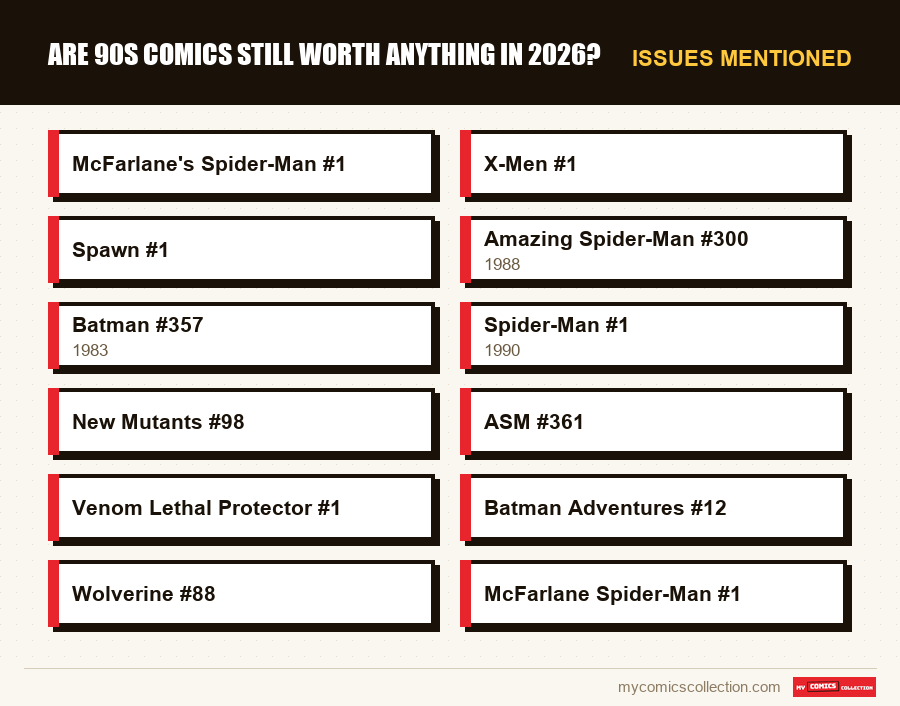
Most 1990s comics are worth very little: print runs in the millions, such as X-Men #1 (1991) at 8.1 million copies, make scarcity structurally impossible. The exceptions are first appearances of characters who became famous, such as New Mutants #98 (Deadpool), Spawn #1, Amazing Spider-Man #361 (Carnage) and Batman Adventures #12 (Harley Quinn), especially in very high grade.
⚠️ For informational purposes only: This information is provided for educational purposes only. My Comics Collection is not an investment advisor. Values vary with condition, scarcity and market trends. Always check recent eBay and GoCollect sales before any buying decision.
If you grew up in the 1990s, chances are you have a box of comics somewhere bought "for their future value." McFarlane's Spider-Man #1 with its chrome cover, X-Men #1 with its four different covers, Spawn #1 carefully stored in its bag... Thirty years later, the question burns: how much are they really worth?
The short answer is disappointing for most of you. But there are important exceptions, and knowing them can prevent you from accidentally throwing out the few issues in your collection that actually have value.
The 90s bubble: understanding why it broke everything
To understand why most 90s comics aren't worth anything today, you have to go back to the mechanics of the speculative bubble that inflated the market then destroyed it.
It all started with the phenomenal success of a few key issues in the 1980s. Comics like Amazing Spider-Man #300 (first Venom, 1988) or Batman #357 (1983) had multiplied their value 10x in a few years. Specialized media started talking about comics as "alternative investments." Thousands of new buyers flooded the market: not to read, but to speculate.
Publishers responded to this demand in a way that would kill the golden goose: by printing massively. X-Men #1 (1991) was printed at 8.1 million copies: a world record that still holds. McFarlane's Spider-Man #1 (1990) exceeded 2.5 million. Death of Superman (1992) in hermetic bags reached similar levels.
The 90s paradox: For a comic to be rare and valuable, it has to have been printed in small runs and most copies destroyed over time. 90s comics were printed in astronomical quantities and carefully preserved by thousands of speculators. Scarcity is structurally impossible.
In 1993, the market collapsed. Publishers declared bankruptcy one after another. The secondary market dried up. Millions of "collectible" comics never found buyers. The lesson should have been definitive, but today's collectors keep hoping their 1991 X-Men #1s will be worth something someday.
The brutal verdict: what's almost worthless
Here's a non-exhaustive list of 90s comics most frequently overestimated by their owners:
- X-Men #1 (1991, Jim Lee): 4 cover variants + collector edition. Current value: $1-5 for standard edition, $10-30 for high-grade "collector" edition. Millions of near-new copies still circulate.
- Spider-Man #1 (1990, Todd McFarlane): Standard edition: $2-10. Gold edition: $30-100 depending on grade. Silver edition: $15-50. No edition exceeds $200 outside CGC 9.8.
- Death of Superman (1992): The sealed plastic bag with black armband is worth almost nothing once opened. Even intact, value stays low: $10-30 maximum for a sealed copy.
- Generic chromium/foil covers: Lenticular, holographic and chrome covers from the 90s have no particular value. They're marketing gimmicks, not rarities.
- Bloodlines and crossover annuals: These multi-series events producing dozens of issues per year are generally worthless, even with first appearances of "Bloodlines" characters who never broke through.
The exceptions that really have value in 2026
Good news: some 90s comics really have value. Not fortunes, but significant value, especially in high CGC grade. These are almost exclusively first appearances of characters who later broke through in film or video games.
Worth something
- New Mutants #98 (first Deadpool)
- Spawn #1 (first Spawn)
- ASM #361 (first Carnage)
- Venom Lethal Protector #1
- Batman Adventures #12 (first Harley Quinn)
- Wolverine #88 (first fight vs Deadpool)
Worth almost nothing
- X-Men #1 (1991) all editions
- McFarlane Spider-Man #1 (std edition)
- Death of Superman (1992)
- Bloodlines crossovers
- Generic foil/chromium covers
- WildC.A.T.s, Brigade, Youngblood
New Mutants #98 (1991): the 90s pearl
This issue contains the first appearance of Deadpool: a character who generated billions at the box office. In CGC 9.8, New Mutants #98 trades between $1,300 and $2,200 in 2026. In non-graded VF/NM, it's still worth $220-440. It's the exception that proves the rule: only a first appearance of a major character can save a 90s comic from insignificance.
Spawn #1 (1992): the Image Comics value
Spawn's first issue, created by Todd McFarlane at Image Comics, benefits from dual aura: it's Spawn's first appearance and a symbol of creator independence. In CGC 9.8, it trades between $330 and $770. Non-graded good condition: $22-90. The live-action Spawn film in preparation with Jamie Foxx could significantly push this issue up.
Batman Adventures #12 (1993): the late discovery
This issue of the Batman animated series contains Harley Quinn's first comics appearance. Long ignored, it exploded when Harley Quinn's popularity via DC films became evident. In CGC 9.8, it can reach $1,650-3,300: exceptional performance for a 90s comic.
Collecting this series?
Track what you own, what you are missing and what your collection is worth. 7 day trial.
Start my trial →Check current value of your 90s comics
My Comics Collection identifies key issues in your collection and gives you their current value, updated daily. Find out if you have a hidden pearl among your 90s comics.
🚀 7-day free trialNo charge during trial · Cancel anytime
What the 90s bubble teaches us about comics investing
Beyond this period's assessment, the 90s bubble offers precious lessons for any collector considering comics as investment, even partially.
Lesson 1: Scarcity is the sine qua non condition
A comic printed in millions of copies will never be rare, whatever its cultural notoriety. A comic's value depends on the combination of few existing copies and high demand. Without scarcity, demand has no grip on price.
Lesson 2: First appearances remain the golden rule
Among all 90s comics, only those containing first appearances of characters who then had significant pop-culture careers maintained or increased value. It's not coincidence: it's the fundamental rule of comics investment, valid for all eras.
Lesson 3: Condition matters even more when print runs are large
Since thousands of very-good-condition copies exist for each 90s comic, only the highest grade (CGC 9.8 or 9.9) creates real artificial scarcity. A non-graded 90s comic in "good" condition has practically no value. A CGC 9.8 of the same issue can significantly.
Lesson 4: Beware of gimmicks
Chrome covers, holographic editions, hermetic bags, polybagged with collector card: all these 90s marketing artifices didn't create value. Today still, some publishers use limited-edition cover variants to stimulate sales. The 90s lesson: a packaging gimmick doesn't create value, it simulates scarcity.
What the 90s left us of value (despite everything)
- New Mutants #98: first Deadpool, $220-2,200 depending on grade
- Spawn #1: first Spawn, $55-770 depending on grade
- Batman Adventures #12: first Harley Quinn, $330-3,300
- Amazing Spider-Man #361: first Carnage, $90-660
- Venom Lethal Protector #1: first Venom solo, $33-330
- Wolverine #88: first Wolverine vs Deadpool fight, $55-440
What to do with your 90s collection in 2026?
If you have boxes of 90s comics, here's a rational approach to get the best out of them without drowning in inventory.
Step 1, Identify key issues. Review your collection and isolate all first-issue series and comics that might contain first appearances. Use an app like My Comics Collection to quickly identify potential key issues.
Step 2, Check real values. For each isolated comic, check recent eBay sales in similar condition. Be realistic about condition. Don't rely on your memory of "having kept it in perfect condition": actually inspect each copy.
Step 3, Decide for each category. Key issues in good condition: keep or get graded before selling. Standard comics without particular value: sell as a lot at modest price or donate. Comics with only sentimental value: keep them, it's your choice, not a financial decision.
Step 4, Free up space and liquidity. Comic storage space has a cost. Keeping 10 boxes of 90s comics worth $55 total costs you more in space and mental time than they'll ever earn. Except for strong sentimental value, rationalization is often the best decision.
Frequently asked questions
Separate the wheat from the chaff in your collection
Stop storing worthless comics hoping for a revalorization that won't come. My Comics Collection identifies your real key issues, evaluates your collection, updated daily, and helps you make the right decisions.
🚀 Start free7-day free trial · No commitment