To read “Y: The Last Man” in French (“Y : le dernier homme”), the five Urban Comics volumes (Vertigo Essentiels line, October 2012 to November 2014) remain the simplest path: the complete series, sixty US issues, under a single numbering. The ten Panini albums (“100 % Vertigo”) will interest those who want the first sustained translation, and the volumes of the Nomad line a pocket format. The two Semic albums of 2004 are the collector's object.
Few Vertigo series have had such a fragmented publishing history in France: three publishers, albums of six issues, then double volumes, then a pocket edition. Before buying, you need to know which breakdown you are holding.
As always in this guide, only verified information (creators, issue numbers, dates) is stated as fact; the analysis is our own, with no reproduction of protected pages or dialogue.
The US original in brief
Sixty monthly issues, from September 2002 to July 2008: that is what Vertigo, DC Comics' mature-readers imprint, publishes under the title “Y: The Last Man”. Brian K. Vaughan writes, Pia Guerra draws, Jose Marzan Jr. inks and Pamela Rambo colors. At the start, a single young man, Yorick Brown, survives with his monkey (called Esperluette in French) the sudden death of every living being carrying the Y chromosome.
The series received Eisner Awards: Best Writer in 2005 for Brian K. Vaughan, then, in 2008, Best Penciller/Inker or Penciller/Inker Team and Best Continuing Series. The issues were then grouped into ten American trade paperbacks, then into five "Deluxe" volumes published from October 2008 to May 2011. This second breakdown, in pairs of paperbacks, is the one Urban Comics adopted in France, which explains why its five volumes do not fall in the same places as the ten earlier albums.
For the original American object, the first booklet and its printings, our guide to issue 1 covers the subject. Here, we stay on the French-language side.
The French editions, in order of publication
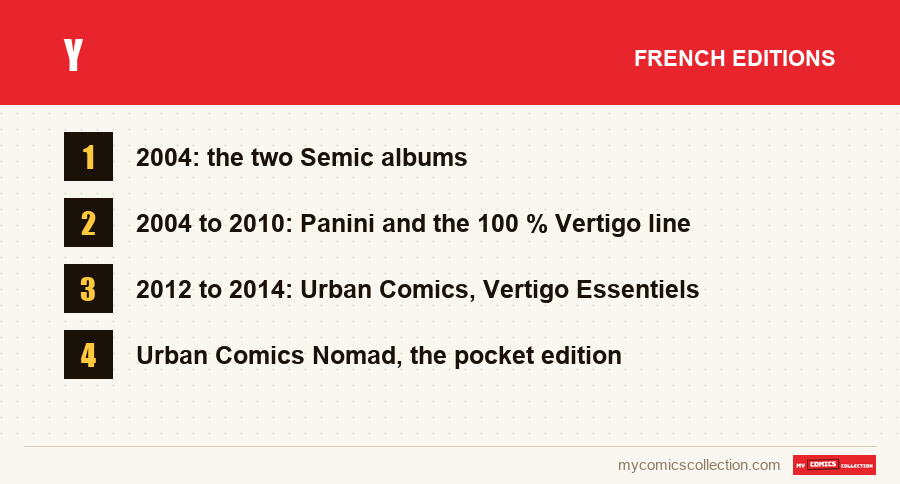
2004: the two Semic albums
The series arrived in France at Semic, in its “Semic Books” line. Only two albums appeared under this imprint, in 2004: “No Man's Land”, which collects issues 1 to 5, then “Un petit coin de Paradis” ("A Little Corner of Paradise"), issues 6 to 10. Sophie Watine-Vievard is credited with the translation of the first of these two albums, a volume of about 120 pages in a 26 cm format.
These two albums are therefore the true first French editions. Their titles were later reused by another publisher, which is the first pitfall of the subject: the same album title can point to two publishing houses, and it is the imprint on the back that tells them apart.
2004 to 2010: Panini and the 100 % Vertigo line
Panini received the French license for DC Comics and continued the translation in its “100 % Vertigo” line. Ten albums appeared there in total: the first two reprint the work already published at Semic, the following eight are first editions. The years can be read in the table below, from “Un petit pas” ("One Small Step") in 2006 to “Trajets d'Y” ("Y's Journeys") in 2010.
An example of a physical reference point: “Alliance contre nature” ("Unnatural Alliance"), the fifth album of the series, has 192 pages, appeared in 2007 and carries Jérémy Manesse's name as translator. This album gathers eight US issues, the largest in the series, which makes it easy to recognize on a shelf.
2012 to 2014: Urban Comics, Vertigo Essentiels
Dargaud then obtained the publishing rights to DC Comics and scheduled a reissue of the series under its Urban Comics label, in the “Vertigo Essentiels” line. The first volume appeared on October 26, 2012: 262 pages, translated by Jérémy Manesse. The fifth and last followed on November 28, 2014. The entire series fits in five volumes.
The logic of this breakdown is that of the five American "Deluxe" volumes, published from October 2008 to May 2011: each French volume groups two albums of the previous series.
Urban Comics Nomad, the pocket edition
Urban Comics also offers the series in its “Nomad” pocket line. Before buying a volume, open it and read which US issues it stops at: a pocket volume of this series does not always say, on its cover, that it leaves the story unfinished.
US / French edition correspondence
| French edition | Volume | US issues included |
|---|---|---|
| Semic then Panini | “No Man's Land” (2004) | 1 to 5 |
| Semic then Panini | “Un petit coin de Paradis” (2004) | 6 to 10 |
| Panini | “Un petit pas” (2006) | 11 to 17 |
| Panini | “Stop/Encore” (2007) | 18 to 23 |
| Panini | “Alliance contre nature” (2007) | 24 to 31 |
| Panini | “Entre filles” (2008) | 32 to 36 |
| Panini | “Scoop” (2008) | 37 to 42 |
| Panini | “Monnaie de singe” (2009) | 43 to 48 |
| Panini | “Terre mère” (2009) | 49 to 54 |
| Panini | “Trajets d'Y” (2010) | 55 to 60 |
| Urban Comics | Volumes 1 to 5 (2012 to 2014) | two Panini albums per volume, 1 to 60 in total |
Urban volume 1 gathers the first two albums, that is issues 1 to 10; for the following volumes, compare the table of contents with the Panini grid before buying.
Do you collect this series?
Track what you own, what you are missing and what your collection is worth. 7-day trial.
Start my trial →
Which edition to choose for your profile
You simply want to read the series
Take the five Urban volumes. They are the most readable: a numbering that stops at five, a first volume translated by Jérémy Manesse, and a line designed to bring the series back in one block. It is also the most compact route on a shelf.
You follow reissues and the first French edition
The ten Panini albums form the first complete translation. For a reader who likes to find the original breakdown, about six issues per album, they hold real interest: the album titles, which do not exist at Urban, are part of the French identity of the series. Count on a patient hunt, however: ten albums to gather means ten listings to check.
You are looking for the oldest object
The two Semic albums of 2004 are the first French editions. Their interest is mostly historical. Check the imprint on the back, since the same titles then exist at another publisher.
You read on the go
The “Nomad” pocket volumes suit this profile. Before betting on them to finish the story, check the issues covered.
Pitfalls and points to watch
The first concerns numbering. A Panini "volume 2" covers issues 6 to 10, whereas the second Urban volume starts at issue 11. A lot mixing the two publishers will therefore give gaps or duplicates without the "volume" label signaling it. Always note the publisher, then the US issues contained.
The second is translation. The credited translators change depending on the edition: Sophie Watine-Vievard for the first Semic album, Jérémy Manesse for the fifth Panini album and for the first Urban volume. Read an excerpt before rebuying a series you already own, to judge whether the change of text justifies the expense.
The third comes from titles. The albums have their own French titles, which are not found in the Urban volumes. A resale listing that talks about “Scoop” or “Monnaie de singe” ("Monkey Business") necessarily describes a Panini album, not an Urban volume.
The fourth concerns the end of the series. In any collection of ten albums, the last is the one you put off. Spot the tenth album, “Trajets d'Y”, from the start, along with the condition in which it sells, before buying the other nine.
Finally, do not confuse the print edition with the television adaptation. To know what the filmed series keeps or changes, read our comparison series and comics.
A simple method avoids lot errors: draw up a ten-line list, one per Panini album, with the title, the number of US issues covered and the publisher on the back. Tick what you own, then search only for the empty lines. This list also helps recognize an album by its page count: “Alliance contre nature”, with its eight US issues, is thicker than “Entre filles” ("Girl Talk"), which gathers only five.
If you are reading the series for the first time, start with a single Urban volume, the first, rather than the whole set: it covers the first ten issues and will tell you whether the world of Yorick, Agent 355 and Dr. Mann suits you before you complete the series.
Finally, think about storage. Shelve by publisher rather than mixing the two series on the same shelf: the volume numbering is not the same, and sorting by publisher avoids believing that a volume is missing when it simply belongs to the other edition.
What these editions are worth as a collection
These editions trade at very different price levels, and we give no figure: they move too fast. What remains is the method, which does not vary. First compare the stated condition to the real condition: spine, corners, dust jacket when there is one, absence of stamps. For a complete series, preferably buy a homogeneous lot, one publisher and one condition, rather than assembling isolated volumes.
The relationship between the three editions follows a constant logic: the old, out-of-print album, the one no longer reprinted, generally costs more than the volume still available in the catalog. Apply this rule to the Panini and Semic albums, but verify it against completed sales. To estimate a specific lot, cross-check several sold listings, not just listings on display. Our guide to the French market versus the American market details why these two markets do not overlap.
If you are considering a resale, the five Urban volumes in perfect condition sell better as a set. Conversely, a collection of ten Panini albums missing an intermediate volume sells less easily than a complete lot in the same condition. For the editorial context of these three houses, see also our overview of comics publishers in France.
Frequently asked questions
With the five Urban Comics volumes of the Vertigo Essentiels line, published from October 2012 to November 2014. They group the sixty US issues into five volumes and were designed as a complete reprint of the series. If you prefer the original album titles, turn next to the Panini albums.
Ten albums in the “100 % Vertigo” line, from “No Man's Land” to “Trajets d'Y”. The first two reprint albums first published at Semic, the following eight are first editions. Each album contains between five and eight US issues, according to the grid above.
Yes, for the first two albums: Panini took the series back from volume 1 after Semic. The titles are identical, only the imprint on the back changes. For a careful collection, note the name of the publisher and not just the album title.
Because Urban adopted the breakdown of the American Deluxe volumes, which combine two paperbacks per volume. Urban volume 1 therefore contains the first two Panini albums, issues 1 to 10, and volume 2 starts at issue 11: it is twice as thick.
Nothing allows us to say so: the series has sixty issues, a pocket volume holds few, and the cover does not always indicate where the story stops. For a complete reading without gaps, the five Urban Comics volumes of the Vertigo Essentiels line remain the reference.
Unsure about the value of your Semic, Panini or Urban albums of Y: The Last Man? A free estimate gives you a first range.
Estimate my comic