The X-Cutioner's Song reading order covers all 12 parts of the X-Men crossover, published from November 1992 to February 1993 across Uncanny X-Men, X-Factor, X-Men (second series) and X-Force. Scott Lobdell, Fabian Nicieza and Peter David wrote it, with several artists including Andy Kubert, Jae Lee, Greg Capullo and Brandon Peterson. Read the twelve parts in publication order, from Uncanny X-Men #294 to X-Force #18, then the two epilogues, Uncanny X-Men #297 and X-Force #19.
Four monthly series, three writers, one strict rotation: X-Cutioner's Song is the textbook crossover that reads badly if you go title by title. Each part picks up from the one before, and the whole thing falls apart if you finish X-Factor before opening X-Men. This guide gives the exact sequence, the issue numbers for each series and the epilogues, and explains how to buy and shelve the whole run.
As always on this site, we only state verified facts (creators, issue numbers, dates); the analysis is our own, with no reproduced pages or protected dialogue.
What to read first
X-Cutioner's Song does not start from a blank page: it is where several storylines already running in the 1992 titles collide. The crossover pits the X-Men, their allies and three villains against each other: Stryfe, Apocalypse and Mister Sinister. It is more enjoyable if you know who is who, but it stays accessible to a reader who knows the broad strokes of the early 1990s mutant universe.
Three starting points are enough. First, Cable, whose debut is in New Mutants #87 (1990): our page on that issue details his entrance, and the one on his first appearance places it in the timeline. Second, X-Force, whose 1991 first issue sets up the team you will meet again in parts 4, 8 and 12; we cover it in this article on X-Force #1. Finally, X-Factor, which launched in 1986 (see our page on issue one) and supplies X-Cutioner's Song with two of its twelve chapters per rotation.
You do not need to read dozens of prep issues. If you still want some preparation, skim the previous issues of each of the four series to see where every team stands in fall 1992, but nothing in the crossover requires that backtracking.
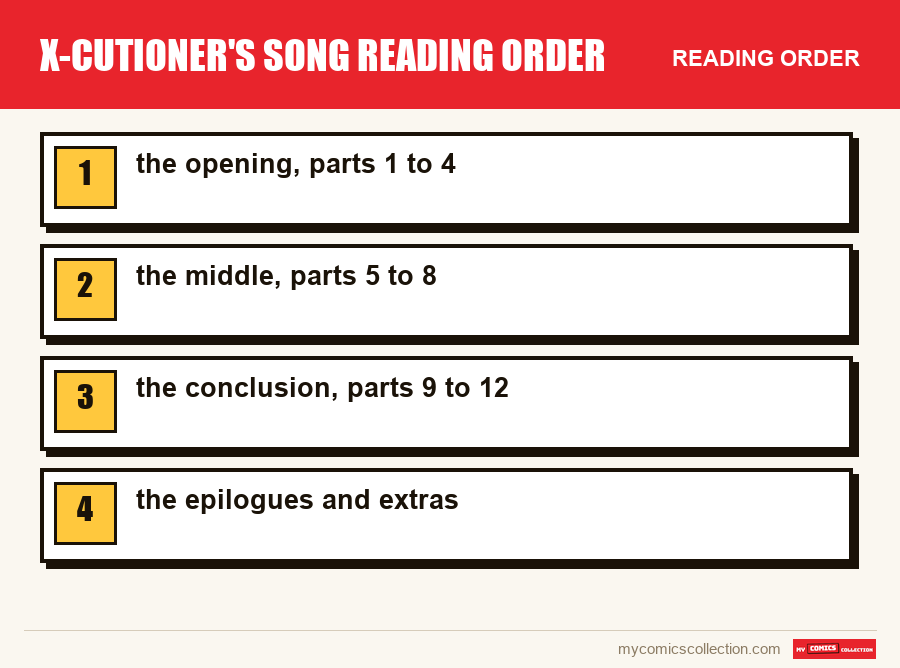
Phase 1: the opening, parts 1 to 4
The crossover opens with Uncanny X-Men #294, part 1. The story begins with a shooting at a free concert in Central Park: that event sets everything else in motion, and it is best discovered without knowing more. This opening kicks off the rotation between the four titles.
- Part 1: Uncanny X-Men #294.
- Part 2: X-Factor #84 (first series).
- Part 3: X-Men #14 (second series).
- Part 4: X-Force #16 (first series).
This first rotation sets up the sides. Each series brings the same drama back to its own characters: the X-Factor team has its reflexes, the second-series X-Men have theirs, and X-Force has its own. Read the four issues back to back, without slipping in any other reading, to feel that alternation of viewpoints rather than endure it.
A note on titles: the X-Men series is indeed the second series, launched in 1991, and not Uncanny X-Men. The two titles ran in parallel, and the part 3 issue belongs to the second series, numbered #14 at this point. Whether you shop online or at a convention, mixing up the two series is a frequent ordering mistake: always check the cover title and the issue number, never the number alone.
Phase 2: the middle, parts 5 to 8
The second rotation repeats the same mechanics: back to Uncanny X-Men, then X-Factor, X-Men and finally X-Force.
- Part 5: Uncanny X-Men #295.
- Part 6: X-Factor #85.
- Part 7: X-Men #15.
- Part 8: X-Force #17.
This is where the crossover gets dense. The villains named above are no longer just names: Apocalypse and Mister Sinister, two characters who each have their own mythology, play a role here. If you want to place Apocalypse before tackling this middle stretch, the Apocalypse reading guide gives the context for his major appearances.
A pacing tip: four issues per reading session is a good unit. The rotating structure favors that split, since each pass through the four titles forms a coherent block of four parts. Stop at the end of a rotation, not in the middle: picking it back up is much more natural when you restart from Uncanny X-Men.
Phase 3: the conclusion, parts 9 to 12
The third and last rotation closes out the story.
- Part 9: Uncanny X-Men #296.
- Part 10: X-Factor #86.
- Part 11: X-Men #16.
- Part 12: X-Force #18.
Spoiler warning: the next few lines mention a major consequence of the finale. The canister Stryfe hands to Mister Sinister carries stakes that go beyond the crossover: it holds the Legacy Virus, deadly to mutants. That revelation has repercussions in several series, notably affecting Illyana Rasputin and Moira MacTaggert. Do not look it up on a character profile before you have read part 12, because it spoils the ending.
The reception at the time is well known: the story sold well at the shop, but it left part of the audience wanting more, mainly because Cable's origin is not revealed in it. That only comes in 1994. Let that guide your expectations: X-Cutioner's Song is a line-wide event, not the answer to every question it raises. For the rest of Cable's story, our history of Cable in comics traces his major milestones.
Phase 4: the epilogues and extras
Two issues extend the crossover and are read right after part 12, in this order:
- Uncanny X-Men #297, billed as the first epilogue.
- X-Force #19, billed as the second epilogue.
These epilogues change the tone: Charles Xavier briefly regains the use of his legs and grows closer to Jubilee, Rogue and Gambit spend time together, Archangel and Beast fix up a bar. They are breathers, closer to team life than to action. Do not skip them if you love the characters: this is where the crossover eases the pressure.
Among the extras, a 1993 X-Men one-shot rounds out the list: Stryfe's Strike File, by Fabian Nicieza and Scott Lobdell. Read it after the epilogues, as a background file on the antagonist. It is mostly for completists.
Do you collect this series?
Track what you own, what you are missing and what your collection is worth. 7-day trial.
Start my trial →
The tie-ins you can skip
Beyond the twelve parts and the two epilogues, two publications are tied to the crossover: the miniseries Cable: Blood and Metal (#1 and #2) and the issue What If? #69. Neither is needed to follow the main story: the twelve parts are built to stand on their own, and the rotation covers everything useful to understand it.
That does not make them uninteresting. They are for readers who want to extend Cable's universe or explore variations on his characters, at the collecting stage more than the first read. Read the main sequence first, then add these two publications if you want to branch out.
The general rule for any event from this era: a growing list of tie-ins is not a list of required reading. The issues that move the plot forward are the ones in the rotation, and the rest are appendices to shelve alongside.
Single issues or trade paperbacks: how to read it
The crossover fits in twelve single issues, plus two epilogues: a reasonable load for a single-issue hunt, as long as you are methodical. The difficulty is not the count but the scatter: four different series means four different spots on your shelves.
Our reading and buying method comes down to four steps. First, write out the list of the twelve issues (the sequence above) before you start hunting. Second, buy in blocks of four issues, one per series, so you can read each rotation without a break. Third, note the condition of each single issue as soon as you buy it, because the four titles do not age the same way. Finally, shelve the twelve issues together, in reading order rather than series by series, at least for the first read.
For a collected edition, favor one that reprints the twelve parts in publication order rather than a volume that groups the chapters by series: that second arrangement breaks the rotation. We do not name a specific edition here: check on the publisher's catalog that the table of contents matches the publication sequence. Issues #294 to #297 of Uncanny X-Men have their place in the series collecting guide, which serves as a benchmark for the rest of the run.
The key issues to know
A twelve-part crossover does not have one key issue, but several reasons to care about particular books. Here is how to sort them.
- The rotation openers. Uncanny X-Men #294 launches the story: it is the natural starting issue for a collection built around the event.
- The conclusion. X-Force #18 closes the last rotation, the one where the Legacy Virus reveal plays out.
- The epilogues. Uncanny X-Men #297 and X-Force #19 are often forgotten on want lists, yet they complete the sequence.
- The printings. When the same issue exists in several printings or reprints, identify the original printing from the cover, the barcode and the credits page rather than from the issue number alone.
To place a copy from this period, compare completed sales of the same issue in the same condition, never a single listing. The opening issue of the crossover, Uncanny X-Men #294, often draws more demand than the middle chapters, but the gap varies with condition and timing. For an accurate estimate of your copy, use our free estimation tool.
If you collect the period more broadly, our page on Cable key issues lists other books from the same era that matter to fans of the character.
Recap: the complete order
- Uncanny X-Men #294 (part 1)
- X-Factor #84 (part 2)
- X-Men #14 (part 3)
- X-Force #16 (part 4)
- Uncanny X-Men #295 (part 5)
- X-Factor #85 (part 6)
- X-Men #15 (part 7)
- X-Force #17 (part 8)
- Uncanny X-Men #296 (part 9)
- X-Factor #86 (part 10)
- X-Men #16 (part 11)
- X-Force #18 (part 12)
- Uncanny X-Men #297 (epilogue)
- X-Force #19 (epilogue)
- Stryfe's Strike File (one-shot, 1993)
For another rotation across four monthly series, see our Messiah Complex reading order, published in 2007 and 2008, where Cable once again plays a role.
Frequently asked questions
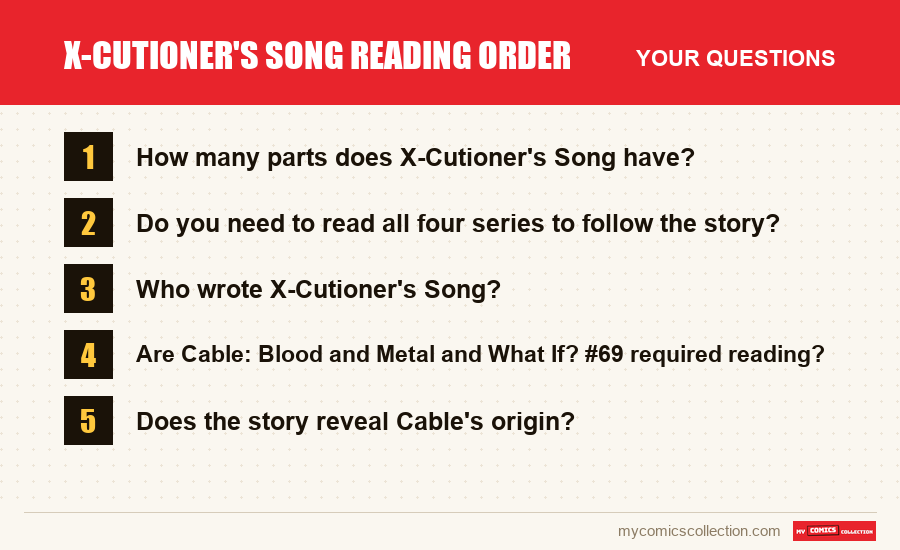
The crossover has twelve parts, spread over four series: Uncanny X-Men #294 to #296, X-Factor #84 to #86, X-Men #14 to #16 and X-Force #16 to #18. Two epilogues, Uncanny X-Men #297 and X-Force #19, extend the story, and the one-shot Stryfe's Strike File (1993) rounds it out.
Yes, because each series supplies three of the twelve parts and the story jumps from one to the next. Skipping a title means losing three chapters out of twelve. Follow the rotation: Uncanny X-Men, X-Factor, X-Men, X-Force, three times in a row, in monthly publication order.
The crossover is written by Scott Lobdell, Fabian Nicieza and Peter David. Several artists share the twelve parts, including Brandon Peterson, Andy Kubert, Jae Lee and Greg Capullo. The credit for each part is listed on the title page of the issue in question.
No. The miniseries Cable: Blood and Metal (#1 and #2) and What If? #69 are tied to the crossover but add nothing essential to the main plot. Read them after the twelve-part sequence if you want to dig deeper into Cable's universe.
No, and that is one reason part of the audience was left wanting more at the time: Cable's full origin is not revealed until 1994. Approach the crossover as a clash between sides rather than as a character's origin story.
Found an Uncanny X-Men #294 or an X-Force #18 in your boxes? See what your copy is worth.
Estimate my comic