
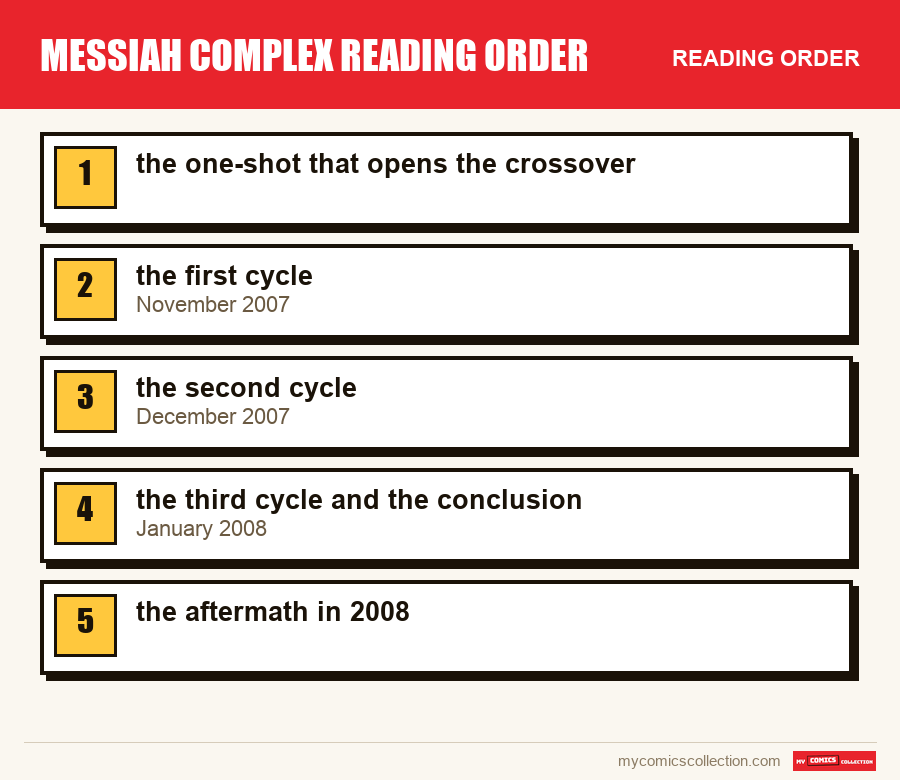
The Messiah Complex reading order covers 13 chapters in order, from October 2007 to January 2008: the one-shot X-Men: Messiah Complex, then the same rotation three times through Uncanny X-Men #492-494, X-Factor #25-27, New X-Men #44-46 and X-Men #205-207. The writers are Ed Brubaker, Mike Carey, Peter David, Craig Kyle and Christopher Yost. Read the one-shot first, then each series in monthly release order, and finish with Cable and X-Force (2008).
A thirteen-chapter crossover spread across four monthly series poses a real methodological problem: if you read one title after another, you lose the rhythm the creators intended; if you follow the release schedule, you need to know exactly which single issue comes after which. This guide gives you the sequence, explains what to read beforehand, flags what is optional, and shows how to approach the story in single issues or in a collected edition.
As always on this guide, we only state verified facts (creators, issue numbers, dates); the analysis is our own, with no reproduction of protected artwork or dialogue.
What to read before you start
Messiah Complex does not require mastering forty years of continuity, but it assumes you know where the mutants stand when it comes out. Before October 2007, these four series each lived in their own corner, with their own team and tone; what ties them together is a 2005 event whose aftermath touches the entire mutant community: House of M, a 2005 miniseries written by Brian Michael Bendis and drawn by Olivier Coipel. Without it, the stakes of the story, the search for a mutant child, lose much of their weight.
For a comfortable entry point, here are the useful reference points, from the most essential to the most optional:
- House of M: the foundation. You do not need to read all of its tie-ins; the main series is enough.
- The Uncanny X-Men issues written by Ed Brubaker that come before #492: they set up the series' team as it enters the crossover.
- The Peter David issues of X-Factor before #25: the series follows an agency of mutant detectives, and its tone differs noticeably from the other titles in the crossover.
- New X-Men (second series) before #44: the series handed to Craig Kyle and Christopher Yost, which ends with this crossover.
- X-Men (second series) before #205, written by Mike Carey: the field team that serves as the backbone of the last chapter of each cycle.
If you are in a hurry, nothing stops you from starting directly with the one-shot: it resets the stakes and introduces the opposing sides. But a reader who has followed even one series beforehand will better understand why a given character reacts the way they do in the other titles' chapters. To extend your preparation, our general X-Men reading guide offers paths by era.
Phase 1: the one-shot that opens the crossover
The starting point is X-Men: Messiah Complex #1, a one-shot dated October 2007. It does not belong to any of the four series and is read first, whichever series you normally follow. Its role is that of a prologue: it lays out the problem and sets the teams in motion before the monthly series take over.
A practical tip for collectors: this one-shot is a standalone single issue, with its own cover and its own numbering, and it is shelved alongside the other chapters rather than in a regular series. If you are building the sequence in single issues, hunting it down therefore takes a separate search from the four series. There is also a companion single issue, X-Men: Messiah Complex - Mutant Files #1, which is associated with the crossover but is not a chapter of the main story.
Phase 2: the first cycle (November 2007)
After the one-shot, the crossover continues through four single issues dated November 2007, to be read in this precise order:
- Uncanny X-Men #492, with Ed Brubaker writing;
- X-Factor vol. 3 #25, by Peter David;
- New X-Men vol. 2 #44, by Craig Kyle and Christopher Yost;
- X-Men vol. 2 #205, by Mike Carey.
This order holds for the entire crossover: each cycle begins with Uncanny X-Men and ends with X-Men. It is important to respect it, because the endings of each issue answer one another from series to series. The crossover brings together several artists: Marc Silvestri, Billy Tan, Scot Eaton, Humberto Ramos and Chris Bachalo all took part across the whole. This gives a contrasting look from one title to the next, which is precisely one of the pleasures of reading in single issues.
The second pitfall of this cycle is the numbering: X-Factor is in its third series, New X-Men in its second, and X-Men in its second as well. When you hunt for an issue, check the volume so you do not buy a same-numbered issue from a different series.
Phase 3: the second cycle (December 2007)
The second cycle repeats exactly the same mechanism, with single issues dated December 2007:
- Uncanny X-Men #493;
- X-Factor #26;
- New X-Men #45;
- X-Men #206.
This is the central part of the story. We do not detail the plot, because the appeal of the crossover lies in its twists, but keep one simple reading rule in mind: do not interrupt this cycle. If you read one of the chapters, read the next three before moving on to anything else, or you will lose the thread between the teams.
Warning, spoiler: by the end of the story, some members of the X-Force group are dead or gravely wounded, which determines the lineup of the series launched afterward. We do not name them here, to preserve your reading.
Phase 4: the third cycle and the conclusion (January 2008)
The last cycle is the one that delivers the resolution, with single issues dated January 2008:
- Uncanny X-Men #494;
- X-Factor #27;
- New X-Men #46, the last issue of the second series;
- X-Men #207, the last issue of the second series under that title.
This cycle closes the crossover and, at the same time, two series: New X-Men ends with #46, replaced in April 2008 by Young X-Men, written by Marc Guggenheim and drawn by Yanick Paquette. As for X-Men, the series takes the title X-Men: Legacy from #208, dated February 2008, with Mike Carey still writing. The crossover therefore serves as an editorial hinge as much as a narrative one, which explains its importance in a collection: these single issues are the last of one series and the moment another begins.
Do you collect this series?
Track what you own, what you are missing and what your collection is worth. 7-day trial.
Start my trial →
Phase 5: the aftermath in 2008
Once X-Men #207 is closed, several paths open up. The most direct way to understand the post-crossover landscape is to read two new series launched in 2008:
- X-Force: a new series from February 2008, with Craig Kyle and Christopher Yost writing and Clayton Crain on art. Its team is made up of members of the X-Force group that appeared in Messiah Complex and who were neither dead nor gravely wounded at the end of the story;
- Cable: a solo series announced for March 2008, written by Duane Swierczynski and drawn by Ariel Olivetti, which follows the character after the events of the crossover.
Alongside these two series, Uncanny X-Men continues a storyline running from #495 to #500, which concludes with the team's reunion in San Francisco. Another sequence, Divided We Stand, covers Uncanny X-Men, X-Factor, X-Force, Young X-Men, X-Men: Legacy, Wolverine and Cable: it shows a team that no longer exists as it once did. It is complementary reading for those who want to know what becomes of each character, but it is not essential to understanding the crossover itself. Our Cable reading guide helps place the 2008 series within the character's journey.
The tie-ins you can skip
A particularity of Messiah Complex: there are almost no tie-ins in the usual sense. The crossover rests on four regular series and one one-shot, and the whole story fits inside those thirteen single issues. That is what makes it so pleasant to read: no need to hunt for issues of other titles to fill in the gaps.
What remains optional therefore comes down to two things. First, X-Men: Messiah Complex - Mutant Files #1, a companion single issue that rounds out the whole without being essential to following the plot. Second, the sequences that follow the crossover, Divided We Stand foremost: they flesh out the universe without conditioning the reading of the thirteen chapters. Skipping them does not leave a piece of the puzzle missing, but it leaves you less informed about where each character stands afterward.
For Peter David readers, the simplest approach is to follow the X-Factor chapter in each cycle without looking further: it is the reading that best respects the writer's work on his own title. Our page on Peter David gathers his other series.
Single issues or collected editions: how to read it
The question plays out differently for a crossover that alternates between four series. In single issues, you have to build the sequence in the exact order of the thirteen chapters, which means shelving together issues from four different boxes. Many collectors choose to keep them in their series order and read with a checklist beside them; others set up a separate "Messiah Complex" lot. Both methods work, but the second avoids missed issues.
In collected form, go through the volume devoted to the crossover: a hardcover edition dates from April 2008, and a trade paperback from November 2008. The announced contents bring together the one-shot, Uncanny X-Men #492-494, X-Men #205-207, New X-Men #44-46, X-Factor #25-27 and Mutant Files. In other words, the volume follows the intended order and removes any risk of picking up the wrong series. For pure reading, it is the route that takes the least effort.
For preservation and collecting value, the method is different: period single issues are judged by condition, by printing notation and by the possible presence of cover variants. For a crossover, aim to assemble all thirteen chapters in matching condition rather than chasing one exceptional copy: a coherent set resells and shelves better than a mismatched assortment.
The key issues to know
A crossover of this scale cannot be summed up in one issue, but some single issues draw more attention from collectors, for reasons tied to their role in the story or to what they launch afterward. Here are the reference points, without claiming to be exhaustive.
- X-Men: Messiah Complex #1: the crossover's opener, a one-shot whose standard printing you should distinguish from any cover variants when buying.
- X-Men #205 (2007): warning, spoiler, this fifth chapter is the first appearance of Hope Summers, a character created by Mike Carey and Chris Bachalo. It is the crossover issue most followed by collectors, for that reason alone.
- Uncanny X-Men #494 and X-Men #207: the single issues that wrap up the crossover. The latter is also the last issue of the series under that title, which gives it a hinge status.
- New X-Men #46: the last issue of the second series, which people sometimes look for to complete a run.
- X-Force #1 (2008): the launch of the series by Craig Kyle, Christopher Yost and Clayton Crain, which follows directly from the crossover's aftermath.
- Cable #1 (2008): the opening of the solo series written by Duane Swierczynski and drawn by Ariel Olivetti.
Method for evaluating one of these single issues: do not rely on the mere presence of the title in a lot. Compare completed sales of the same reference, note the stated condition, then check the exact printing: first printing or reprint changes how you read a listing. Our page on Cable key issues details this approach for the character whose fate is tied to this crossover.
Recap: the complete order
- X-Men: Messiah Complex #1 (one-shot, October 2007).
- Uncanny X-Men #492 (November 2007).
- X-Factor #25 (November 2007).
- New X-Men #44 (November 2007).
- X-Men #205 (November 2007).
- Uncanny X-Men #493 (December 2007).
- X-Factor #26 (December 2007).
- New X-Men #45 (December 2007).
- X-Men #206 (December 2007).
- Uncanny X-Men #494 (January 2008).
- X-Factor #27 (January 2008).
- New X-Men #46 (January 2008).
- X-Men #207 (January 2008).
- Follow-up: X-Force #1 (February 2008) and Cable #1 (2008).
Frequently asked questions
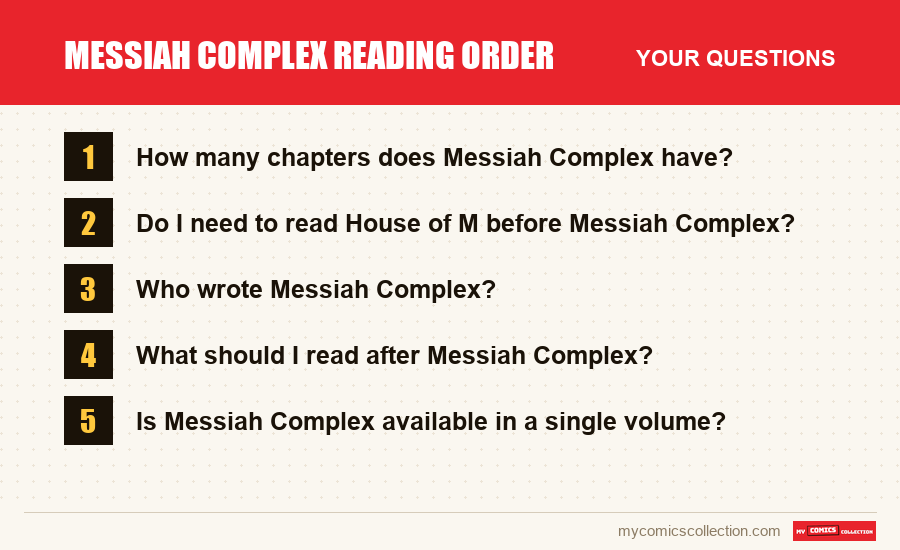
Thirteen: the one-shot X-Men: Messiah Complex, then three cycles of four single issues (Uncanny X-Men #492-494, X-Factor #25-27, New X-Men #44-46, X-Men #205-207), published from October 2007 to January 2008. The reading order follows release order and alternates between the four series.
Not strictly, but ideally yes: the House of M series (2005, Brian Michael Bendis and Olivier Coipel) sheds light on the crossover's mutant backdrop. Its main series is enough, without the tie-ins. The Messiah Complex one-shot puts the essentials back in place for other readers.
Five writers: Ed Brubaker for Uncanny X-Men, Peter David for X-Factor, Craig Kyle and Christopher Yost for New X-Men, and Mike Carey for X-Men. The artists are Marc Silvestri, Billy Tan, Scot Eaton, Humberto Ramos and Chris Bachalo.
The two direct follow-ups are X-Force, launched in February 2008 by Craig Kyle, Christopher Yost and Clayton Crain, and Cable, a solo series by Duane Swierczynski and Ariel Olivetti. Uncanny X-Men #495 to #500 and the Divided We Stand sequence also continue the story.
Yes: a hardcover came out in April 2008 and a trade paperback in November 2008. It collects the one-shot, the twelve single issues of the four series and the companion issue Mutant Files, which saves you from assembling the sequence yourself.
Do you own single issues of Messiah Complex or of the series around it? Get them appraised.
Estimate my comic