The best X-Factor run is the one by Louise Simonson and Walt Simonson, from #6 into the early 1990s: Apocalypse, Warren's fall into Archangel, Inferno. Next come Peter David and Larry Stroman from #71 (1991), then Peter David's third volume (2005-2013), the Bob Layton and Jackson Guice launch (1986) and Leah Williams's 2020 relaunch. Collected editions are enough for reading; single issues are best kept for the milestones.
X-Factor is a series that has changed its mission more often than its title: a front-company agency of mutant hunters, a government-attached squad, a private detective firm in New York, then an investigative team in the Krakoa era. Choosing a run therefore means choosing which series you want to read.
As always on this guide, only verified information (creators, issue numbers, dates) is stated as fact; the analysis is our own, with no reproduction of protected pages or dialogue.

How to rank four decades of a shifting series
The series starts with an issue dated February 1986 and the reunion of the five original X-Men: Cyclops, Jean Grey, Angel, Iceman and Beast. The first volume runs until 1998, then two more launches follow: a third volume in 2005-2006, then a relaunch in 2020. Between these eras, the only common point is the name.
To rank them, we asked each period a concrete question: can you open it without knowing everything else, and do you come away with a complete story rather than one chapter of an event? Crossovers therefore weigh less than sagas carried by a single creative team. As for collector value, it enters the ranking only as a bonus: an excellent run may contain no sought-after single issue, and the reverse is also true.
A note on terminology: sources do not all date the ends of runs the same way, because writing credits blur when moving from one period to the next. When a boundary remains uncertain, we write it as such rather than smoothing it over.
Top 1: Louise Simonson and Walt Simonson, X-Factor #6 onward (1986-1991)
After Bob Layton's five issues, Louise Simonson takes over the scripts with #6 and keeps them for several years, until the early 1990s. Walt Simonson joins on art in late 1986 and draws a good share of the issues of this first period. This is where the series stops looking like a simple reunion monthly and gains its own enemies and its own mythology.
The most striking thread is the arrival of Apocalypse, whose first appearance is placed in the 1986 #5 and whose Horsemen then take over in the series. From there, X-Factor treats the Marvel mutant as a long-form threat, not a passing adversary. Add Fall of the Mutants in 1988, where the series holds #24 to #26 of the crossover, Warren Worthington's transformation into Archangel in its wake, and then Inferno (1988-1989), which closes the storyline of Madelyne Pryor and of the couple formed by Scott and Jean.
This run carries real weight: remove X-Factor from your pile and both Fall of the Mutants and Inferno become stories full of holes. It suits readers who like team soap operas, long-term enemies and patchwork mutant families. It may feel crowded to anyone who prefers tighter stories, since the subplots abound.
To collect it: #5 is the issue Apocalypse fans hunt first, while the rest of the period turns up in quantity. The big volumes of the Epic Collection reprint this sequence and spare you from tracking down every event issue.
Top 2: Peter David and Larry Stroman, X-Factor #71 to #89 (1991-1993)
Peter David takes over the series in late 1991, with Larry Stroman on art, and changes its tone right away. The team becomes a unit officially attached to the American authorities, with Multiple Man (Jamie Madrox), Strong Guy, Wolfsbane, Havok, Polaris, then Quicksilver. The writer brings in dry humor, dialogue that sounds like real office conversations, and a taste for characters nobody else had wanted to develop.
The high point of this period is the participation in the X-Cutioner's Song crossover, in 1992, with #84 to #86. But the real achievement lies elsewhere: Peter David turns Madrox, a supporting character, into a writing pivot, and Strong Guy into a thread that is both comic and tragic. This first period ends with #89, in 1993: Peter David then leaves the series, and will not return to it until the third volume.
It speaks to readers who have already read some X-Men and want a more sarcastic, less operatic series. It puts off those who want straightforward fights: Stroman's angular style is open to debate, and the humor takes a little time. To assemble it, buying lots of 1991 to 1993 issues remains very affordable, and a bound collection of David's issues avoids the scattering effect that crossovers impose.
Top 3: Peter David and his artists, X-Factor volume 3 (2005-2013)
After the Madrox miniseries, published in 2004-2005, and in the wake of House of M, Peter David relaunches X-Factor in late 2005 with a number one dated 2006. No more government commandos: the series follows a private detective agency based in Mutant Town, the New York neighborhood where mutants who lost their powers or live on the margins reside. Madrox runs the agency, surrounded by Siryn, Rictor, Strong Guy, Monet and Layla Miller, with Wolfsbane joining later.
The charm of this version comes from its mix of crime fiction, humor and character serial: a case is settled within a few issues, but the investigators' lives change with every episode. This volume has the sweep of a sprawling novel, since the numbering later reverts to the old count and reaches #200 in 2010. Sources place the end of the series around #262, in 2013, with the whole thing carried by Peter David for nearly all of those years.
Why it matters: it is the only X-Factor run long enough to build a real setting, and it produced characters who still exist today in the mutant universe. It suits readers of long-running series, comfortable with branching storylines. It discourages anyone looking for an entry point without context, since the House of M setup calls for a short bit of prior reading.
In a collection, this volume lends itself better to collected editions than to single issues: the series has no key issue in the 1980s sense, and ordinary issues can be found in bulk for very little. It is the best ground for building a reading collection rather than a portfolio.
Do you collect this series?
Track what you own, what you are missing and what your collection is worth. 7-day trial.
Start my trial →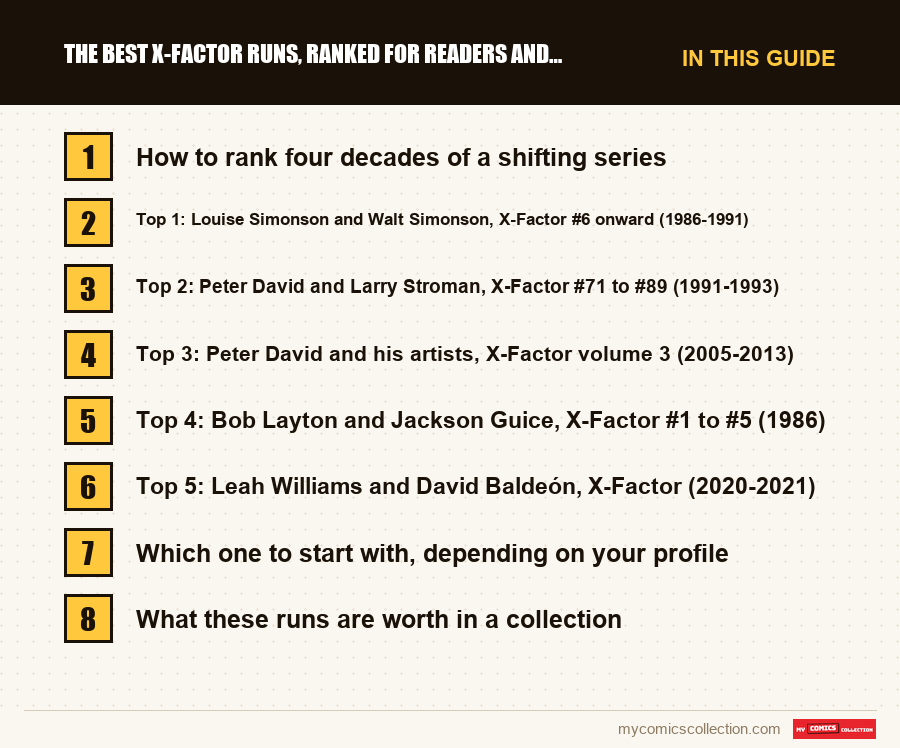
Top 4: Bob Layton and Jackson Guice, X-Factor #1 to #5 (1986)
The first five issues are best read as a single whole. Bob Layton writes the opening, Jackson Guice handles the initial art, and the monthly sets out its starting idea: a team disguised as an agency in charge of "hunting" mutants, in order to protect them from the inside. This ruse is what sets X-Factor apart from the other mutant titles of the time.
The short run also sets in motion the drama of Scott Summers, torn between the life he built with Madelyne and the return of Jean Grey. The fifth issue brings Apocalypse, which gives it weight in collectors' memory without our being able to speak of a major arc. Our profile of the launch details the dates and the credit ambiguities; this ranking judges it as a read.
It matters because it explains why the team exists. These five issues serve the reader in a hurry to grasp the premise, but frustrate anyone expecting a conclusion, since no storyline is closed there. To collect it, this is the segment where the original single issue makes the most sense, because #1 carries the label of the beginning and #5 interests Apocalypse fans.
Top 5: Leah Williams and David Baldeón, X-Factor (2020-2021)
The 2020 relaunch, written by Leah Williams with art by David Baldeón, belongs to the Krakoa era. Ten issues are enough for Leah Williams to assemble a team of investigators where Polaris, Northstar, Prodigy and Daken cross paths, tasked with searching for the truth about what the mutant nation leaves in the dark. It is the shortest of the periods in our ranking, and the only one written for a reader already settled in this phase of the X-Men.
Its interest is that of a counterpoint: while the other titles celebrate Krakoa, this one questions its gray areas. It therefore matters for anyone who wants to read the Krakoan season from several angles. The tone is lively, chatty, sometimes disorienting, and it divides readers. That is the reason for its fifth place more than its intrinsic quality: it reads in two evenings, but assumes you know the context.
On the market side, these 2020 issues have no established value, and it is better to admit it. What will move it: the short run of the series, which limits supply, possible later printings, general interest in the characters involved and the fate of Krakoa's continuity in the years ahead. We put forward no adaptation, as none has been announced to our knowledge for these characters.
Which one to start with, depending on your profile
If you are discovering the mutants and want a complete story, start with Peter David's volume 3: the series can be understood without having read forty years of continuity, apart from the setting established by House of M. To follow the mutant saga of the late 1980s without gaps, read the Simonson era; the launch profile will help you place the credits.
If team humor appeals to you, take the Peter David and Larry Stroman issues from #71, then go back to Fall of the Mutants. If you mostly follow Jean Grey, our Jean Grey ranking places the title in fourth place, and the Layton and Guice opening is enough to find its place there. If you want to understand the whole X-Men family, the New Mutants and X-Force show how the neighboring series evolved after 1990.
If you read regularly and follow Krakoa, the Leah Williams run is read last, as a commentary. Finally, if you collect before you read, favor #1, #5 and the crossover milestones: the rest is worth mostly in collected editions. For an overview of the shelf, the X-Men collecting guide places X-Factor among the other mutant series worth owning.
What these runs are worth in a collection
We give no amounts: values change, and a dated figure misleads. We suggest ratios instead, which are more stable than prices.
First ratio: #1 against #5. The launch issue represents the starting point of the series, while the fifth issue represents the most sought-after villain. Compare the two in the same condition and note the gap; it will tell you what the market rewards in X-Factor: the first appearance, more than the opener. Second ratio: a single issue from the Louise and Walt Simonson era, set against a lot of ten consecutive issues. If the lot costs less than two single copies, you are paying for scattered supply, not for scarcity.
Third ratio: the certified copy against a raw copy of the same issue. For a mass-market title like this one, the difference is justified mostly on the milestones; for filler issues, the grade does not make up for its own cost. Fourth ratio: the collected edition against the single issues of the same period. For reading, the collected edition almost always wins; for keeping, only the pivotal issues deserve buying one by one.
The method we follow to estimate a copy: find three completed sales of the same issue, in the same condition, on comparable channels, and refuse to rely on a listing displayed without a sale. Also check where the issue came from, newsstand or specialty shop, because the condition gap between these two channels in 1986 remains visible on the spine and corners.

Frequently asked questions
For most readers, it is the Louise Simonson and Walt Simonson period, from #6 in 1986: Apocalypse, Fall of the Mutants, Archangel and Inferno. Peter David remains the big favorite of those who prefer humor and supporting characters, with Larry Stroman and then in the third volume.
It is not required, but the Simonson period is in dialogue with the parent series. Fall of the Mutants and Inferno cross several titles, and X-Factor carries part of them. Reading Uncanny X-Men alongside sheds light on the events; Peter David's volume 3, for its part, can be approached without this preparation.
Sources place it in X-Factor #5, dated 1986, which explains collectors' interest in this particular issue. #1, for its part, opens the series but presents no major new character. Check the printed issue number and the publication date on the cover before paying.
Yes: the first volume, from late 1991 with Larry Stroman, then the third volume launched in 2005-2006 with Madrox and the investigators. The two periods have similar tones but different settings, one governmental, the other detective-style, which lets you read them independently.
No, the series was printed in large quantities and circulates widely at specialty shops. The difficulty lies in the condition of the 1986 to 1991 copies, often handled. Only #5 and a few event issues concentrate the demand; the rest can be found individually or in lots.
Do you own a 1986 X-Factor or an issue from the Peter David period? Compare completed sales in the same condition before estimating it.
Estimate my comic