First in the ranking: the Dark Phoenix Saga, by Claremont and Byrne in 1980 (Uncanny X-Men #129 to #138). Next come the Phoenix Saga by Claremont and Cockrum (#101 to #108) and then Grant Morrison's New X-Men, from 2001 to 2004. This ranking keeps seven sets, from 1976 to 2018, with the level of continuity each demands and the format to aim for, single issues or collected editions.
Marvel Girl, Phoenix, Jean resurrected, a teenage Jean pulled out of the past: the X-Men's heroine has carried so many statuses that no single run sums her up. Our reading guide offers a path in publication order; here we do something else and rank, accepting that a set vital to Marvel's history comes after a more successful one.
As always in this guide, we only state verified information (creators, issues, dates); the analysis is our own, with no reproduction of protected pages or dialogue.
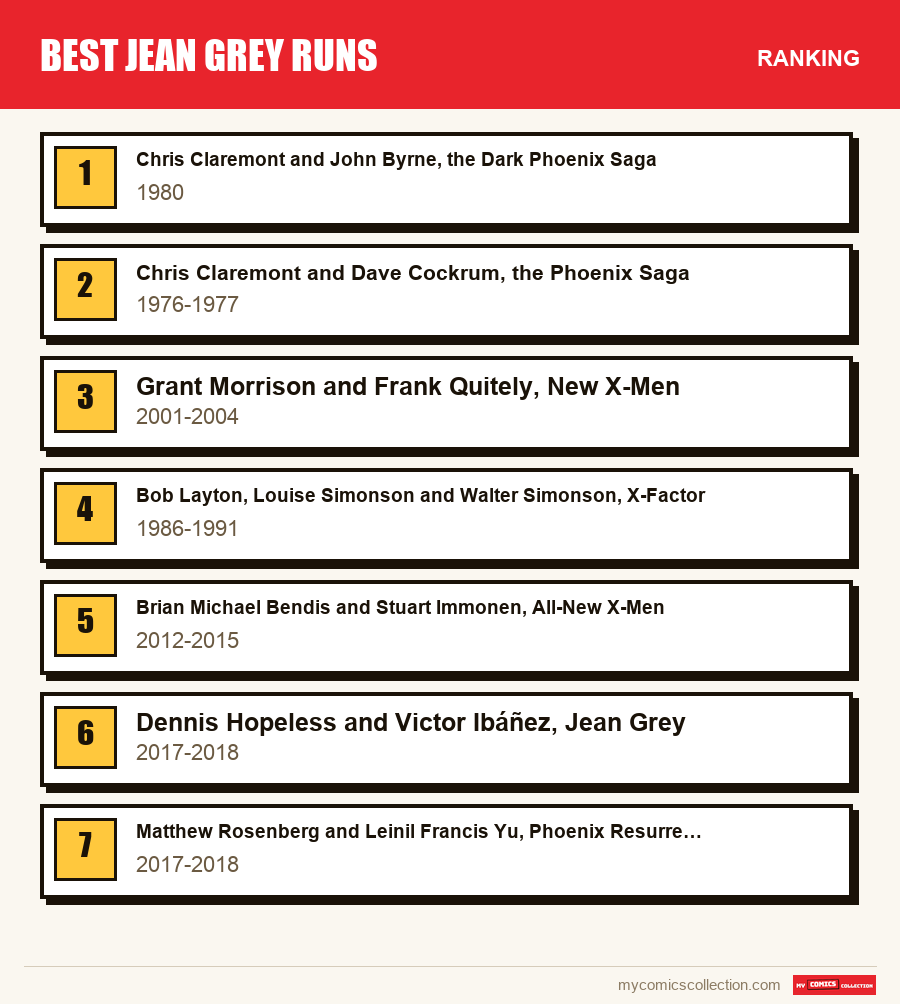
The scoring behind this ranking
Jean Grey has almost no solo series before 2017. She lives in team books, so what we rank is a portion of those books: a stretch of issues in which she plays the central role, not a title in her name. To separate the seven sets, we weighed four things. First, Jean's place in the plot, because a run in which she is only a silhouette behind Cyclops does not make the cut. Second, the story's ability to be read without twenty years of prior reading. Third, the mark left on later writers, measured by what they reused, contradicted or repaired. And finally, how easy it is to get hold of the text today.
This rank judges the reading, not the market. The issues that sell for the most, X-Men #1 (1963) and X-Men #101 (1976), do not open the finest story; they mark a birth. Keep that distinction in mind when we get to the collecting section.
Top 1: Chris Claremont and John Byrne, the Dark Phoenix Saga (1980)
Ten issues of Uncanny X-Men, from #129 (January 1980) to #138, inked by Terry Austin. The Hellfire Club, a secret society operating behind the scenes in the upper circles of New York, takes an interest in Jean; its manipulation of a mind already shaken by the power of the Phoenix tips the story from adventure into tragedy. #129 introduces Kitty Pryde and Emma Frost, and #134 sees Jean appear as Dark Phoenix. From #135 on, the story leaves Earth for space, and the Shi'ar empire ends up demanding accountability, which sets up issue #137.
Why first place? Because John Byrne does not just draw: he takes part in building the plots, and it shows in the mechanics of the episodes, which waste not a single page. The ending was, moreover, changed at the request of the editorial office of the day: the two creators' original plan is not the one that was published. No other Jean run puts such weight on the rest of the mythology: Avengers #263 and Fantastic Four #286, six years later, exist to undo what played out here.
It even suits readers who are strangers to mutants: Claremont slips into each episode the reminders a beginner needs. As for format, the original issues are collectibles in their own right, but the story reads very well in a collected edition. The details of the French editions, from the 1982 newsstand run to the Panini albums, are in our article on the Dark Phoenix Saga in French.
Top 2: Chris Claremont and Dave Cockrum, the Phoenix Saga (1976-1977)
The starting point for everything else. Uncanny X-Men #101 (October 1976) shows Jean back from a space flight that turned into a catastrophe and transformed into Phoenix; Dave Cockrum draws the green and gold figure that will remain the character's visual signature. The #101 to #108 sequence blends this change of status with a war inside the Shi'ar empire, where Lilandra, the rightful heir, seeks the mutants' support against D'Ken. John Byrne arrives on pencils at the end of this period, which sets up the 1980 pairing.
This run matters because it makes Jean the engine of the team: until then, the Marvel Girl of 1963 served as a counterpoint to the other members. It is more dated than the 1980 saga, with explanatory narration that will feel heavy to a contemporary reader, but it supplies the explanation that makes the dark arc legible. We recommend it to anyone who loved 1980 and wants to know where the power comes from. For the collection, #101 is the issue everyone is after; see our piece on X-Men #101 and the first appearance of Phoenix.
Top 3: Grant Morrison and Frank Quitely, New X-Men (2001-2004)
The run goes from #114 to #154 of the series renamed New X-Men. Grant Morrison reinvents the X-Men as an open school, with a Xavier Institute taking in hundreds of students, and places Jean and Scott among the teacher-teammates. Emma Frost, also a telepath, becomes a presence close to Cyclops: this triangle runs through the whole run and tests Jean in a way the 1990s had not foreseen. Frank Quitely draws the first arcs; other artists, including Phil Jimenez and Igor Kordey, take over.
The Phoenix mythology is taken up from a new angle: "Planet X" (#146 to #149) sets up a #150 that upends Jean's situation, then "Here Comes Tomorrow" (#151 to #154) projects the story far into the future, with a cosmic version of the Phoenix. We do not detail the outcome, but #150 is the issue of this run that collectors remember. Our article on Grant Morrison, where to start places this work within the writer's output.
The run is aimed at readers already familiar with the X-Men universe: Morrison's inventions assume you know the conventions he subverts. The issues are abundant and cheap individually; the thick collected editions make for a smoother read.
Top 4: Bob Layton, Louise Simonson and Walter Simonson, X-Factor (1986-1991)
After Avengers #263 and Fantastic Four #286 (January 1986), which reveal that the real Jean was not dead, X-Factor #1 (February 1986) reunites the five original X-Men. Bob Layton launches the series; Louise Simonson then writes it and Walter Simonson draws part of it. The run follows a team that presents itself to the public as mutant hunters in order to better protect young mutants, and Jean's return to normal life there comes with an awkward question: what becomes of Madelyne Pryor, Scott's wife during Jean's absence?
The high point is Inferno (1988-1989), which interlaces X-Factor, X-Men and New Mutants and settles Madelyne's fate. It is also the least accessible of the earlier runs: Inferno assumes reading several titles in parallel. The first issues, on the other hand, are approachable by anyone. For the collection, X-Factor #1 is the issue to aim for, and the pairing of Avengers #263 and Fantastic Four #286 most often sells as a lot.
Do you collect this series?
Track what you own, what you're missing and what your collection is worth. 7-day trial.
Start my trial →
Top 5: Brian Michael Bendis and Stuart Immonen, All-New X-Men (2012-2015)
The idea fits in a sentence: Hank McCoy, worried about Cyclops's evolution, brings the five original X-Men from the past to the present. Jean therefore arrives in a world where she knows a future version of herself played the role of Phoenix, and the run feeds on that knowledge. Brian Michael Bendis writes with a lively ear for dialogue; Stuart Immonen delivers clean, perfectly readable art. Our article on Bendis's history places this work within that career.
This ranking puts All-New X-Men in fifth position because Jean shares the screen with four other characters and the frame is that of a long saga, dependent on crossovers. The pleasure of the whole comes mostly from the scenes in which the young Jean measures the gap between her teenage powers and those of her own future self. It is the ideal run for someone coming from a screen adaptation who wants a fresh Jean. The issues are recent, printed in volume, and pose no access problem.
Top 6: Dennis Hopeless and Victor Ibáñez, Jean Grey (2017-2018)
Eleven issues: the first regular series carried by Jean's name alone. It follows the teenage Jean from the past, whom the series prepares to face the Phoenix Force. Dennis Hopeless writes an almost inward quest, and Victor Ibáñez draws clear pages in which the psychic scenes stand in for big battles. The tone is that of an investigation of the self.
The run is short and dependent on All-New X-Men, which keeps it from climbing higher. It matters all the same because it makes Jean the exclusive subject of a series, a first in her publishing history. Whom to recommend it to? To anyone who prefers a heroine in the making to the tragic figure of 1980. For the collection, eleven modern issues come together quickly; a single collected edition is enough for reading.
Top 7: Matthew Rosenberg and Leinil Francis Yu, Phoenix Resurrection (2017-2018)
A five-issue miniseries, subtitled The Return of Jean Grey, that brings back the adult Jean after years of absence. Jean's return is what is at stake across the five issues, written by Matthew Rosenberg; Leinil Francis Yu delivers dense, sweeping art, very much at ease in action. The sequel is Tom Taylor and X-Men Red (2018), where Jean assembles her own team: the logical follow-up for anyone who wants to see what becomes of the resurrected Jean.
The miniseries closes the ranking because it mostly serves as a milestone: it puts the heroine back in the present more than it offers a standalone story. It speaks to the reader who already knows Jean. It also bridges to the Krakoa era, which House of X and Powers of X open in 2019, and helps in grasping the character's current situation.
Which one to start with, depending on your profile
If you are discovering Jean Grey, start with Top 1 and only go back to 1976 afterwards: the 1980 tragedy is best savored when the ascent is fresh, but it can be understood without it. If you have already read the X-Men and want a new point of view, Grant Morrison's Top 3 will make you read the same characters differently. For someone coming from a screen adaptation who wants a young heroine, Top 5 and Top 6 form a coherent path in few volumes.
The reader who loves crossovers will take the X-Factor route, through to Inferno; the reader in a hurry will pick a single album for the 1980 saga. Our pages on the best Jean Grey arcs complete this ranking, isolating arcs rather than runs.
What these runs are worth as collectibles
A run is valued differently from a single issue. The first reflex is to separate the pivotal issues, which carry the demand, from the ordinary issues, which barely follow it: in the Dark Phoenix Saga, those are #129, #134, #135 and #137; in the 1976 Phoenix, #101; in X-Factor, #1. Between the two families, the price gap is the real indicator of what a reader pays, and it is the one to watch before buying a complete series.
To price a piece, look for completed sales for the same condition and the same edition, and set aside reprints, which skew the comparison. Issues from 1976 to 1980 are scarce in high grade, while issues from 2012 to 2018 are abundant: it is better to buy the latter as a lot and the former one at a time, with a precise idea of the condition you want. On a graded copy, read the whole label before trusting the grade.
The recent series, All-New X-Men, the 2017 Jean Grey and Phoenix Resurrection, have no settled pricing. What will move it depends on factors you follow from afar: the length of the series, successive reprints, the character's possible return in an adaptation, the scarcity of variant covers. We offer no figure for these issues, for lack of stable data. Collected editions, finally, are reading books: they can be found at a reasonable price, and their value comes down to condition and edition. To build your list of pivotal issues, lean on our page of Jean Grey key issues.

Frequently asked questions
It is the Dark Phoenix Saga, a work by Chris Claremont and John Byrne published in 1980 in Uncanny X-Men, from #129 to #138. It is self-contained, compact at ten issues, and remains the benchmark for the character. It comes ahead of the 1976 Phoenix Saga and Grant Morrison's New X-Men, which require more context.
No. The Phoenix Saga, from #101 to #108, explains Jean's merging with the cosmic Force, but Chris Claremont recalls the essentials in the 1980 episodes. Publication order remains preferable if you want to live the ascent before the fall, though it is not a condition.
Yes, since 2017: Jean Grey, by Dennis Hopeless and Victor Ibáñez, eleven issues centered on the teenage version of the character. A 2023 limited series, written by Louise Simonson, then returns to the Phoenix Force. Before that, the character lived only in team books.
Her return is prepared in Avengers #263 and Fantastic Four #286, in January 1986, then established in X-Factor #1 the following month. The first two issues explain that the Jean who disappeared was not the real one; X-Factor reunites her with Cyclops, Iceman, Angel and Beast.
For reading, a collected edition is enough and costs less than a run of single issues. For collecting, aim for the pivotal issues one at a time: #101, #129, #134, #135, #137 and X-Factor #1. The ordinary issues of the 2012 to 2018 runs are so abundant that a collected edition replaces them without regret.
Own an Uncanny X-Men from the Claremont period, an X-Factor #1 or a copy of the Dark Phoenix Saga? Have its condition and its place in the market estimated.
Estimate my comic