
In short
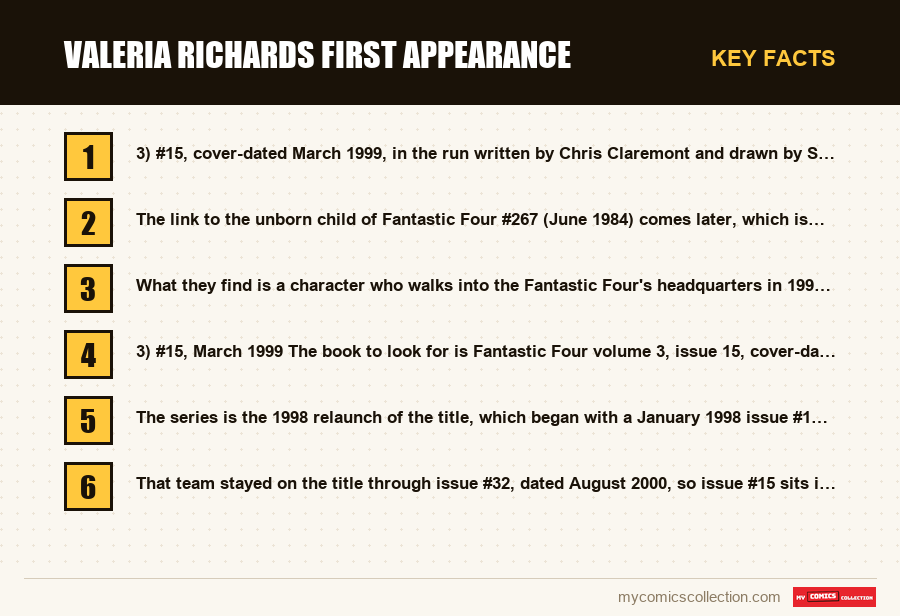
Valeria Richards debuts in Fantastic Four (vol. 3) #15, cover-dated March 1999, in the run written by Chris Claremont and drawn by Salvador Larroca. The issue presents her as a young woman tied to an alternate universe, not as the baby of Reed and Sue Richards. The link to the unborn child of Fantastic Four #267 (June 1984) comes later, which is why her key issues are spread over several volumes and several years.
Few Marvel characters have a first appearance that needs a footnote, and Valeria Richards is one of them. Collectors who type her name into a search bar expect a single issue and a tidy answer. What they find is a character who walks into the Fantastic Four's headquarters in 1999 under one identity, then sees that identity rewritten by the creative teams who followed.
For this guide, the debut issue, its cover date and the creators of the run were checked against the reference pages for the character and for the series. Everything about what to buy and in which order is analysis built on that record, with no prices quoted.
The issue at a glance: Fantastic Four (vol. 3) #15, March 1999
The book to look for is Fantastic Four volume 3, issue 15, cover-dated March 1999. The series is the 1998 relaunch of the title, which began with a January 1998 issue #1 written by Scott Lobdell and drawn by Alan Davis. After three issues, Chris Claremont took over as writer, and Salvador Larroca became the regular penciller with Art Thibert on inks. That team stayed on the title through issue #32, dated August 2000, so issue #15 sits in the middle of a long, stable run rather than at a transition point.
Two practical points follow from that. First, the numbering: this is the third Fantastic Four series, so a seller who lists only "Fantastic Four #15" is describing something else entirely. The original Lee and Kirby series reached its fifteenth issue in 1963 and has nothing to do with Valeria. Always confirm the volume number and the 1999 date before you pay for anything.
Second, the scope of the debut: reference works agree on this issue and on the Claremont and Larroca credit, so the next section describes the appearance itself.
How Valeria enters the story
Issue #15 gives her an unusual parentage: she is introduced as the daughter of the Invisible Woman and Doctor Doom of an alternate universe, a line that makes sense of the name she carries in some reference material, Valeria von Doom. She materializes in the Fantastic Four's headquarters claiming to come from the future, and after an initial clash with the team she is accepted into the group in issue #22 (October 1999).
That framing is exactly why this debut deserves care. A buyer who expects a toddler in a Richards nursery will not find one here. The character on the page is a young adult who has her own agenda, her own powers and a family story that the team has to take on trust. The Doom connection is also what ties the issue to the relationship explored in our look at Doctor Doom and Valeria Richards, where the name Valeria is traced to Doom's lost love.
The creative team of the 1999 run is Claremont and Larroca with Thibert inking.
Why the Richards name is a later reading
The word "Richards" is attached to this character by a chain of later stories, and the earliest link in that chain is older than the 1999 debut. In Fantastic Four #267, cover-dated June 1984, the series written and drawn by John Byrne reveals that Sue Richards had been carrying a second child with Reed. In that issue the unborn baby is the story's subject, not a character who appears as an adult or a child. Her brother's story starts elsewhere: Fantastic Four Annual #6 (November 1968), by Stan Lee and Jack Kirby, introduced Franklin, and Fantastic Four #94 (January 1970) gave him his name.
Byrne's tenure as writer, penciller and inker ran from issue #232 (July 1981) to issue #293 (August 1986), so issue #267 is a deep-run Byrne story, and it is worth owning on its own merits for readers who follow his work. If that run is new to you, John Byrne: where to start maps the key points, and the John Byrne author page lists the other titles he handled.
The reconnection came in the years after the 1999 debut. Later writers explained that the young woman who had appeared in issue #15 was the child from that 1984 story, whom Franklin had saved under Roma's guidance. In that reading, issue #15 becomes the first appearance of a person who is later identified as Valeria Richards, while the 1984 issue is the first story to concern her as an unborn baby. Both statements are true at once, and which one you chase depends on whether you collect appearances or origins.
Who made her, and in what editorial moment
The creators credited on the debut are Chris Claremont and Salvador Larroca. Claremont arrived on the 1998 relaunch after Scott Lobdell and Alan Davis opened the series, which means the character was born during a deliberate reset of the book. A new volume is exactly when a publisher can introduce a mysterious newcomer without disturbing decades of continuity, and Valeria is the clearest example of that freedom in the Claremont stretch.
The reference page for the character adds a detail about the creative handover. Claremont had a plan to resolve her storyline, but he left the title before he could carry it out. When the book moved to a new team, Carlos Pacheco took over as penciller and co-writer, first with Rafael Marín, then with Marín and Jeph Loeb, and that team took the character in a different direction and changed her origin. For a collector this is useful context: the 1999 issue is not the end of a planned arc but the start of a thread that was picked up, bent and redrawn by successors.
The tables for the series place Pacheco and Marín on issues #35 to #54 (2000 to 2002), with Loeb credited on #38 to #50. That span is where the character's identity is revised, and it is the second cluster of issues worth keeping in a Valeria run.
Do you collect this series?
Track what you own, what you are missing and what your collection is worth. 7-day trial.
Start my trial →
Why the issue matters for a collection
There are three reasons to treat issue #15 as a key issue rather than a curiosity.
The first is the obvious one: it is the debut of a character who later became a permanent member of the Fantastic Four's extended family. Valeria returned to the main universe in Dan Slott's 2018 relaunch of the series, alongside Franklin, and she has stayed a visible part of the family in the years since. A debut issue of a character who keeps coming back is a more durable collecting target than one tied to a single storyline.
The second is the connection to Doctor Doom. The 1999 story gives Valeria a Doom-related origin and the name Valeria von Doom, and later stories keep returning to that bond, including the 2003 storyline in which Doom places a spell on her. If Doom is the reason you are here, the Doctor Doom hub gathers the rest of his history.
The third is the rewritten origin: a reader who learns that the young woman of 1999 is the baby of 1984 has a reason to read both issues.
Reprints, collected editions and issues people mix up
Several look-alike numbers circulate in listings, and a short checklist avoids most mistakes.
- Fantastic Four #15 from 1963. A different series, different creators, no Valeria. Check the year on the cover.
- Fantastic Four #267 (June 1984). The story of the unborn child, by John Byrne. It is a vital companion but not her debut as a character who appears on the page.
- Fantastic Four Annual #6 (November 1968) and Fantastic Four #94 (January 1970). These concern Franklin Richards, not Valeria. They are sometimes sold in the same lot as "Richards family firsts."
- The 1998 volume 3 against later relaunches. The 2018 relaunch by Dan Slott starts again at #1, and a seller who writes "Fantastic Four #15" without a volume could mean any of them.
- Direct and newsstand copies. Some issues of the era exist in both editions, and the barcode box on the cover tells them apart. Neither is a different story, but a listing should say which it is.
For a read-only way into the 1999 run, the issues are available in the collected volumes of the Claremont period, and the reprint and fake reprint guide explains how to tell a legitimate reprint from an original when a listing is vague.
What to check before you buy
Because this is a late-1990s book, the checklist is less about age and more about handling. A modern-era comic printed in 1999 should be crisp, and the common faults are the ones a quick look catches.
Start with the spine. Stress lines, small color-breaking creases and spine ticks are the usual downgrade points on books of this period, and they are easier to see under a raking light than flat. Check the corners and the top edge for the small dents that come from stacking in a long box, and look at the staples for rust or bleed marks. Open the pages and look for tanning at the margins, which tells you how a copy has been stored.
Next, the edition. If the barcode area shows a direct market box, the copy came through comic shops; a newsstand copy carries a standard barcode instead. Both are legitimate, and a seller should name which one it is.
For a graded copy, read the label rather than the case. Compare the volume, the issue number and the March 1999 date on the label with the comic inside the case, then read the page-quality line and any defect notes. Cases can be reused or tampered with, and a label that does not match the book is a reason to walk away. The Fantastic Four grading guide goes through the grade bands and what each defect costs a copy in relative terms.
Finally, the method for judging price without quoting any: compare the same issue in the same grade across several recent completed sales, set aside outliers tied to a short-lived spike, and keep a note of the sale dates.
The appearances after the debut that count
If you want a short, defensible Valeria run rather than a single book, these are the issues to put next to the debut.
- Fantastic Four (vol. 3) #22 (October 1999). The team accepts her after the first conflict, which confirms how the early version of the character is meant to be read.
- Fantastic Four (vol. 3) #49 (January 2002). Valeria helps reconstitute Galactus, and the resulting reality shift reverts her to a fetus.
- Fantastic Four (vol. 3) #54 (June 2002). The issue in which she is reborn, the key step in the revised origin written by Pacheco and Marín.
- Fantastic Four (vol. 3) #67 to #70 (May to September 2003). The storyline in which Doom places a spell on her that makes her his familiar.
- Runaways (vol. 4) #1 to #4 (August to November 2015). A Secret Wars tie-in in which she leads the Victor von Doom Institute for Gifted Youths in Latveria.
A collector with a small budget in mind can reasonably stop after the debut, issue #267 and issue #54, because those three carry the whole identity story: the baby, the adult who appears, and the rebirth. The longer list becomes interesting once you want the Doom thread, and the Hickman run on Fantastic Four shows how the family's mythology kept growing around Doom after these stories.
Valeria's issues span more than one volume and a few other titles, so record the volume, number, cover date and edition for each copy. That habit prevents the classic mistake of buying a second "issue 15" from another decade. The Fantastic Four first appearance guide shows how the original book sits beside the later key issues, and the blog index lists the rest.
Frequently asked questions
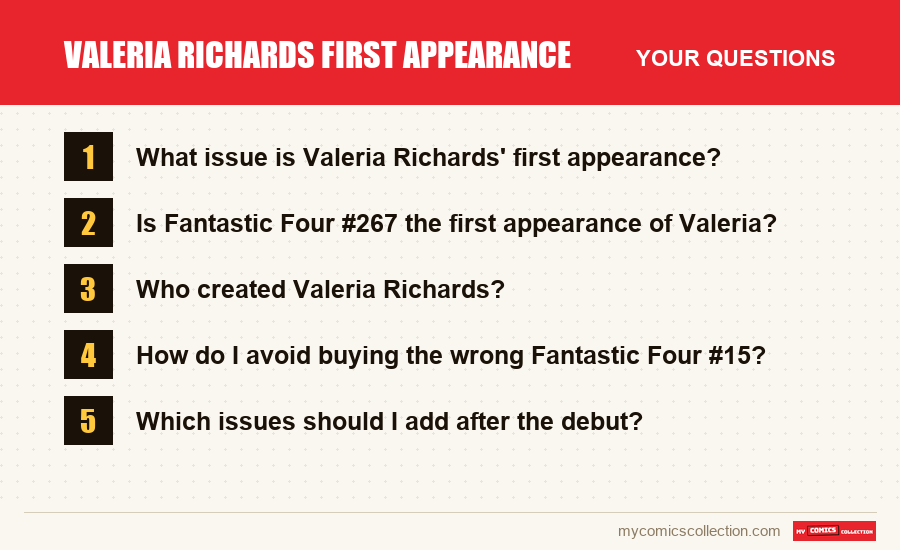
Reference works place it in Fantastic Four (vol. 3) #15, cover-dated March 1999, by Chris Claremont and Salvador Larroca. In that issue she is presented as a young woman from an alternate future, and later stories identify her as the daughter of Reed and Sue Richards.
No. Issue #267 (June 1984), written and drawn by John Byrne, concerns the unborn second child of Reed and Sue. Later stories tie it to Valeria, yet the character introduced in 1999 does not appear in it. Collectors who want the origin thread should own it next to the March 1999 debut, as a companion rather than a substitute.
Writer Chris Claremont and artist Salvador Larroca are credited with creating the character during their run on the 1998 Fantastic Four series. Art Thibert inked that run. Later teams, including Rafael Marín, Carlos Pacheco and Jeph Loeb, reshaped her origin in the issues that followed.
Check the volume and the year. The 1999 issue belongs to the third series and is cover-dated March 1999, while the 1963 issue of the original series has no connection to Valeria. A listing that omits the year or the volume should be questioned before you pay.
Start with issue #267 for the origin link, then Fantastic Four (vol. 3) #22, #49 and #54 for her acceptance by the team and her reversion and rebirth. Issues #67 to #70 add the Doom storyline, and Runaways (vol. 4) #1 to #4 covers her Secret Wars role.
Found a copy of the March 1999 Fantastic Four issue in your boxes? Get a quick read on its likely grade band before you decide whether to send it for grading.
Estimate my comic