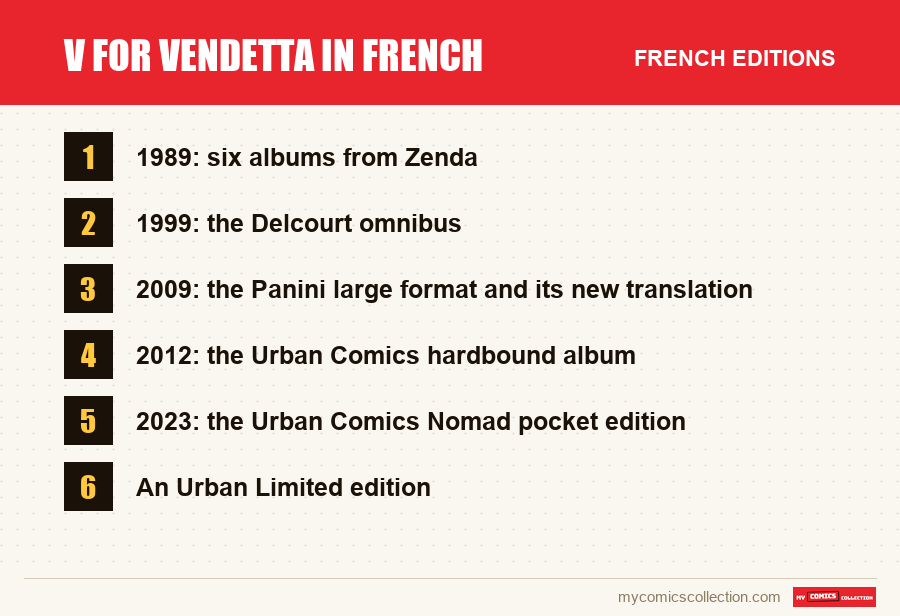
To read V for Vendetta in French, the Urban Comics Nomad pocket edition (2023) is the simplest, and the 2012 Urban hardbound album is the best compromise on format. Readers who want a different French text should look for the 2009 Panini edition, the only one with a new translation. Collectors of the first French edition should aim for the six Zenda albums of 1989, then the Delcourt omnibus of 1999.
Few English-language comics have been published in France in so many forms: six albums with V titles, an omnibus in the Contrebande collection, a large-format edition, a hardbound collection and a pocket book. Each follows a different breakdown and translation, and the right choice depends on whether you read, collect or shelve.
As always in this guide, only verified information (creators, issues, dates) is stated as fact; the analysis is our own, with no reproduction of protected pages or dialogue.
The original edition in brief
Alan Moore wrote it, David Lloyd drew it. The story first appeared in black and white in the British magazine Warrior, published by Quality Communications: from issue 1, dated March 1982, to issue 26, dated February 1985. The episodes announced for issues 27 and 28 were never published in the magazine, which folded.
DC Comics then took the story up in color, in ten issues, from September 1988 to May 1989. The Warrior episodes were reprinted there, then the new material began with issue 7, from January 1989, which contains the two episodes that had been left in the drawer. Steve Whitaker and Siobhan Dodds did the colors for the DC series.
Keep this path in mind, because it explains why the French editions do not line up: the material exists in three states, magazine, ten individual issues and collections. The details of the American pieces to look for are in our collecting guide. Here, we stay on the side of the French-language albums.
The French editions, in order of publication
1989: six albums from Zenda
The first French edition is the one from Zenda, starting in 1989. It comes in six volumes whose titles all begin with the letter V: "Visages", "Vérités", "La Valse du vice", "Valérie", "Voyages" and "Victoria". The library records credit Jacques Collin as translator of the "Visages" and "Vérités" volumes.
One point remains open: the date of the last volume. An online encyclopedia places it in 1990, while the library records date all six volumes to 1989. We do not settle it. Nor do we detail which American issues each volume contains, for lack of a reliable source; the fact that Zenda splits into six a body of American material running to ten issues is enough to rule out any one-to-one match.
1999: the Delcourt omnibus
Delcourt published in January 1999 an omnibus in a single hardbound volume, in its Contrebande collection. The translation is by Jacques Collin, as in the Zenda albums. The page count varies a little from one listing to another, 271 or 272 pages, and we do not retain it.
For the first time, the French reader gets the whole story under a single cover.
2009: the Panini large format and its new translation
Panini Comics launched a large-format line called Vertigo Deluxe in September 2009, and V pour Vendetta (V for Vendetta) was its first title. The publisher presents it as a complete edition. The translation is new: it is by Alex Nikolavitch, and it is the only one on this list that does not reuse Jacques Collin's text.
We did not retain the page count: a press release gives 288 pages, a book database 272. For a reader attentive to the text, this is the edition apart, the one that lets you compare two translations of the same story.
2012: the Urban Comics hardbound album
Urban Comics published in May 2012 a hardbound omnibus in the Vertigo Essentiels collection, in a format of about 29 by 19 centimeters. The translation goes back to that of Jacques Collin. Here again, the listings contradict each other on the page count, 334 or 352 pages, and we do not choose.
This is the edition to favor for a lasting book: hardbound, of reasonable size, written in the oldest French text, without the translation break of 2009.
2023: the Urban Comics Nomad pocket edition
On January 20, 2023, Urban Comics released a pocket-size, paperback version of 352 pages in its Nomad collection. The records credit Jacques Collin for the translation, Siobhan Dodds and Steve Whitaker for the colors, and mention additional art by Tony Weare for some chapters.
The mention of Tony Weare matters: it is a reminder that not every chapter is by David Lloyd. This is the lightest edition, the cheapest to live with, and the one to leave in a bag.
An Urban Limited edition
A limited, numbered edition also exists at Urban Comics, under the Urban Limited label. We found only a single bookseller listing about it, which is not enough to give its date or exact contents. If it interests you, check it with the publisher before any purchase.
US / French correspondence
Since the American breakdown into three states (magazine, ten individual issues, collections) does not overlay any French edition, the following table indicates only what is verified: the publisher, the form and the announced contents.
| French edition | Year | Form | Translation | Contents |
|---|---|---|---|---|
| Zenda | 1989 | Six volumes with V titles | Jacques Collin ("Visages" and "Vérités" volumes) | Breakdown by US issue not documented |
| Delcourt, Contrebande | 1999 | Hardbound omnibus | Jacques Collin | Whole story |
| Panini, Vertigo Deluxe | 2009 | Large format, omnibus | Alex Nikolavitch | Whole story |
| Urban, Vertigo Essentiels | 2012 | Hardbound omnibus | Jacques Collin | Whole story |
| Urban, Nomad | 2023 | Pocket, paperback | Jacques Collin | Whole story, additional art by Tony Weare |
The page count does not appear in this table, on purpose: the listings consulted diverge too much for it to serve as an identification criterion.
Do you collect this series?
Track what you own, what you're missing and what your collection is worth. 7-day trial.
Start my trial →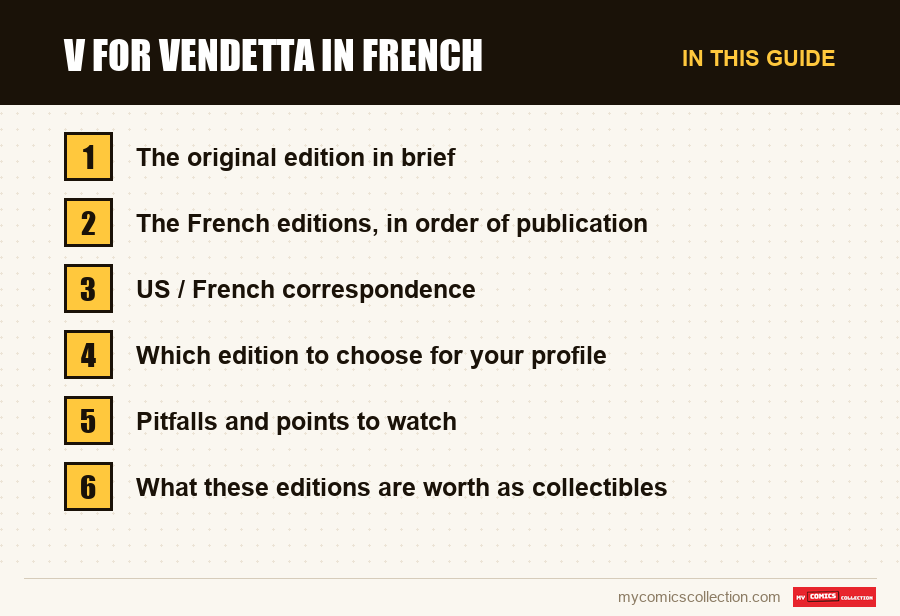
Which edition to choose for your profile
You simply want to read
For an easygoing read, the 2023 Nomad pocket edition goes anywhere. If you prefer a book that holds up on a shelf, the 2012 hardbound album suits better. In both cases, you read Jacques Collin's text, which gives you a point of comparison with the older copies.
You want to read a different translation
The 2009 Panini edition is the only one whose French text differs. If you already know a Collin version, it will show you what a new translator changes in the same story. It is also the bulkiest of the five.
You collect the first French edition
You need the six Zenda albums, one by one. Count the titles: a copy of "La Valse du vice" does not replace "Valérie". Check that the series is complete before buying it as a lot, because the albums scatter easily. An incomplete lot has the value of loose parts, not of a series.
You like large formats
Choose between the 2009 Panini and the 2012 Urban. The first is a large format from a deluxe line and the second is a hardbound album of 29 by 19 centimeters. Compare photographs of the spines and edges: on these thick volumes, that is where wear shows.
Pitfalls and points to watch
Two translations in circulation
Three editions reuse Jacques Collin's text, one offers Alex Nikolavitch's. A quotation found in one book is therefore not necessarily valid in another. For research work, always note the publisher and the year. Our guide to the translation of character names in French editions shows other cases where the same name changes from one edition to another.
Six volumes, ten individual issues
The Zenda albums do not follow the American breakdown into ten issues. If you want to match a volume with the DC series, do not do so from the title alone: we have no source establishing the correspondence. A seller who claims it without a reference is taking a risk you do not have to share.
Dates that diverge
The last Zenda volume is dated 1989 by some and 1990 by others. Even the date of the Delcourt omnibus depends on the listing read: 1999 for the release, another year for the collection. When you catalog, enter the year printed in your copy.
A story by several hands
The main artist is David Lloyd, but some chapters have additional art by Tony Weare. A copy that omits this credit is not fake for that reason: credits vary by publisher. Do not reject a book for this reason alone.
The film is not the source
None of these editions reuses the film's screenplay: this is the story by Moore and Lloyd, and nothing else. To measure the gap between the feature film and the book, read our comparison of the film and the comics.
What these editions are worth as collectibles
This market is read through relationships, not figures. The first relationship sets the Zenda series against single volumes: six out-of-print albums to complete cost more than the apparent total, because the last missing one sets the price of the whole. The second sets the editions still in Urban Comics' catalog against those that no longer are: as long as a publisher reprints, the secondhand price stays capped.
The third relationship concerns condition. On a large-format hardbound, the corners and the head of the spine wear first; on a pocket book, it is the edge. A clean copy of the Panini edition is not worth more, on principle, than a clean Urban copy: scarcity makes the difference, not the age of the paper.
To estimate without going wrong, collect several completed sales of your exact edition, discard lots and keep the central value. Our explanation of how to estimate a French-edition comic repeats these steps. Keep the valuations of Warrior and DC issues separate: they are English-language objects, with a worldwide market that has nothing to do with that of the French albums.
Frequently asked questions
The one from Zenda, starting in 1989, in six volumes with titles beginning with a V: Visages, Vérités, La Valse du vice, Valérie, Voyages and Victoria. Jacques Collin is named as translator for at least two of them. The date of the last volume varies, 1989 or 1990, depending on the sources consulted.
The 2009 Panini edition, published in the Vertigo Deluxe large-format line, is the only one to offer a new translation, by Alex Nikolavitch. The Delcourt (1999), Urban (2012) and Urban Nomad (2023) editions reuse Jacques Collin's translation, used since the Zenda albums.
It is presented as an omnibus in a single hardbound volume, released in January 1999 in the Contrebande collection, translated by Jacques Collin. It is the first French edition to bring the story together under a single cover. The exact page count varies by listing, 271 or 272, and we do not guarantee it.
No, not one to one: Zenda offers six volumes, and the American series has ten. We found no source saying which episodes are in which volume, and we do not invent it. To check off your collection, rely on the French titles rather than the US issue numbers.
The January 2023 Nomad contains Jacques Collin's translation across 352 paperback pages, with colors by Siobhan Dodds and Steve Whitaker. The 2012 hardbound album offers a larger format and better durability. The pocket edition is enough for reading; the album suits a library.
Do you own a French edition of V for Vendetta, from a Zenda album to the recent pocket book? Estimate it from sales of your edition.
Estimate my comic