V for Vendetta, by Alan Moore and David Lloyd, exists in three original forms. First in black and white, serialized in the British magazine Warrior (Quality Communications), from #1 of March 1982 to #26 of February 1985, when the magazine stopped and left the story unfinished. Then in color, in a ten-issue miniseries published by DC Comics from September 1988 to May 1989, which takes up the Warrior episodes and delivers the ending, new from #7 on. Finally in collections, including the Absolute edition of August 2009. In France, the story came out from Zenda as early as 1989, then in omnibus from Delcourt (1999), Panini (2009, new translation) and Urban Comics (2012). For a collection, the two original pieces are the Warrior issues and the 1988 DC #1.
For most readers, V for Vendetta is a book: a bound volume, a smiling mask on the cover, a complete story. Yet it is one of the works with the most bumpy editorial path in English-language comics. It began in a British black-and-white magazine, broke off in the middle of a chapter, slept for three years, then was finished and colorized by an American publisher.
This path makes V for Vendetta a singular collectible. There is not "one" first issue, but two, in two countries, in two formats, six years apart. This guide untangles these publications, then the French editions, and indicates what really deserves a place in a collection.
First life: the Warrior serial (1982-1985)
Warrior is a British anthology launched by the publisher Dez Skinn at Quality Communications. The first issue is dated March 1982. The magazine brings together several short series per issue, on the model of English weeklies, but monthly and for an older readership. V for Vendetta shares its pages notably with Alan Moore's Marvelman.
Skinn had asked Moore and David Lloyd, who had already worked together, for a dark story in the spirit of 1930s pulps. The two creators ultimately chose a near future rather than a reconstructed past: a Britain turned fascist after a nuclear war, and a masked anarchist who sets out to bring it down.
The episodes appear in black and white, drawn by Lloyd with large flats of shadow and no sound effects. Almost every issue of Warrior contains one, up to #26 of February 1985. A few issues are exceptions: #17 publishes instead a text by Moore, "Behind the Painted Smile," which tells the series' genesis, and #20 a short vignette, "Vincent." #5 also contains a vignette, "Vertigo."
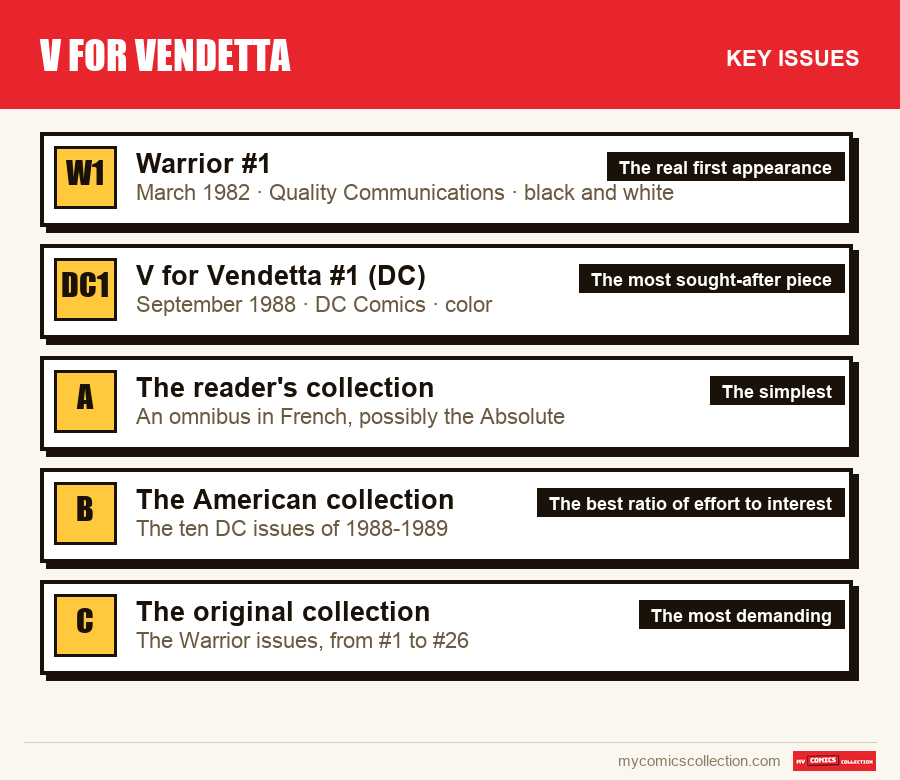
Warrior #1
It is the first published episode of V for Vendetta, and therefore the first appearance of V and Evey Hammond. The issue also contains the first episode of Moore's Marvelman, which makes it a double piece of history. The magazine format, larger and more flexible than an American comic, calls for particular attention to the condition of the spine and corners.
In 1985, Quality Communications stops Warrior. Two additional issues were ready, with the next episodes of V, but they do not come out. The story breaks off at the end of the second book, and several publishers then try to convince Moore and Lloyd to finish it with them.
Second life: the ten DC issues (1988-1989)
It is DC Comics that gets the sequel. The publisher publishes in 1988 and 1989 a ten-issue miniseries, in American comic format, with coloring entrusted to Steve Whitaker and Siobhan Dodds, with David Lloyd. #1 is dated September 1988, #10 May 1989.
The first six issues take up the Warrior episodes, colorized. The new material begins at #7: it contains first the episodes planned for issues 27 and 28 of Warrior, never published, then the end of the story. Tony Weare draws the "Vincent" chapter and takes part in two others.
| DC issue | Cover date | Content |
|---|---|---|
| #1 to #6 | September to December 1988 | Warrior episodes in color |
| #7 | January 1989 | First new episodes (those of Warrior #27 and #28) and interludes |
| #8 to #10 | February to May 1989 | End of the story, entirely new |
V for Vendetta #1 (DC)
It is the work's most in-demand issue: first American single issue, first in color, iconic cover, and far wider distribution than Warrior, therefore easier to find. The ten issues form a short and coherent run, which is realistic to complete.
The content: three books, one story
Whatever the format, the story divides into three books. "Europe After the Reign" sets up Norsefire's Britain and the meeting between V and Evey. "This Vicious Cabaret" ends where Warrior broke off. "The Land of Do-As-You-Please" is the book written and drawn after DC took over. Added are off-continuity interludes and Moore's essay, taken up in most collections.
This split has a reading consequence that collectors know well: the first two books were conceived for black and white. The color of the DC edition, sober and often muted, was designed to respect Lloyd's art, but it changes the perception of some pages. Reading both versions is not a scholar's whim, it is seeing two slightly different works.
The 2005 film drew on these three books while deeply changing the point. Our article V for Vendetta, the film versus the comics details these gaps. Here, we stick to the paper editions.
The English-language collections
The first one-volume collection comes out in the United States in May 1990, with a preface by David Lloyd. The following reissues are published under DC's Vertigo label, and in the United Kingdom by a licensed book publisher. A new hardcover edition, with improved printing and colors, comes out in 2005. In August 2009, DC publishes an Absolute edition, in oversized slipcased format.
These collections made V for Vendetta a lasting bookstore success: DC reported in 2006 having sold more than 500,000 copies in the United States. It is also what explains why the original single issues have remained collector's objects, read by a minority.
The French editions, from Zenda to Urban Comics
In France, the work has known four successive publishers, each with its format and, for one of them, its own translation.
Zenda, from 1989
The first French edition comes out at Zenda in successive albums, from 1989, almost at the same time as the end of the DC series. The translation is signed Jacques Collin. For a French collector, these are the original French-language editions, to be distinguished from reprints.
Delcourt, 1999 omnibus
Delcourt publishes the work in a single volume in 1999, in its Contrebande collection, devoted to adult comics. It is the edition that introduced the book to a generation of French readers.
Panini, 2009
Panini Comics publishes an omnibus in its Vertigo Deluxe collection in 2009, with a new translation by Alex Nikolavitch. It is the only French edition that does not reuse Jacques Collin's text.
Urban Comics, since 2012
After taking over the DC and Vertigo catalog in France, Urban Comics in turn publishes an omnibus in 2012, which returns to Jacques Collin's old translation. It is the edition available today.
The coexistence of two translations interests the reader as much as the collector: the "V" wordplays scattered through the original text have been rendered differently. Our comparison French first edition or reissue explains why, on the French market, a first album edition stands clearly apart from the following omnibuses.
What to collect, and in what order
The choice depends on what you are looking for: the work as it was conceived, the most recognized object, or a reader's library.
The reader's collection
A French omnibus is enough to read the complete work, essay and interludes included. If you read English, the 2009 Absolute edition offers the best reading comfort and the largest format to appreciate Lloyd's art.
The American collection
Ten single issues, wide distribution, an iconic first issue: it is the most realistic run to complete in fine condition. Start with #1, then #7, which opens the new part, before filling in the rest.
The original collection
Gathering the Warrior issues that contain V for Vendetta means owning the work in its first state, in black and white, as Moore and Lloyd drew it. It also means gathering Moore's Marvelman at the same time. The difficulty lies in the magazine format and limited British distribution.
To place this work in its writer's career, see our history of Alan Moore. For his other great book of the decade, also published at DC, our Watchmen collecting guide follows the same approach.