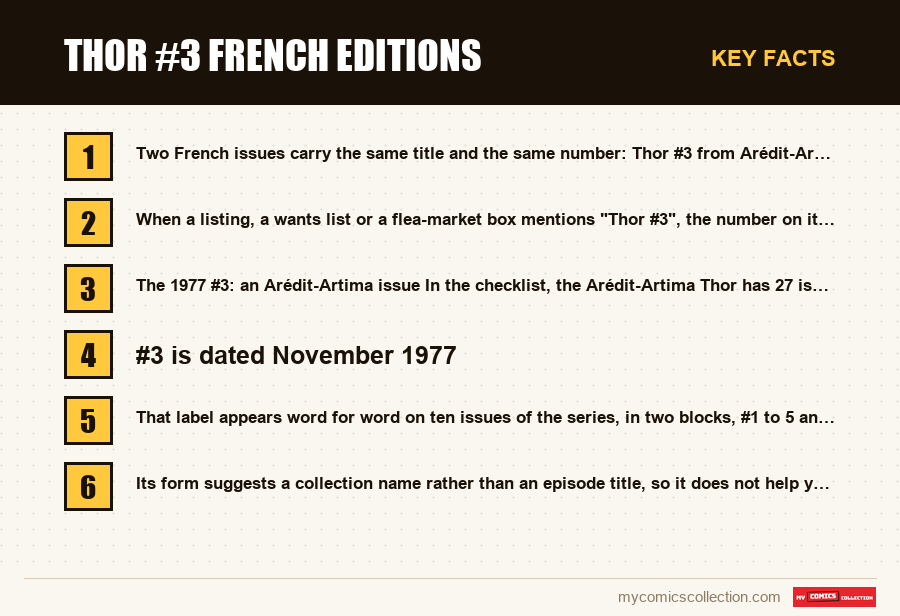
Two French issues carry the same title and the same number: Thor #3 from Arédit-Artima, dated November 1977, and Thor #3 from Semic S.A., dated 1989 with no further detail. In the catalogue, their credits share no name. The publisher and the creators are therefore what tell them apart, not the number. Neither one is the "first" of anything: the checklist says nothing more than that.
When a listing, a wants list or a flea-market box mentions "Thor #3", the number on its own identifies nothing. At least two French issues carry it, separated by about a dozen years and by a complete change of publisher and creative team. This page compares them, because their relationship is what causes trouble for the collector.
As always on this guide, only verified information (creators, issue numbers, dates) is stated as fact; the analysis is our own, with no reproduction of artwork or protected dialogue.
The 1977 #3: an Arédit-Artima issue
In the checklist, the Arédit-Artima Thor has 27 issues numbered 1 to 27, with no gap in the numbering. #3 is dated November 1977. Its credits, at the level of the issue: Stan Lee and Larry Lieber for writing, Jack Kirby, Carmine Infantino and Paul Reinman for art.
The "story title" field reads "Collection Flash". That label appears word for word on ten issues of the series, in two blocks, #1 to 5 and then #9 to 13. Its form suggests a collection name rather than an episode title, so it does not help you recognise #3 in particular, unlike the credits.
One detail makes this #3 more distinctive than its neighbours: Paul Reinman is credited on this issue alone in the 1977 checklist, and Larry Lieber on three, #3, #6 and #18. This is a useful identifying clue, with the caveat that these credits belong to the issue, not to a specific episode.
The Semic S.A. #3: an issue dated by year alone
The Semic S.A. Thor opens, in the checklist, on this same #3. Its story title is "The Storm Giants", its writer Walt Simonson, its artists Sal Buscema and Walter Simonson. The cover date is a single word: "1989". No month is given.
The spelling of the name deserves a note. The checklist sometimes writes "Walt" and sometimes "Walter" Simonson, occasionally within the same issue (this is the case for #4, as writer). It is very probably one person, but the catalogue does not say so: if you search for this creator by name, try both spellings.
Another point changes how the checklist should be read: of the 29 Semic issues, four (#4 to 7) have no cover date at all. For #3, having the year is therefore already better than its immediate neighbours, but it is not a month.
"The checklist starts at #3" does not mean "the series starts at #3"
The 1977 Thor is documented from its #1. The 1989 one is documented from its #3. It is tempting to conclude that the Semic series began at #3, for example because it continued an earlier count. The data does not allow that.
What can be stated: in the checklist, the lowest Semic number is 3, and the run has no gaps up to #31. What cannot be stated: that the two preceding numbers never existed, or that they do. An absence in a catalogue may mean a series really launched at #3, or simply that issues have not been listed yet. Sources differ on this point, and it has to be checked against a copy or other references.
The figure "29" is itself a trap. It counts the issues in the checklist; it is not the number of the last one, which is #31. Someone who wrote "29 issues, so up to #29" would be off by two places.
Credits as a means of identification
Between the two #3s, no name is shared, neither for writing nor for art. For the 1977 Thor, Stan Lee is credited on 18 issues and Jack Kirby on 18 as well. In the 1989 checklist, neither appears on any of the 29 issues.
This contrast goes beyond the #3 alone. At Semic, Tom DeFalco and Ron Frenz are each credited on 27 issues, all of them from #5 to the last one in the checklist. Neither appears in the Arédit-Artima checklist. For the bulk of the credits, the catalogue therefore shows two distinct teams.
A few names do cross from one series to the other, outside of #3. Sal Buscema, for example, is credited on four Arédit-Artima issues and on four Semic issues.
This last point calls for caution: a shared name does not prove shared content. The catalogue does not link creators to episodes, and nothing indicates that pages drawn for one series appear in the other.
Do you collect this series?
Track what you own, what you are missing and what your collection is worth. 7-day trial.
Start my trial →
What affects the value of these two issues
The checklist contains no prices, so this is a method, not a figure. The 1977 #3 sits early in a series of 27 issues; the 1989 one sits in a set of 29, of which it is the oldest on the checklist. For a buyer aiming at the complete series, each of them is a link in the chain, not an isolated piece.
Three factors play a part: the condition of the paper and cover, whether the neighbouring issues are in the same lot, and whether the issue really is the one you think it is. That last condition is specific to this case: a listing that only says "Thor 3" does not say which series the copy comes from, and nothing in the checklist allows us to assume that the two are worth the same.
Neighbouring issues, on the 1977 and 1989 sides
On the Arédit-Artima side, #2 is dated September and #4 January 1978: the checklist lists no issue dated October, and #3 fits a two-month rhythm. #5 credits Stan Lee and Jim Steranko for writing. #6, "The Mysterious Mr. P", is the first whose title is no longer "Collection Flash".
On the Semic side, #4 is titled "The Song of Mjolnir", #5 "From One Shell to the Next!", and #6 "The Clash of the Titans". Like #3, they carry Simonson and Sal Buscema; DeFalco and Frenz join from #5 onward. #3 therefore belongs to a small opening block crediting the Simonson team, before a switch to DeFalco and Frenz, whom Simonson no longer joins afterwards.
To sort a mixed lot, look at these neighbours first: an issue dated 1978 belongs to Arédit-Artima, and a "Song of Mjolnir" belongs to Semic.
How to record this issue without making a mistake
On a list of gaps, "Thor #3" is an ambiguous line. Write instead "Thor, Arédit-Artima, #3, November 1977" or "Thor, Semic, #3, 1989". The publisher, printed on the object, is the first check; the date comes next; the credits serve only as a last resort, since they are read at the level of the issue and their spelling varies.
Also keep two separate lines if you are looking for both: if one is ticked, the other is not ticked along with it. On the Thor hub, an apparent duplicate is not always a real duplicate.
Storing and tracking these two copies
Store them separately, with the publisher noted on the sleeve. The two #3s look alike by title: that is precisely why they end up side by side and then get confused years later. For tracking, note the publisher, the year, the condition and what you checked yourself, keeping apart what the checklist says from what you observed on the object.
What you cannot deduce from a catalogue page: the full contents, a possible first French appearance of a character, or a match with an American issue. For that, the copy in hand remains the only source. The other guides on the site are gathered in the blog.
Frequently asked questions
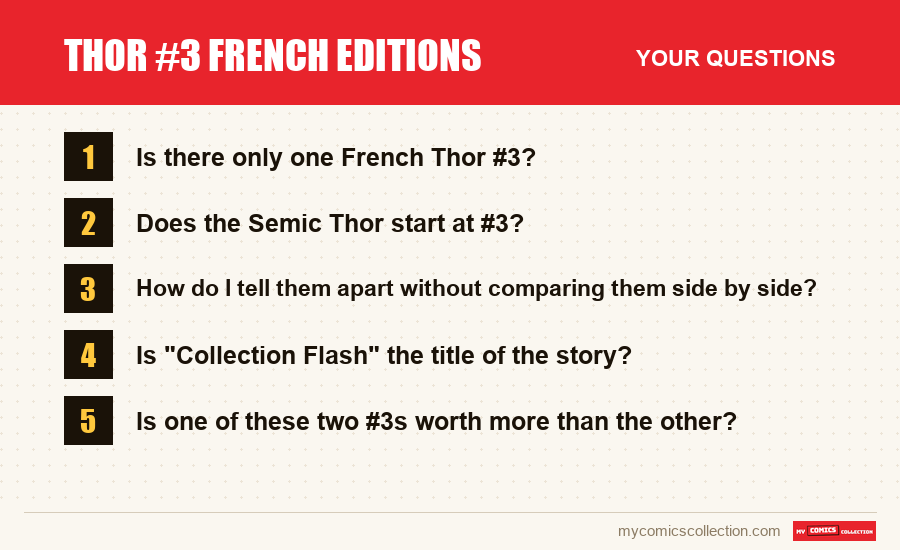
No, the checklist lists two: one from Arédit-Artima dated November 1977, one from Semic S.A. dated 1989. They share the title and the number, but neither the publisher, the period nor the credits. So always check the publisher before buying or ticking a line on a list.
The checklist starts at #3, which is not the same thing. It does not say whether #1 and #2 exist: an absence from a catalogue is not proof. Only a copy or another reference can settle the question without risk.
By the publisher printed on the object, then by the date: November 1977 against 1989. The credits confirm it: Stan Lee, Larry Lieber and Kirby on one side, Simonson and Sal Buscema on the other. No name is shared by the two issues.
The checklist gives it as the story title, but it looks like a collection name. It is repeated on ten issues of the Arédit-Artima series, so it does not identify #3 on its own: only the date and the credits do.
The checklist contains no prices, and we do not invent any. Value depends on condition and on the market. Start by knowing exactly which of the two you hold, then have that specific copy valued, with its real condition.