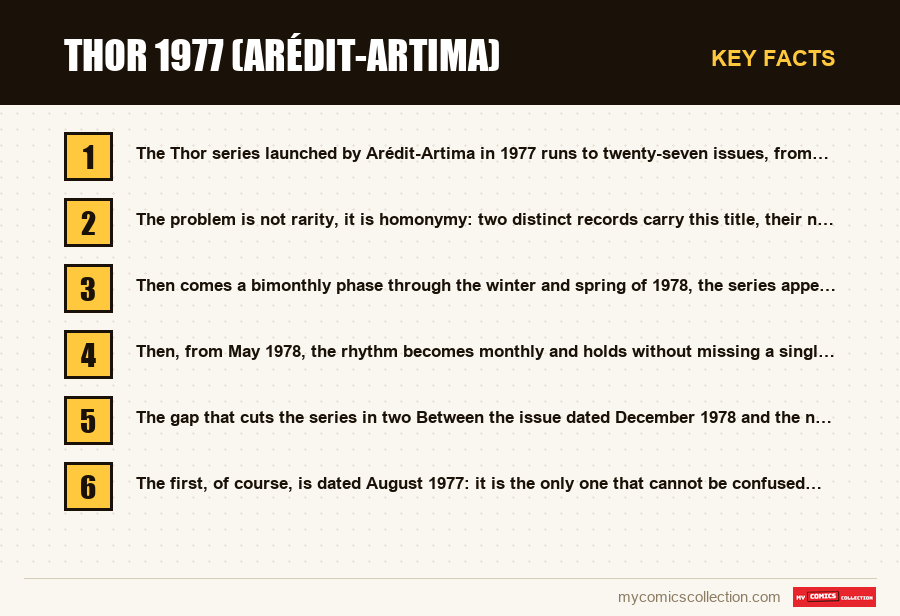
The Thor series launched by Arédit-Artima in 1977 runs to twenty-seven issues, from the first dated August 1977 to the last dated September 1983. In between, the rhythm changes three times, and a two-and-a-half-year interruption splits the series into two halves. A Semic record bearing the same title starts at a number already high, which makes the low numbers ambiguous until you have looked at the credits.
You have a stack of Thor issues in front of you, the numbers do not run in order, and nothing on the cover tells you which series they belong to. The problem is not rarity, it is homonymy: two distinct records carry this title, their numbering almost entirely overlaps, and a seller acting in good faith who lists "Thor 12" cannot measure for themselves how much that mention leaves open. This guide settles the question first, then tells you what you are actually missing.
As always on this guide, only verified information (creators, numbers, dates) is stated as fact; the analysis is ours, with no reproduction of panels or protected dialogue.
What this issue actually published
The record for this series holds a surprise for a collector expecting a list of Asgardian episodes. The titles recorded for the first issues are not story titles but labels of features and cross-references: "Collection Flash" recurs across almost the whole first half, and further on we read "Télé Junior", "Commando / Wham !", even "Le Pape Jean Paul II". These are not errors in the record; they are traces of what an issue of that period contained around the main story.
That says something important about the nature of the object: you are not buying an episode, you are buying a mixed-contents issue of which only one entry was recorded. Everything that came with it, house advertising, editorial pages, secondary stories, can only be read on the copy itself. A seller who tells you "the complete contents" is describing what they have in front of them, not a fact that can be verified from a distance.
From the middle of the series on, the labels become story titles: "La défaite d'un immortel", "La Menace de L'homme Noir", "L'origine de Blok". The shift from one register to the other gives you an internal dating marker more reliable than the cover, which is often faded or covered by a price sticker.
Three publishing regimes in a single series
The series never keeps the same pace for long, and that is the first thing to understand before looking for what you are missing. The start is slow: the second issue follows the first by a month, then the next skips a month. Then comes a bimonthly phase through the winter and spring of 1978, the series appearing every other month.
Then, from May 1978, the rhythm becomes monthly and holds without missing a single deadline until December of the same year. Eight consecutive issues carry cover dates that follow one another month by month. It is the easiest sequence to complete in the whole series: the copies circulated together, and they are often found grouped in a single original lot.
The third regime comes after the interruption and is bimonthly again, but with a metronomic regularity the first half did not have: September, November, January, March, May, July, September, November, January. Nine perfectly alternating deadlines. When you date an issue from this phase, you can deduce its number, and vice versa, which is valuable when faced with an unreadable cover.
The gap that cuts the series in two
Between the issue dated December 1978 and the next, dated June 1981, there is nothing. Two and a half years of absence in the middle of a series that has only twenty-seven issues. It is the structuring fact of this collection, and it has very concrete consequences for what you will find at a flea market.
The two halves did not circulate in the same world. The late-1970s half addressed a readership that stopped buying during the interruption, and did not always come back. The practical result: the original lots you come across almost always contain numbers from only one half, rarely both. A seller offering a set that straddles the break has, in most cases, reassembled it themselves, which is not a defect but does change what you pay.
The consequence for difficulty is that a complete collection actually requires two separate hunts, conducted in different sources. Many collectors unknowingly stop at the threshold of the resumption, convinced that the series ended there.
The issues that matter, and why
Two issues concentrate the interest, and they are not the ones you would expect. The first, of course, is dated August 1977: it is the only one that cannot be confused with anything, and it opens a numbering that was never reset. The second is the June 1981 issue, the relaunch issue. It is the hardest to find in the series, precisely because it appeared when nobody was still waiting for the sequel.
Then comes the last one, dated September 1983, which closes the series without announcing it. Its recorded title, "L'origine de Blok", evokes nothing Asgardian, which suggests the final issue had already changed its content. Closing issues are rarely kept: people buy them, read them, and do not know they will be the last.
The rest of the series trades issue by issue without a strong hierarchy. That is good news for someone aiming to complete it: your budget should concentrate on three positions, not spread out.
Reading the credits to recognize the edition
Here is the decisive test, and it is not decided on the cover. The first half of this series is credited to Stan Lee on writing and Jack Kirby on art, with Carmine Infantino returning on most of the early issues. If you read these names, you hold an issue of the 1977 series, without ambiguity.
The second half changes team without changing title. Stan Lee disappears from the credits after the May 1982 issue, replaced by Gerry Conway and Roy Thomas, who together carry the whole final stretch. John Buscema takes the dominant place on art. An issue credited to Conway and Thomas belongs to the second phase of the Arédit series, not to anything else.
The record also mixes, among the writers, names that have nothing to do with American comics: André Lefèvre, Alfred Kastler, Léopold Massiéra, Jean Starcky. They flag editorial contents of the issue, not episodes. Do not take them for errors to correct, nor for creators to look for.
Do you collect this series?
Track what you own, what you are missing and what your collection is worth. 7-day trial.
Start my trial →
The homonymous series, and how not to be misled by it
Another record carries exactly the same title, from Semic, and that is where purchase errors happen. Its peculiarity: it does not start at one. The lowest recorded number is three, and it runs up to thirty-one. The Arédit numbering, by contrast, stops at twenty-seven.
The overlap is therefore massive: every number between three and twenty-seven exists in both series. In other words, of the twenty-seven positions in the Arédit series, only two are safe from confusion, the first two. At the other end, the last four numbers of the Semic record have no Arédit equivalent: beyond twenty-seven, the ambiguity disappears on its own.
To settle the common zone, look at the credits, never at the number. The Semic record is credited to Tom DeFalco and Ron Frenz, with Walt Simonson at the start, and French artists on art such as Ciro Tota or Jean-Yves Mitton. None of these names appears in the 1977 series. Conversely, Kirby and Infantino are absent from the Semic record. Two names are enough to conclude.
The condition of a copy of this series
These issues were printed to be read, not kept. The paper yellows at the edges, the spine opens where the reader broke it, and the cover loses its original gloss before any other deterioration. Assess first the top corner of the spine: that is where a stack laid flat shows its first wear.
Issues from the monthly phase of 1978 are often the best preserved in the series, for a purely logistical reason: bought month after month, they were stacked in order and handled little individually. Those from the bimonthly phase that followed the interruption travelled more, bought one at a time and stored without logic.
Watch out for price stickers on the cover, common on copies that passed through a newsstand distributor. Peeling them off tears the ink. A clean copy with its sticker is worth more than a cleaned copy with a gap.
Purchase traps specific to this title
The first trap is the listing that mentions a number without the publisher. In the overlap zone, that listing describes nothing, and you cannot contest it: the seller told the truth as they read it. Always ask for a photo of the interior credits, not just the cover.
The second is the "complete series" listing that stops just before the interruption. Thirteen issues, numbered without a gap, dates following one another: the lot has every appearance of a finished object. It lacks half of the series. Always check that the lot crosses the 1981 break.
The third concerns the start of the series. The feature labels recorded on these issues have led people to believe they were tables of contents without Thor, and some sellers leave them out of their lots as off-topic. That works in your favor: these issues are sometimes filed elsewhere, at the price of an anonymous issue.
Completing the series and tracking its progress
Work phase by phase, not number by number. Close the monthly sequence of 1978 first, the densest and most often grouped, then the bimonthly phase after the resumption, whose regularity lets you deduce what is missing from the dates alone. Keep the three difficult positions for last: the opening, the relaunch, the closing.
Keep your tracking on dates as much as on numbers. In this series, the cover date carries more information than the number, because it tells you which publishing regime the issue belongs to and therefore in which source to look for the next one. An inventory that records only the number will leave you helpless in front of a damaged cover.
Finally, note the publisher on every line of your inventory, even if it seems redundant today. The day you resell or insure the whole set, that column will spare you from going back down to the cellar to check the credits of twenty-five issues.
What moves the price today
Three factors dominate, in this order. Certain identification of the publisher comes first: an issue whose belonging is proven by a photo of the credits trades better than an identical issue whose listing stays vague, at the same condition. Uncertainty always carries a cost, and it always works against the seller.
Next comes the condition of the spine and cover, then the position in the series. The gap between an issue of the monthly sequence and the June 1981 relaunch issue is clear, and it rests on real scarcity, not on reputation. It is one of the rare cases where the logic of supply alone explains the difference.
Do not reason in absolute values but in ratios. For this series, ask yourself one question before buying: does this issue belong to the three difficult positions, or to the rest? The answer decides whether you negotiate or pass.
Frequently asked questions
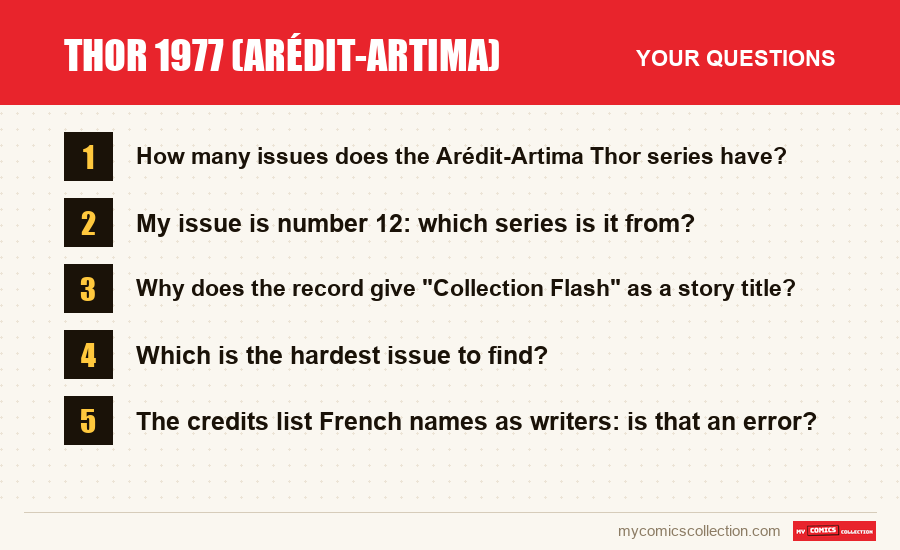
Twenty-seven, numbered continuously without any reset. The first is dated August 1977, the last September 1983. Between the two, publication stops for a long time, which often makes the series look shorter. A lot that ends at the close of 1978 is therefore never complete, even if its numbering shows no gap.
The number alone cannot tell you, because this position exists in both homonymous series. Open the issue and read the credits. Stan Lee and Jack Kirby place it in the 1977 series. Tom DeFalco and Ron Frenz place it in the other one. None of these names appears in both records at once.
Because what was recorded for these issues is a feature or cross-reference label, not the title of the main story. The catalog keeps only one entry per issue, and it is not always the episode's. The actual contents can only be checked on the copy, page after page, and only the copy is authoritative.
The one dated June 1981, which relaunches the series after an interruption of several years. It came out without an established audience: the readers of the first phase had scattered, and those of the second were only arriving. Surviving copies are few and rarely turn up in an original lot, almost always sold singly.
No. These names correspond to editorial contents present in the issue, not to drawn episodes. The catalog records them at the same level as the American creators because they do appear in the object. Do not look for an episode signed by these writers, and do not use them as a criterion for identifying the edition.