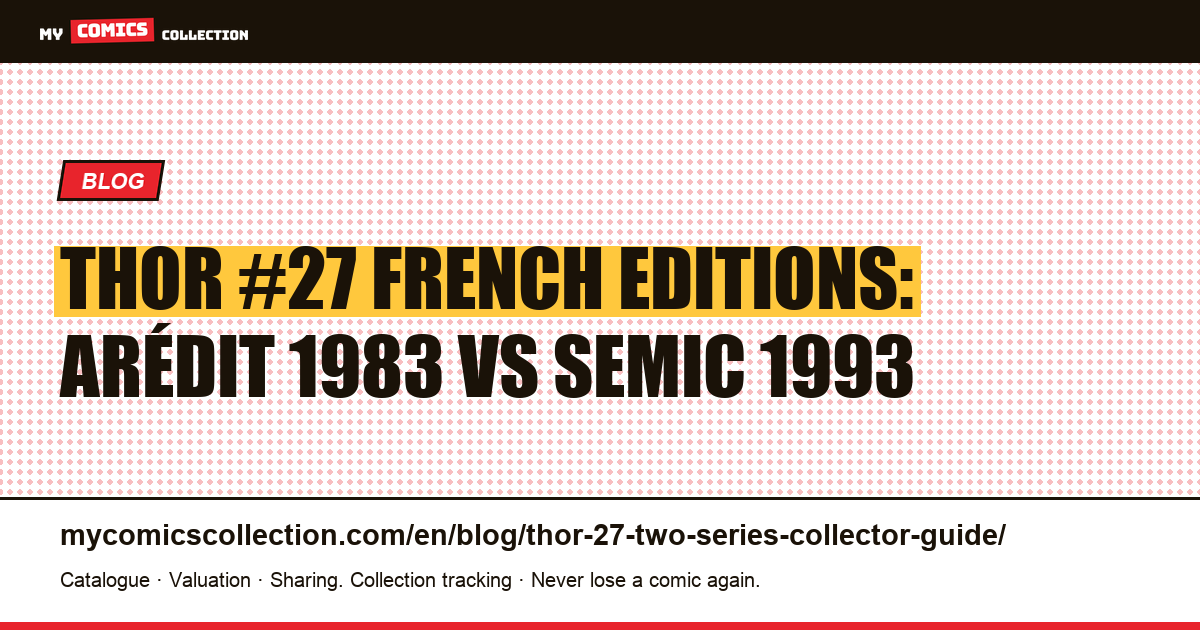
There are two Thor issues numbered 27 in the catalogue. The first, published by Arédit-Artima and dated September 1983, is the last entry on its checklist: it is titled "The Origin of Blok". The second, published by Semic and dated 1993 with no month, is titled "Whoever Wields This Hammer!"; four more issues follow it on the checklist. About ten years separate them. In a list of gaps, note the publisher and the year along with the issue number.
You hold a Thor whose spine reads 27 and you want to tick it off somewhere. In the catalogue, that number covers two different items, and the way to record each one on a list is not the same.
As always on this guide, only verified information (creators, issue numbers, dates) is stated as fact; the analysis is our own, with no reproduction of artwork or protected dialogue.
Two issues under one label
The same title, "Thor" followed by 27, refers in the catalogue to issue 27 of the Arédit-Artima series, whose first checklist entry is dated August 1977, and to issue 27 of the Semic series, whose checklist runs from #3 to #31 with dates from 1989 to 1993. No field links one series to the other, and this page assumes no connection between them.
In the Arédit-Artima series, #27 is the last entry on the checklist: that is the end of the checklist, not necessarily the end of the series. In the Semic series, #27 is the twenty-fifth entry out of twenty-nine, with four issues after it: it sits near the end of the checklist.
Arédit-Artima #27: September 1983, last entry on the checklist
The Arédit-Artima checklist has 27 entries, numbered from 1 to 27 with no gaps and no duplicates. Issue 27 is therefore both the twenty-seventh and the last. Its cover date is September 1983. The story title is "The Origin of Blok". Writing credits go to Gerry Conway, Roy Thomas and Harlan Ellison, and art credits to Gil Kane, John Buscema and Barry Windsor-Smith.
Harlan Ellison does not appear on any other entry in this checklist: this issue is his only appearance in the credits. These credits are given at the level of the issue. They say who worked on something in the issue, not who wrote the story titled "The Origin of Blok". And the checklist names only one title: nothing guarantees it is the only story in the issue, so the rest of the contents has to be read on the copy itself.
Semic #27: a year, and no month
The Semic entry gives only "1993" as its date. The checklist therefore cannot tell whether the issue is from January or December, nor whether this date appears as printed on the copy. The title is "Whoever Wields This Hammer!", the writing credit goes to Ron Frenz and Tom DeFalco, and the art credit to Ron Frenz alone. It is the first entry in the checklist dated 1993: the six before it (#21 to #26) are dated 1992, and the four after it (#28 to #31) are dated 1993.
This checklist starts at #3: issues #1 and #2 are not listed, and #4 to #7 have no date at all. Issue #27 is therefore the twenty-fifth of twenty-nine entries. It is not the last one, which is #31; and nothing in the checklist allows us to say that the series stops at #31.
Ten years apart, and what sets them apart at a glance
Because the Semic date has no month, the gap can only be given as a range. From September 1983 to January 1993 is nine years and four months; from September 1983 to December 1993 is ten years and three months. Call it about ten years. This is a calculation made here from two dates, not a catalogue data point.
More importantly, no name is shared by the two entries. On the writing side, Conway, Thomas and Ellison on one hand, Frenz and DeFalco on the other; on the art side, Kane, Buscema and Windsor-Smith on one hand, Frenz alone on the other. The credit line is therefore a surer way to tell them apart than the number on the spine, provided you read it on the copy itself.
Do you collect this series?
Track what you own, what you are missing and what your collection is worth. 7-day trial.
Start my trial →
What this means for a list of gaps
The two numbers do not occupy the same position, and that is what changes the list. Arédit-Artima #27 closes the checklist: a list of gaps can stop there, with one caveat in the wording. It closes the checklist, not the series; if a #28 existed, the catalogue would not show it. Write "complete up to #27 of the checklist" rather than "complete series".
Semic #27 closes nothing. A list that treated it as the last issue would miss #28 to #31, that is four issues, and would ignore whatever might exist beyond them. It would also leave two open edges: #1 and #2, which are absent from the checklist, and everything after #31.
Finally, there is the simplest trap: two copies labelled "Thor 27" are not duplicates. Do not merge them in a spreadsheet, do not sell one because you have the other, and do not tick a box with a copy from the other series. A usable list line has three elements: the publisher, the year the series started, and the issue number.
Neighbouring issues
On the Arédit side, #24 (April 1983) and #25 (May 1983) carry the same title, "Pope John Paul II", but their art credits differ: Gil Kane, Ernie Chan and George Pérez for the first, John Buscema and Barry Windsor-Smith for the second. A repeated title is therefore not proof of identical copies.
Next comes #26 (July 1983), "The Menace of the Black Man", where both "Barry Windsor-Smith" and "Barry Smith" appear; this is most likely one creator under two spellings, and we do not count them as two people. The date gaps are two months between #25 and #26, then two months between #26 and #27.
On the Semic side, #24 to #26 are titled "If Tomorrow Brings Defeat...", "Fire, Frost and Fury!" and "Requiem for the Demolisher", and #28 to #30 are "The Power of Thor!", "Monsters and Marvels" and "If Death Is My Destiny!". Ron Frenz and Tom DeFalco are credited for writing on all nine entries from #23 to #31, and Ron Frenz for art on those same nine. Among them, #27 is the only one whose art line names just one person.
Recognising the copy, grading its condition, tracking it
The checklist gives no format, page count or price: all of that is read from the object itself. Check the printed publisher, the date if it appears, and the names on the credits page. Once the copy is identified, grade each copy on its own: spine, corners, staples, page browning. Do not assume that the two have been kept the same way; ten years of production separate them.
For tracking, keep two separate lines in your inventory and record what you actually observed, for example "month not printed" for the Semic.
Frequently asked questions
No. One is published by Arédit-Artima and dated September 1983, the other by Semic and dated 1993. Their story titles, "The Origin of Blok" and "Whoever Wields This Hammer!", and their credits share no name. Only the number is shared.
In the checklist, Arédit-Artima #27 is the last of the 27 entries. Semic #27 is not: the checklist runs up to #31. Saying "last of the series" is beyond what the checklist can show, since it does not prove what exists beyond it.
It depends on what you collect. If you follow each series on its own, each has its own list and its own #27. If you collect the character in French, both count. In either case, do not tick one off with the other.
No, it names only part of it. The checklist gives one title per issue, and the credits are recorded at the level of the object. The full contents and the match with an American issue still need to be checked on the copy itself.
Set up one column for the publisher and one for the year the series started, in addition to the number. Add the month only if it is printed on the copy. That way, "Arédit 1977, #27" and "Semic 1989, #27" remain two lines that nothing can confuse.