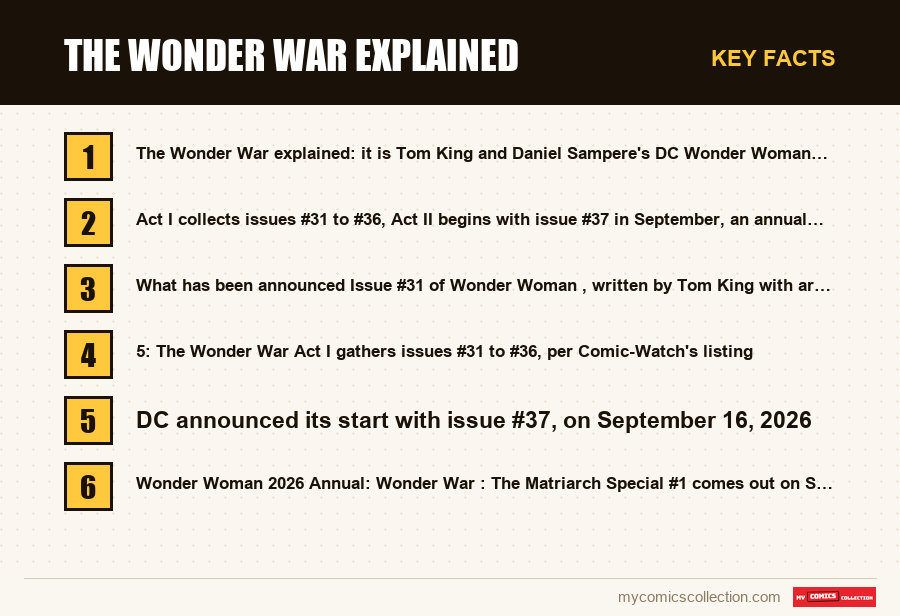
The Wonder War explained: it is Tom King and Daniel Sampere's DC Wonder Woman event, an arc in Wonder Woman that opens with issue #31 on March 18, 2026, in a future twenty years ahead where the Matriarch rules. Act I collects issues #31 to #36, Act II begins with issue #37 in September, an annual devoted to the Matriarch arrives on September 30, and issue #40, which closes the cycle, ships on December 16, 2026.
Tom King wraps up his time on Wonder Woman with a family war on a universe-wide scale: a daughter, a mother, a monstrous father and an authoritarian queen. This article lays the event out flat before the final issue.
The dates and credits below rest on DC's announcements as picked up by Bleeding Cool, Comics Beat and Comic-Watch; the suggested reading order and the buying advice are our own analysis.
What has been announced
Issue #31 of Wonder Woman, written by Tom King with art and cover by Daniel Sampere, opened The Wonder War in shops on March 18, 2026. According to Bleeding Cool, the story is set twenty years in the future: the Justice League is dead, villains hold power and the Matriarch reigns as queen of America. Diana and her adult daughter Trinity have to unite against her, in what the site describes as a blend of family drama and war epic.
The alternate covers on that issue were signed by David Nakayama, Joshua Middleton and Mattia De Iulis, with a Women's History Month variant by Leirix.
The event's schedule then comes down to four landmarks.
- Act I. The collection Wonder Woman Vol. 5: The Wonder War Act I gathers issues #31 to #36, per Comic-Watch's listing.
- Act II. DC announced its start with issue #37, on September 16, 2026. Steve Trevor and his daughter Trinity arrive in the present after losing to the Matriarch twenty years later; they must convince Wonder Woman that a child who looks harmless will become a threat.
- The annual. Wonder Woman 2026 Annual: Wonder War : The Matriarch Special #1 comes out on September 30, 2026. Stephanie Williams and Leah Williams write it, Belén Ortega and Eduardo Pansica draw, Eber Ferreira inks, Romulo Fajardo Jr. and Tríona Farrell color, and Clayton Cowles letters.
- The finale. Issue #40, announced by DC on September 18, ships on Wednesday, December 16, 2026 and concludes the story.
Point 1: A series launched in 2023 and a character from issue #800
Comics Beat recalls where the duo's run on Wonder Woman began: a 2023 launch under the Dawn of DC banner, preceded by a backup story in issue #800 in which Trinity appeared. The series tied into the Absolute Power event in 2024 but otherwise stayed largely self-contained. A Tom King miniseries with Belén Ortega, Trinity: Daughter of Wonder Woman, came out in 2025.
To follow The Wonder War, then, it is enough to place Trinity: Diana's daughter, whom the issue #37 solicitation shows alongside Steve Trevor, named as her father, carries the arc's emotional stakes. If you want to catch up on this character, our page on Trinity, Wonder Woman's daughter lists the issues that matter.
The event does not require rereading Absolute Power, although the publication order of that period is detailed in our Absolute Power reading guide.
The series' longevity has a practical consequence for the reader: the final arc is not the start of a saga but the culmination of several years. Issue #31 works as an entry point, since it lays out in a few pages the setting of the future, the death of the Justice League and the Matriarch's reign.
The team behind the conclusion is known for issue #40: Tom King on script, Daniel Sampere on art, Tomeu Morey on colors and Clayton Cowles on lettering. That quartet finishes what the writer and the artist began together in 2023, which gives the last issue the weight of a run-ending book for collectors of the regular series.
Point 2: The Matriarch, introduced before the war
The Matriarch does not come out of nowhere: Bleeding Cool says she was introduced in issue #25 of the series, which sold out at retail. The same article ties the war to what recent issues had shown, including the clash between Trinity and Lyssa, daughter of the Amazon Emelie. Tom King has since confirmed, again according to Bleeding Cool, that the Matriarch is none other than Lyssa, daughter of Emelie and the Sovereign.
In the Act II storyline, the Matriarch and her father, the Sovereign, have assembled a group of violent villains to destroy Wonder Woman and everything she stands for, according to DC's description of issue #40. Diana and her family must defend the shores of Themyscira.
The September 30 annual adds another angle: the Matriarch must cross hell to return to the living and stop Steve Trevor and Trinity from changing the past; a river of souls of the heroes and villains she has killed bars her way. Handing this story to Stephanie Williams and Leah Williams rather than Tom King makes it a reading from a shifted perspective on the antagonist.
Another useful detail from issue #37: its editorial team is made up of Paul Kaminski, Brittany Holzherr and Marquis Draper, the same as on the September annual, which confirms that the special is conceived as a direct extension of the series rather than an editorial side dish. That kinship also explains why the annual carries Wonder War in its very title.
Finally, the annual's alternate covers are signed by KyuYong Eom, Guillem March and Lesley "Leirix" Li. They let you quickly spot the right item, in a shop or online, among the many Wonder Woman issues released in 2026.
Do you collect this series?
Track what you own, what you are missing and what your collection is worth. 7-day trial.
Start my trial →
Point 3: The future twenty years out, a storytelling device
The structure rests on a back-and-forth in time: Act I shows a future crushed under the Matriarch, and Act II sends Steve Trevor and Trinity into the present to warn it. Time travel shifts the central question: Diana no longer fights only an enemy, she must decide what to do with a threat that is still a child.
This mechanism means the reading naturally splits into two stages, and a reader arriving at issue #37 can grasp the situation from the issue's recap even without having read Act I.
To place the event in the history of the character's great arcs, our selection of the best Wonder Woman arcs offers points of comparison.
The future twenty years out is not a new device in superhero comics, and the reading gains from comparing it with other stories of this type that you may own: a dark future almost always serves to ask what has to change today. Here, the novelty is that the messenger is not a stranger but the heroine's daughter accompanied by Steve Trevor, which makes Diana's decision personal before it is political.
For reading purposes, this means issues #37 to #40 follow one another like an investigation: who is the child, what does the child know, what will Diana do. Issues #31 to #36, for their part, read as a demonstration of the dreaded future. Reading Act II first and then going back to Act I is possible, but it deprives the reader of the cause-and-effect payoff the writer built.
What this means for a collector
An event wrapped up in about ten issues is easy to shelve, as long as you know what you want to keep from it. Here is a method with no price speculation.
- Choose your format. The The Wonder War Act I collection covers issues #31 to #36; for Act II, no collected edition is dated in the sources we read. Single issues keep the appeal of the alternate covers.
- Follow release order. File issues #31 to #40 and the annual by on-sale date, placing issues #38 and #39 at their shop release date.
- Tell the covers apart. For issue #31, the main cover is by Daniel Sampere, the variants by David Nakayama, Joshua Middleton, Mattia De Iulis and Leirix. For issue #37: Nakayama, KyuYong Eom, Mahmud Asrar. On issue #40 of December 16, Daniel Sampere keeps the main cover while Jamie Hewlett, Julian Totino Tedesco and David Nakayama share the alternates.
- Watch the condition. An issue bagged from the day you buy it, straight spine, sharp corners, no sign of reading; photograph it if you resell.
- Place the annual. It carries a different creative team from the series: shelve it next to issue #37 or at the end of Act II, depending on your filing logic.
Issue #25 deserves a particular check: it introduced the Matriarch and, according to Bleeding Cool, it sold out at retail; if you are hunting for it, check the printing and the condition rather than trusting generic photos.
Issue #40 marks the end of Tom King and Daniel Sampere's collaboration on the series. To place this run within the writer's whole bibliography, our Tom King: where to start guide helps you decide what to read next. And if you want to build a real collection around Diana, our Wonder Woman collecting guide gives the general landmarks.
For an arc followed from March to December 2026, preservation starts on the day of purchase: slip each issue of The Wonder War into a bag as soon as you are back from the shop, then store the series upright and without pressure in a suitable box, away from direct light and humidity. Note the exact cover of each copy: a Nakayama variant and a Sampere main cover are not interchangeable, and the difference matters when it comes time to resell or have a book appraised.
For a sold-out issue like #25 bought remotely, ask the seller for sharp photos of the spine, the corners and the edges, the exact cover, the printing if known and the return terms. These checks apply to every issue in the series and protect you from a bad surprise without any assumption about how prices will move.
Finally, a collection and single issues do not replace each other: the Act I collection gives you continuous reading, while the single issues give you the covers and the period object. Many collectors keep both for an arc that matters, one for lending and rereading, the other for preservation.
What remains to be confirmed
This information comes from the publisher's announcement; a release date can move. What is not confirmed in the sources we read:
- the identity of the creative team that will take over Wonder Woman after issue #40: the DC text relayed by Comics Beat does not specify it;
- the exact contents of issues #38 and #39 and their release dates;
- the date and contents of the Act II collection;
- where the annual sits in the reading order: the listing presents it as belonging to the event without placing it between two issues;
- the outcome of the conflict between Diana, Trinity, the Matriarch and the Sovereign, held for issue #40.
Frequently asked questions
It is Tom King and Daniel Sampere's big arc in Wonder Woman. Launched with issue #31 on March 18, 2026, it pits Diana and her daughter Trinity against the Matriarch, who rules America in a future twenty years ahead where the Justice League is dead. It concludes with issue #40.
Issues #31 to #36 form Act I, collected in Vol. 5. Act II starts with issue #37 on September 16, 2026, and the Matriarch Special annual comes out on September 30. Issue #40, on December 16, 2026, concludes the whole thing.
The arc's central antagonist, she reigns as queen of America in the future shown from issue #31. She was introduced in issue #25 of the series, according to Bleeding Cool, and her father is the Sovereign. The September 2026 annual tells of her journey through hell.
This special belongs to the event without being part of the main series. Stephanie Williams and Leah Williams write it, Belén Ortega and Eduardo Pansica draw it, and it shows the Matriarch climbing back out of hell. It will mostly interest readers who want to follow the antagonist closely.
Yes: issue #40, announced by DC on September 18, 2026 and dated December 16, closes The Wonder War and the run of Tom King and Daniel Sampere, which began in 2023. The next team was not named in the announcement we read.
Do you own Wonder Woman issues from the Tom King and Daniel Sampere era? Have them appraised for free.
Estimate my comic