
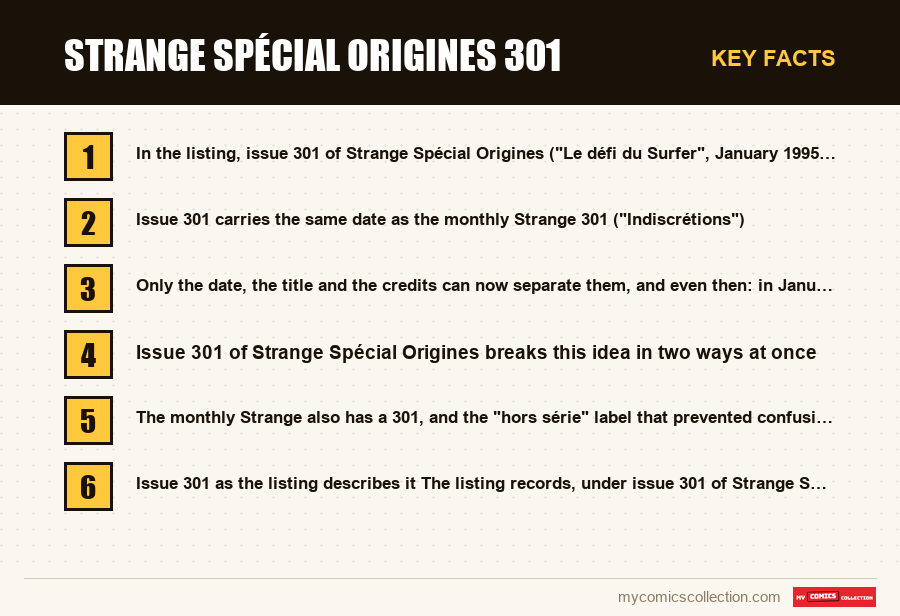
In the listing, issue 301 of Strange Spécial Origines ("Le défi du Surfer", January 1995) is the first of the series no longer carrying "hors série": 298 is the last one that did. Issue 301 carries the same date as the monthly Strange 301 ("Indiscrétions"). Only the date, the title and the credits can now separate them, and even then: in January 1995, the date does not separate them.
A gap list rests on a simple idea: one number, one object. Issue 301 of Strange Spécial Origines breaks this idea in two ways at once. The monthly Strange also has a 301, and the "hors série" label that prevented confusion no longer exists at that point in the listing. This page measures where it stops, what changes at that moment and, above all, what does not change.
As always in this guide, only verified information (creators, issue numbers, dates) is stated as fact; the analysis is ours, with no reproduction of artwork or protected dialogue.
Issue 301 as the listing describes it
The listing records, under issue 301 of Strange Spécial Origines, a cover date of January 1995 and a story titled "Le défi du Surfer". The credits are given at issue level: Stan Lee on writing, then Jack Kirby, John Romita Jr. and Lee Weeks on art. They do not say who did what in which episode, nor how many episodes the issue brings together.
That is all the data asserts. It gives neither a full contents list, nor a correspondence with American issues, nor a first French appearance of a character. The title names "le Surfer", which is a reading clue and not proof of the contents: the rest of the issue must be checked on the copy.
The last issue bearing the mention
In the listing, 24 issues of the series carry "hors série" in their number, from 229 to 298, in steps of three. The last, 298, is dated October 1994 and titled "Partir la tête haute". The two before it, 292 ("La civilisation japonaise") and 295 ("Le Japon d'hier et d'aujourd'hui"), are dated April and July 1994 and still carry the mention.
Issue 301 is therefore the first without the mention, and eleven remain in the listing: 301, 304, then 305 to 313. This division is a property of the listing: it copies a number, not a photograph of the cover. If the issue itself prints "hors série" on its cover or title page, only the object says so, and one must not assume that the cover changed at the same point as the listing.
The rhythm changes three numbers later
The disappearance of the mention does not coincide with the change of calendar. The intervals show it. From 229 in January 1989 to 304 in April 1995, that is 26 issues, every interval between two consecutive issues in the listing is three months: the series is quarterly, and 301 (January 1995) as well as 304 (April 1995) still respect this rhythm.
The switch comes between 304 and 305. Issue 305 is dated June 1995, two months after 304, and each of the following issues up to 313 (October 1996) is separated from the previous one by two months: nine intervals of two months. The number, for its part, advances one notch at a time from 304, whereas before it advanced in steps of three. The mention and the rhythm therefore do not change at the same point: the mention disappears at 301, the calendar and the numbering change at 305. Between the two, two issues (301 and 304) combine the old rhythm with the new absence of a label.
Two issues, one date: 301 and 304
The monthly Strange, in the listing, is dated January 1995 for its 301 ("Indiscrétions") and April 1995 for its 304 ("Armageddon"). Strange Spécial Origines carries exactly the same dates for its 301 and 304. In the listing, no mention therefore distinguishes these two pairs: same number, same month, same year, and no more "hors série" label.
What can then separate them is the story title retained and the credits. For 301: "Le défi du Surfer" (Stan Lee; Jack Kirby, John Romita Jr., Lee Weeks) on one side, "Indiscrétions" (David Michelinie, Ann Nocenti, Len Kaminski; Eleonor Duport, Mark Bagley, Mike Mignola) on the other. For 304: "Prends garde... aux Frères de Sang !" (Jim Starlin, Mike Friedrich; Jim Starlin, Joe Rubinstein) against "Armageddon" (Fabian Nicieza, David Michelinie, Len Kaminski; Mark Bagley, Joe Madureira, Kevin Hopgood).
One must nonetheless remain cautious: these titles are a single title per issue, chosen by the catalogue, and not the contents. Two copies you do not have in front of you cannot be told apart with certainty by this one title. The safest course remains to look at the cover and the title page of the object.
Do you collect this series?
Track what you own, what you are missing and what your collection is worth. 7-day trial.
Start my trial →
After 304, the date becomes a criterion again
From 305 onward, the two series never again share the same month in the listing. Issue 305 of Strange Spécial Origines is dated June 1995 and that of the monthly May 1995: a one-month gap. The gap grows by one month with each issue, up to nine months at 313 (October 1996 for Origines, January 1996 for the monthly). The Origines title is "Et si Serval avait épousé Mariko ?" at 305 and "Confrontation" at 313; the monthly's, "Jonction de parallèles" and "Rupture".
This is a useful fact in practice: across these nine numbers, two issues with the same number separate at first glance by their cover date. The trap has shifted. At 301 and 304, the absence of a mention was the problem; after 304, the mere fact that a "310" designates two objects, one dated October 1995 and the other April 1996, depending on the series it is attached to.
How to enter 301 in a gap list
A list sorted by number and filtered on "hors série" loses 301, 304 and the following ones: the filter excludes them although they do belong to the series. Do not tick "hors série" as a property of the whole series; in the listing, it is a property of the 24 issues from 229 to 298.
Instead, record each entry with three elements: the series title (Strange Spécial Origines and not Strange), the number, and the cover date. For 301 and 304, add the story title from the listing: it is what prevents you from wrongly validating the monthly in place of the quarterly issue. In a collection built as two parallel series, this care also prevents a single copy from being counted twice, or none at all.
What to check on the object
Three checks on the copy in hand. The name of the series on the cover, first: it decides between the two publications, well before the number. The cover date, next, to be read as printed, with or without a day. The listing writes "January 1995" with no day for both 301s, while it gives "5 April 1994" for 292; do not deduce one from the other. Finally, the printed contents, because the listing gives only one story title.
There is no reason to estimate that a copy without the mention would be more or less common than another on the sole basis of the listing: the data measures neither print runs nor frequency on the market. The condition of the paper and of the binding, for its part, is judged in the same way as for any issue of this period.
Frequently asked questions
In the listing, from 301, dated January 1995. Issue 298 (October 1994) is the last one whose number is written "298 hors série". Between the two, the listing contains neither 299 nor 300 for this series: only the monthly Strange carries them.
No. The mention disappears at 301, but the issues remain quarterly until 304 (April 1995). The move to a two-month interval happens at 305 (June 1995), one issue later, and the number then advances one notch at a time.
Look first at the series title printed on the cover. Both are dated January 1995 in the listing, so the date is not enough. The story title from the listing helps: "Le défi du Surfer" for Origines, "Indiscrétions" for the monthly.
Not in the listing: from 305 to 313, the numbers stay identical but the dates diverge, by one month at 305 up to nine months at 313. An Origines "310" (April 1996) is therefore not dated like the monthly's "310" (October 1995).
The listing does not allow us to claim so: it gives neither a full contents list, nor a print run, nor a correspondence with an American issue. What it does establish is a position: the first number of the series without the mention, in the middle of a rhythm that is still quarterly.