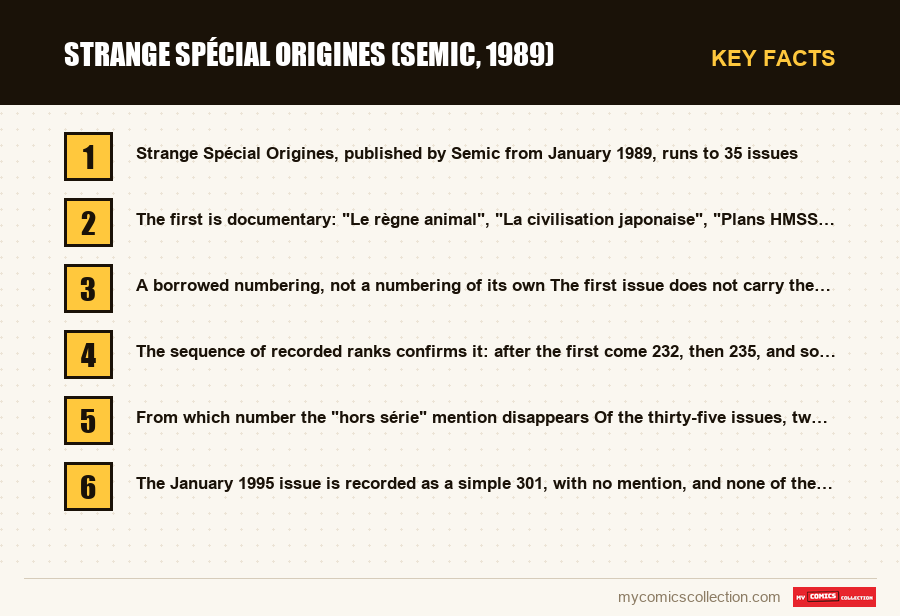
Strange Spécial Origines, published by Semic from January 1989, runs to 35 issues. Its particularity is its numbering: it is not autonomous, it copies that of the monthly magazine to which this title is the satellite, first with the mention "hors série" (special issue), then with no distinctive mark at all. Faced with an advertisement, the number alone does not tell you which of the two issues you are buying. You must cross-check the cover date and the lead title.
You have a stack of Semic magazines at home, and among them a few thicker issues whose cover number already appears on a monthly sitting right next to them. This is neither a printing error nor a duplicate: it is the normal functioning of this special. As long as you sort this collection by number, you will pick the wrong copy one time in two.
As always in this guide, only verified information (creators, issue numbers, dates) is stated as fact; the analysis is ours, with no reproduction of artwork or protected dialogue.
What this special actually contains
The lead titles catalogued for the series fall into two families, and the distinction matters when deciding what you keep. The first is documentary: "Le règne animal", "La civilisation japonaise", "Plans HMSS Starjammer", "Top 10 des super-vilains des New Warriors". These are fact sheets, plans and rankings, not continuous stories. A reader looking for a story will find them frustrating; a collector documenting a universe will find them valuable, since this material was rarely reused afterwards in album form.
The second family belongs to alternate history and retrospectives. "Et si Serval avait épousé Mariko ?" announces an alternative story, outside the ordinary continuity; "Qui est Daredevil ?" and "Les origines des X-Men", on the contrary, announce explanatory flashbacks. But the catalogue keeps only one title per issue, the lead title, whereas this format stacked several. The full contents can therefore only be read on the copy itself: do not judge the interest of an issue on what an advertisement says about it.
A borrowed numbering, not a numbering of its own
The first issue does not carry the number one, it carries rank 229. This figure does not come from this title, it comes from the monthly magazine of which the special is an offshoot, and which had precisely reached this rank in the month of its release. In other words, this special never had a counter of its own: it grafted itself onto that of the monthly and followed it to its last delivery.
The sequence of recorded ranks confirms it: after the first come 232, then 235, and so on step by step. No intermediate rank exists. The special advances in steps of three because the monthly advances by one each month, and the special appears only one quarter in four. The cover number is therefore not a rank within the series: it is a disguised date, which tells you to which month of the monthly this issue was attached on the newsstand.
The practical effect is immediate. Counting the holes in your series by subtracting numbers does not work: the gap between your lowest and highest rank does not give the number of missing issues, it gives three times that, and only over the first part of the collection. The only reliable list is that of the ranks actually published, never the interval between two bounds.
From which number the "hors série" mention disappears
Of the thirty-five issues, twenty-four carry in the catalogue a rank followed by the mention "hors série", from the first in January 1989 to the one of October 1994. This is the comfortable period: the label itself warns you that you do not have in hand the monthly of the same rank. As long as it is there, no confusion is possible for anyone who knows how to read it.
Then it drops. The January 1995 issue is recorded as a simple 301, with no mention, and none of the following ones carries it again. That makes eleven issues, the last third of the collection, which circulate with a bare rank, identical to that of an existing monthly. Note that the change of label does not coincide with the change of rhythm: the first two issues without the mention still keep the former step of three.
When one number designates two different issues
Take the clearest case, that of 301. The monthly dated January 1995 carries this rank and a lead title recorded as "Indiscrétions". The special of the same month carries the same rank and a lead title recorded as "Le défi du Surfer", credited for writing to Stan Lee. Same number, same cover month, two different objects, and no mention to separate them: an advertisement that gives the rank and the year does not allow a decision.
304 repeats the configuration in April of the same year: on one side a lead title recorded as "Armageddon", on the other "Prends garde... aux Frères de Sang !", with Jim Starlin on writing as well as art. These two ranks are the most dangerous of the collection, because they combine the shared rank, the shared month and the absence of a mention. Faced with them, only the lead title or the thickness of the issue will save you.
Beyond that, a more favourable mechanism sets in. The special moves to a step of one while the monthly remains monthly: the two series start to drift apart in time while still sharing their ranks, and the date gap widens by one month with each release. At the first rank of this zone the gap is only one month; at rank 313, the last to overlap, the monthly is dated January and the special October.
This progressive widening is your best sorting tool for the end of the collection. The higher the rank, the more the cover date becomes discriminating: a late issue carrying a high rank and an autumn date is the special, not the monthly. For the ranks in the middle of this zone, where the gap is still only a few months, go back to the lead title, which remains the only unambiguous criterion.
Periodicity: a quarter, then two months
The cover dates tell the story of a very regular title, then of a title that speeds up. In the first period, the months recur with metronome-like constancy: January, April, July, October, year after year, without a single missed quarter. For a collector, this regularity is a windfall: it means there is no ghost issue, no interruption to document, no aborted publication whose existence could be disputed.
The second period is shorter and denser: after the move to a step of one, the issues follow one another every two months, up to the last one dated October 1996. A bimonthly rhythm on a special of this format usually signals a desire to make the most of a documentary stock while it still finds its audience. The sources differ on the reasons for the stop; let us stick to the observation: the monthly continues when this title ends.
Do you collect this series?
Track what you own, what you are missing and what your collection is worth. 7-day trial.
Start my trial →
Creators who recur, and what they tell you
One name dominates the art credits: Ciro Tota, credited on 14 of the issues, nearly two out of five. His presence is massive in the period with the "hors série" mention and ends before the end of the title. For a French collector, this is a useful dating marker: an issue credited to this artist very probably belongs to the first half of the collection, the period in which the label still protects against confusion.
On the writing side, the listings bring up Roy Thomas and Stan Lee on equal footing, followed by Chris Claremont. An "origins" special logically draws on the founding signatures and on those who rebuilt the X-Men. Be careful, however: the credits recorded per record are multiple because the issue stacked several segments. Seeing three artists on one line does not mean that three people drew the same pages; these names serve to date and to recognise, not to attribute.
Recognising and filing a copy
The method that works comes down to three moves, in this order. First look for a "hors série" mention next to the rank: if present, the issue is classified. If not, note the cover month and compare it with that of the monthly of the same rank. If that is not enough, open the contents and compare the lead title. This third move never fails; it only costs one question to the seller.
For filing, give up sorting by rank and move to chronological sorting. This is counter-intuitive when you are used to series with their own numbering, but here the rank is not a series order, it is a borrowed marker. A shelf sorted by date makes the real gaps visible, whereas a shelf sorted by number will have you searching for issues that never existed. Also note the mention as it appears, not as you reconstruct it.
The condition of a copy and the buying pitfalls
A special of this format suffers first at the spine. Thicker than a monthly, it was opened flat by readers who did not have a collector's object in hand, and creases at the spine are the norm rather than the exception. So check the spine before the cover: a pristine front on a broken spine remains an average copy, and an advertisement showing only the front should be read with this reservation in mind.
The second check is internal completeness, and it targets the documentary family more than the stories. Fact sheets, plans and rankings are exactly the pages that young readers used to cut out or pin up. Finally, the pitfall specific to this title remains the bare rank: on a lot sold in bulk, a well-meaning seller will count the same rank twice as a duplicate and may set one aside. Always ask for the cover dates of the end-of-collection ranks.
Completing the series, and value today
Completed, this title represents thirty-five issues, a reasonable goal for a French collection. The difficulty is not the volume, it is identification: most of the time you will spend will go to checking that the copy offered is indeed the special and not its monthly namesake. Plan for this verification time rather than a major search effort, and refuse lots described by a simple list of numbers.
On value, the useful reasoning is a ratio, not a figure. In this kind of series, the end of publication is harder to find than the beginning, because late print runs are lower and buyers become scarce at the same time. Here, this rule combines with the disappearance of the distinctive mention, which makes late issues both rarer and more often misidentified. Poorly labelled advertisements are therefore where the finds happen, including on a title with Punisher or Hulk at the head of the contents.
Following this collection over time
Three pieces of information are enough to keep this series properly, and none of them is the rank alone: the cover date, the lead title, and the presence or absence of the mention. With these three fields, you describe without ambiguity any one of the issues and check an advertisement in a minute. A spreadsheet is enough, provided you never merge the rank column with that of the monthly.
The catalogue, moreover, leaves the lead title empty for the August 1996 issue, and it is a good example of what a personal inventory adds: where a generic database stops, your copy has a contents page. Note it. Finally, keep in mind that this special is never understood on its own: it borrows its ranks, follows and then leaves the rhythm of the monthly. For this title, the number is an indication of date, not an identity.
Frequently asked questions
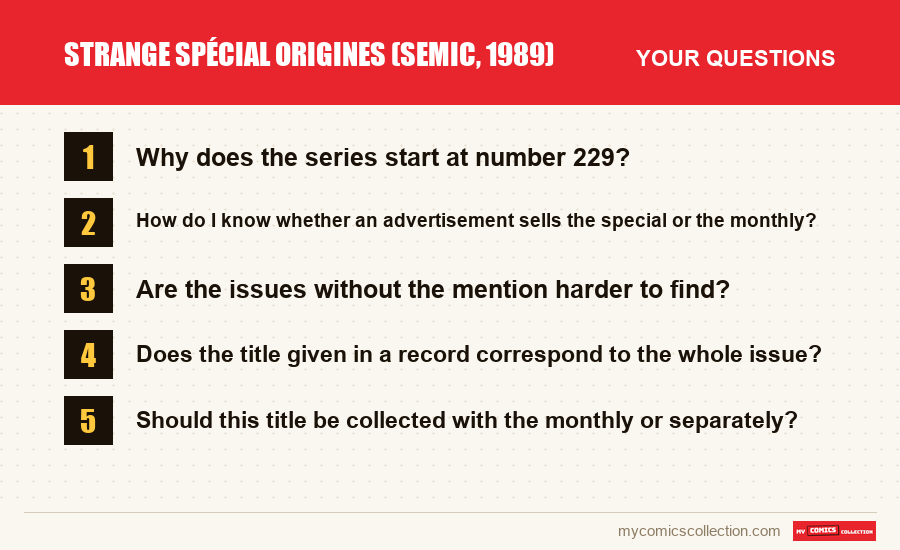
Because it has no counter of its own. This special takes over the rank reached by the monthly magazine to which it is attached, in the month it appears. The first issue, dated January 1989, therefore carries the rank of the monthly for that month. No issue of this title carries the number one.
First look for a "hors série" mention next to the rank: if present, it settles the matter. If absent, compare the announced cover month with that of the monthly of the same rank. As a last resort, ask for the lead title or a photo of the contents, which settles the doubt in every case.
They are above all harder to identify, which often amounts to the same thing on the market. A late, poorly labelled issue goes unnoticed in a list of numbers and can remain unsold for a long time. For a buyer attentive to the cover date, it is an opportunity rather than an obstacle.
No. The available listings keep only one title per issue, the lead title, whereas this format stacked several. The actual contents can only be read on the copy. That is why we never state, on the basis of a record alone, exactly what a given issue contains.
Separately on the shelf, together in the inventory. The two series share their ranks, so mixing them on one shelf guarantees filing errors. But keeping both lists side by side is what lets you know immediately, faced with an ambiguous advertisement, which of the two issues you are missing.