
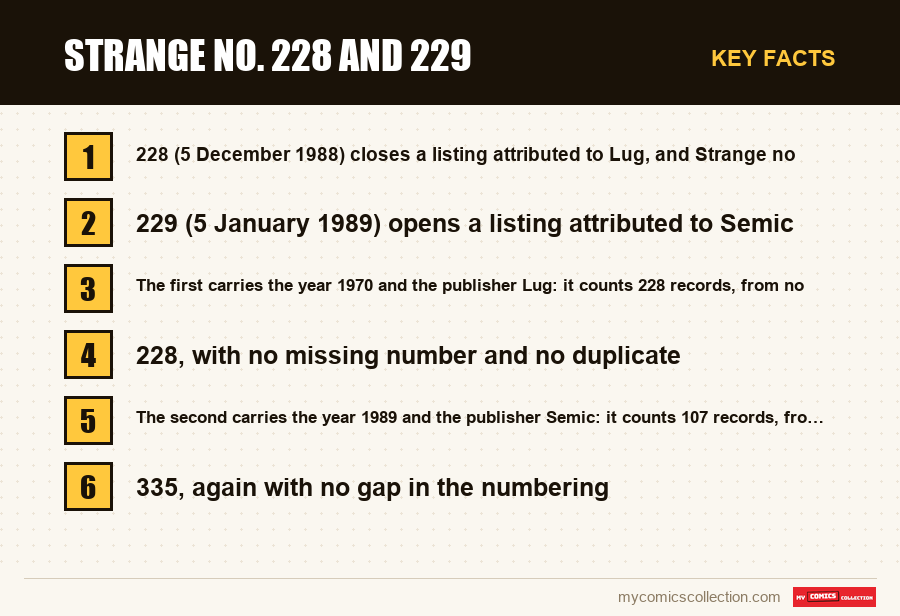
In the catalogue, Strange no. 228 (5 December 1988) closes a listing attributed to Lug, and Strange no. 229 (5 January 1989) opens a listing attributed to Semic. The numbering continues with no gap and the dates follow one month apart. The counter is therefore not reset: what changes is the publisher named, not the rank of the issue.
If you are completing Strange, you will meet this border without seeing it: it does not come from an extra number one, but from a change of publishing house in the record. Knowing what the data establishes at this point, and what it leaves open, avoids two opposite errors: looking for an issue that does not exist, or treating the two numbers as a single homogeneous block.
As always on this guide, only verified information (creators, numbers, dates) is stated as fact; the analysis is our own, with no reproduction of panels or protected dialogue.
Two listings, one counter
The catalogue sorts Strange into two series. The first carries the year 1970 and the publisher Lug: it counts 228 records, from no. 1 to no. 228, with no missing number and no duplicate. The second carries the year 1989 and the publisher Semic: it counts 107 records, from no. 229 to no. 335, again with no gap in the numbering. The two totals added together give 335, which is exactly the final rank of the second listing.
This arithmetic is the simplest proof that the counter stayed the same: had Semic started again at 1, the second listing would stop at 107, not 335. The title "1989" given to the second series designates the year of its first issue in the catalogue, not a new start. When you look for "Strange no. 12", there is only one issue of that rank in these two listings, and it belongs to the first series.
What the dates say at the junction
No. 228 carries the date 5 December 1988 and no. 229 that of 5 January 1989. One month separates them, as between the preceding months: in the Lug listing, the 228 records cover 228 consecutive months, from January 1970 to December 1988, with not one month skipped. The border therefore coincides neither with an interruption in publication nor with a visible change of rhythm in the dates.
A detail of form confirms the continuity: the day "5" is the one the listing retains for both issues. Elsewhere, the data is less regular. In the first series, 216 records carry the 5th, 11 give only the month, and one gives 10 August 1985 (no. 188). Just before the border, no. 225 is dated "septembre 1988" without a day; just after, no. 232 is dated "avril 1989". The dates on either side are therefore of the same kind, with the same imprecisions.
The credits cross the border
At the level of the issue, the listing gives for no. 228 three writers: Ann Nocenti, David Michelinie and Bob Layton, with John Byrne, George Freeman and Cyndy Martin on art. For no. 229, one reads Bill Mantlo, David Michelinie and Bob Layton, with Bob Layton, Terry Shoemaker and Alex Saviuk. Michelinie is credited on writing for every issue from no. 222 to no. 235, on both sides of the change of publisher; Layton is credited for nos. 222 to 225, absent from nos. 226 and 227, then credited for every issue from no. 228 to no. 235. These two names therefore do not mark the border, and the change of publisher cannot be read in the credits.
Bill Mantlo is credited for nos. 223 to 227, absent from no. 228, then present for nos. 229 to 235 of the second listing. Ann Nocenti, for her part, is credited for nos. 226, 227 and 228, but no longer for nos. 229 to 235. On art, no name is common to nos. 228 and 229, but Alex Saviuk is credited on no. 225 and then on no. 229. These back-and-forth movements look like a rotation of episodes, not a rupture.
What the data does not prove
The listing gives one story title per issue: "Bénis soient les innocents..." (Blessed Are the Innocent...) for no. 228, "Conflit de dames" (Ladies' Quarrel) for no. 229. These titles are not the contents. The catalogue names only one per number. It therefore does not say whether a story begun in no. 228 ends in no. 229, nor whether the two numbers share an ongoing serial.
The catalogue also does not tell you what you have in hand. It establishes neither the logo printed on the cover, nor the publisher's name carried by the copy, nor the format, the paper, the page count or the price of each of the two issues. The publisher is attributed to the series as a whole and not to each record: the border that the catalogue shows is therefore first of all the border of how the file is divided. That it coincides with the actual junction between two houses is not demonstrated by the data, and the exact date of that passage must be read on the object.
Do you collect this series?
Track what you own, what you are missing and what your collection is worth. 7-day trial.
Start my trial →
Recognising the two copies
First look at the rank number: it is that which gives you the issue, not the year of the series. No. 228 and no. 229 each have an unambiguous rank. Then compare the publisher's indication carried by each of the two copies, and note the exact printed date. It should match December 1988 for one and January 1989 for the other; if the day differs from that of the listing, note it rather than correcting it.
This check is also the only way to know whether your own no. 228 and no. 229 differ in their make. This point cannot be read in the data; it has to be observed. Lay the two issues side by side: thickness, paper and type of cover tell you what the listing does not.
Entering these two numbers in a list of gaps
In a spreadsheet, a single rank column is enough: the 335 ranks form a continuous sequence in the catalogue. Add a column "publisher printed" that you fill in yourself from the copy, rather than deducing it from the rank. The classic trap is to split the list into two sheets, "1970" and "1989", and to look in the second for a beginning that does not exist.
For a search list, give the rank, the year and the known story title, for example "no. 229, January 1989, Conflit de dames". That is enough to rule out a homonym without claiming to describe the contents. A seller who announces a "first Semic issue" is referring to a landmark that is not the one in the catalogue; in that catalogue, this issue is the 229th of the same magazine.
Condition and tracking of these two numbers
An issue is judged by its spine, its corners and its paper, not by its place on a border. For these two numbers, the only check specific to the subject is pairing: if you own only one, make sure the other is not already in your piles, since sorting by two distinct series makes it easy to miss the sequence.
In your tracking, keep one line per rank and a free field for the date read on the copy. The day your issue differs from the listing, you will have written proof of the difference.
Frequently asked questions
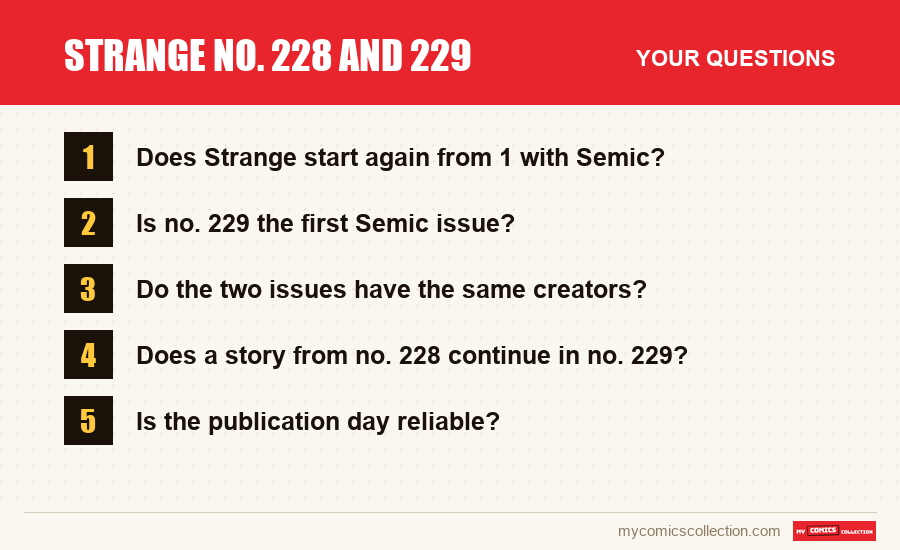
No, according to the catalogue. The Lug listing stops at no. 228, the Semic listing begins at no. 229 and runs to no. 335, with no gap. There are therefore no two issues bearing the same rank across these two listings.
It is the first of the second series in the catalogue, attributed to Semic. The data does not prove the actual date of the change of publishing house: check the publisher indications on your copy to see what it carries.
Partly. David Michelinie and Bob Layton are credited on writing for both. Ann Nocenti appears on no. 228 but not on no. 229, where Bill Mantlo is credited. No artist is common to the two issues in the listing.
The catalogue does not say so: it gives only one story title per issue, "Bénis soient les innocents..." and then "Conflit de dames". Only reading the two copies can show whether an episode carries on.
For these two issues, the listing gives the 5th. Elsewhere, some records carry only the month, as no. 225 or no. 232 do. Treat the day as a cover date from the listing, to be checked against the copy.
In short, the border between Lug and Semic in Strange is a border of file and attribution, which the continuous numbering and the consecutive dates make seamless for your list. Treat no. 228 and no. 229 as two neighbouring ranks, check on the object what the catalogue does not say, and keep the single counter as the only sorting rule.