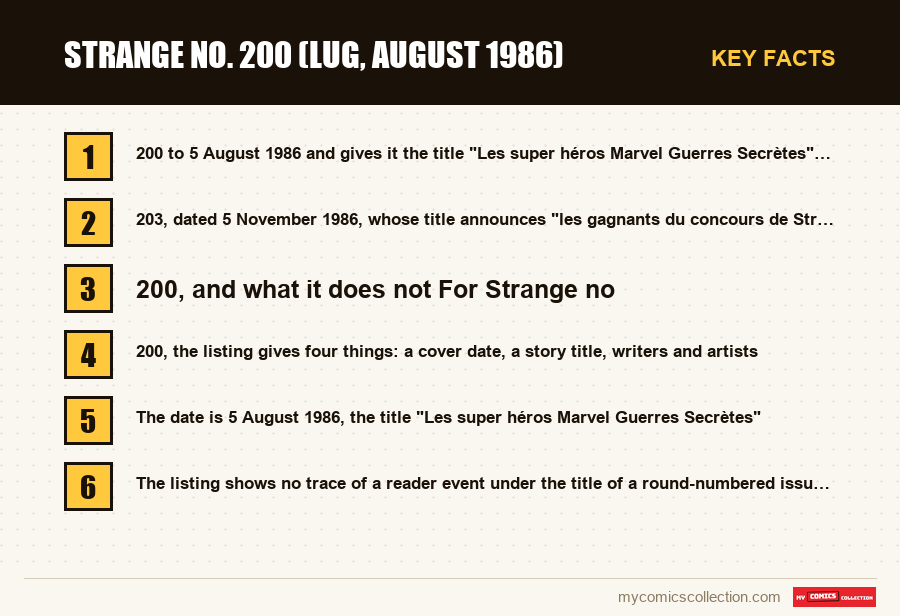
The listing dates Strange no. 200 to 5 August 1986 and gives it the title "Les super héros Marvel Guerres Secrètes" (The Marvel Super Heroes Secret Wars). It mentions no competition for this issue: the word appears only at no. 203, dated 5 November 1986, whose title announces "les gagnants du concours de Strange 200" (the winners of the Strange 200 contest). The link is therefore established by a name, not by contents.
A round number makes a collector's hand go up: the two hundredth issue of a monthly magazine, one expects it to be more elaborate, bigger, more eventful than its neighbours. What the listing allows us to state about it is more modest, and that is precisely what makes this record useful.
As always on this guide, only verified information (creators, numbers, dates) is stated as fact; the analysis is our own, with no reproduction of panels or protected dialogue.
What the listing attributes to no. 200, and what it does not
For Strange no. 200, the listing gives four things: a cover date, a story title, writers and artists. The date is 5 August 1986, the title "Les super héros Marvel Guerres Secrètes". That is all. The word "concours" (contest) does not appear, neither in the title nor elsewhere.
The listing shows no trace of a reader event under the title of a round-numbered issue: of the 228 issues in the listing, the word "concours" appears in only two titles, no. 105 and no. 203, and neither of them is a round number. They are two issues that follow a round number.
What can therefore be written without reservation: no. 200 exists, it is dated 5 August 1986, and its title associates "super héros Marvel" with "Guerres Secrètes". What cannot be written: that this issue contains the rules, the questions or the entry form of a contest. The listing does not settle the matter, and a serious record says so.
No. 203 and the name of the contest
No. 203, dated 5 November 1986, carries the title "Les gagnants du concours de Strange 200" (The winners of the Strange 200 contest). Two issues fall between the two covers. The wording does name the contest through the number 200: it is "the Strange 200 contest". It does not say that the contest ran inside no. 200, that it was announced there, or what its tests or prizes were.
Two readings remain open. In the first, the August 1986 issue carried the call for entries and the November issue the list of results. In the second, the contest was held to mark the two hundredth issue but was announced elsewhere, for example in the preceding issues. The listing does not decide between these two hypotheses, and neither can be proven from a database that keeps only one title per issue.
For the same magazine, no. 105 carries "Suite des résultats du concours de Strange n° 100" (Continued results of the Strange no. 100 contest). Another guide deals with that round number and its contest; let us retain only the contrast in wording here: the title of no. 203 has no "Suite" (continued), which does not establish that there was no other part, but does not allow us to assert it either.
Reading the titles of issues 198 to 206
On either side of no. 200, the listing runs through short headings: "Magie" (Magic) and "Le deuxième secret" (The Second Secret) before it, "A la fin de l'envoi... je touche !" (At the end of the mailing... I'm getting it!) and "La proie du Vautour" (The Vulture's Prey) after. Then come the two titles that concern us, at 203 and 204, and finally "Le héros et l'holocauste !" (The Hero and the Holocaust!) and "Place à Slyde !" (Make Way for Slyde!).
These headings look like episode titles. Three stand out from the batch through their tone: those of 200, 203 and 204. They are headings that address the reader or speak of the magazine itself, and 204, "Club Lug des héros Marvel !" (Lug Marvel Heroes Club!), is the only one in the whole listing to contain "Club Lug". This is our reading, not a datum: a title speaking of the readers' club may just as well belong to a letters page as to a story.
One precaution applies to the whole zone. A few issues earlier, the listing gives "Publicité" (Advertisement) for 195 and "Titans n° 88" for 196. These entries refer to other publications or to a feature, not necessarily to a story. The "story title" field is therefore a title the catalogue retains to identify the issue, and it may designate something other than a story.
The 5th of the month, and the gaps around no. 200
Almost the whole listing gives a cover day, and that day is almost always the 5th. There is a single exception, no. 188, dated the 10th. No. 200, dated 5 August, therefore follows the rule: an issue "of the 5th" is the norm for this magazine, an issue "of the 10th" is a known exception.
Around no. 200, the regularity is fragile. Issues 193 to 197 carry only the month, from January to May 1986. The 5th then reappears and runs without interruption across seven issues, of which no. 200 is the third. No. 205 again carries only the month, then the 5th returns.
What this means for you: the absence of a day on a neighbouring issue says nothing about the object, only about the way the date was recorded. On the other hand, the months follow one another without a gap from the first to the last issue of the listing. A no. 200 of August is therefore consistent with a monthly rhythm kept up, and the winners' issue comes three months after it, no more and no less.
Do you collect this series?
Track what you own, what you are missing and what your collection is worth. 7-day trial.
Start my trial →
Credits: what changes at no. 200
The credits are given at the level of the issue, not the episode. John Byrne is credited on writing for issues 182 to 201 without interruption, absent from 202 and 203, then credited again from 204 to 209. Across issues 182 to 209, the two issues where he is missing are therefore 202 and 203, the one of the contest.
Two names stand out at no. 200. Mark Gruenwald, on writing, appears in no other issue of the listing, and the art credits for it pair Jean-Yves Mitton, John Byrne and John Buscema. John Buscema, on art, is credited only at no. 200 within the window of issues 194 to 210. Jean-Yves Mitton is cited first for no. 200, whereas he is listed second just before and just after. The order of names in a listing has no proven value; one notes it, one does not interpret it.
Jean Frisano, present on the art of no. 201 which follows it and of no. 203, is not credited on no. 200. Relying on the habits of its neighbours to recognise this issue would therefore be misleading here.
Recognising the copy and avoiding confusion
Three checks take only a few moments. First, the number: 200 is the number of the Lug magazine, before the series was taken over by another publisher at no. 229, so the two should not be confused. Second, the date: August 1986 is the cover date given by the listing; check what the copy shows. Third, the day: a "5" matches the listing; a different day deserves a note, not a rejection.
The trap specific to this issue is false certainty. You may be told that "the contest is in the 200". The listing does not prove it, and neither does the title of no. 203. If the information matters to you, the proof is on the object: open the copy and look for the feature, rather than deducing it from a catalogue sentence.
The same caution applies to the rest of the contents. The catalogue gives only one title per issue: it does not say how many episodes no. 200 contains, which characters appear in it, or whether it is a first French publication. The issues of a magazine are verified in hand.
Entering no. 200 and no. 203 in a list of gaps
In a collection record, treat no. 200 and no. 203 as two separate lines. No. 200 is an issue of the run, no. 203 is the one whose title cites the contest. A collector who looks only for "the contest issue" risks buying just one of the two, or taking for certain an association that the listing does not demonstrate.
For each copy, note: the number, the cover date as printed, the general condition, and the mention "contents not verified" until you have opened the issue. This last field is filled in after checking, and it is what separates a useful list from a list copied from the catalogue.
For valuation, no data in the listing serves as a basis: neither price, print run, nor rarity. The honest method is to compare the condition of your copy with sold listings, not with asking prices.
Frequently asked questions
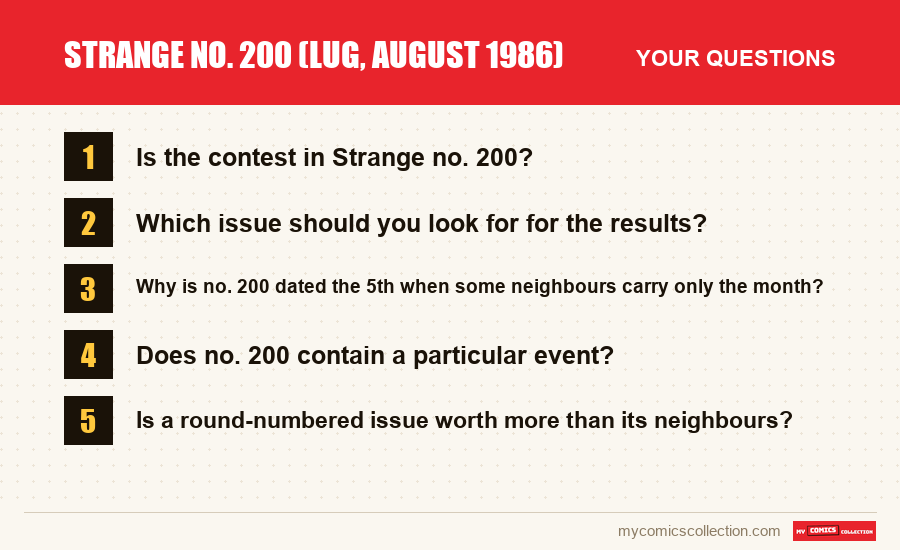
The listing does not say so. The title of no. 200 mentions no contest; it is that of no. 203 which speaks of the winners of the "Strange 200 contest". To know whether the call for entries appeared in no. 200, you need to open the copy.
The title of no. 203, dated 5 November 1986, announces the winners. The listing does not guarantee that it is the only one to mention them: check the neighbouring issues if the results really interest you.
Because the listing did not record the day everywhere: issues 193 to 197 carry only the month, while no. 200 is dated 5 August. On the object, the printed date is what counts, and a day missing from the listing is not an anomaly of the issue.
Its title combines "super héros Marvel" with "Guerres Secrètes", and its credits include two names absent from its neighbours. The listing says nothing more: the real contents of the issue are not described.
The listing contains no valuation data. Value depends on the condition of the copy and on the market at the time; a round number draws attention without justifying a higher price. Compare real sales of the same issue, in equivalent condition.