
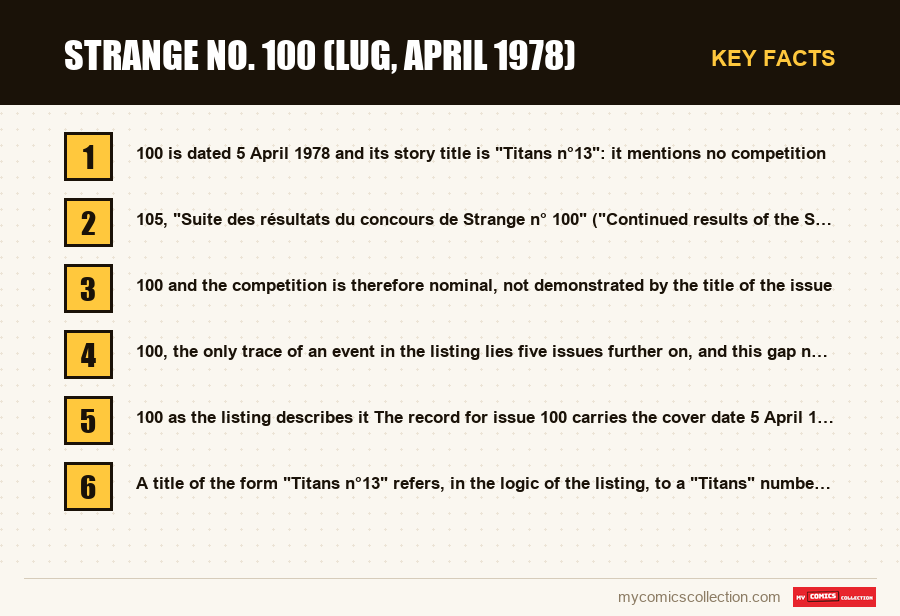
In the listing, Strange no. 100 is dated 5 April 1978 and its story title is "Titans n°13": it mentions no competition. The competition appears only in the title of no. 105, "Suite des résultats du concours de Strange n° 100" ("Continued results of the Strange no. 100 contest"). The link between no. 100 and the competition is therefore nominal, not demonstrated by the title of the issue.
A round number catches the eye on a shelf, and the temptation is to attribute to it a story of matching importance. For Strange no. 100, the only trace of an event in the listing lies five issues further on, and this gap needs to be taken apart before this copy is entered in a list of gaps.
As always on this guide, only verified information (creators, numbers, dates) is stated as fact; the analysis is our own, with no reproduction of panels or protected dialogue.
Issue no. 100 as the listing describes it
The record for issue 100 carries the cover date 5 April 1978 and a single story title, "Titans n°13". The credited writers are Steve Gerber, Bill Mantlo and Gerry Conway; the artists, Jean-Yves Mitton, Don Heck and G. Tuska. These credits are those of the whole issue, not of a particular episode: it is not possible to say who drew what.
The title is the point that matters. A title of the form "Titans n°13" refers, in the logic of the listing, to a "Titans" numbering that is not Strange's, and not to an isolated story. What the issue actually contains around that title, the listing does not say: it gives only one line per number, never the contents.
What the titles of issues 98 to 106 say
Let us read the nine titles in order. Issue 98 announces "Ces 3 super-héros chaque mois dans Nova" (These 3 superheroes every month in Nova), a formula that resembles an advertisement for another magazine. Issue 99 is "Spécial Strange n°11", and issue 100 "Titans n°13".
Then come "Des billes en plastique qui réchauffent" (Plastic marbles that warm up) (101), "Daredevil présente : les animaux fantastiques" (Daredevil presents: the fantastic animals) (102), "Le gaz naturel source d'énergie" (Natural gas, a source of energy) (103) and "Navires spatiaux" (Space ships) (104).
Next, issue 105, "Suite des résultats du concours de Strange n° 100" (Continued results of the Strange no. 100 contest), and issue 106, "Prophète du progrés... Jules Verne" (Prophet of progress... Jules Verne).
Within this window, only one title mentions a competition: that of 105. None of issues 98 to 104, no. 100 included, carries the word in its title. This is the exact finding, and it should be kept as it is: the competition is named after no. 100, but it is no. 105 that bears it.
What links no. 100 to the competition, and what does not
What links them: the wording of the title of no. 105. A competition "de Strange n° 100" is attached, by its name, to this issue. Nothing in the listing specifies whether it was announced there, whether it was an anniversary game, or what form it took.
What does not link them: the title of no. 100 itself, which is "Titans n°13". The wording the data allows is a narrow one: no. 100 gives its name to a competition of which the listing shows only the sequel of results, five issues later.
The word "suite" (continued) also deserves weighing. It implies that a first set of results exists somewhere. The titles of issues 98 to 104 bear no trace of it: it may be found in an issue whose story title says something else, since the listing records only one title per issue. This silence is a limitation of the listing, not proof of absence.
Context: titles that change in nature around no. 100
Issues 94 to 100 run through titles that refer to other collections, from "Album les Fantastiques numéro 13" at 94 through to "Titans n°13".
The rhythm is almost regular: the numbering of Titans moves from 11 to 12 and then 13 across Strange issues 95, 97 and 100.
From 101 on, the mechanism seems to change. Across issues 101 to 112, the listing displays titles that sound like documentary subjects (energy, ships, laser, matter and antimatter, Jules Verne, astrology), with one clear exception, the "Daredevil présente" of 102.
Issue 100 is therefore the last of the run of titles numbered "Titans" or "Spécial Strange" before this change of tone, and that is a more precise way of placing it than its round number alone. The editorial meaning of this change is not in the data.
Do you collect this series?
Track what you own, what you are missing and what your collection is worth. 7-day trial.
Start my trial →
A round number with no break in the periodicity
As far as the date goes, no. 100 marks no break. No. 1 is dated 5 January 1970, no. 100 is dated 5 April 1978: 99 months separate the two, one per issue, which corresponds to a monthly release with no missing month in this portion of the listing.
Issues 94 to 110 are all dated the 5th of the month, consecutively.
The contrast comes from elsewhere, from the credits. In the listing, 167 of the 228 records mention Jean Frisano among the artists. Across issues 80 to 130, only two lack him: 90 and 100. Issue 100 therefore belongs to a measurable rarity within the series, on a par with no. 90, without knowing why or what it changes in the issue.
Recognising the copy and avoiding confusion
Three markers are enough to avoid picking up the wrong issue. First, the number of the magazine, 100, which is Strange's counter and not that of "Titans n°13": the figure 13 refers to another numbering, and a copy bearing that other numbering is not yours. Next, the cover date, April 1978, consistent with the 5th of the month in the listing. Finally, the publisher of the series in the listing, Éditions Lug.
The trap specific to this issue is looking for proof of the competition inside the copy. If your copy bears a trace of it, all well and good; if it does not, do not regard it as incomplete or "different": the listing assigns nothing of the kind to this issue. Conversely, no. 105, whose title cites the competition, is the issue to own if that theme interests you.
Condition and tracking this issue in a collection
The listing says nothing about the form the competition participation took. Leaf through the issue from the first page to the last and note the actual condition of the pages, without concluding that something is missing: nothing in the listing says so.
In a list of gaps, enter it under "Strange n°100, avril 1978" with, as a note, "titre relevé : Titans n°13". This mention is enough to distinguish it from a "Titans" issue and to find it again.
In brief
Strange no. 100 is a round-numbered issue with no break in its dates, carrying a story title that refers to another numbering, and a competition whose name appears in a title only at no. 105. The listing links the two through the name of the competition, not through the contents. Keep this nuance: it protects your list from an assertion that only the copy itself could support. The other guides are gathered on the blog.
Frequently asked questions
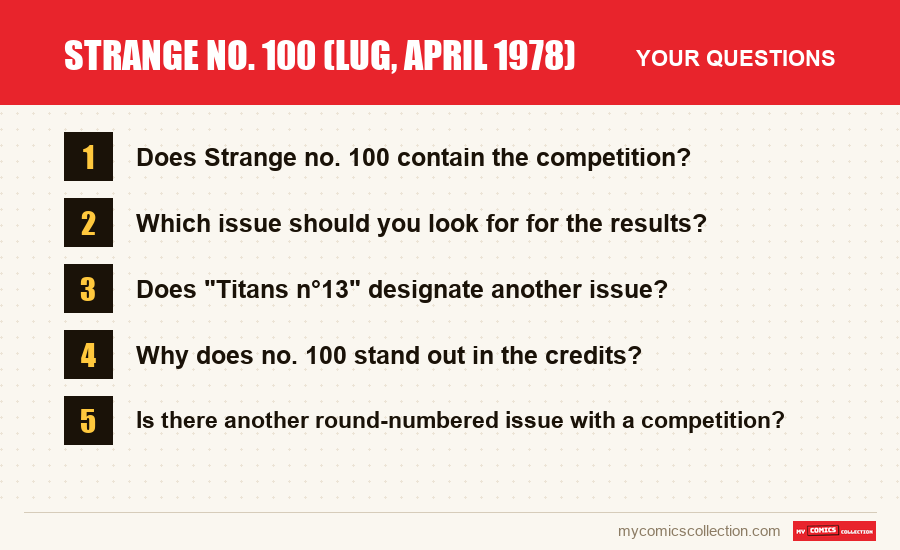
The listing does not establish it. The story title of no. 100 is "Titans n°13" and mentions no competition. Only no. 105, with its title on the continued results of the Strange no. 100 contest, attaches the game to this issue by name. Leaf through the issue to settle it.
No. 105, dated 5 September 1978, whose title announces the continued results. The word "suite" (continued) suggests that a first part exists elsewhere, but no title in issues 98 to 104 signals it: the listing gives only one title per issue, so the first part may be hidden there.
It is the story title the listing associates with Strange no. 100, not a second object. The figure 13 refers to a "Titans" numbering, which is not Strange's. Your copy is a Strange, numbered 100 on its cover, and that is the number to enter in the list.
Among issues 80 to 130 in the listing, 90 and 100 are the only two whose artists do not include Jean Frisano. The listing gives the credits for the whole issue, without tying them to an episode: it shows the gap, it does not explain the reason.
The listing contains a second title of this kind, at no. 203, which refers to the winners of a Strange 200 competition. That issue belongs to a different record. The point to retain here is that no. 100 and no. 105 answer each other by name, the competition being read only in the title of the second.