Death of the Endless first appears in The Sandman vol. 2 #8 (DC Comics, August 1989), in the chapter "The Sound of Her Wings" written by Neil Gaiman and drawn by Mike Dringenberg, with cover by Dave McKean. This number remains the holy grail for collectors of the series: the CGC census listed 381 copies in 9.4 at the end of 2021 and 828 in higher grade, and the Overstreet 2021 valued an NM-9.2 at $125. The popularity of the character, played by Kirby Howell-Baptiste in The Sandman on Netflix, continues to maintain demand for this founding example.
There are few comic book characters who have subverted an archetype as much as Death in Neil Gaiman's universe. Where decades of American comics had frozen Death in the form of a hooded skeleton brandishing a scythe, Gaiman and his designer Mike Dringenberg proposed, in 1989, a pale teenager in a total black look, with a warm smile and an ankh symbol worn as a pendant. This aesthetic and tonal departure was not just a stroke of graphic brilliance: it redefined the way mainstream comics could deal with mortality, empathy, and grief, and it made Death one of the most beloved characters ever created under the Vertigo label.
Older sister of Dream (the protagonist of Sandman) within the Endless siblings, Death occupies a special place in Gaiman's mythology: she is both the most terrifying of the seven cosmic incarnations (since she comes to seek out every living being, without exception, at the moment of their last breath) and the most benevolent, the most psychologically stable, the most loved by those around her. This ambivalence, associated with writing that refuses easy pathos, explains why its first issue, its derivative series and the slightest editorial object that puts it on the cover continue to attract collectors well beyond the usual readership of superhero comics.
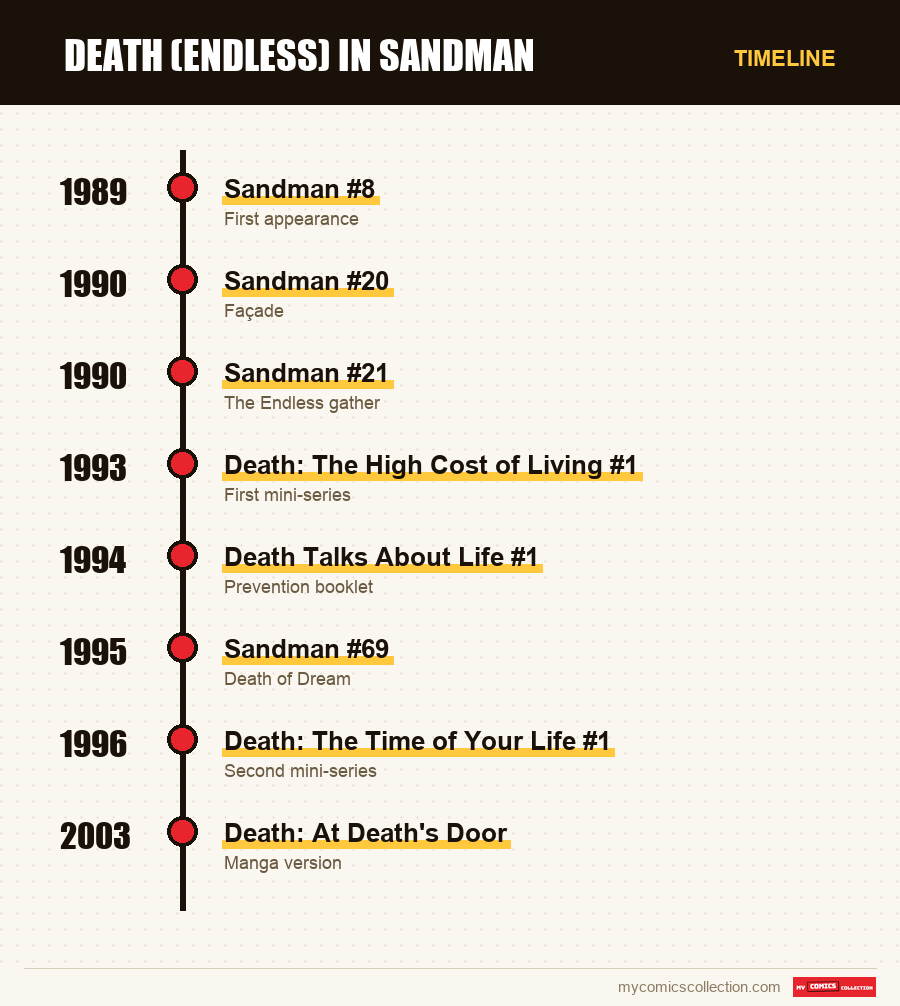
This article traces the complete editorial history of Death: its creation in Sandman #8, his evolution through the major arcs of the parent series, his solo mini-series, the more confidential objects which have marked his journey (including a health prevention booklet which is now very sought after), the impact of the Netflix adaptation on the market rating, and finally a practical guide for anyone wishing to build a serious collection around the character.
The genesis of Death: how Sandman #8 reinvented the Grim Reaper
When Neil Gaiman throws The Sandman at DC Comics in January 1989, the title opens with a first arc, “Preludes and Nocturnes” (issues #1 to #8), centered on Dream's escape after more than seventy years of captivity. The very last chapter of this arc, published on the cover dated August 1989 under number #8 and entitled "The Sound of Her Wings", radically changes register: after seven episodes of gothic horror and vengeful quest, Gaiman introduces an almost intimate moment of pause, where Dream finds his big sister in a park to talk about his captivity, his resentment and what he intends to do with his newfound freedom.
It is in this seemingly innocuous setting (a public bench, two silhouettes talking) that Death makes his entry into comics. The script is by Neil Gaiman, the drawings for this issue are by Mike Dringenberg (who succeeds Sam Kieth, who left after the first issues), and the iconic cover is by Dave McKean, the artist who will illustrate all of the covers of the series until its final issue. Dringenberg's choice for the character's design is not trivial: several testimonies from the time, corroborated by Gaiman himself in subsequent interviews, indicate that the final appearance of Death owes a lot to the graphic interpretation of the designer, who moved away from the first more classic indications to propose an androgynous figure, dressed in black, with pale makeup and an Egyptian ankh as a necklace.
Issue #8 thus marks a double turning point: it is the last episode of “Preludes and Nocturnes”, and it is the first issue where Gaiman demonstrates that Sandman will not be a simple gothic horror comic but a series capable of dealing, with a formidable economy of means, with themes as heavy as mourning, acceptance and finitude. This change in tone was praised by critics upon its original publication and remains, even today, cited as one of the chapters most often recommended to anyone discovering the series for the first time: to the point that some readers begin their reading with this issue before going back.
A Death unlike any other: design and personality
The most commented on aspect of Death remains, even today, its break with the traditional iconography of the Grim Reaper. Where Western popular culture associates death with a hooded and silent skeleton, Gaiman and Dringenberg make it a young woman with short-cropped black hair, a very pale complexion, and kohl-rimmed eyes, dressed in a mix of gothic and casual clothing: a look directly inspired by the British goth scene of the late 1980s. She wears an ankh, an Egyptian symbol of life, as a pendant: an iconographic choice that alone sums up the paradox of the character, a figure of death who celebrates life.
Characterization-wise, Death is consistently written as the most balanced, warmest, and most lucid of the seven Endless characters. While Dream is proud and rigid, Desire is manipulative, and Delirium descends into chaos, Death demonstrates constant empathy towards the mortals she comes to seek, without ever denying the sadness or injustice of death: she accompanies it with humor, gentleness and a form of almost maternal wisdom towards those around her, Dream included. It is this humanization of a concept as abstract and anxiety-provoking as death that has earned the character popularity that goes well beyond the usual readership of horror comics, particularly among an adolescent and gothic audience who immediately recognized themselves in his aesthetic.
Gaiman has also recounted several times, not without humor, that readers came to thank him for having “invented” a representation of death which had helped them through bereavement or illness: a rare cultural impact for a secondary comic book character, which never became the main title of the series but which nevertheless largely eclipsed it in the collective imagination of part of the readership.
Death through the great arcs of Sandman
Although she is not the central character of Sandman, Death returns several times throughout the 75 issues of the series (published from January 1989 to March 1996), always in pivotal moments of the narrative. After her founding appearance in issue #8, she reappears notably in “Season of Mists” (issues #21 to #28), where she intervenes in the negotiations between Dream and Lucifer around the control of Hell, then especially in “Brief Lives” (issues #41 to #49), an arc in which Dream and Délire go in search of their missing brother Destruction: a quest which pushes Dream into introspection, the consequences of which Death, in the background, observes with a lucidity tinged with sadness.
However, it is at the end of “The Kindly Ones”, in issue #69, that Death takes on a leading role again: she is the one who comes to get Dream himself, later replaced by a new incarnation of Dream, thus closing the thematic loop opened in issue #8. The following arc, “The Wake” (#70 to #72), depicts his funeral, before three epilogue issues (#73 to #75). This funeral arc, hailed as one of the most masterful conclusions in modern comics history, owes much of its emotional force to the way in which Gaiman reuses Death as a figure of calm rather than terror, exactly as he had established her seven years earlier.
Death: The High Cost of Living (1993): the first solo miniseries
The critical and commercial success of the character pushed DC Comics, via its newly launched Vertigo label, to offer him his own mini-series in 1993. Death: The High Cost of Living is a three-issue story, published monthly from March to May 1993, written by Neil Gaiman, drawn by Chris Bachalo, and inked by Mark Buckingham, with covers by Dave McKean. The premise of the series has become a classic of Endless mythology: once a century, Death takes an ordinary human form, here a teenage mortal named Didi, to remember what it means to be alive. The plot follows his friendship with a suicidal teenager, Sexton Furnival, and his encounter with a 250-year-old woman in search of his literally lost heart.
This mini-series, the first solo version taken from the universe of Sandman, won the Comics Buyer's Guide Fan Award for Best Limited Series of 1993, tied with Daredevil: The Man Without Fear by Frank Miller: a recognition which confirms, from the outset, the character's special status in the eyes of the readership and the profession.
Death: The Time of Your Life (1996): the character's return to full Sandman glory
Three years later, while Sandman comes to an end, Gaiman signs a second mini-series in three issues, published from April to July 1996, still with Chris Bachalo and Mark Buckingham on the drawings. Death: The Time of Your Life reconnects with secondary characters who appeared in the “A Game of You” arc of the parent series, the singer Foxglove and her partner Hazel, and develops a plot centered on motherhood, fame and mourning, with a preface signed by actress Claire Danes. The series has been republished as a single collection, supplemented with additional pages absent from the original publication in fascicles.
More confidential objects: Death Gallery and Death Talks About Life
Beyond these two narrative mini-series, two more atypical publications complete the character's bibliography and are of particular interest to discerning collectors. Death Gallery #1, released in 1994, is a one-shot of full-page illustrations devoted exclusively to Death, bringing together more than thirty artists (including Joe Quesada, Arthur Adams, Brian Bolland, Dave Gibbons and P. Craig Russell), with an introduction by Gaiman and a painted cover by Dave McKean.
Even rarer, Death Talks About Life, also published in 1994, is a prevention booklet distributed free of charge as an insert in certain issues of Sandman , Shade, the Changing Man and Hellblazer. Written by Gaiman and drawn by Dave McKean, this short story features Death explaining, using a banana as an educational prop, HIV prevention measures: with an embarrassed appearance by John Constantine. The subject, considered sensitive at the time, led many points of sale to remove the booklet from displays shortly after its distribution, which, combined with its fragile format as a simple promotional insert intended to be thrown away, makes it today one of the most difficult objects to find in good condition in the entire Sandman-related bibliography.
Collecting this series?
Track what you own, what you are missing and what your collection is worth. 7 day trial.
Start my trial →The impact of adaptations on the rating
The adaptation of Sandman by Netflix, launched in 2022, has considerably broadened the character's notoriety beyond the historical comic book readership. In the first episode adapted directly from "The Sound of Her Wings", Death is played by actress Kirby Howell-Baptiste, whose interpretation (warm, soothing, down-to-earth) was widely praised by critics and by fans of the original comic strip, to the point of being considered by part of the public as one of the most faithful adaptations in spirit of the series. The second season of the series also offered a bonus episode directly adapting Death: The High Cost of Living, bringing mainstream attention back to the 1993 miniseries.
This television exposure has a well-documented mechanical effect on the vintage comics market: each broadcast or renewal of the Netflix series generates a renewed interest in Sandman #8, identified on many ads as "the first appearance of Death, seen in the Netflix series". Major auction houses have seen several very high grade copies (up to CGC 9.8) of this founding issue pass through in recent years, a sign that demand for high-end certified copies remains strong. However, it is important to distinguish the notoriety generated by the adaptation, real and measurable in volume of searches and announcements, from the precise market value of a given copy, which depends above all on its grade, the quality of its pages and the occasional dynamism of the auction market: parameters that an ungraded copy does not allow us to evaluate with certainty.
As an indication, the CGC census recorded 381 copies of Sandman #8 graded 9.4, and 828 copies in higher grade, a volume which testifies to a relatively comfortable circulation for a Vertigo title from the end of the 1980s but which does not prevent the highest grades (9.8 and beyond) from remaining much rarer and sought after. The Overstreet Comic Book Price Guide 2021 edition, for its part, valued a copy of NM- (9.2) at 125 dollars: a figure which gives an historical order of magnitude but which must be cross-referenced with recent sales, as the Netflix effect has been able to change demand since that date.
Buying guide: how to collect Death with peace of mind
Building a coherent collection around Death requires particular attention to some classic pitfalls of the vintage comics market, particularly on a title as collectible as Sandman. Here are the points to check before any purchase:
- Distinguish the first printing of issue #8 from the reprints. Sandman having seen multiple reprints over the decades due to its continued success, always check the printing code on the back or inside page, as well as the original cover price, before paying the price of a true first printing.
- Favor copies graded by a trusted third party (CGC or CBCS) for high grades. Beyond 9.0, the difference in value between two half-grade points can be significant; an ungraded copy advertised “as new” by a private seller does not guarantee anything without independent certification.
- Check for the presence of the “Sandman Netflix” label on recent ads. This type of marketing mention has no official value and should not justify a price premium in itself: what counts remains the actual grade and the quality of the pages (white to cream, without yellowing).
- Look for both complete mini-series rather than individual issues. Death: The High Cost of Living and Death: The Time of Your Life are naturally collected in sets of three numbers; a collector looking for a complete reading of the character will be wise to target complete lots rather than mismatched issues.
- Do not neglect the collected editions (trade paperbacks) for reading. If the objective is above all to read the history of the character rather than to speculate on booklets, the collections in bound volumes offer an economical alternative and much easier to find in good condition than the original booklets.
- Be wary of the fragility of promotional items like Death Talks About Life. Distributed free as an insert and often thrown away after reading, this booklet is rarely found in near-new condition; carefully inspect the corners and center fold before making any high-priced purchase.
- Compare several recent sales before setting a budget. The vintage comics market is evolving quickly, particularly for titles supported by an active television adaptation; a single auction result is not enough to establish a reliable reference value.
For collectors who follow several series in parallel, keeping an up-to-date digital inventory remains the best way to avoid duplicates and quickly identify missing pieces from a collection targeted at the Endless: the collection management application of the site makes it possible to centralize numbers, ranks and personal notes across an entire bibliography as ramified as that of Death.
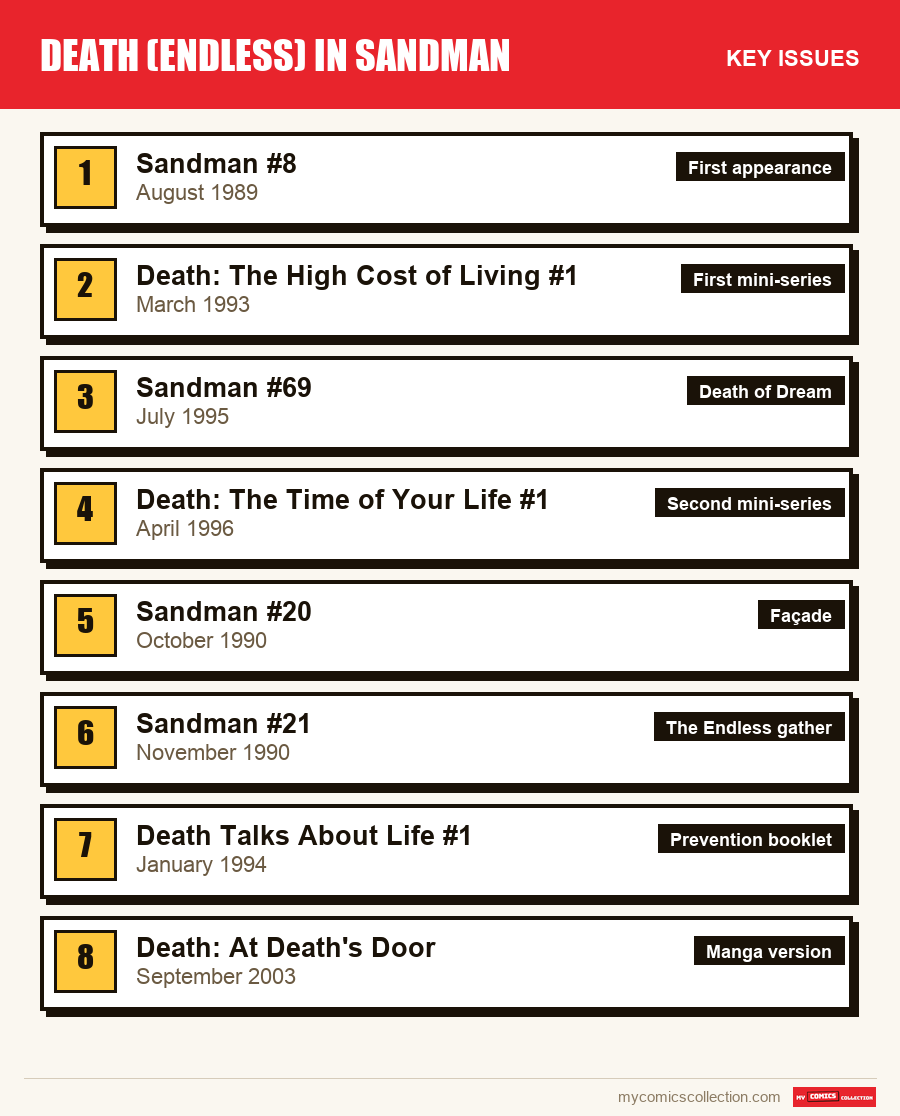
Key issues to know
Sandman #8
In The Sound of Her Wings, Neil Gaiman and Mike Dringenberg introduce Death, Dream's older sister, as a warm young goth woman. Dream accompanies her as she comes for the dying. Cover by Dave McKean.
Death: The High Cost of Living #1
Gaiman and Chris Bachalo launch the character's first mini-series, in three issues: once a century, Death takes human form for a day. She spends it in New York with Sexton, a suicidal teenager.
Sandman #69
At the close of The Kindly Ones, Dream dies and it is his sister Death who comes for him, closing the loop opened in #8. The Dreaming then passes to a new incarnation.
Death: The Time of Your Life #1
Gaiman, Chris Bachalo and Mark Buckingham return to singer Foxglove and her partner Hazel, from the A Game of You arc. A second three-issue mini-series, published as Sandman was drawing to a close.
Sandman #20
In this story drawn by Colleen Doran, Urania Blackwell, the former Element Girl left monstrous by her powers, wants to die but cannot. Death comes to help her: one of the episodes that best define her compassion.
Sandman #21
Prologue to Season of Mists: Destiny summons his siblings and the Endless arrive one by one, Death first. It is the series' first big family gathering, leading Dream to face Lucifer in Hell.
Death Talks About Life #1
Prevention booklet written by Gaiman and drawn by Dave McKean: Death dispels myths about AIDS and gives a safe-sex demonstration, with John Constantine's embarrassed help. A promotional item that is now hard to find in good condition.
Death: At Death's Door
Jill Thompson, a former Sandman artist, revisits the events of Season of Mists from Death's point of view, in a lighter, humorous manga style. An offbeat take on the character, fourteen years after her creation.