Sandman (DC, 1989) was born from an exceptional creative team: writer Neil Gaiman, cover artist and designer Dave McKean (who drew all 75 covers and the series logo), and a rotation of interior artists:Sam Kieth then Mike Dringenberg at launch, followed by Jill Thompson , Marc Hempel , and P. Craig Russell. On value, the founding issue Sandman #1 (January 1989) stays accessible: an eBay median of €8 across 76 listings (June 2026), all editions and grades combined.
Gaiman's Sandman is a Modern-age character: the series launched in 1989 under DC, moved under the Vertigo imprint from #47, and ended at #75 in 1996. What sets this title apart isn't a single artist but a succession of them, each bringing a distinct style to a specific arc: a visual mosaic rare in mainstream comics.
This editorial guide maps the major creators and their imprint, grounded in verified facts and, where a price is cited, on real-time eBay medians via our estimator. When listing volume is too thin to set a value, we say so plainly rather than inventing a figure.
Neil Gaiman, the architect
It all starts with Neil Gaiman, who in 1988 conceived a new Sandman for DC: Dream, or Morpheus, one of the seven Endless. Across 75 issues and seven years, Gaiman wove a coherent mythology blending myth, history, and literature. The peak of that ambition remains Sandman #19, "A Midsummer Night's Dream," which won the 1991 World Fantasy Award for Best Short Fiction: to this day the only comic ever to win in that category (the rules were changed shortly after to exclude comics). Gaiman also co-created, with Mike Dringenberg, the character of Death , who first appeared in Sandman #8 ("The Sound of Her Wings," 1989).
Dave McKean, the visual identity
If Sandman was instantly recognizable on the newsstand, that's thanks to Dave McKean. From 1989 to 1996 he created every single cover of the run (mixed-media collages (photo, paint, found objects, sculpture) unlike anything else at the time) as well as the series logo. McKean had already collaborated with Gaiman on Violent Cases (1987). His covers were collected in 1998 in Dustcovers: The Collected Sandman Covers, with commentary from both authors.
The interior artists, arc by arc
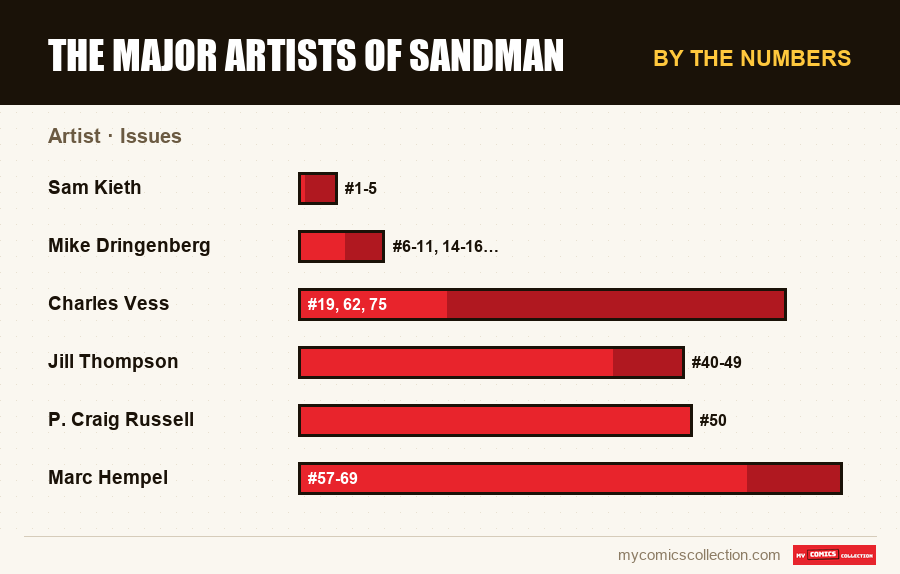
Unlike the covers (McKean from start to finish), the interiors changed hands regularly. Here are the main artists and the arcs they defined:
| Artist | Issues | Contribution |
|---|---|---|
| Sam Kieth | #1-5 | Launches the series, then steps away |
| Mike Dringenberg | #6-11, 14-16… | Co-creates Death's design |
| Charles Vess | #19, 62, 75 | Draws the award-winning "A Midsummer Night's Dream" |
| Jill Thompson | #40-49 | Illustrates the "Brief Lives" arc |
| P. Craig Russell | #50 | Delivers "Ramadan," a celebrated standalone |
| Marc Hempel | #57-69 | Angular style of the final "The Kindly Ones" arc |
Sources: Wikipedia (The Sandman), DC, Sandman Wiki. Sam Kieth left the series after #5; Dringenberg took over on pencils, and it was he who, on a suggestion from Gaiman, settled Death's iconic look (inspired by an acquaintance, Cinamon Hadley).
Values of the issues tied to these creators
Values = median of active eBay listings, all editions and grades combined (our estimator, eBay.fr + eBay.com, June 2026).
- Sandman #1 (Kieth / January 1989): the founding issue. Median €8 across 76 listings: solid volume, a reliable and accessible value.
- Sandman #4: Lucifer appears in the opening arc. Median €6 across 16 listings: treat it as a ballpark, since the volume sits just above the reliability threshold.
- Sandman #8: first appearance of Death, the most sought-after issue in the series. Our estimator finds only a handful of listings (8): too few to set a precise value. Qualitatively it's the grail of the run, so check it live before any purchase.
- Sandman #19 (Vess): the award-winning issue. Very few active listings: treat qualitatively, not as a stable value.
An important nuance about "the Sandman"
Don't conflate them: Gaiman's Sandman (Morpheus) is a 1989 character. There are no Silver- or Bronze-Age issues of HIS series. The earlier "Sandman" figures are different characters: Wesley Dodds, the Golden-Age Sandman (debut in Adventure Comics #40, 1939), and the Kirby/Simon Sandman (1974, Bronze Age). For Gaiman's series, the keys to know are all 1989-and-later issues.
Worth noting too: the prequel miniseries Sandman: Overture (2013-2015), drawn by J.H. Williams III, earned him a 2015 Eisner Award for Best Painter, and the work took the 2016 Hugo Award for Best Graphic Story.
Frequently asked questions
Dave McKean did every cover from 1989 to 1996, as well as the logo, using mixed collages of photo, paint, objects and sculpture. They were collected in 1998 in the book Dustcovers.
The interior changes hands regularly: Sam Kieth launches the series, then Mike Dringenberg, Charles Vess, Jill Thompson, P. Craig Russell and Marc Hempel take over depending on the arc. This visual mosaic is rare in mainstream comics.
In Sandman #8 ("The Sound of Her Wings", 1989), co-created by Neil Gaiman and Mike Dringenberg. It is the most coveted issue of the series, with very few active listings.
Not for Gaiman's series, which starts in 1989. Earlier Sandmen are different characters: Wesley Dodds, who debuted in Adventure Comics #40 (1939), and the Kirby and Simon Sandman (1974).
Sandman #19, "A Midsummer Night's Dream", drawn by Charles Vess, won the World Fantasy Award for best short fiction in 1991. It is still the only comic to have won in that category.
Own a Sandman comic? Get a free valuation with our tool based on real eBay sales to find its low, median and high value.