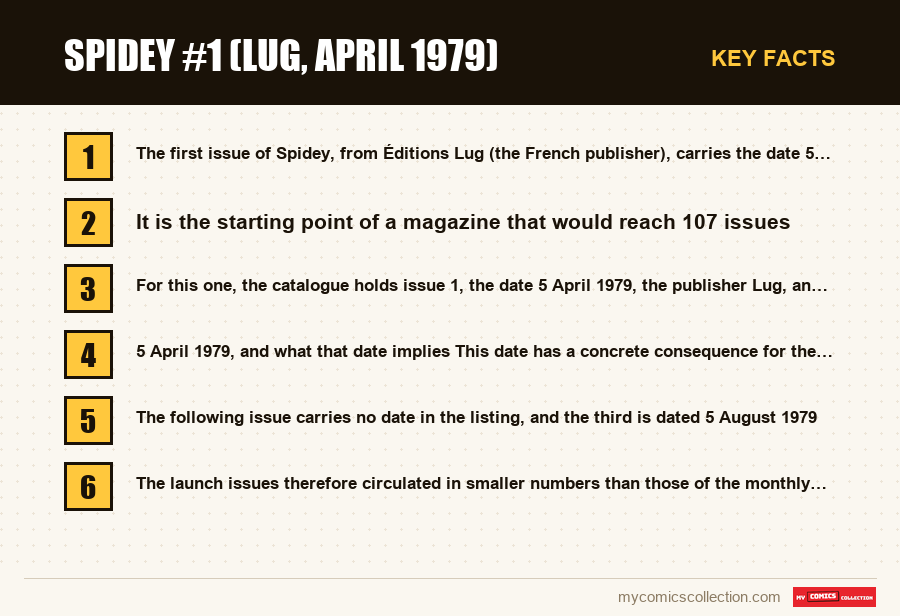
The first issue of Spidey, from Éditions Lug (the French publisher), carries the date 5 April 1979. The catalogue attaches to it a story titled "L'Homme Foudre" ("Lightning Man"), written by Jean Thomas and Yves Chantereau and drawn by Win Mortimer, Yves Chantereau and Jean-Yves Mitton. It is the starting point of a magazine that would reach 107 issues. The rest of its contents, as in any assembled magazine, is checked with the copy in hand.
In a stack of Lug magazines, the first issue of Spidey is one of the rare ones whose release date can be pinned down to the day. This is a real advantage when buying at a distance: most disputes over this kind of object concern less the condition than the identity of the issue, and a printed date settles what a cover scanned from afar leaves in doubt. You still need to know what to compare, and what to expect when a seller announces "the first issue" without further detail.
As always on this guide, only verified information (creators, numbers, dates) is stated as fact; the analysis is our own, with no reproduction of panels or protected dialogue.
What the catalogue says about this issue
The record is short, and that is normal: a magazine issue has no album title, it has a number and a date. For this one, the catalogue holds issue 1, the date 5 April 1979, the publisher Lug, and a story titled "L'Homme Foudre". The names credited on the writing are Jean Thomas and Yves Chantereau. On the art appear Win Mortimer, Yves Chantereau and Jean-Yves Mitton.
These four lines are already enough to distinguish the object from everything that resembles it on the second-hand market. A seller who announces a first issue of Spidey and gives you a different date, or who cannot tell you which date is printed on the issue, is describing something else: a later issue, an issue of a neighbouring magazine, or a copy he does not have in front of him.
The list of artists deserves a second look, because it mixes American and French names. This is the usual signature of an assembled magazine: material translated from one side, a French-made layout on the other. The exact split between the two, for this specific issue, can be read only on the copy and nowhere else.
5 April 1979, and what that date implies
This date has a concrete consequence for the buyer, and it has nothing to do with nostalgia. The following issue carries no date in the listing, and the third is dated 5 August 1979. Between the first and the third, roughly four months therefore passed: at launch, this magazine did not come out every month.
A spaced-out rhythm early in its life changes everything about print run and survival. A magazine that establishes itself slowly is distributed cautiously, then pushed harder once it sells. The launch issues therefore circulated in smaller numbers than those of the monthly period, which runs until 10 December 1988 and issue 107. This is the first of two or three facts that explain why this number one trades differently from its immediate neighbours.
In practice, remember the form of the date as well as the date itself. An issue from spring 1979 is not dated like one from 1985: the wording, its position and the printed cover price change over the years. Comparing one printing detail between the copy offered and a copy you are sure of is better than relying on the description.
The recorded story title, and what it does not prove
"L'Homme Foudre" is the title the catalogue attaches to this issue, and it appears nowhere else in the series. This is useful: a listing that mentions it most likely describes the right issue, or at least someone who has opened it.
However, the title does not tell you the contents. A French magazine of this format published several episodes per issue, and the listing keeps only one. The two or three stories that accompanied it, the features and the readers' letters if there were any, are therefore missing by construction. When a seller claims that an issue contains a particular famous episode, the claim cannot be verified from a catalogue record: it is verified on a photographed contents page of the copy.
This caution has a corollary that many listings overlook. From a French title you cannot deduce which American issue served as the source, nor that a character makes his first appearance in French in it. The sources disagree on some of these questions, and a serious collection is built on what is printed, not on what one assumes.
The creators credited on issue no. 1
Jean Thomas and Yves Chantereau on the writing, Win Mortimer, Yves Chantereau and Jean-Yves Mitton on the art: the listing therefore associates Chantereau with both roles, which happens when the same person adapts a text and retouches pages for the French format.
The name of Jean-Yves Mitton is the one that will serve you most. He recurs across the great majority of the issues, without covering all of them, and the listing stops crediting him on the art after issue 97, dated February 1988: the last ten issues of the magazine go without him. For a collector, this is therefore a dating marker as much as a thread of continuity, and the visual coherence of the first three quarters of the run rests largely on the work done in France. A copy whose cover has been restored or trimmed loses precisely what gives it its documentary value.
One last detail that seems minor: Win Mortimer appears elsewhere in the series as "Winslow Mortimer". Two spellings, one artist. If you keep a tracking file, normalise this kind of variant when you enter the data, or you will end up with duplicates that make you think issues are missing.
What sets this issue apart from the ones that follow
Three things, none of them a matter of taste. The first is the date, already discussed, which places it in the establishment phase of the magazine. The second is the status of the first issue itself: it is the only issue of the series about which no one can say "there is an equivalent just before it", which gives it a structural demand independent of its contents.
The third is less well known. In the listing, six issues of the series, located further along in the run, have no recorded story title. The first one, by contrast, is documented. This does not make it rarer, but it makes it easier to identify, and therefore easier to sell and to compare. In a market where uncertainty pushes prices down, being identifiable is a measurable advantage.
Do you collect this series?
Track what you own, what you are missing and what your collection is worth. 7-day trial.
Start my trial →
Recognising a genuine first issue in a listing
Start with what is not up for debate: the number on the logo and the date. Ask for a clear photo of the top of the cover, and a photo of the spine or of the legal notice. If the date shown is not April 1979, you are not looking at this issue, however closely the cover resembles it.
Next, be wary of the vocabulary. "Number 1", "first issue", "collector's no. 1" and "special number 1" do not mean the same thing. French publishers issued special numbers, binders grouping several issues, and reprints, and a bound volume containing the first issue is not the first issue. Ask directly: is it a single stapled issue, or a collected volume?
A third reflex, the most profitable: ask for a photo of the inside contents page. It settles the identification at once, the completeness of the booklet, and the condition of the interior block. A seller who refuses this photo for an issue he presents as a starting piece tells you something without saying it.
The possible confusions, and there are many
The same character had several French magazines under different titles, and this is where hurried buyers get lost. The catalogue keeps track of a series called "Une Aventure de l'Araignée" (An Adventure of the Spider) whose first issue is dated the third quarter of 1977, before Spidey launched. A listing that refers to "the first Araignée" may therefore be pointing to that object, which has nothing to do with the one you are interested in.
More tangled still: the catalogue also knows of a series titled "L'Araignée", launched in 1978, whose first recorded item carries an issue number in square brackets, a sign that its numbering is not firmly established. The sources disagree on this point. In other words, there is at least one French title devoted to the character for which the very notion of "number 1" is open to question. If a listing offers you one, demand the printed date rather than the announced number.
Finally, a "Spider-Man" title appears from April 1991 at Semic. A buyer who types the character's name and the words "number 1" will come across this 1990s issue as often as the 1979 one. Both are legitimate, both are first issues, but they do not belong to the same collection. The character hub helps untangle these families of titles before you commit.
What to look at on the object before buying
An April 1979 issue is nearly fifty years old and was printed to last a season. Four checkpoints, in this order. The spine first: that is where the staples work, where rust appears and where the paper tears when turning pages. A clean spine on an issue of this age is worth more than a glossy cover.
Then the corners and folds, keeping in mind that the vertical reading fold is the most common mark on newsstand magazines, and the hardest to make disappear. The colour of the inside paper third: yellowing is normal, a damp smell and halos are not, and they announce a deterioration that is still going on. Finally, completeness: count the pages if the seller allows it, and check that no inside cover page has been cut out, a common practice at the time among young readers.
One last point specific to older magazines: the newsagent's or distributor's stamp or label. It is not a defect in the strict sense; it is part of the copy's history, but it weighs on the appraisal depending on the buyer. Make up your mind before, not after receiving it.
What makes it relatively rare
It is not due to a confidential print run, of which we have no measure, but to the combination of three effects. The first is the spaced-out launch described above: the first issues of a magazine still being tested circulate less, and fewer people keep them, because nobody yet knows there will be a series.
The second effect is use. This magazine was read by children in 1979 and thrown away like a children's comic. The surviving copies in good condition are those that someone set aside without knowing why. The third effect is demand, which was built retrospectively: a series that lasts to its hundredth issue creates collectors who, ten or twenty years later, all look for the same entry point.
These three effects explain why the gap in value between a worn copy and a well-kept copy is, for this type of issue, much more marked than for issues from the middle of the series. Reason in ratios rather than figures: condition makes the difference, more than the number does.
Keeping it, seeking it, tracking it
If you already have it, treat it as the reference piece of your lot: neutral sleeve and board, flat or upright but never tightly packed, away from light and humidity swings. Record the date 5 April 1979 in your inventory rather than the number alone, because that is the data that will stop you from accidentally buying a neighbouring issue or a collected volume again.
If you are looking for it, be prepared to wait. Newsstand issues resurface in lots, often when an estate is sold, and a first issue rarely comes alone. Watch instead for sales of entire collections: the number one is often cheaper there than when sold individually, because the seller reasons by weight and not by piece. The blog guides explain this lot-based logic for other Lug magazines, and the Daredevil or X-Men hubs help spot other titles where the same method applies.
In short: the date 5 April 1979, the title "L'Homme Foudre", the presence of Jean-Yves Mitton on the art from this very issue, and a photo of the contents page. With these four elements, you are buying an identified object. Without them, you are buying a cover.
Frequently asked questions
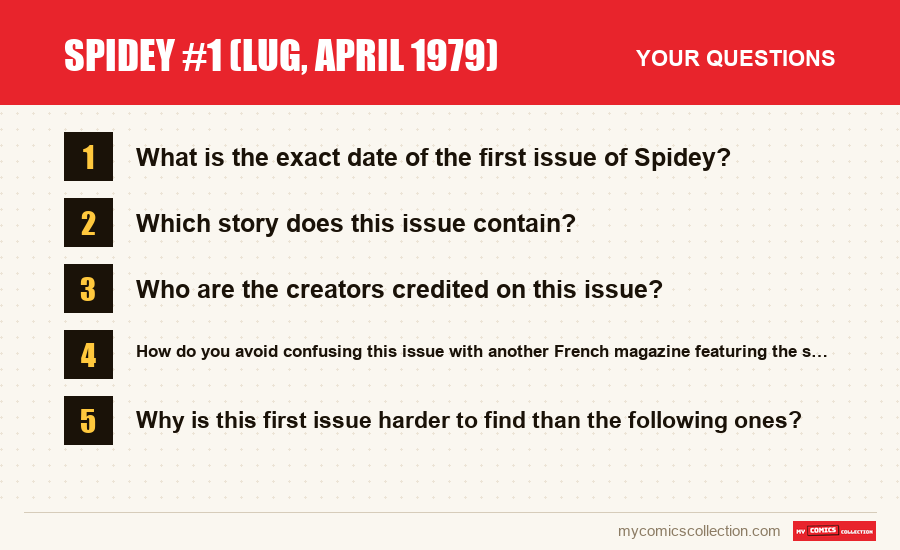
The catalogue dates issue 1, published by Éditions Lug, to 5 April 1979. It is the most reliable detail for identifying it in a listing: if the date printed on the copy offered is different, it is another issue, even if the cover looks familiar to you.
The listing attaches to it a story titled "L'Homme Foudre". Be aware that a French magazine of this format published several episodes per issue, and the catalogue keeps only one. The full contents, with the other stories and the features, can be checked only on the copy, ideally through a photo of the contents page.
On the writing, Jean Thomas and Yves Chantereau. On the art, Win Mortimer, Yves Chantereau and Jean-Yves Mitton. Chantereau therefore appears in both roles. Jean-Yves Mitton, present from this very first issue, recurs across the great majority of the following issues, but not to the end: the listing stops crediting him on the art after issue 97. He nonetheless remains the most constant name in the magazine.
Three neighbouring titles exist in the catalogue: "Une Aventure de l'Araignée", whose first issue is dated the third quarter of 1977, "L'Araignée", launched in 1978 with a numbering that is not firmly established, and "Spider-Man", published by Semic from April 1991. Rely on the printed date.
The listing shows a spaced-out launch: issue 3 is dated 5 August 1979, four months after the first. A magazine still establishing itself circulates less widely, and nobody kept it, since the series did not yet exist. Add the wear typical of newsstand comics read by children.