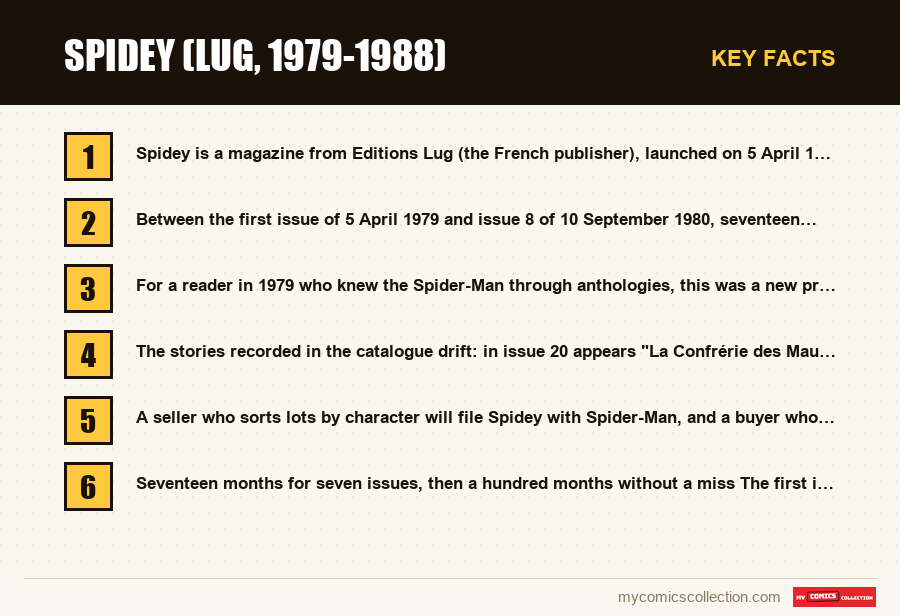
Spidey is a magazine from Editions Lug (the French publisher), launched on 5 April 1979 and stopped at issue 107, dated 10 December 1988. Its distinctiveness lies in its contents: a whole title carried by a single hero, where the publisher's other magazines assembled unrelated series. For the collector, the run splits in two: seven rare and irregular issues, then one hundred uninterrupted monthly releases.
You have a stack of Spidey at home, and you are stuck on the same question as everyone else: how far back should you go, and from which issue does the hunt become easy again? The answer is written in the cover dates, provided you read them in order. Between the first issue of 5 April 1979 and issue 8 of 10 September 1980, seventeen months pass for seven issues. After that, not a single gap until the end. This fracture governs everything else: the price, the difficulty, the order in which you should buy.
As always on this guide, only verified information (creators, numbers, dates) is stated as fact; the analysis is our own, with no reproduction of panels or protected dialogue.
A whole magazine for a single name
The editorial choice is obvious from the title. The publisher's other periodicals bore genre or family names, and their contents gathered independent series that readers took as they pleased. Spidey carries the nickname of a single character, and so promises a single door of entry. For a reader in 1979 who knew the Spider-Man through anthologies, this was a new proposition: buying an issue knowing in advance who would be on the cover.
The promise held for less time than the title. The stories recorded in the catalogue drift: in issue 20 appears "La Confrérie des Mauvais Mutants" (The Brotherhood of Evil Mutants), in issue 53 "Les Nouveaux Mutants" (The New Mutants), in issue 88 "Les Vengeurs de la Côte Ouest" (The West Coast Avengers). The magazine nominally remains Spidey's, but its contents increasingly borrow from other series. This shift is the most useful piece of information for anyone buying by issue: from the middle of the run on, you are no longer buying an issue of Spider-Man, you are buying a mixed issue in which he appears.
This drift also explains a common misunderstanding at flea markets. A seller who sorts lots by character will file Spidey with Spider-Man, and a buyer who came looking for mutants will walk past issue 81 titled "La reine des Morlocks" (The Queen of the Morlocks). The title of the magazine is not an index of its contents.
Seventeen months for seven issues, then a hundred months without a miss
The first issue carries the date 5 April 1979. The third carries that of 5 August 1979, four months later. Between issue 6 and issue 7, another four months. This erratic early rhythm is not a catalogue error: it is the trial run of a title whose publisher did not yet know what pace it could sustain.
Then everything stabilises. From issue 8, dated 10 September 1980, each following issue carries the next month, without a single skip, up to issue 107 of December 1988. One hundred consecutive releases, one a month, over more than eight years. This is a rare regularity, and it has an immediate practical consequence: beyond issue 8, you can calculate the date of any issue at a glance, and above all you will never search for an issue that never existed.
The day of the month also changes, and this detail helps date a copy whose cover is damaged. Issues 1, 3, 5, 6 and 7 are dated the 5th. Issue 4 and every issue after issue 8 are dated the 10th. If you hold an issue whose number has worn away but whose date is still legible as the 5th of the month, you are among the first seven, and so in the expensive part.
What the story titles reveal about the contents
Read in sequence, the French titles outline three phases that nobody announces on the cover. The first are simple, named confrontations: "L'Homme Foudre" (Lightning Man) opens the series, "Face au Docteur Fatalis !" (Face to Face with Doctor Doom!) arrives with issue 3, "L'Homme-Sable" (Sand Man) with issue 7. A magazine starting out sells its villains.
Next comes a run of alternate-history stories, recognisable by their question form. Nine recorded titles begin with "Et si" (What if), from issue 33 to issue 50, including "Et si Gwen Stacy avait vécu ?" (What if Gwen Stacy had lived?), spread over issues 49 and 50. For a collector, this pocket has a particular value: these are stories sought by their subject rather than their number, which makes them more in demand than their immediate neighbours.
The end of the series turns into a team-book catalogue: "La saga des Brood" (The Brood Saga), "Firestar", "Fantastiques contre X-Men" (Fantastic Four versus X-Men), "Le Surfer d'argent" (The Silver Surfer) in the very last issue. One case deserves separate mention: issue 24, titled "Superman et Spider-Man", and issue 61, "Les étranges X-Men et les Jeunes Titans" (The Uncanny X-Men and the Teen Titans). These two titles designate crossover stories between publishing houses, which makes these issues sought after by two audiences instead of one.
A last signal, less glorious but revealing: issue 66 is recorded under the title "Mots croisés en images" (Picture Crosswords). A magazine in which an issue is referenced by its puzzle says something about the bulk of editorial material that surrounded the stories.
The signatures: one artist on three issues out of four
One name dominates the credits. Jean-Yves Mitton is credited as artist on 75 of the 107 issues, almost three in four, and he appears from issue 1 alongside Win Mortimer. In a magazine whose stories come from elsewhere, this permanence is the mark of French production: covers, illustrations, layout. It gives the stack its visual unity, and it also explains why a Spidey can be recognised from a distance.
Around him, the catalogue rotates Werner Roth across thirty-one issues, then Don Heck, Jack Kirby and Win Mortimer in close proportions. On the writing side, the credits follow the periods of the reprinted stories: Stan Lee dominates the single year 1982, Roy Thomas the middle stretch of 1983 and 1984, and Louise Simonson returns more often than any other writer over the last four years, up to issue 107. Ciro Tota appears both as artist and as writer, and Jean Frisano signs visuals on issues 49, 86 and 87.
Beware of one reading trap in the credits: the same artist appears under two spellings, "Ciro Tota" and "Cyrus Tota", and sometimes "Win Mortimer" and sometimes "Winslow Mortimer". If you search for an issue by its artist's name in a search tool, try both spellings before concluding that an issue is missing.
The issues the catalogue says nothing about
It must be said frankly, because this is the limit of this guide. For the six issues from 10 to 15, published from November 1980 to April 1981, the catalogue gives neither a story title nor a writer. Only the artist is recorded, and in each case it is Jean-Yves Mitton. These six issues exist, their dates are known, but their contents must still be read from the copy itself.
Another, smaller gap concerns issue 2: its story title is recorded, "Piège en quatre dimensions..." (Trap in Four Dimensions...), but not its cover date. It necessarily falls between 5 April and 5 August 1979, which is enough to place it but not to date it to the month. Finally, five issues carry only a month without a day: issues 42, 65, 75, 100 and 103.
If you own one of these eight incomplete issues, you hold information that the public databases do not have. Noting the contents from the back of the cover and the exact date takes ten seconds and is worth more than any guesswork.
Do you collect this series?
Track what you own, what you are missing and what your collection is worth. 7-day trial.
Start my trial →
What the data does NOT allow us to claim
The catalogue records only one story title per issue, whereas an issue of this period contained several. In other words, when you read here "Le Lézard revit !..." (The Lizard Lives Again!...) for issue 16, you know that a story of that name is in it, but you do not know whether it opened the issue or what accompanied it.
From this gap follows a rule we apply without exception: we never claim that a Spidey issue contains the first French publication of a character, nor that it matches a given American issue. Both claims circulate widely, and both require a page-by-page collation that the catalogue does not provide. A seller who offers them to you should be able to show the contents page, not just an issue number.
This caution has a concrete advantage for the buyer: it shifts the question from the issue number to the copy. What you pay for is an object whose contents and condition you have checked, not a legend attached to a rank in the series.
Recognising the edition and judging the condition
A series of 107 issues spread over ten years does not present itself uniformly. The early issues, published before the stabilisation of 1980, had a shorter print run, and the copies that survived are often those that readers had set aside without knowing the magazine would last. At the other end, the last issues of 1988 were bought by a readership already made up of collectors, and so are better preserved on average.
The points to check are always the same and always in the same place. The staple block first: a rusted staple stains the central section and the stain does not come out. The spine next, which whitens as soon as an issue has been read folded. The corners last, which tell the story of how the copy was stored: blunted corners point to a stack kept upright, a dog-eared corner points to reading.
Also check that the central section is present and in the right place. On a magazine whose issues included game pages and illustrated features, whose photo credits recorded across a dozen issues between 22 and 54 bear witness to this, the detachable pages are the first to go missing. A copy stripped of its poster or game is not complete, even if the story is intact.
Buying traps specific to this series
The first trap is the "complete" lot announced on the strength of a count. Since the series runs to 107 without a break after issue 8, a seller who counts his issues and gets a hundred concludes quickly that only seven are missing. Yet it is precisely those first seven that carry most of the value of the lot. Ask for the issue numbers, never the total.
The second trap is attribution by cover. Because French production is largely signed by the same artist from one end to the other, two issues several years apart look alike, and a well-preserved issue from 1986 to 1988 can be presented as an early issue of the series. The cover date and its day, the 5th or the 10th, settle the question in a second.
The third trap concerns two-part stories. About ten titles run across two consecutive issues, for example "Le triomphe du docteur Octopus" (The Triumph of Doctor Octopus) in issues 68 and 69, or "Nemrod" in issues 98 and 99. Buying one without the other leaves a story cut in half. Before validating a single-issue purchase in this range, check whether the neighbouring issue carries the same title.
Completing the series and following it over time
The method that works comes down to one order. Start with the monthly stretch, from issue 16 to issue 107: it turns up in lots, it fills up quickly, and it gives you a coherent base. Then go after issues 10 to 15, cheaper than the very first ones but often missing from lots because their contents are poorly documented. Save issues 1 to 9 for last: they trade individually and must be watched for.
To follow a series this long, a list of issue numbers will not hold up for long. What needs recording is the condition of each copy, the presence of the central section, and, for the eight poorly documented issues, the contents you have noted yourself. A Spidey collection kept at this level of detail becomes a source, not just a stack.
As for value, it is not read from a price guide. It is deduced from three ratios: the gap between one of the first seven issues and a monthly issue, which is considerable; the gap between two copies of the same issue depending on condition, which can be of the same order; and the premium on issues sought for their subject, the alternate-history stories and the two crossover stories between publishers. Reasoning in ratios rather than amounts protects you from market swings.
Frequently asked questions
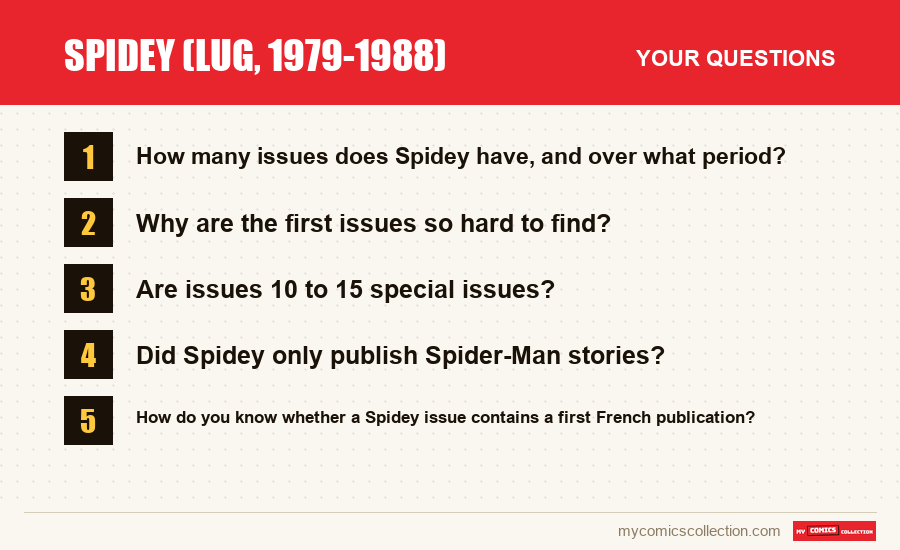
The series runs to 107 issues. The first is dated 5 April 1979, the last 10 December 1988, a little over nine years. After issue 8, dated 10 September 1980, publication is monthly without interruption: one hundred consecutive issues, one a month, until it stopped.
Because there are few of them and they are spaced out. Only seven issues cover the first seventeen months, with gaps of up to four months between two releases. A title that does not come out every month builds little loyalty, unsold copies get returned, and the copies that survive are those of readers who were already buying by collection.
No, they are ordinary issues published from November 1980 to April 1981. What is missing is their documentation: the catalogue records for them neither a story title nor a writer, only Jean-Yves Mitton on the art. Their contents have to be read from the copy, and that check is worth more than any guesswork.
No. The recorded titles show a gradual opening to other series: The Brotherhood of Evil Mutants in issue 20, The New Mutants in issue 53, The West Coast Avengers in issue 88, and the X-Men and the Silver Surfer in the final years. The magazine's name remains that of a hero, its contents no longer do.
Not from a catalogue. Each issue contained several stories, and the catalogue records only one title per issue. Any claim of a first French publication therefore calls for a page-by-page collation of the copy. Ask the seller for a photo of the contents page, and be wary of an ad that puts forward an issue number without showing its contents.