In short
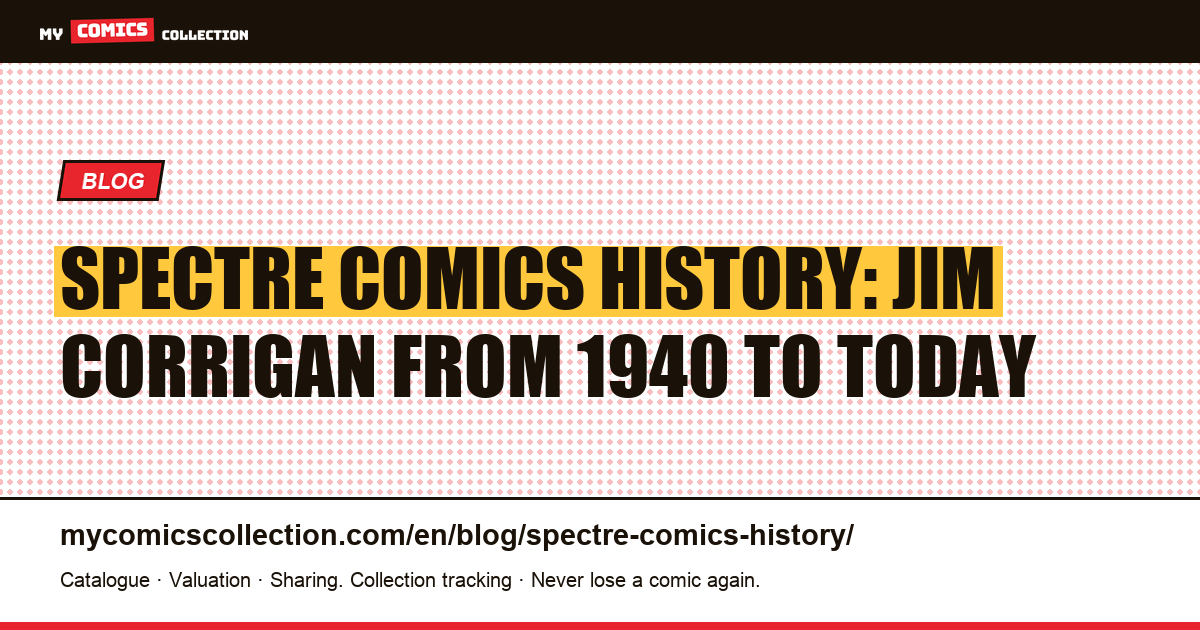
The Spectre, Jim Corrigan's ghostly avenger, debuted in More Fun Comics #52 (1940), created by Jerry Siegel and Bernard Baily. He joined the Justice Society, vanished from newsstands in 1945, and returned in Showcase #60 (1966). Michael Fleisher and Jim Aparo made him a horror figure in Adventure Comics (1974), and John Ostrander and Tom Mandrake gave him a conscience in a 1992 series. Later hosts, Hal Jordan and Crispus Allen, widened the role.
Few DC characters have changed purpose as often as the Spectre. He begins as a murdered policeman sent back to punish killers, becomes a cosmic embodiment of divine wrath, and ends up as a spirit that needs a human host to stay in check. Following him through the decades means following how DC itself handled death, faith and fear.
For Corrigan's timeline, each name and issue number was cross-checked, and a cover month is printed only when it could be confirmed; the interpretation is ours. The readings of what each era meant, and the advice on assembling a run, are our own analysis.
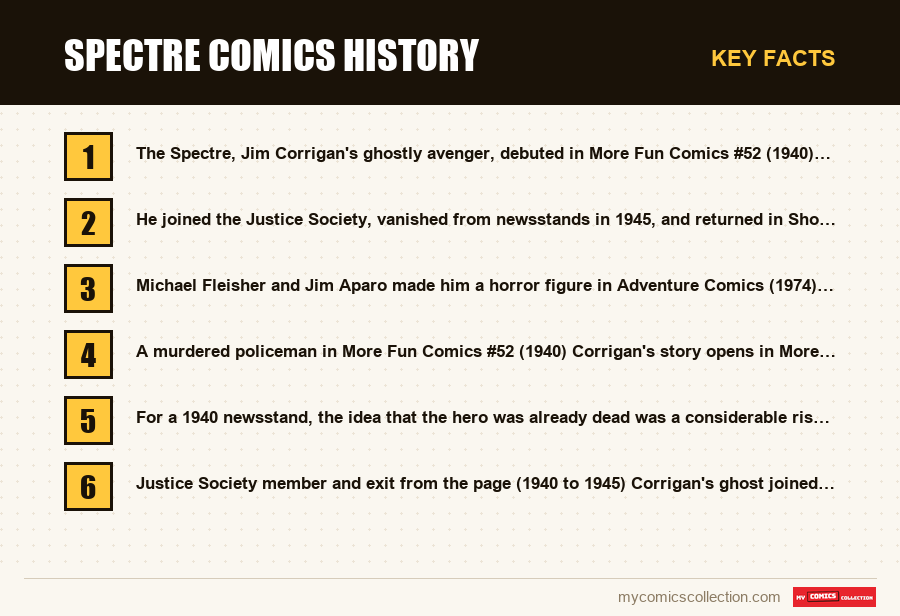
A murdered policeman in More Fun Comics #52 (1940)
Corrigan's story opens in More Fun Comics #52 with a February 1940 cover date. Jerry Siegel and Bernard Baily are the credited creators, and the Spectre was a far darker idea than the costumed strongmen then filling the anthologies.
The setup is blunt. Jim Corrigan, a police officer, is murdered by criminals. A presence called the Voice sends his spirit back to Earth as an instrument of divine justice. Corrigan keeps living as a policeman while the Spectre handles what the law cannot. For a 1940 newsstand, the idea that the hero was already dead was a considerable risk, and it is the root of every later reinterpretation.
The feature stayed in More Fun Comics long enough to establish its own conventions: the pale, caped figure, the grim punishments, the sense that vengeance was a force larger than the man carrying it. Our guide to the debut issue covers the origin story itself and what to check on a copy; this page picks up from there and follows the character forward.
Justice Society member and exit from the page (1940 to 1945)
Corrigan's ghost joined the Justice Society as a charter member in the pages of All Star Comics. He remained a presence there until his last appearance in All Star Comics #23 (winter 1944 to 1945). In his own feature the story kept moving: More Fun Comics #74 (December 1941) introduced Percival Popp, the Super Cop, whom the Spectre watches over as a guardian angel, a tonal shift toward comedy that the character would later shed.
In More Fun Comics #75 (January 1942), Jim Corrigan is resurrected, which changes the logic of the series: the Spectre is no longer bound to a dead man's identity in quite the same way. By More Fun Comics #90 (April 1943), Corrigan enlists for World War II and the Spectre effectively leaves his own series. The feature ends with More Fun Comics #101 (February 1945), after a run that began with a murder and finished almost as a footnote.
The lesson for a collector is that the Golden Age Spectre has two faces. The early issues are a horror premise; the later ones are a wartime anthology strip. Anyone tracing the character should treat #52 as the conceptual start and #75 as an early reset.
The Silver Age revival: Showcase #60 and a ten-issue series (1966 onward)
After more than two decades off the stands, the Spectre returned in Showcase #60 in 1966, written by Gardner Fox with pencils by Murphy Anderson. The timing fits the broader revival of Golden Age heroes at DC. The revival led straight into a Justice League and Justice Society crossover in Justice League of America #46 and #47.
DC then tested the Spectre as a team-up partner. He co-starred with the Flash in The Brave and the Bold #72 (July 1967) and with Batman in The Brave and the Bold #75 (1968). In December 1967 he received his own title, The Spectre, which ran ten issues. Neal Adams drew issues #2 to #5 and also wrote #4 and #5, and the last two issues moved toward a horror anthology format.
The series is short, but it matters for two reasons. It re-established Corrigan as a modern character, and it let Neal Adams put his stamp on the figure. The ten-issue length also points to a pattern: until the 1990s, each revival of the Spectre was short.
Fleisher and Aparo turn him into a horror avenger (1974 to 1975)
The Spectre's most extreme reinvention came in Adventure Comics #431 to #440, published from February 1974 to July 1975 under the banner "The Wrath of the Spectre." Michael Fleisher wrote the stories and Jim Aparo drew them. The premise pushed the avenger's methods to their logical end: Corrigan's ghostly alter ego destroyed criminals through increasingly grotesque supernatural executions, and the stories pointedly asked whether a force of divine vengeance should have no mercy at all.
This run looks unlike most of what DC published at the time, and its reputation grew over the years. In 1988, DC published Wrath of the Spectre, a four-issue miniseries in which issues #1 to #3 reprinted Adventure Comics #431 to #440 and issue #4 added three newly drawn stories.
For collectors, this is the era that most clearly separates the Spectre from every other Golden Age revival. Whether you want the Fleisher and Aparo run in single issues or in the 1988 reprint is a question of budget and shelf space; our where to start guide places it among the essential reads.
Crisis, the Swamp Thing crossover and the late 1980s (1985 to 1989)
After Crisis on Infinite Earths, the Spectre was recast in the revised continuity as a largely depowered figure. A more lasting image came from Alan Moore, Stephen Bissette and John Totleben in Swamp Thing (volume 2) Annual #2, where the Spectre appears in the horror landscape that Moore was building around the swamp creature. Inside that series' "American Gothic" storyline, the Great Evil Beast gets the better of him, which leaves the avenger outmatched. Our Man-Thing history covers a neighboring swamp creature from the same era.
The Spectre also appeared in the Last Days of the Justice Society of America special, and then received a solo series written by Doug Moench, which ended with issue #31 in November 1989. A short while later he showed up in a cameo in Neil Gaiman's four-issue The Books of Magic. In our reading, these years bridge two models: the horror avenger of the 1970s and the theological figure of the 1990s.
One planned project never reached stands: a new series with Steve Gerber as writer and Gene Colan as penciler was cancelled in 1986 before launch, after the writer missed the deadline for the first issue. It is one of those near misses that explain why the character kept resetting.
Do you collect this series?
Track what you own, what you are missing and what your collection is worth. 7-day trial.
Start my trial →
John Ostrander and Tom Mandrake: the wrath of God gets a conscience (1992 to 1998)
The turning point is the volume 3 series, The Spectre, written by John Ostrander with art by Tom Mandrake, which ran from 1992 to 1998. It is numbered #1 to #62, with a #0 issue and an Annual #1. Ostrander used morally ambiguous cases and revised the character's history: the Spectre was recast as an entity tied to a fallen angel named Aztar who had repented, and the Spectre replaced Eclipso as the embodiment of God's wrath.
This reframing is what makes the series remarkable for readers today. Instead of punishing every offender, Corrigan and the Spectre are in conversation with each other, and the stories turn on the question of whether vengeance and justice are the same thing. The series also reached into the wider DC universe: issue #54, dated June 1997, introduced Michael Holt as a new Mister Terrific.
The run is collected in several volumes. The first four issues are gathered in Crimes and Punishments, issues #13 to #22 in Wrath of God, and an omnibus also exists. If you plan to read only one stretch of Spectre comics, this is the one most collectors choose, and the numbering is clean enough that completing it in single issues is realistic.
New hosts: Crispus Allen and Hal Jordan (1999 to the 2000s)
By the end of the 1990s DC had moved the Spectre away from Jim Corrigan altogether. Crispus Allen, a Gotham police detective, debuted in Detective Comics #742 (March 2000), created by Greg Rucka and Shawn Martinbrough, and later became a host of the Spectre. That shift continued the character's central idea, a police officer wronged in life who carries a spirit of vengeance, while changing the person under the cloak.
Hal Jordan also became the Spectre. He took the role after the 1999 miniseries Day of Judgment, and a fourth The Spectre series ran 27 issues from 2001 to 2003, with Hal losing his brother Jack to a supernatural assassin. After that series ended, Jordan was pulled back into the Spectre's mission for a time before returning to Green Lantern in the wake of Green Lantern: Rebirth in 2004.
These years matter for collectors because "the Spectre" is not a single person. A listing that says "Spectre" can mean Corrigan, Jordan or Allen, and the same cloak appears in all three. Always check which host the issue is about before assuming what you are buying.
Day of Vengeance, Gotham by Midnight and other versions
In the Infinite Crisis era, the miniseries Day of Vengeance showed Jean Loring becoming Eclipso, who manipulates the Spectre into attacking magic itself. Day of Vengeance: Infinite Crisis Special #1 includes the death of Nabu, the force behind Doctor Fate. That crossover ties the Spectre to the magical corner of the DC universe that also includes Zatanna, which is why the character sits in our magic hub.
The Spectre also appears in later events, including Blackest Night and Brightest Day, and in the Final Crisis: Revelations miniseries. In the New 52 period, Gotham by Midnight collected issues #1 to #5, then #6 to #12 and an Annual #1, and placed Corrigan on a Gotham task force handling supernatural cases, a return to his police roots.
Alternate versions also exist. An Earth-2 version of Jim Corrigan appears in JSA Annual #1 (2008), and an Earth-3 version appears in Countdown #31 (2008). They are minor in terms of key issues but useful for filling out the character's different incarnations in a collection.
The key issues across the Spectre's history
- More Fun Comics #52 (1940): debut of Jim Corrigan as the Spectre, by Jerry Siegel and Bernard Baily.
- More Fun Comics #75 (1942): Corrigan is resurrected, resetting the series' premise.
- Showcase #60 (1966): the Silver Age revival, written by Gardner Fox with pencils by Murphy Anderson.
- Adventure Comics #431 (1974): the start of Michael Fleisher and Jim Aparo's "Wrath of the Spectre" run, which continues through #440.
- The Spectre volume 3 #1 (1992): the start of John Ostrander and Tom Mandrake's series.
- The Spectre volume 3 #54 (1997): Michael Holt appears as a new Mister Terrific.
- Detective Comics #742 (2000): Crispus Allen debuts, created by Greg Rucka and Shawn Martinbrough.
- Day of Vengeance: Infinite Crisis Special #1: the Spectre kills Nabu.
How to follow the Spectre in a collection
Start with the series, not the debut. The Ostrander and Mandrake The Spectre volume 3 gives the clearest picture of what the character is, and the issue numbers run cleanly from #1 to #62. Treat the Fleisher and Aparo stretch of Adventure Comics as a second purchase, either as single issues #431 to #440 or through the 1988 reprint miniseries. Add the 1967 series and Showcase #60 as historical pieces.
Numbering is the main trap. There have been several Spectre series, so "Spectre #1" can mean 1967, 1992, 2001 or later; always note the year and volume in your records. Hosts matter as well: record whether an issue stars Corrigan, Jordan or Allen. A collection tracker works best when every entry carries the series, the volume, the cover year and the host, so that duplicates of similar titles do not get merged by mistake.
Frequently asked questions
Corrigan's ghostly alter ego arrives in More Fun Comics #52, with a February 1940 cover date. Jerry Siegel and Bernard Baily are the credited creators. In it a police officer, Jim Corrigan, is killed and sent back by the Voice to deliver divine justice. The feature ran in the title through issue #101.
The Spectre is a spirit of vengeance bonded to a human host. The original host is Jim Corrigan, a murdered police officer, and later hosts include Hal Jordan, who took the role after Day of Judgment in 1999, and Crispus Allen, a Gotham detective introduced in Detective Comics #742 in 2000.
Most readers start with the volume 3 The Spectre by John Ostrander and Tom Mandrake, which ran from 1992 to 1998 and has clean numbering from #1 to #62. After that, read Michael Fleisher and Jim Aparo in Adventure Comics #431 to #440, a darker and more violent take on the same idea.
Yes. He was among the Justice Society of America's founders in All Star Comics, and his final outing with the team in that era came in All Star Comics #23 (winter 1944 to 1945). He returned to the Justice Society orbit in the 1960s, when Gardner Fox wrote the Showcase #60 revival.
No. Hal Jordan became the Spectre after the 1999 miniseries Day of Judgment and headlined a 27-issue The Spectre series from 2001 to 2003. He later returned to his role as a Green Lantern after Green Lantern: Rebirth in 2004. Crispus Allen later served as host, and Jim Corrigan returned in the New 52 period.
If you hold a Golden Age More Fun Comics or a run of Ostrander's The Spectre, a quick estimate shows where each issue stands.
Estimate my comic