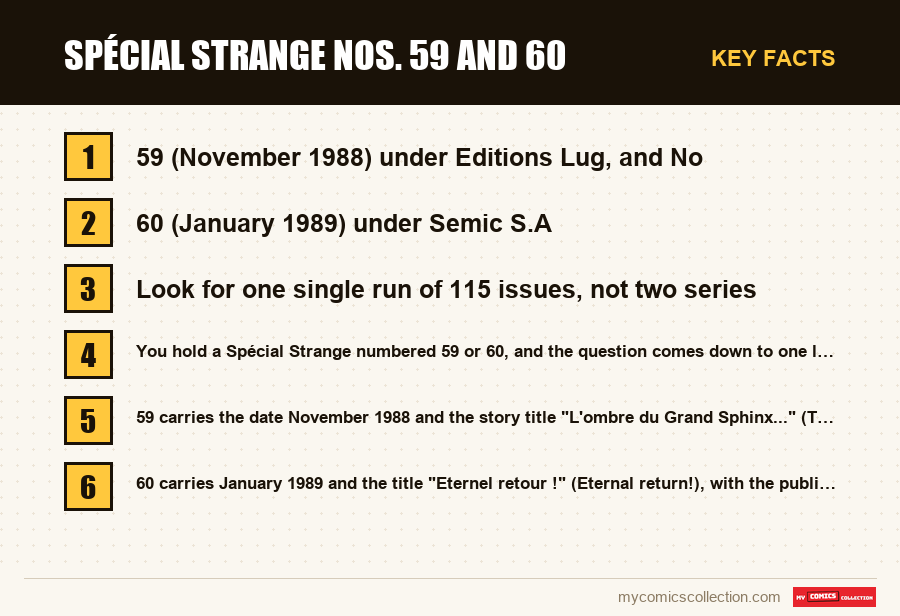
The catalogue files Spécial Strange under two series records: No. 59 (November 1988) under Editions Lug, and No. 60 (January 1989) under Semic S.A. Between the two, the numbering is not reset and the interval stays at two months. What changes is the publisher's name and the record under which the issue is filed. Look for one single run of 115 issues, not two series.
You hold a Spécial Strange numbered 59 or 60, and the question comes down to one line: is there a break here that would force you to file these two issues in two different series? On the shelf, the answer is no. In a list of gaps built from the catalogue, it is more subtle, because the same magazine occupies two entries there.
As always on this guide, only verified information (creators, issue numbers, dates) is stated as fact. The analysis is our own, with no reproduction of any panel or protected dialogue.
Two issues, two records, one run
In the catalogue listing, No. 59 carries the date November 1988 and the story title "L'ombre du Grand Sphinx..." (The shadow of the Great Sphinx...), with the publisher Editions Lug. No. 60 carries January 1989 and the title "Eternel retour !" (Eternal return!), with the publisher Semic S.A. The two series records are both called Spécial Strange. Only the publisher and the starting year of the series change: 1975 for one, 1989 for the other.
The first fact that matters to you: the numbers do not overlap and leave no hole. The Lug record counts issues 1 to 59, with no missing rank; the Semic record counts issues 60 to 115, with no missing rank either, that is 56 issues. Added together, 59 and 56 give 115, which is the last rank in the listing. In this data, there is neither a second "No. 60" on the Lug side nor a "No. 1" on the Semic side.
What the date shows on either side
November 1988, then January 1989: two full months, with December 1988 carrying no issue. This is the simplest test for whether an issue is missing between two others, and it is negative here. If a list offers you an "intermediate issue" between 59 and 60, it has the wrong magazine or the wrong edition.
The cover of No. 60 therefore does not mark a new year in the sense of a relaunched series: 59 closes 1988 and 60 opens 1989, which is the natural division of a calendar, not that of a renumbering. Keeping this in mind stops you filing 60 as a "first" out of habit, just because the series record that contains it starts at 60 in the catalogue.
The rhythm does not change at the border
One might expect a change of publisher to come with a change of rhythm. The listing says otherwise. From No. 20 to No. 43, the issues follow one another at intervals of two, three or four months, in a recurring cycle. From No. 44 (May 1986) onwards, each issue follows the previous one by exactly two months, that is 57 consecutive intervals, up to September 1995.
The step from 59 to 60 is one of these intervals: sixteen precede it, from 44 to 59, and forty others follow it, from 61 to 100. The border between the two publishers therefore falls in the middle of a stable cadence, not at a turning point. The only visible change of rhythm after No. 44 occurs at No. 101 (October 1995), forty-two ranks further on, and it no longer concerns this page.
For you, the consequence is practical: over the zone from 44 to 100, the date of an issue can be deduced from its rank. 59 is November 1988; 60, January 1989; 58 is September 1988, and 61 March 1989. A date that departs from this step should be checked on the copy.
The day of the month: a detail that is lost, then returns
This is where the border blurs the most. From No. 45 to No. 51, the issues carry a day in their date, most often the 10th. From No. 52 (September 1987) onwards, the record gives only the month and year, up to 59. No. 60, the first on the Semic side, carries none either: nine ranks in a row without a day, on both sides of the border.
This is not a permanent disappearance, however. No. 61 is dated "10 March 1989", and among the seven issues 60 to 66, five carry a day (the 10th) and two do not: 60 and 64. Across all 56 Semic records, 15 carry a day and 41 do not. No rule is drawn from this; we note an unevenness, and it is enough to warn against a methodological error.
Which error? The one that would consist of sorting your issues by day. For 59 and 60, the datum stops at the month. Nothing in the catalogue tells us which day of November or January they went on sale, and the rank is enough to order them without ambiguity.
Do you collect this series?
Track what you own, what you are missing and what your collection is worth. 7-day trial.
Start my trial →
The credits: what crosses the border, what arrives
The credits in the listing are given at the level of the issue, not the episode: we know who is credited, not who did what in which story. With that caveat, the comparison is instructive. No. 59 credits three writers: Chris Claremont, Tom DeFalco and Ann Nocenti. No. 60 credits three as well, the same ones, in a different order. The name of Chris Claremont appears in the credits of every rank from 52 to 66, eight times on the Lug side and seven on the Semic side: his name crosses the border without noticing it.
On the art side, the overlap is thinner. No. 59 cites Ciro Tota, Ron Wilson and Arthur Adams; No. 60 cites Arthur Adams, Jackson Guice and Marc Silvestri. Only one name is common to both. Ciro Tota, credited on 58 and 59, is absent from 60, then, across ranks 61 to 66, returns on 61, 62, 65 and 66.
The clearest fact is the arrival of Marc Silvestri. His name appears nowhere in the listing before No. 60, and he is then credited on all seven issues 60 to 66. A new artist from the very first Semic issue: here is a border that the listing makes visible in the credits, independently of the publisher. It does not prove that Silvestri drew the episode titled "Eternel retour !": the credit covers the whole issue.
Recognising 59 and 60 in hand
What the data does not give you, the object does. Three checks, in order. The publisher's name first: the listing gives Lug for 59 and Semic for 60, and it is up to the copy to confirm this. If a copy numbered 60 still carries Lug, or a 59 already carries Semic, do not settle it from the catalogue: the listing gives a single publisher per record and does not describe intermediate cases.
Then the number on the cover: the title is the same on both issues, it is the figure that tells them apart. Finally the date, to the month: November 1988 for 59, January 1989 for 60. If the printed date is one of the months in the run of issues 44 to 100 (September, November, January, March, May, July), it is consistent; otherwise, look more closely.
Lastly, the contents. The listing gives only one story title per issue: "L'ombre du Grand Sphinx..." for 59, "Eternel retour !" for 60. The listing does not say whether the issue contains other episodes than this title; only the copy allows you to read that. Do not deduce from these two titles either a first appearance or a match with an American issue.
The neighbours, and how to enter the pair in a list of gaps
The three issues that precede 59 are 56, 57 and 58, all in the Lug record and dated May to September 1988. The three that follow 60 are 61, 62 and 63, all in the Semic record and dated March to July 1989. Taken as a block, from 56 to 63, they fit on a single date sequence without a break.
For your list, the method is to number continuously. Write "Spécial Strange No. 59" and "No. 60" in the same column, with the publisher as a simple attribute. If you tick off against the catalogue, you will see two series: do not copy that split into your file, or you will create two lists where there is only one run. If a block from 1988 and a block from 1989 are offered to you together, that is the only place where the run changes publisher, and it is therefore easy to verify at a glance.
Frequently asked questions
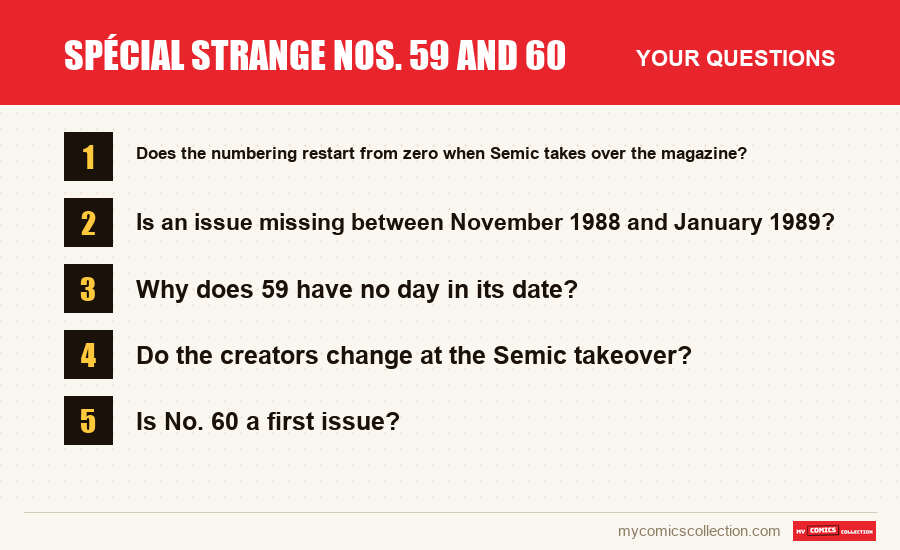
No. The listing shows No. 59 at Lug, then No. 60 at Semic, with no overlap and no missing rank. The Semic record starts at 60 and runs to 115: it is the continuation of a single run.
Nothing in the listing points to an intermediate issue. The gap is two months, like the sixteen before it from 44 to 59, and no issue is dated December 1988.
The records from 52 to 60 give only the month and year. The listing does not explain why. The day reappears later on several Semic issues, for example 61, dated 10 March 1989.
Not the writers: the same three names are credited on 59 and on 60. On the art side, Arthur Adams is the only common name, and Marc Silvestri appears from 60 onwards in the listing.
No, it is the sixtieth rank of a series begun in 1975. Only the catalogue's series record starts at 60. Do not treat it as a "number one" in a listing or in an inventory.