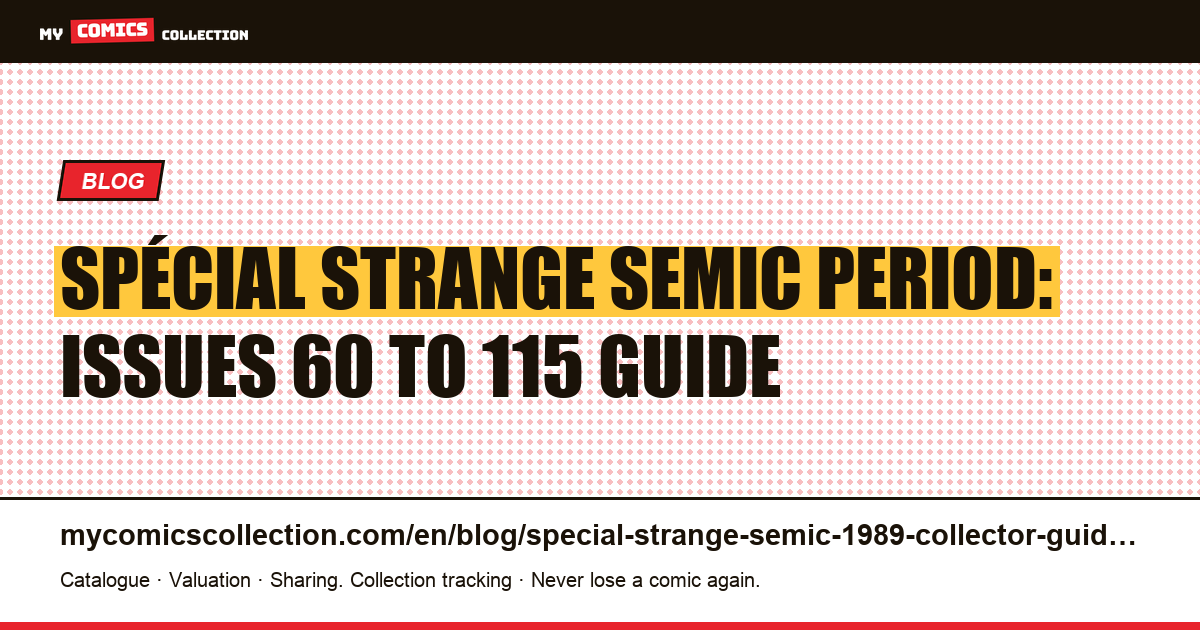
Semic did not reset the counters. The catalogue shows that Lug stops at issue 59, dated November 1988, and that Semic continues with issue 60, dated January 1989. The Semic period therefore covers issues 60 to 115, fifty-six issues without a gap, from early 1989 to the end of 1996. A "Spécial Strange 72" designates only one object, the one dated January 1991.
You have a pile of Spécial Strange at home, and you want to know where the old series ends and where the one called "the Semic period" begins. The answer lies in a numbering detail that changes how you read a listing, and that a stubborn legend has been blurring for years. This guide settles it with the catalogue dates, then sets out what you need to know to buy, file and complete these fifty-six issues.
As always on this guide, only verified information (creators, issue numbers, dates) is stated as fact. The analysis is our own, with no reproduction of any panel or protected dialogue.
The numbering does not restart at 1, and that is the starting point
The received idea is that a change of publisher brings a new issue 1. For Spécial Strange, the catalogue says exactly the opposite. The last issue of the series launched in 1975 carries number 59 and a cover date of November 1988. The first of the Semic series carries number 60 and a date of January 1989. Two months apart, one number apart: the continuation is mechanical, and there is neither a jump nor a duplicate in the run.
For a collector, the consequence is reassuring. When a listing gives a number, there is never any ambiguity about the object, unlike titles where two different issues compete for the same figure. A number below sixty necessarily belongs to the earlier period, a number of sixty or above necessarily belongs to the Semic period. You can sort an entire pile without opening a single copy.
The flip side is that a series judged complete on its Semic segment alone remains a fragment. A seller who announces "the complete series" while offering you the upper run is selling a continuation, not a whole. Always check which number opens the lot: it is the only piece of information that distinguishes a collection begun in 1975 from one begun in 1989.
What the magazine published under Semic
The credits recorded in the catalogue are telling about how these issues were built. Across the fifty-six issues, the great majority carry three writer names and three artist names, whereas only one story title is recorded. This mismatch is not a data-entry error: it signals a contents page with several episodes, of which the catalogue keeps only the title put forward.
Only one issue of the series escapes this rule on the writing side, No. 90, dated January 1994, credited to Fabian Nicieza alone. It is the kind of anomaly that deserves a look at the copy rather than a hasty conclusion: it may signal a tighter contents page, or simply an incomplete listing. Everywhere else, assume that the issue in your hand contains more episodes than a single title suggests.
The recorded names outline a magazine centred on the mutant line, with additions that change over the years. The early issues cross paths with Chris Claremont, Ann Nocenti and Tom DeFalco on the writing side; the last ones with Scott Lobdell, D. G. Chichester and Gregory Wright. In between, the catalogue allows no statement about correspondence with a particular American issue, and we will make none.
Two publication regimes, and a switch in autumn 1995
The cover dates tell a very regular story, then a clear acceleration. From January 1989 to September 1995, the magazine appeared every two months, on odd months: January, March, May, July, September, November, year after year, with not a single missing month. Forty-one issues follow this rhythm, which explains why these numbers turn up in whole runs from the same seller: subscribers and loyal readers accumulated six a year.
Then No. 101 carries the date October 1995, when the previous one was dated September. The magazine goes monthly and does not miss a month again until December 1996. Fifteen issues in fifteen months is a rhythm that leaves less time for newsstand distribution, and it changes how these copies circulate today.
This switch is your best mental dating tool. If you have an issue from the upper run in front of you and its month is even (February, April, June), you immediately know it belongs to the monthly phase, and therefore to the last fifteen. Conversely, an even month is impossible in the long bimonthly phase, and a date of that kind on a low number should make you suspect a mix-up in the lot.
The creator markers that divide the series
Two names are enough to cut the Semic period into readable segments. Chris Claremont is credited as writer on twenty-four consecutive issues, from 60 to 83, and then disappears from the credits. This marker is clean, with no intermittence: it isolates a first homogeneous block that many collectors look for as a set.
On the art side, Marc Silvestri is credited on fifteen issues in a row from the very first, and his last appearance falls on No. 74, dated May 1991. Here again, the continuity is total: if you are looking for his contributions to this magazine, you only have to go through one segment, not leaf through the entire series. This is exactly the kind of marker that drives up demand for one segment without moving the rest.
The second half belongs to Fabian Nicieza and Scott Lobdell. The former appears on the writing side from No. 75 and returns up to No. 112; the latter joins with No. 86 and stays credited to the last issue. A detail will amuse French readers: No. 100 lists Jean-Paul Jennequin among the writers, the only French name on the writing side of the listing, on an issue titled "Anniversaires" (Anniversaries).
A French name also appears, and often, on the art side. Ciro Tota is credited on eleven issues, from 61 to 87, spread over almost the whole series rather than grouped. His spread-out presence is a good reminder that these magazines were not simply translations laid end to end.
The issues that matter, and why
No. 60 matters first because it is the first under the new publisher. Dated January 1989 and titled "Eternel retour !" (Eternal return!), it opens a run that a buyer may want to assemble as a block. The first issues of a new editorial regime are often the most sought after in a series, less for their content than for their function as a marker in a sequence.
No. 83, dated November 1992, deserves your attention for the opposite reason. Its title, "L'éternel retour, 2ème partie : espoir et trahison" (Eternal return, part 2: hope and betrayal), looks very much like that of No. 60. Two issues separated by more than three years thus carry almost the same heading, which is enough to mislead a title-based search on a marketplace. Always search by number.
The trap recurs elsewhere. Issues 91 and 92, from March and May 1994, both carry the title "Mots croisés" (Crossword). A seller who describes a copy by its title therefore leaves you a one-in-two chance of receiving the one you already had. Finally, No. 115 closes the series in December 1996: it is the last issue, and the final issues are often harder to find than the first, because they appeared when the readership had already thinned.
Do you collect this series?
Track what you own, what you are missing and what your collection is worth. 7-day trial.
Start my trial →
What the contents pages show, and what they leave out
The titles recorded point to many multi-part stories, and rarely to part one. No. 88 carries the mention "3ème partie" (part 3), No. 89 "4ème partie" (part 4), No. 106 a "4ème partie" of another arc, No. 108 an "8ème partie" (part 8). This abundance of mid-story issues is not a chance of collection: it comes from the fact that the magazine ran several serials in parallel, and the title put forward could be that of any one of them.
The conclusion to draw is a cautious one. An issue whose title announces a "3ème partie" does not guarantee that the earlier parts are to be found in the two preceding issues. They may have been published in another magazine from the same publisher, or in a special issue. The catalogue does not allow this chain to be reconstructed, and we will not reconstruct it for you: check the copy.
Above all, never deduce from a story title that an issue contains the first French appearance of a character, nor that it matches a particular American issue. One title per issue, for a contents page that held several, rules out that conclusion. It is a real limit of the data, and knowing it will spare you paying a premium for an attribution nobody can prove.
Recognising the edition and dating a copy
The date listing holds a useful curiosity. For some of the issues, the catalogue records a precise day, and that day changes over the course of the series: several early issues carry a release on the 10th of the month, and those of 1994 and 1995 for which a day is noted carry the 5th. For most of the others, only the month is recorded.
This irregularity tells you two things. First, a day read somewhere is not a criterion of authenticity: its absence on your copy means nothing. Second, if you enter your dates in collection software, take the month as the common granularity, or you will get a shaky ranking in which a few issues fall in arbitrary positions relative to the others.
Judging condition and avoiding buying traps
These issues circulated on the newsstand, then in jumble-sale boxes, and their condition is judged first on the areas that suffer most: the edge, the corners, and the join between the cover and the interior block. Open at the middle and check whether the pages hold without play. A copy that gapes at the centre has been read flat many times, and that matters more than slight corner wear.
The most common trap on this series, however, is not condition: it is the poorly described lot. Many listings mix the earlier period and the Semic period under the same title, because the magazine's title did not change. Always ask for the list of issues, not a photo of a pile: in a photo, the spines of a 1980 issue and a 1992 issue look alike enough to fool a hurried buyer.
Completing the series without paying twice
Regularity of publication is your best ally. Since no number is missing from the numbering, your gaps can be described by a simple list of figures, with no exceptions or variants to handle. Build that list once, keep it with you, and you will stop buying again, out of caution, issues you already own.
Start with blocks rather than single units. The bimonthly phase produced six issues a year, which is why sellers often offer them by full year, and why a whole year almost always costs less than the sum of its issues taken separately. Creator segments lend themselves to the same reasoning: asking for issues 60 to 83 in one go is a request that many sellers understand immediately.
Value today, and how to track a collection
No amount makes sense here, because the value of these issues depends on three things that nobody can fix in advance: the actual condition, the relative scarcity of the issue in French stocks, and the current demand for the characters concerned. What can be measured, on the other hand, are ratios. The first and last issues trade structurally higher than the middle of the series, and a copy without a reading crease trades structurally higher than a copy that has been read.
Track your collection therefore in relative value rather than absolute value. Note for each issue the condition observed and the date on which you acquired it, and your real gaps will appear, which are rarely the ones you think. A series where ten issues are in poor condition has more to gain from replacing them than from adding one more issue.
For keeping the inventory, the essential thing is to record the number and the publisher, and to resist the temptation to record a contents page you have not checked. The Cyclops and Mister Sinister hubs will help you place the characters these issues put forward.
Frequently asked questions
No. The catalogue shows a last issue 59 dated November 1988 for the earlier series, then an issue 60 dated January 1989 for the Semic period. The numbering runs on without interruption up to 115. No number is therefore assigned twice, which makes listings easy to interpret for this magazine.
Fifty-six, from number 60 to number 115, with no gap in the numbering. The first carries a date of January 1989, the last a date of December 1996. A complete collection for this period is therefore described by two markers, which simplifies both the search and the description of a lot for resale.
With No. 101, dated October 1995. Up to No. 100, the cover dates fall only in odd months, that is six issues a year. From 101 to the end, every month is represented. An even month on a cover therefore points with certainty to an issue of the last phase.
Up to No. 83, dated November 1992, after twenty-four consecutive issues from 60. His name does not reappear afterwards in the series' writing credits. Marc Silvestri, for his part, is credited on art from 60 to 74 without interruption, which delimits a second segment sought for its own sake.
Issues 91 and 92, from March and May 1994, are both listed under the title "Mots croisés" (Crossword), and No. 83 almost repeats that of No. 60. A magazine published several episodes per issue, and the title retained is only one of them. Always buy by quoting the number, never the title alone.