The booklet which introduces the Silver Surfer, Fantastic Four No. 48 of 1966, claims to be expensive: on a statement dated August 30, 2026 carried out on a general auction site in the American market, the thirty-two ordinary advertisements still visible asked between $99.99 and $3,384.47, with a median ask of $657.00. The five cheapest advertisements, however, are not the same object five times: two Dutch editions, a German edition, a complete American copy and an American copy with advertising pages removed. These are four distinct compromises, quantifiable side by side, and not four versions of the same renunciation.
There comes a time in the life of every collector when the desired item is out of budget and the discussion shifts: we no longer wonder whether to buy it, but whether there is an acceptable alternative. The default response is to postpone the purchase indefinitely, or to fall back on a modern reprint that tells the same story without being the same object. Between these two extremes there is an intermediate zone that few people explore methodically, because it requires giving up something specific-language, completeness, freshness-rather than the whole.
This area can be observed. On August 30, 2026, a request relating to this 1966 booklet on a general auction site oriented to the American market returned thirty-two ordinary advertisements, that is to say not passed by a verification body. These thirty-two amounts are not concluded sales: they are sums displayed by sellers who hope to obtain them, entered at a single moment. No comparison over time is possible from a single reading: the question of whether these demands are rising, falling or stagnating remains entirely open, and nothing in what follows purports to answer it. On the other hand, an instant photograph is perfectly sufficient to do what I want to do here: rank the compromises in order of cost and look at what each one actually costs.
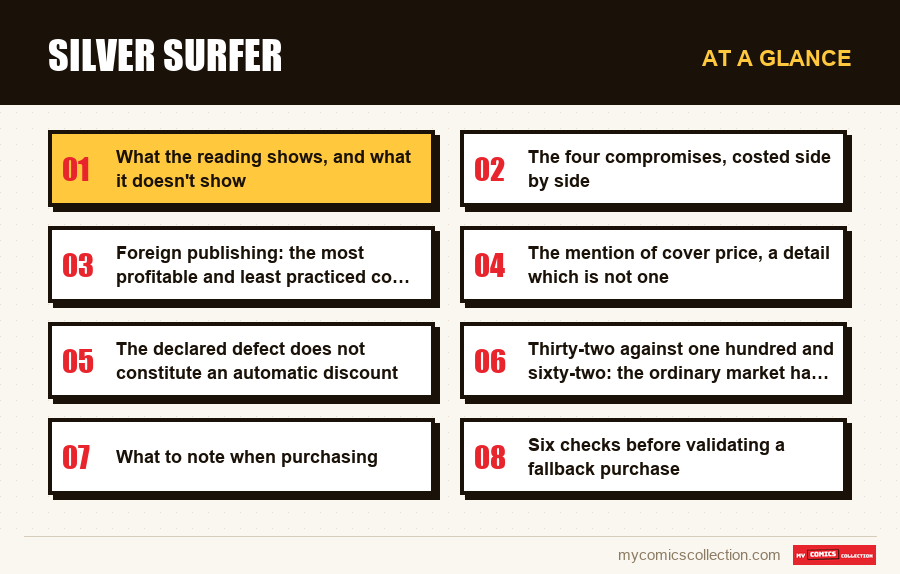
What the reading shows, and what it doesn't show
Let's start by putting the numbers properly, because the whole reasoning depends on them. The thirty-two regular listings on August 30, 2026 range from $99.99 to $3,384.47, with the median value being $657.00. Next to it, counted separately and never mixed with the previous ones, one hundred and sixty-two copies passed by a verification agency asked for $125.16 to $35,000.00, with a median of $1,320.00.
Two precautions are immediately necessary. The first concerns the maximum. An amount of $35,000.00 isolated at the top of a list does not describe a market level: it describes the expectation of a single seller, who can wait for years without being contradicted by anyone. The ceiling of an ad statement is always the least informative measure it contains, and yet it is the one that is taken up in forum conversations. The second caution concerns the very meaning of the word “price” here: nothing in these two series of numbers corresponds to a completed transaction. These are requests, with what that implies of optimism, input errors and announcements forgotten for months.
Still, the median says something. Six hundred and fifty-seven dollars claimed on the ordinary side against one thousand three hundred and twenty on the verified side: the difference is simple to double, and it cannot be explained only by the quality of the copies. It is also explained by the fact that the two populations do not contain the same objects. This is precisely what the sequel will show.
The four compromises, costed side by side
The Vintage Foreign Edition: $99.99
The cheapest of the thirty-two regular ads is a German edition of this issue, asking $99.99. This is not a late reprint: it is a booklet printed for another market, in another language, bearing the same story and the same first appearance. The collector loses the original version of the text; he wins a period object for about a quarter of what the cheapest complete American copy of the same record asks for.
Second language available: $199.00 and $325.00
Two Dutch editions are among the five cheapest listings, at $199.00 and $325.00, with the second described as a variant for the European market. Their joint presence indicates that the “foreign edition” compromise is not an isolated accident of the statement: there are at least two different countries of origin and three distinct announcements at the bottom of the list alone.
The complete American copy: $372.30
The first American copy on the list, dated March 1966, asks $372.30. Its announcement specifies that it is a cent cover price draw. This is the reference point of the statement: the amount from which the object begins without concession of language or completeness, in the condition in which the seller describes it.
The amputated copy: $425.00
The fifth advertisement is an American copy of which the seller indicates the absence of advertising pages. He asks for $425.00, more than the complete American copy cited just above. Five announcements obviously prove nothing; the inversion is nevertheless worth noting, because it contradicts the automatism according to which a declared defect mechanically leads to a discount.
Ranked like this, the four compromises cease to be abstract ideas. They become four amounts, four identified renunciations, and an order of magnitude for each. The reader who hesitated between “wait” and “give up” now has a third axis: decide what he agrees to give up, then look at how much this renunciation saves him on this precise statement.
A compromise is not a substitute. A foreign edition does not replace the original edition, an amputated copy does not replace a complete copy, and no one should buy one in the belief that they own the other. The distinction matters at the time of purchase, but it matters even more at the time of resale, where the next buyer will ask the exact same questions.
What is measurable here is the difference in the amount requested between these options on a given date. What is not clear is their respective trajectory: a single statement says nothing about how these differences behave from one month to the next.
Foreign publishing: the most profitable and least practiced compromise
Of the four paths listed, the one which produces the most spectacular difference is also the one that French-speaking collectors consider the least willingly. Ninety-nine dollars compared to three hundred and seventy-two: on this statement, the German edition is around a quarter of the cheapest complete American copy. No other compromise on the list comes close to this ratio.
The reason for this disinterest is cultural rather than rational. The American comics market has been built around an ideal of authenticity which readily confuses “original” and “American”. An edition printed at the same time in another country, under license, with the same plates, is nevertheless a period object in its own right: it is the same age, it has survived the same half-century, it bears the same images. What it doesn't have is the English text and the symbolic legitimacy attached to the country of origin print.
We have to be honest about the price of this renunciation, and it is not just sentimental. A foreign edition may differ in format, pagination, cover, color, order of stories or division between several local issues. It can group together two American episodes, or publish only part of them. These variations are not details for those who want to possess “the” number: they mean that we possess a similar thing, not the same thing. The collector who takes this route must therefore know exactly what object he is purchasing, and enter it as such in his inventory rather than placing it under the American line.
In return, the reading is intact, the first appearance of the character is there, and the place occupied in a thematic collection is real. For someone who builds a set around the character rather than around a specific series, this is often the best ratio of what you get for what you spend. Those who want to place this number in the sequence of readings will find the context in the reading guide dedicated to the character, and the editorial history of the home series in the history of the Fantastic Four in comics.
The mention of cover price, a detail which is not one
Only one of the five least expensive listings specifies the copy's cover price regime: the one at $372.30, which indicates that it is a cent print. This mention is not decorative. At the time in question, the same issue could circulate in several price presentations depending on the market for which the edition was intended, and this difference can be read directly on the cover.
I am sticking here to what the statement allows. One in five advertisements mentions this point, which is far too few to compare the mentions with each other or to assert that one is more expensive than the other. What I can say, however, is that the mention exists, that it is considered important enough by the seller to appear in an already cluttered advertisement title, and that it distinguishes prints intended for different audiences. A buyer who ignores this distinction risks comparing two advertisements which do not relate to the same object.
The practical lesson is simple: when an advertisement mentions the cover price system, the information must be copied into the inventory, as is, at the time of purchase. When she doesn't mention it, the box remains empty rather than being filled by guesswork. An inventory that distinguishes “not informed” from “verified as such” is infinitely better than a complete, half-invented inventory.
The declared defect does not constitute an automatic discount
The most counterintuitive observation from the survey comes down to two numbers. The American copy without advertising pages costs $425.00. The complete American copy, in the same listing, asks for $372.30. The incomplete object requires more than the complete object.
We must immediately defuse overinterpretation: five announcements do not constitute a sample, and two of these announcements even less. No market rule can be deduced from a pair of numbers. It is entirely possible that the amputated copy is much better preserved elsewhere, that the seller is optimistic, or that the complete copy is described with unusual severity by a seller in a hurry.
This is precisely why the comparison is useful. It demonstrates nothing; it reminds us that a declared defect is one parameter among many others, and not a coefficient that is mechanically applied to a reference amount. The mental shortcut “there are missing pages, so it's cheaper” does not survive the first real list of announcements that we take the trouble to read line by line. The practical consequence is that a buyer cannot simply spot the mention of a shortage: he must read what exactly is missing, and ask himself if it changes anything for him.
On this precise point, the nature of the lack matters enormously. Absent advertising pages do not detract from the story or the first appearance; they damage the entire object, which is not the same thing. A collector who buys to read loses almost nothing. A collector who buys to pass on or resell loses an argument, and he will have to declare it in turn.
Thirty-two against one hundred and sixty-two: the ordinary market has become a minority
The most structuring imbalance in the statement is not an amount, it is a workforce. Thirty-two ordinary announcements, one hundred and sixty-two announcements of copies passed by a verification body: there are five times more seconds than first ones. On this booklet, on this date, the “raw” market has become less than half (and not even half, just a sixth) of the visible supply.
This has a direct consequence on the question of compromises. The four paths described above are all on the minority side. Foreign editions, the amputated copy, the weak condition copy: these are objects that verification bodies receive less often, because the cost of verification has little meaning in relation to their value, and because some of them are simply not eligible for standard treatment. A buyer who filters his search engine to only display verified copies therefore deletes, with a single gesture, all of the fallback options listed in this article.
This is not an argument against verification, which meets a real need for remote trust. This is an argument against automatic filtering. The two populations must be consulted separately, with different expectations: one to compare homogeneous and reassuring objects, the other to find crossroads. Merging them into the same average produces a number that describes neither.
It is also necessary to note the lower limit on the verified side: $125.16. It is higher than the regular minimum of $99.99, but the difference is small, and the amount remains well below the regular median. In other words, the border between the two worlds is not watertight from below. Here again, a single reading does not allow us to say whether this terminal is moving; it only allows us to note that at this date, it is not located where intuition would place it.
Collecting this series?
Track what you own, what you are missing and what your collection is worth. 7 day trial.
Start my trial →What to note when purchasing
Each compromise is documented differently, and this is where most inventories break down: they provide a “number” line and a “condition” line, which is enough for a complete American copy and nothing else. The following five points relate to the items described in this article, not to inventory keeping in general.
The country of publication and language. Three of the five cheapest listings are non-US editions, two Dutch and one German. An inventory that records them simply as number 48 makes these copies indistinguishable from the original edition, and renders any subsequent estimate false. The country and language must appear in the form itself, not in a free note that you forget to reread.
The mention of cover price. When the ad indicates the pricing plan printed on the cover: the words “cents” in the case of the $372.30 copy: this information is copied word for word. When it is absent, the box remains explicitly empty. Informing by deduction what we have not verified amounts to fabricating data, and fabricated data is no longer distinguishable from others six months later.
The exact list of what is missing.“Incomplete” means nothing. “Advertising pages missing” means something, and does not have the same consequences as the absence of a story page or detachable element. The seller's exact wording must be kept, and supplemented by what you see yourself upon receipt. It is this list, and not the generic label, which must be passed on to the next buyer.
The state observed by oneself, distinct from the state announced. On a booklet from this period purchased in the compromise zone, the discrepancy between the description and the object received is the norm rather than the exception. Two fields are better than one: what the seller said, what we saw when we opened the package. The second is the only one we can honestly rely on later.
The price paid, shipping included. The amounts cited in this article are requests excluding delivery, on an American market. The actual cost of a copy arriving at your home includes shipping, and sometimes more. Recording the total amount actually debited is the only way to know, years later, if the compromise chosen was a good one, and it is also the only data in the batch that is neither an estimate nor an opinion.
How is the compromise to be decided in concrete terms?
The decision is not made by comparing amounts, but by first identifying what we really want to do with the object. Three uses dominate, and each designates a different compromise as the best.
To read the story and have an issue of the right age, the foreign edition clearly wins: it is the option which preserves the essentials (the age, the plates, the appearance) at the lowest price of the statement. To own an American copy whatever the cost, the amputated copy or the copy in weak condition are the only entry points, and the survey shows that they are not necessarily less expensive than a complete copy poorly valued: they must therefore be compared, not presumed. To constitute an asset intended to be transmitted or resold, none of these compromises is neutral, and the imbalance between the thirty-two ordinary announcements and the one hundred and sixty-two verified ones indicates quite clearly where the market's expectation lies.
A fourth position exists, less glorious but perfectly defensible: buy none of the four and keep the empty place in the inventory, documenting the difference observed. An assumed empty box is better than a purchase whose nature we will regret two years later, and the fact of having recorded the amounts of the day at least allows us to resume our reflection where we left off.
What must disappear, however, is the idea that the choice is limited to “paying the high price” or “doing nothing”. The survey shows four actual middle positions, separated by differences of several hundred dollars, in an ad population that represents barely a sixth of the visible supply. Most buyers don't see any because they filtered the listing before reading it. Those looking for other affordable issues in this series will find a complementary approach in the tips for buying Fantastic Four without leaving your budget.
Six checks before validating a fallback purchase
Read the full ad title
The decisive mentions of the statement (the German origin, the Dutch origin, the European variant, the cent regime, the absence of pages) all appear in the title, often at the end of the string and in abbreviation. A half-read title makes you buy an item you didn't choose.
Check the announced print date
The American copy of the list is marked March 1966. This date distinguishes a period print from a later reprint, and it is the first thing to compare with the photographs rather than the text of the advertisement.
Separate verified ads from others
The two populations have neither the same size nor the same median, and the compromises almost all live on the ordinary side. Consulting the two lists separately is the only way to avoid depriving yourself of options that you have never seen before.
Figure out the routing before comparing
Statement amounts are requested on a US market. A difference of one hundred dollars between two advertisements can be canceled out by the difference in transport, and this comparison is only made once the two complete costs have been calculated.
Be wary of the displayed ceiling
The maximum of $3,384.47 on the ordinary side, and even more that of $35,000.00 on the verified side, describe individual expectations and not a market level. The median is the only one of the three statistics that stands up to an isolated announcement.
Request photographs of missing pages
When an announcement declares a shortage, the exact scope of this shortage cannot be deduced from its wording. Obtaining images of the affected area before purchasing avoids discovering afterwards that the defect affects something other than what was previously understood.
Frequently asked questions
The amounts cited here are requests noted on August 30, 2026 on a general auction site on the American market, never sales concluded. Copies passed through a verification body are counted separately, and a statement taken on a single date says nothing about how these requests are progressing.
It contains the same story and the same plates, published under license at the same time, but it is not the original edition for the American market. The distinction is made when registering the copy in an inventory: it must be designated by its country and language, and not confused with the American line. To read and own a period object, the path is legitimate; to resell on the other hand, the next buyer will make exactly the same distinction.
Nothing in the survey explains it, and that is precisely the interest of the observation. Of the five least expensive ads, the copy without advertising pages asks $425.00 compared to $372.30 for a complete American copy. With two listings, no deal conclusion is possible: the discrepancy may come from the general condition, the optimism of the seller or a particularly harsh description from the other side. The only solid lesson is that a declared default does not automatically produce a reduction in the amount requested.
It provides information on the price regime printed on the cover, which distinguishes between prints intended for different markets. Only one announcement in the survey mentions it, which is insufficient to compare the mentions with each other or to assert that one is more claimed than the other. What we can take away from this is that the seller considers the information important enough to include it, and that it must therefore be copied as is in an inventory.
Verification meets a real need when purchasing remotely, but it greatly reduces the range of possibilities. The statement counts one hundred and sixty-two verified announcements against thirty-two ordinary ones, and the four compromises described here are all on the minority side. Filtering from the outset therefore amounts to removing fallback options before even looking at them. The reasonable approach is to view the two lists separately, with distinct expectations.
No, and this is a structural limitation rather than a lack of data. A survey taken on a single date provides a snapshot: there is no previous point of comparison in what was measured, so no direction can be established. It would take repeated measures, constructed in the same way, to speak of a movement. What the day measurement allows is to classify options among themselves at this precise moment.
Keep track of exactly what you buy
Country of publication, mention of cover price, list of shortages, condition noted, price paid including shipping: these five pieces of information do not fit in a “condition” box. My Comics Collection saves them by copy, including foreign editions and incomplete copies, so that your inventory remains readable years after purchase.