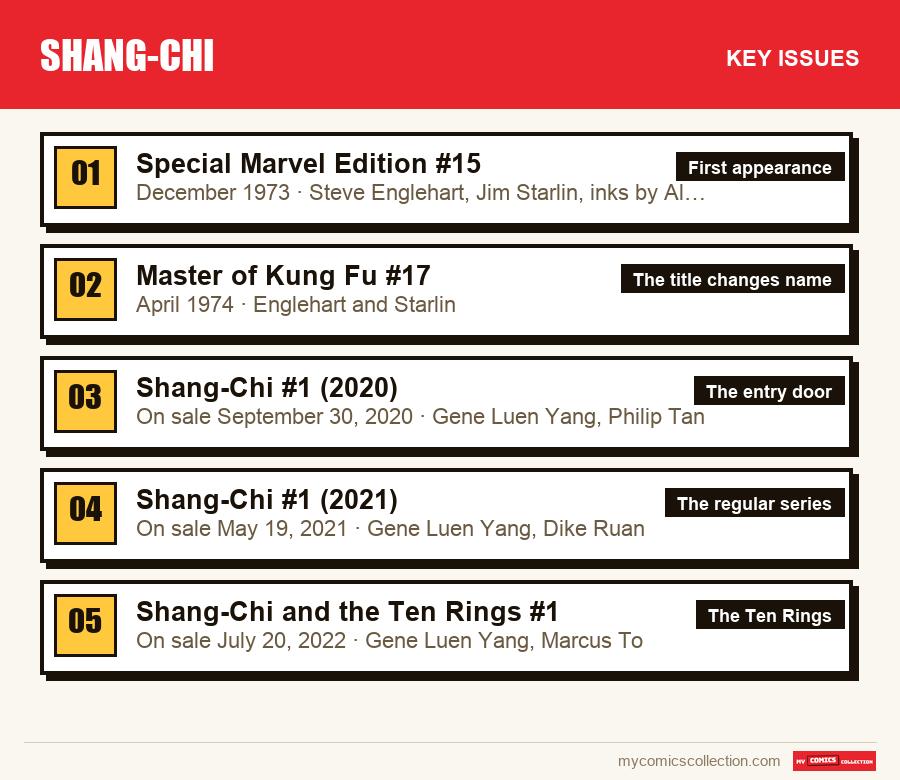
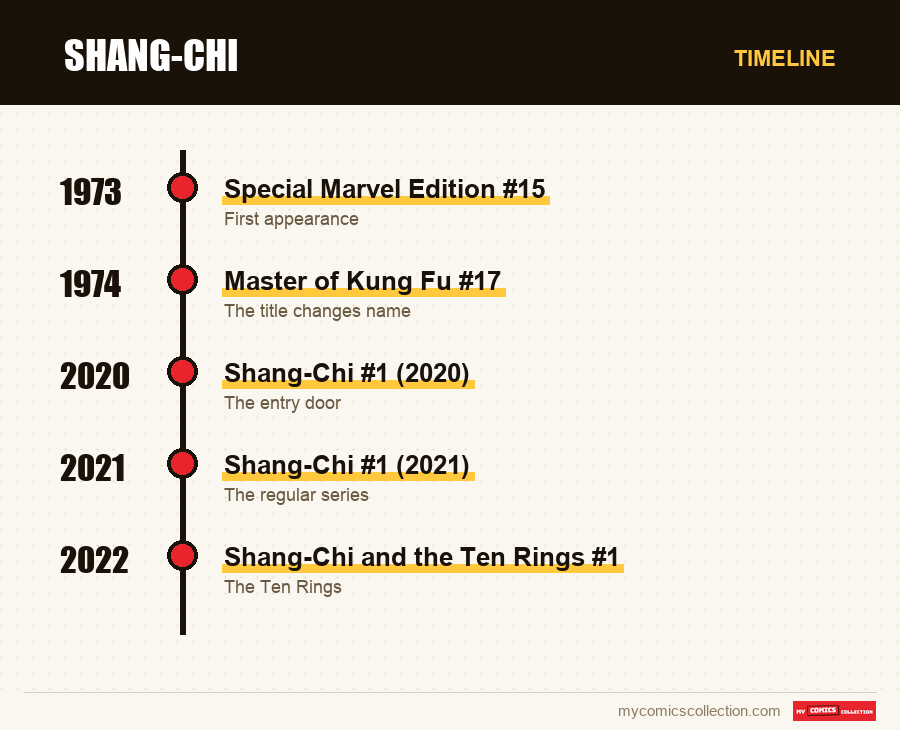
Shang-Chi first appears in Special Marvel Edition #15, dated December 1973 and put on sale September 4, 1973, created by Steve Englehart and Jim Starlin. The title changes name at #17 (April 1974) to become Master of Kung Fu, which runs until #125 (June 1983). To start reading today, two doors exist: the collections of the original series, dominated by Doug Moench and Paul Gulacy's cycle, or Gene Luen Yang's modern series, launched in November 2020 (five issues, art by Philip Tan), continued in July 2021 (art by Dike Ruan) then in Shang-Chi and the Ten Rings in September 2022. The newcomer will start with Yang; the collector will aim at Special Marvel Edition #15.
Shang-Chi is a case apart in the Marvel catalog. For decades, his best stories were both famous and unfindable: cited by connoisseurs as one of the great series of the 1970s, but absent from reprints for a reason that had nothing to do with their quality. This situation shaped how the character is collected, and it explains why the "where to start" question does not have the same answer depending on whether you read or buy.
This article is a collecting and reading sheet. It does not compare the character to the 2021 film, which our article Shang-Chi, the film versus the comics does. It answers two concrete questions: which issue carries the first appearance, and which read to choose when you have never opened a comic of the character, as his return to the screen approaches in Avengers: Doomsday, expected on December 18, 2026, where Simu Liu takes the role again.
Special Marvel Edition #15: the first appearance issue
Special Marvel Edition is, at the start, a reprint title. Marvel republished old stories there, notably of Thor. At #15, the house decides to launch a new character there rather than open a new series, a common practice at the time: a concept was tested under an existing title, which avoided paying the risk of an issue 1. The issue carries the cover date of December 1973 and comes out on September 4, 1973. The story is titled "Shang-Chi, Master of Kung Fu!" Steve Englehart writes it, Jim Starlin draws it, Al Milgrom inks it.
The context is known: the martial arts wave crosses American popular culture in the early 1970s, in film and television. Marvel seeks to exploit it and chooses a legally clever solution: making its hero the son of Fu Manchu, a novel character whose rights the publisher had obtained. Shang-Chi is raised in isolation to become his father's assassin, discovers the truth about him on his first mission, and turns against him.
What follows is logical: Special Marvel Edition #16 continues the adventure, then the title changes name at #17, dated April 1974 and out on January 15, 1974. It becomes Master of Kung Fu, keeping the numbering. It is a classic trap for beginners: there is no 1974 "Master of Kung Fu #1." The original series starts at 17.
Special Marvel Edition #15
First appearance of Shang-Chi, and first appearance at Marvel of his father in the role of antagonist. The issue is the centerpiece of any collection devoted to the character.
Master of Kung Fu #17
"Lair of the Lost!" First issue published under the title Master of Kung Fu. It carries no major first appearance, but it marks the series' editorial birth and interests those who collect title beginnings.
Why the original series disappeared for years
The choice of Fu Manchu, which had been the launch's strength, became a problem. The character did not belong to Marvel: he came from Sax Rohmer's novels, and the publisher was exploiting a license. When that license stopped being exploited, Marvel could no longer reprint the episodes where Shang-Chi's father appears under that name. Yet he appears in a large part of the series.
The result is singular. For a long time, Master of Kung Fu was one of the few great Marvel titles of the 1970s that could only be read in period single issues. That is what sustained the reputation of Doug Moench and Paul Gulacy's episodes: an admired series that few readers could verify. The situation unblocked with the publication of big collections in the mid-2010s, and recent readers could finally access the stories. In the modern series, the father was renamed, which lets him be used without depending on outside rights.
For a collector, this history left a trace: the single issues of Master of Kung Fu were long read and reread, for lack of alternative, which weighs on the condition of available copies. A Moench and Gulacy period issue in very fine condition is not an ordinary object.
The major periods of Master of Kung Fu
The series runs from #17 to #125, the latter dated June 1983 and written by Alan Zelenetz. In between, several teams follow one another, but one name dominates: Doug Moench, who writes most of the series for nearly a decade.
Englehart and Starlin, the launch. The first issues set up the character, his conflict with his father and his ethics. They are historically important, less for their style than for their founding role.
Moench and Gulacy, the series' golden age. It is the period connoisseurs cite. Moench steers the title toward espionage storytelling, with a tone close to the secret agent films of the time, and Paul Gulacy brings a cinema-inspired layout, far ahead of what the competition was doing. Shang-Chi becomes an agent working with British services, surrounded by recurring characters.
Moench and Gene Day, maturity. Later, Gene Day draws the series with remarkable graphic density. This period, less famous than Gulacy's, has its defenders who rank it even higher.
The character also appears, during the same decade, in a black-and-white magazine devoted to martial arts, published by Marvel in magazine format. It is a separate part of his bibliography, which mostly interests completists.
Where to start: three profiles, three doors
You are discovering the character
Start with Gene Luen Yang's Shang-Chi miniseries, out from September 2020 (November 2020 cover date), in five issues drawn by Philip Tan. It presents the hero's family, his brothers and sisters, and the secret society his father led. It reads with no prerequisites.
You liked it and want to continue
Follow with the 2021 regular series, still written by Yang and drawn by Dike Ruan, whose #1 comes out in May 2021 (July cover date). Shang-Chi takes the lead of the family organization there and confronts the rest of the Marvel universe. Then Shang-Chi and the Ten Rings, launched in July 2022 with Marcus To on art.
You want the classics
Move on to the Master of Kung Fu collections, aiming directly at the Moench and Gulacy period. The tone is different, darker and closer to the spy novel, but it is where the character's reputation lies.
This breakdown has an advantage: it respects the order of difficulty. Yang's series are written for today's reader, with a fast rhythm and family relationships in the foreground. Master of Kung Fu requires a bit more adaptation: dense narration, abundant captions, 1970s codes. Starting with the original series is not a mistake, but it is a narrower door.
The modern series in profile
Shang-Chi #1 (2020)
"Brothers & Sisters." First issue of a five-part miniseries that redefines the hero's family circle. It is the character's modern starting point, the one recent adaptations used most.
Shang-Chi #1 (2021)
"Shang-Chi vs. the Marvel Universe." The regular series, which sets the hero up as the head of an organization and confronts him with the catalog's big names. Ideal read right after the 2020 miniseries.
Shang-Chi and the Ten Rings #1
"Absolute Power." Shang-Chi inherits the ten rings, the weapon the film had made central. The series brings the comics closer to the screen's imagery.
What counts for a collector
The collecting hierarchy is simple. At the top, Special Marvel Edition #15, the only first appearance. Below, Master of Kung Fu #17, first issue under the title. Then the issues of the Moench and Gulacy period, sought after for their quality rather than for a "key" status. Finally the modern issue 1s, printed in large numbers and accompanied by many variant covers, which are first of all reads.
We give no price here. Prices of this issue depend heavily on condition and on the character's news, and no source consulted publishes a verifiable recent movement. A note of method is enough: attention to Shang-Chi peaked in 2021, around the film, and the announcement of his presence in Avengers: Doomsday may cause another. The quiet periods between two announcements are the time to choose a copy, not to pay for it at the top.
For period copies, two points deserve attention. The first is the condition of the original series' single issues, long read for lack of reprints. The second is the distinction between cover date and sale date: many listings show one or the other, and a beginner may believe in two different issues. Our article on the comics to read before Avengers: Doomsday places Shang-Chi among the other announced characters, and the Avengers hub gathers the team's pages.
Shang-Chi in the rest of the Marvel universe
Long confined to his series, Shang-Chi later joined teams, which widened his readership. He notably joins the Avengers during Jonathan Hickman's cycle in the early 2010s, a period when the team has a very wide roster. These appearances do not change the collecting hierarchy, but they explain why many readers discovered him outside his own titles.
For anyone following the character issue by issue, these team passages pose a practical problem: they are scattered across series not devoted to him. It is the kind of scatter a tracking tool makes manageable, by noting in which series and at which issue each appearance is found rather than relying on memory.