The Second Coming reading order covers the 2010 X-Men crossover, published from March to July in 14 chapters: two X-Men: Second Coming one-shots (#1 and #2) that bookend three rotations across Uncanny X-Men #523-525, New Mutants #12-14, X-Men: Legacy #235-237 and X-Force #26-28. The credited writers are Craig Kyle, Christopher Yost, Matt Fraction, Zeb Wells and Mike Carey. Read Messiah Complex and Messiah War first, then the Prepare prologue, then the chapters in publication order.
Fourteen chapters across five series is easy to get lost in if you read one title after another: the chapters answer each other from one week to the next, and several parallel series ship issues in the same months. Here you will find the March to July 2010 sequence, the background reading worth having beforehand, the side issues that matter, and a way to choose between single issues and the hardcover.
As always in this guide, only verified information (creators, issue numbers, dates) is stated as fact; the analysis is our own, with no reproduction of protected art or dialogue.
What to read first
Second Coming presents itself as the last chapter of a trilogy: it began with Messiah Complex (2007-2008), continued with Messiah War (2009), and ends here. The first two parts are not optional if you want to understand why the characters react the way they do from the opening pages of 2010.
- Messiah Complex: the 13-chapter crossover that launches the trilogy. Our dedicated guide gives the exact order: Messiah Complex, the reading order.
- Messiah War (2009): the second part, centered on Cable and X-Force. It sets the stage for the characters the 2010 crossover puts in motion.
- Utopia, Nation X and Necrosha (2009): three stories from the X-Men books that the crossover builds on, and that set up the mutants' situation at its opening. Reading them in full is not essential, but they explain the context.
- The prologue X-Men: Second Coming Prepare (February 2010): a one-shot that bridges everything together.
If you are new to this corner of the Marvel universe, keep the main thread in mind: a mutant child born in Messiah Complex is the common thread of all three stories, and each part shifts the center of gravity a little more toward Cable. To place these characters in a wider path, the Cable reading guide puts the series back in order.
Phase 1: the February 2010 prologue
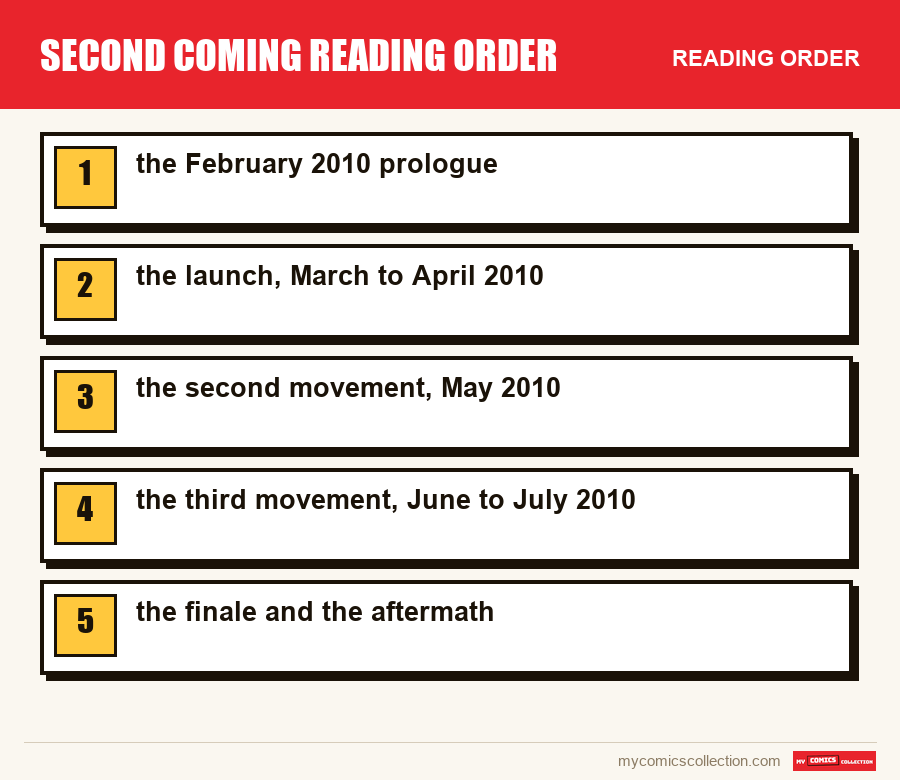
Start with X-Men: Second Coming Prepare, cover-dated February 2010. It works as an airlock into the chapters that follow. It is not one of the 14 numbered chapters of the crossover, but skipping it is like walking into a conversation already in progress.
At this point, make sure you have the February issues of the series involved, because the crossover moves straight into a heavy monthly schedule. For a smooth read, go through Prepare before opening X-Men: Second Coming #1.
Phase 2: the launch, March to April 2010
Chapter 1 is X-Men: Second Coming #1, cover-dated March 2010. It is the first of the two one-shots that bookend the crossover: it opens the sequence before the regular series take over in April.
April 2010 contains four chapters, to be read in this order:
- chapter 2: Uncanny X-Men #523;
- chapter 3: New Mutants #12;
- chapter 4: X-Men: Legacy #235;
- chapter 5: X-Force #26.
The tie-ins published around these issues are as follows: Cable #25 goes with chapter 2, and Revelations: X-Factor #204 goes with chapter 4. The first deals directly with the character at the heart of the trilogy; the second shows what becomes of the X-Factor detective agency during the crossover.
A pacing tip: read each chapter in one sitting with its immediate neighbor rather than rereading the whole series first. The crossover is built so that the last act of one issue carries straight into the next.
Phase 3: the second movement, May 2010
May's rotation follows the same pattern, with one chapter in each series:
- chapter 6: Uncanny X-Men #524;
- chapter 7: New Mutants #13;
- chapter 8: X-Men: Legacy #236;
- chapter 9: X-Force #27.
It is also the month of several tie-ins: Revelations: Hellbound #1 sits with chapter 6, Revelations: X-Factor #205 with chapter 8, and the one-shot Revelations: Blind Science #1 with chapter 9. If you are reading everything, slot them in at those points; if you want to go straight to the point, save them for a second read.
One note on method for this month: X-Force #27 is the chapter where the series of the same name edges toward its conclusion, since the book ends at #28. Read it back to back with X-Men: Legacy #236 to keep the flow of events.
Phase 4: the third movement, June to July 2010
The last rotation is slightly staggered: three chapters ship in June, the fourth in July.
- chapter 10: Uncanny X-Men #525 (June);
- chapter 11: New Mutants #14 (June);
- chapter 12: X-Men: Legacy #237 (June);
- chapter 13: X-Force #28 (July).
The tie-ins for this stretch: Revelations: Hellbound #2 with chapter 10, and Revelations: X-Factor #206 with chapter 12. Chapter 13 closes the X-Force series, which ends at issue 28; that is a landmark to remember if you collect the series in single issues.
Spoiler warning: the crossover's ending changes the situation of some characters going forward. If you want to stay completely in the dark, stop here and go straight to reading chapter 14.
Phase 5: the finale and the aftermath
Chapter 14 is X-Men: Second Coming #2, cover-dated July 2010, the second one-shot, which closes the structure as a mirror of #1. Two tie-ins come out at the same time: Revelations: Hellbound #3 and Uncanny X-Men: The Heroic Age. X-Men Phoenix Force Handbook #1 also appears the same month.
The consequences then play out in several directions. On one side, the Generation Hope series (17 issues) takes over to follow the five new mutants who emerge in the wake of the crossover. On the other, several series disappear: X-Force ended at issue 28, and Cable at issue 25. Finally, new books are born after the crossover, including Uncanny X-Force, Wolverine and a third X-Men series. For what comes next, the page on the best X-Force runs will help you choose between the two series that carry that name.
If you keep following Marvel's timeline, the next story on the X-Men calendar is Curse of the Mutants. It is not a direct sequel, but it is the next read in editorial order.
Do you collect this series?
Track what you own, what you are missing and what your collection is worth. 7-day trial.
Start my trial →
The tie-ins you can skip
A crossover this size brings along several titles that tell the same period from another character's angle. None of it is bad; it is simply optional for following the main plot.
- Revelations: X-Factor (#204 to #206): a look at the detective team, useful if you follow that series, optional otherwise.
- Revelations: Hellbound (#1 to #3): a parallel miniseries whose three issues come out in May, June and July.
- Revelations: Blind Science #1: a one-shot from May.
- Uncanny X-Men: The Heroic Age: a July issue that already looks ahead to the next period of the Marvel universe.
- X-Men Phoenix Force Handbook #1: a reference guide, not a plot installment.
For the reader who wants only the essentials, the fourteen numbered chapters are enough, plus Cable #25 if you want to keep the central character in view.
Single issues or collected editions: how to read it
In single issues, the difficulty is practical first of all: the crossover spreads 14 chapters across five series, three of which (Uncanny X-Men, X-Men: Legacy and X-Force) have numbering that has nothing to do with one another. Write down the list below before you buy, or check off issues as you go.
If you prefer collected editions, note that there is an X-Men: Second Coming hardcover, published in October 2010, which gathers the sequence in a single 472-page volume. It is the simplest way to read in the right order without juggling fifteen single issues, but it sticks to the chapters and the prologue: the Revelations issues (Blind Science, Hellbound #1-3, X-Factor #204-206) are collected in a separate volume, X-Men: Second Coming Revelations.
Our method for a collector: pick one format and stick with it. Mixing single issues and a collected edition leads to duplicate reads, and above all to gaps when a chapter is in neither. In every case, check the exact table of contents before buying a collected edition, rather than trusting the title on the cover alone.
The key issues to know
The key issues of a crossover are spotted by their role in the structure, not by market rumor. For Second Coming, five landmarks stand out:
- X-Men: Second Coming Prepare (February 2010): the prologue, worth hunting down as the starting piece of a complete collection.
- X-Men: Second Coming #1 (March 2010): the crossover's opening, a one-shot that is sought after and priced separately from the regular series.
- X-Men: Second Coming #2 (July 2010): the finale, with any cover variants to identify before buying.
- X-Force #28 (July 2010): chapter 13, which closes the X-Force series launched under this numbering.
- Cable #25: the last issue of the Cable series.
A one-shot like X-Men: Second Coming #1 is valued by comparing closed sales of that title alone, at equal condition, without mixing a standard cover and a variant. Condition and scarcity figures are read from the copy's own record, not from the lot title. Our guide to Cable key issues details the method for this character.
Recap: the complete order
- Messiah Complex (2007-2008), see our dedicated guide.
- Messiah War (2009).
- X-Men: Second Coming Prepare (February 2010).
- X-Men: Second Coming #1 (March 2010), chapter 1.
- Uncanny X-Men #523 (April), chapter 2, with Cable #25.
- New Mutants #12 (April), chapter 3.
- X-Men: Legacy #235 (April), chapter 4, with Revelations: X-Factor #204.
- X-Force #26 (April), chapter 5.
- Uncanny X-Men #524 (May), chapter 6, with Revelations: Hellbound #1.
- New Mutants #13 (May), chapter 7.
- X-Men: Legacy #236 (May), chapter 8, with Revelations: X-Factor #205.
- X-Force #27 (May), chapter 9, with Revelations: Blind Science #1.
- Uncanny X-Men #525 (June), chapter 10, with Revelations: Hellbound #2.
- New Mutants #14 (June), chapter 11.
- X-Men: Legacy #237 (June), chapter 12, with Revelations: X-Factor #206.
- X-Force #28 (July), chapter 13.
- X-Men: Second Coming #2 (July), chapter 14, with Revelations: Hellbound #3 and Uncanny X-Men: The Heroic Age (the same month: X-Men Phoenix Force Handbook #1).
- Generation Hope (17 issues), for the follow-ups.
Who writes and who draws
The credited writers across the whole event are Craig Kyle, Christopher Yost, Matt Fraction, Zeb Wells and Mike Carey. On the art side, several artists share the crossover, including David Finch, Terry Dodson, Greg Land, Mike Choi and Ibraim Roberson. The exact credit, chapter by chapter, can be read in the printed credits of each issue, which we invite you to check before filling in a record.
To browse the creators who defined this period, the pages for Matt Fraction and Zeb Wells gather our guides.
Frequently asked questions
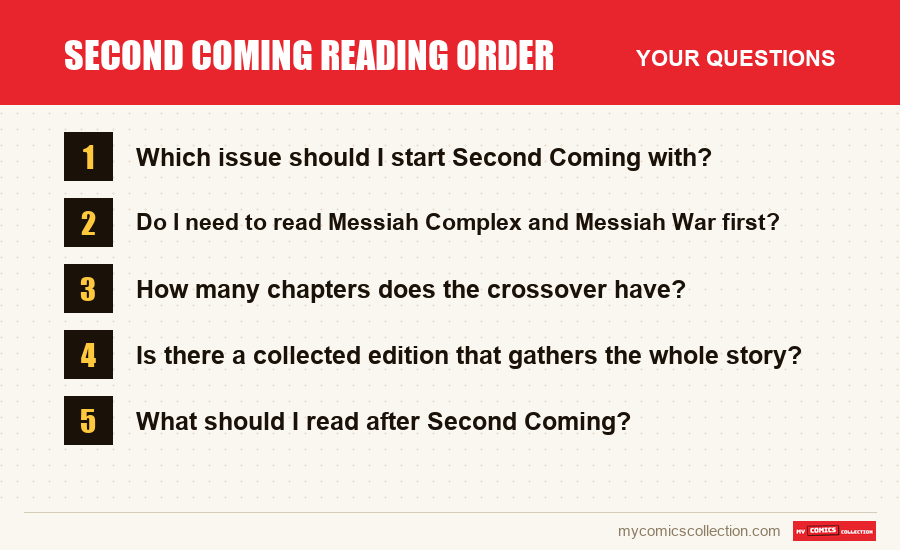
Start with the prologue X-Men: Second Coming Prepare (February 2010), then read X-Men: Second Coming #1 (March 2010), which is chapter 1. After that, follow the monthly rotation across Uncanny X-Men, New Mutants, X-Men: Legacy and X-Force, up to chapter 14, X-Men: Second Coming #2.
Yes, it is strongly recommended. Second Coming is the last part of a trilogy that begins with Messiah Complex (2007-2008) and continues with Messiah War (2009). Without those two stories, the characters' motivations and the central stakes are hard to follow. Our Messiah Complex guide gives the exact order of the first part.
Fourteen numbered chapters: two X-Men: Second Coming one-shots (#1 and #2) and twelve regular series issues, three each from Uncanny X-Men, New Mutants, X-Men: Legacy and X-Force. On top of that come a prologue and several optional tie-ins.
Yes, an X-Men: Second Coming hardcover came out in October 2010, at 472 pages. It gathers the prologue and the fourteen chapters in a single volume. The Revelations tie-ins have their own collection, X-Men: Second Coming Revelations, which includes Hellbound #1-3 and X-Factor #204-206.
The direct follow-up for the new mutants is the Generation Hope series, in 17 issues. On the publishing side, new series are born after the crossover, including Uncanny X-Force, Wolverine and a third X-Men series, while X-Force and Cable come to an end.
Have you gathered the Second Coming chapters in single issues? Estimate the value of your copy before completing the run.
Estimate my comic