To read Scott Snyder, start with Batman: Court of Owls (Batman #1 to 11, 2011-2012, with Greg Capullo), which reads with no prerequisites. Continue with Death of the Family, Zero Year, the Black Mirror saga and Endgame, then finish with the more demanding Dark Nights: Metal. If you want a Batman with no past to know, Absolute Batman (2024) with Nick Dragotta is another way in, independent of everything else.
Snyder has written Batman for nearly fifteen years, along with horror for Vertigo and Image, and readers are split on how to approach this body of work: follow publication order, or pick chapters? This guide offers six steps that move from the most accessible to the most demanding, without asking you to reread forty years of continuity.
As always in this guide, only verified information (creators, issue numbers, dates) is stated as fact; the analysis is our own, with no reproduction of protected pages or dialogue.
Our guiding thread is a single question: what does the reader need in mind for the next chapter to work? With Snyder, the answer rarely has to do with old continuity. It has to do with what was set up a few arcs earlier, because the Batman of 2011 to 2016 is a continuous serial, in which one arc's Joker answers another's Court. Hence a path that follows publication order for the most part, with two flagged detours.
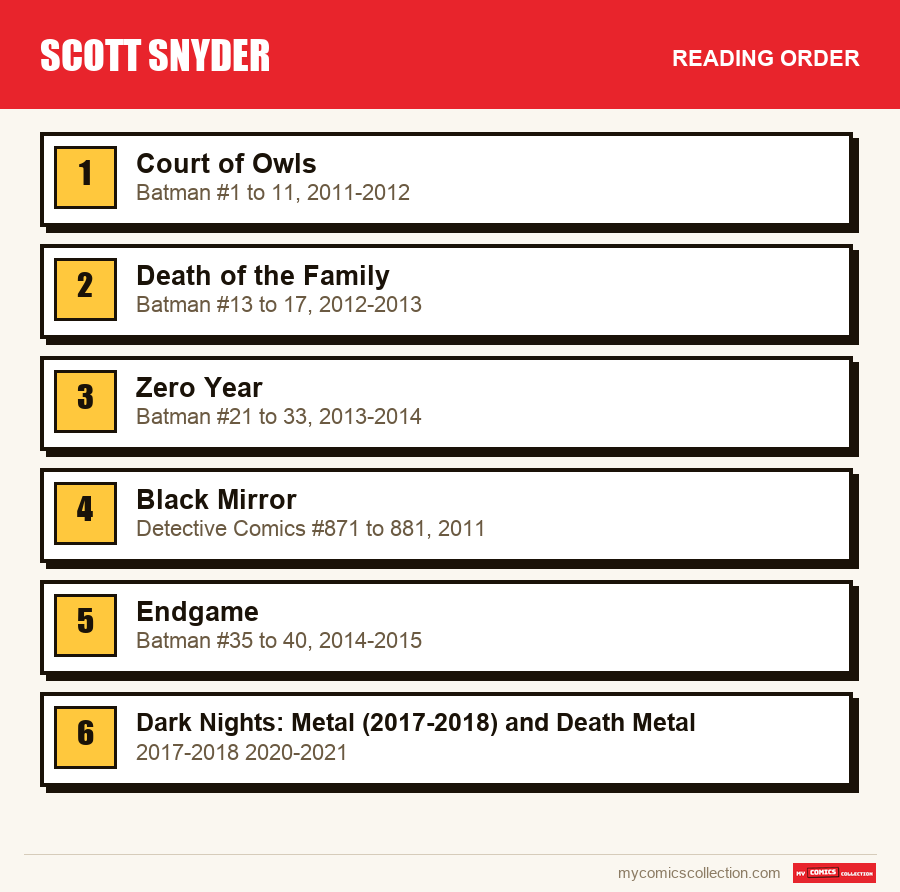
Step 1: Court of Owls (Batman #1 to 11, 2011-2012)
Batman #1 came out in September 2011, with a November cover date, as part of DC's company-wide relaunch. Snyder writes, Greg Capullo draws. The central idea is simple and effective: Gotham has supposedly been governed from the shadows for generations by a secret society that Bruce Wayne has always refused to believe in. The eleven issues of the arc follow the slow destruction of that certainty.
Why start here: the arc asks for nothing beyond a basic knowledge of the character, and it sets the tone for everything that follows. Issue 5 became famous for its layout, which gradually rotates to convey the hero's disorientation in a labyrinth. For hunting key issues and variants, the Court of Owls key issues feature covers the subject; this page concentrates on reading order.
One extra: the "Night of the Owls" crossover begins in Batman #8 in spring 2012 and spreads to other series in the line. It is not needed to understand what follows. Read it only if the first arc won you over.
Step 2: Death of the Family (Batman #13 to 17, 2012-2013)
The Joker returns, after more than a year away, and goes after Batman's family. The arc occupies issues 13 to 17 of the main series, published from October 2012 to February 2013, and its ramifications reach the other Bat-Family titles. For a reader discovering Snyder, it is the second pillar of the run: a terrifying version of the character, one that readers often tie to the Joker's publishing history, though you do not need to master that history to follow along.
What to watch for: the arc assumes you have seen how the Court of Owls left Gotham and its protagonists. Without step 1, some of the stakes seem hazy. Issue 13 uses a die-cut cover, which complicates storing the single issue: keep it flat, with no pressure on the cut-out part.
On the reading side, two volumes are enough if you buy collections, and it is worth checking that the table of contents includes issues 13 to 17, since some collections add episodes from the other series.
Step 3: Zero Year (Batman #21 to 33, 2013-2014)
Snyder and Capullo reinvent Batman's beginnings. The arc, thirteen issues long by the breakdown we use, puts Gotham under threat from the Riddler and a giant blackout, with a Bruce Wayne who is not yet quite the vigilante we know. Zero Year is an origin retelling, and as such it can be read independently of what precedes it.
The reason we put it third: it is easy to read, but it gains relief when you already know Snyder's Gotham, its obsessions and recurring motifs. It also touches on classic questions about the character's origins, which reading Frank Miller's Year One lights up by contrast. The exact boundaries of the arc vary between editions, since tie-in issues and an annual are added to it: go by the publisher's table of contents.
Step 4: Black Mirror (Detective Comics #871 to 881, 2011)
Here is the detour from publication order. Before the Batman run, Snyder wrote Detective Comics #871 to 881, with Jock and Francesco Francavilla on art, at a time when Dick Grayson wore the Batman costume. The plot pits the Gordons against each other, with James Gordon Jr. as a disturbing antagonist. It is a Gotham noir novel, more intimate and darker than Capullo's serial.
Why this spot: the work sheds light on the writer's obsessions with family ties and fear, and it reads better once you recognize Snyder's universe. It demands a small effort of context, since the caped Batman is not Bruce Wayne. We do not consider it essential for what follows, but it gives the whole its depth. Jock's covers on issues 880 and 881 stuck in memory and are in steady demand, which makes buying single issues trickier: favor the collected edition if you only want to read.
Do you collect this series?
Track what you own, what you're missing and what your collection is worth. 7-day trial.
Start my trial →
Step 5: Endgame (Batman #35 to 40, 2014-2015)
The last face-off between Batman and the Joker in Snyder's writing occupies issues 35 to 40. The arc leans heavily on Death of the Family and on the Court of Owls thread: reading it without those steps is like listening to a conclusion without having heard the beginning. We reveal nothing of its ending, which got a lot of people talking when it was published.
It is a more demanding step than the previous ones emotionally, but also practically: a few stand-alone issues and annuals sit between Zero Year and Endgame, and the series carries on after the arc with "Superheavy," which puts Jim Gordon in the Batman armor. If you read in collections, check that you have not skipped a volume. To place the full run against other periods of the series, the ranking of modern Batman runs puts Snyder's place in perspective next to Tom King, James Tynion IV and Chip Zdarsky.
Step 6: Dark Nights: Metal (2017-2018) and Death Metal (2020-2021)
The last step leaves Gotham for the multiverse. In 2017, Greg Capullo draws Dark Nights: Metal, the starting point of a saga that spills over into several series; it brings in the Batman Who Laughs, a hybrid of the hero and the Joker, who would later get his own miniseries. Dark Nights: Death Metal is its sequel, in 2020-2021.
Why keep it for the end: these stories assume broad knowledge of the DC universe, its teams and its cosmic myths. They are written for longtime readers, and they are better appreciated once Snyder is anchored in the Batman arcs. The payoff is real for anyone who likes big events. For anyone who prefers Gotham crime, step 5 is a perfectly respectable place to end.
How to read: single issues or collected editions
For reading, collections beat any other format: Snyder's run is written in arcs, and each arc makes a coherent volume. Check the edition before ordering, because groupings differ by language and reissue. Original single issues suit collectors: Batman #1 had a very high print run, and scarcity comes not from the first issue but from its variants and certain tie-ins.
A parallel path exists for those who want no past: the Absolute line started in October 2024 with Absolute Batman, written by Snyder and drawn by Nick Dragotta. This series requires no prerequisites, and in France it is published in hardcover volumes; the details of the editions are in our guide to Absolute Batman in French. It is the fastest route to judge whether Snyder's style suits you before committing to the 2011 run.
Outside Batman, several series show another side of Snyder's writing, and none is tied to the main path. American Vampire, launched at Vertigo in 2010 with Rafael Albuquerque, follows Skinner Sweet, a new kind of vampire, through the American twentieth century; Stephen King wrote the character's origin story in the first issues. Severed, at Image in 2011-2012, is a period horror tale set in 1916 America. Wytches, at Image from 2014 with Jock on art, sets up a rural, family-centered threat. The Wake, at Vertigo in 2013-2014 with Sean Murphy, mixes science fiction and an undersea story. Nocterra, with Tony Daniel, launched at Image in 2021 in a world plunged into permanent night.
One in-between case is worth flagging: All-Star Batman, published by DC from 2016, where Snyder writes the first arc, "My Own Worst Enemy," with John Romita Jr. on art. The series takes the form of a trip across the United States and reads outside Capullo's thread. It suits anyone who has already tasted the writer's style and wants a more brutal variation. For collectors, these non-Batman titles have an advantage: their series are short, and a complete set comes together without hunting a particular issue.
One last tip on method: as you buy, note the volume and the exact contents of each collection. Between a book that contains Batman #13 to 17 alone and another that adds episodes from neighboring series, the difference rarely shows on the cover, and it is the most frequent cause of duplicates in a Snyder library.
Recap: the recommended order
- Step 1: Court of Owls, Batman #1 to 11 (2011-2012).
- Step 2: Death of the Family, Batman #13 to 17 (2012-2013).
- Step 3: Zero Year, Batman #21 to 33 (2013-2014).
- Step 4: Black Mirror, Detective Comics #871 to 881 (2011).
- Step 5: Endgame, Batman #35 to 40 (2014-2015).
- Step 6: Dark Nights: Metal (2017-2018), then Death Metal (2020-2021).
The shortest route: steps 1 and 2 give you the essence of the style. The simplest: Absolute Batman, with no prerequisites. The most complete: the order above, keeping Black Mirror as a breather between two arcs.
Frequently asked questions
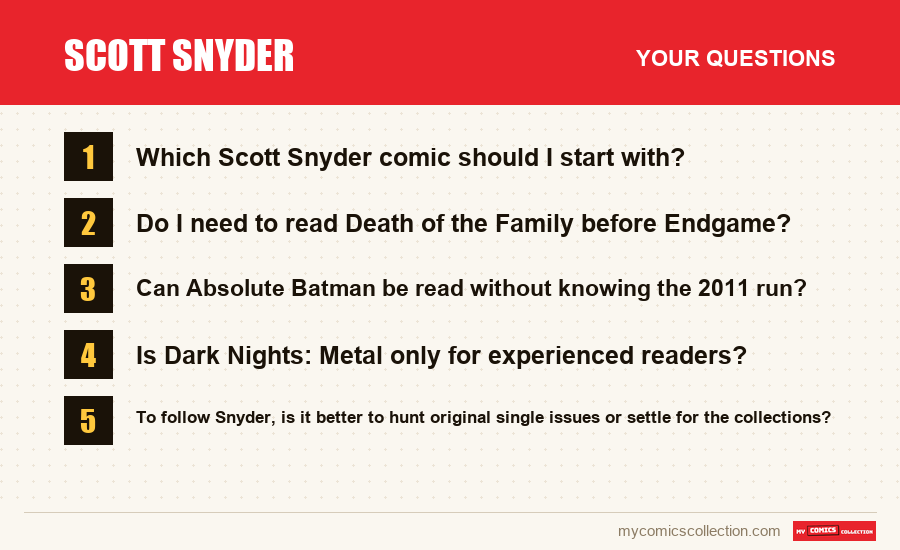
Start with Batman #1 to 11 (2011-2012), the Court of Owls arc drawn by Greg Capullo. It only requires a general knowledge of the character. If you want to know nothing at all going in, Absolute Batman, launched in 2024 with Nick Dragotta, is another way in.
Yes, it is strongly recommended. Endgame (Batman #35 to 40) takes up the Joker and the legacy left by Death of the Family (Batman #13 to 17). Reading Endgame alone is possible, but you lose most of the echoes that give this conclusion its strength.
Yes. Absolute Batman, launched in October 2024, belongs to a continuity separate from the usual DC universe. The first issue is enough to get in, and the series does not pick up the Court of Owls thread or Capullo's Joker.
It is written for them. The saga draws on the DC multiverse, the Justice League and myths that Snyder does not re-explain in detail. A reader who has only read Batman can follow it, but will gain from first getting to know the publisher's major teams.
For reading, collections are simpler: one arc equals one volume. For collecting, original single issues let you aim for key issues and covers. Always check the table of contents of a volume, since groupings vary from one edition to the next.
Do you own a 2011 Batman #1, a Batman #13 with the die-cut cover or a Detective Comics #880? Estimate them from current listings.
Estimate my comic