Sagédition published Superman and Batman in French for nearly two decades. The catalog lists four titles under this name, from the monthly launched in January 1969 to the last issues dated March 1987, roughly two hundred and fifty issues in all. For a collector, the essential point is not the total: these issues were assemblies, and their numbering contains irregularities you need to know before buying.
You inherit a box of softcover magazines where Superman sits alongside Batman, Robin, Supergirl and Jimmy Olsen, with no note telling you which American issues the material came from. You want to know which numbers are missing, and you run into a sequence that does not add up neatly. This is the ordinary situation when you open a Sagédition stack: the house published a great deal, for a long time, and the catalog keeps a record of its irregularities rather than of its intentions.
As always in this guide, only verified information (creators, issue numbers, dates) is stated as fact. The analysis is ours, with no reproduction of panels or protected dialogue.
Four titles, eighteen years, one publisher
First, a word of caution: we have a catalog of issues, not the company's archives. The date the house was founded, its ownership structure, and the conditions under which the license to these characters was obtained and then lost: sources disagree on all of this, and this guide will settle none of it. What can be measured are the issues themselves, their sequence and their cover dates.
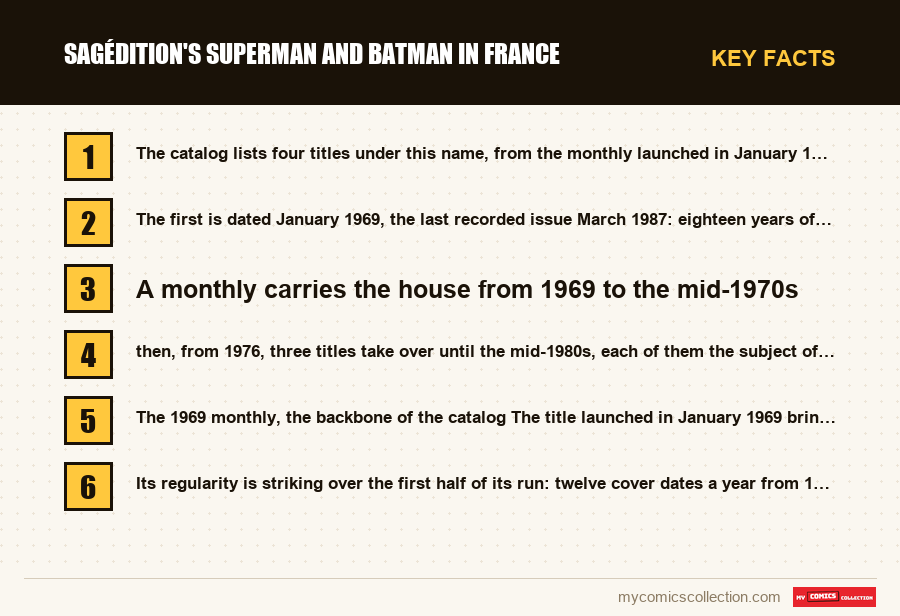
Under this publisher's name, the catalog records four series devoted to the heroes of the Superman and Batman stable. The first is dated January 1969, the last recorded issue March 1987: eighteen years of continuous presence on the newsstands, making it a supplier of backlist material for a whole generation of French readers, long before Urban Comics took over this heritage in bookstores. For you, this longevity has an immediate practical consequence: the same characters circulate from one title to another, and a single issue cannot be tied to its series by its cover alone.
This presence divides clearly into two phases. A monthly carries the house from 1969 to the mid-1970s; then, from 1976, three titles take over until the mid-1980s, each of them the subject of a separate guide. This article therefore concerns the house, the way it assembled an issue, and the inaugural monthly, which remains the least documented of the four.
The 1969 monthly, the backbone of the catalog
The title launched in January 1969 brings Superman, Batman and Robin together in one contents page, and the catalog records seventy-four issues of it. Its regularity is striking over the first half of its run: twelve cover dates a year from 1969 to 1972, without a single missing month. This is newsstand mechanics, and it tells you that a gap in your run during this period is a real missing issue, not an irregularity of the publisher.
The end of the run tells a different story. The year 1974 carries only ten cover dates, and publication stops in March 1975. A title that fades leaves behind issues that circulated less, and so are less present today in the lots that change hands: this is why the last issues of this series take longer to find than the first ones, in comparable condition.
The French headings show, in passing, that the contents were not limited to the title's trio. Among them are the Zone Fantôme, Kandor, the Légion des Super-Méchants, the misadventures of Jimmy Olsen, a Supergirl trial, and Lois Lane. The issue worked as a family anthology, and a buyer of a specific number was purchasing a basket whose contents they could not know before opening it.
What the cover titles leave unsaid
We counted the headings that name a character: fifty-two of the seventy-four issues name none. "Le félon", "La révolte", "Le costume infernal", "Combat singulier": these titles are newsstand hooks, not descriptions of contents. The direct consequence for you: a listing that cites only a story title does not tell you what the issue contains, much less whether it overlaps with an issue you already own.
When a name does appear, it is often the one you would not expect. Issue 45, dated September 1972, is headed "Robin garçon d'étage" (Robin, the bellboy); issue 46, from the following month, "Le jour où Superbébé dédruisit le monde !" (the day Super-Baby destroyed the world), misspelling included as it appears in the catalog. These misspellings are a useful clue: they show that the source was transcribed from the issues themselves and not reconstructed afterward, and they give you exact search strings when you comb through listings.
Three teams in one issue: how to read the credits
The most instructive point in the catalog is the shape of the credits. For fifty-seven of the seventy-four issues, three writers are credited side by side, and as many artists. The inaugural January 1969 issue thus carries Frank Robbins, Cary Bates and Otto Binder on the script, and Irv Novick, Bob Brown and Ross Andru on art. Only one story title appears, but three hands worked on it: the magazine assembled several episodes under a single cover.
This structure governs your entire verification method. The catalog keeps only one title per issue, the lead piece; the rest of the contents does not appear. You therefore cannot assert either that a French issue corresponds to a particular American issue, or that it contains the first French appearance of a character. The only honest approach is to record the contents from the copy itself, title page by title page, and note what is actually there. It is tedious, and it is precisely what is missing almost everywhere else on the French-language web.
Recurring names nonetheless give the catalog its character. Curt Swan is credited as artist on fifty-three issues of the monthly, Frank Robbins as writer on thirty-six. Two house habits follow: a very consistent graphic identity over time, and a premium, for the collector, on the issues that depart from it.
The issues collectors look for first
Nineteen issues credit Neal Adams as artist, and they are not spread at random: they cluster between issue 19, dated July 1970, and issue 70, dated October 1974. Within the same window, eighteen issues carry Denny O'Neil as writer. This window is the most sought-after of the monthly, and it falls in the second half of the run, the one whose copies are hardest to find in good condition.
Be careful, however, about what this information allows you to conclude. The credit belongs to the issue, not to the episode: nothing in the data says which of the three assembled stories carries the signature. A seller who advertises an "Adams episode" without showing the internal title page is selling you a deduction, not a fact. Ask for a photo of the contents before buying on this argument alone.
Do you collect this series?
Track what you own, what you are missing and what your collection is worth. 7-day trial.
Start my trial →
Publishing accidents, and how to anticipate them
Here is the costliest trap in this series. The issue labels run from 1 to 75, but the catalog records only seventy-four issues, for a double reason. Two issues share a joined number, in May 1974 and then December 1974: four labels for two objects. If you count by label, your run will look incomplete when it is not.
Conversely, an extra issue slips in without a number of its own: a "50bis" dated February 1973, the same month as issue 50. Two distinct objects, one single month, and a label that does not fit in a sequence of whole numbers: sales databases file it wrongly, sellers forget it, and it often disappears from inventories in good faith. It is the issue to check first in any run presented as complete.
A last irregularity: the chronology breaks down near the end of the run. Issues 67 and 69 both carry a July 1974 date, while issue 68 is dated August: the order of the labels no longer follows the order of the months. Sort your run by number rather than by cover date, or you will believe in a gap where there is only a late delivery.
Recognizing a copy and judging its condition
Two markers let you place an issue without knowing the series: the cover date, printed plainly as a month and a year, and the publisher's imprint. Two dates of the monthly are exceptions and carry a day, "5 avril 1972" and "5 février 1973": if your copy shows a date to the day, you are looking at one of these two issues, which removes the ambiguity immediately.
On condition, these newsstand magazines combine three weaknesses you can check in a few seconds. The top corner of the front cover, exposed on the rack and almost always blunted; the title area, where ink has rubbed against neighboring copies; and the inside paper, which has yellowed unevenly depending on storage. A yellowed but flat magazine is better than a bright but wrinkled one: the ripple signals an old humidity that is still at work.
Also check the internal completeness before discussing condition. The anthologies of that period were often missing a games page, a letters page or a full-page advertisement cut out by a reader. Count the pages against a reference copy from the same year before considering an issue intact.
Completing a run without mixing up the titles
Start by settling the question of scope. Collecting Sagédition means four independent runs, not a single collection: the numbering restarts at 1 for each title, and an ad that mentions "issue 12" tells you nothing until you have identified the series. Photograph the full front cover, title included, before adding a line to your inventory.
Then keep two columns in your tracking: the printed label, and the number of physical objects. For the 1969 monthly, the first column goes up to 75 and the second stops at seventy-four. Once you have noted this gap, you will stop chasing numbers that never existed separately, and you will have a clear test for judging a lot advertised as complete.
For active searching, the catalog's misspellings are your best allies. A misspelled heading can only be searched exactly as written, and it turns up only genuine listings, whereas a generic query drowns you in modern reprints. Keep a list of these exact spellings beside your inventory, and consult our collecting landmarks on Batgirl or Flash for the secondary characters who pass through these contents.
What gives these issues their value today
The price of these magazines rests on three factors, and the issue number is only the third. The condition of the spine and the front cover comes first, because a stapled, read magazine has almost always suffered. Next comes the real scarcity of the printing, of which the last issues of the monthly, which stopped in March 1975, give the best example. The credited contents come only after that, and only if they are proven from the contents page.
One arbitration rule, specific to this catalog: prefer an average copy of a hard-to-find issue to a perfect copy of an early issue, of which the steady print run left many copies in circulation. On print runs, sources disagree and no reliable figure circulates; reason from the frequency of the listings you observe, which is a more honest market indicator than a reconstructed print run.
Finally, document your collection while you inventory it. An issue whose internal contents have been recorded, photographed and dated is worth more, at resale and for insurance, than an identical issue with no information at all. For these French series that nobody has indexed in detail, your own record is the piece that makes the difference.
Frequently asked questions
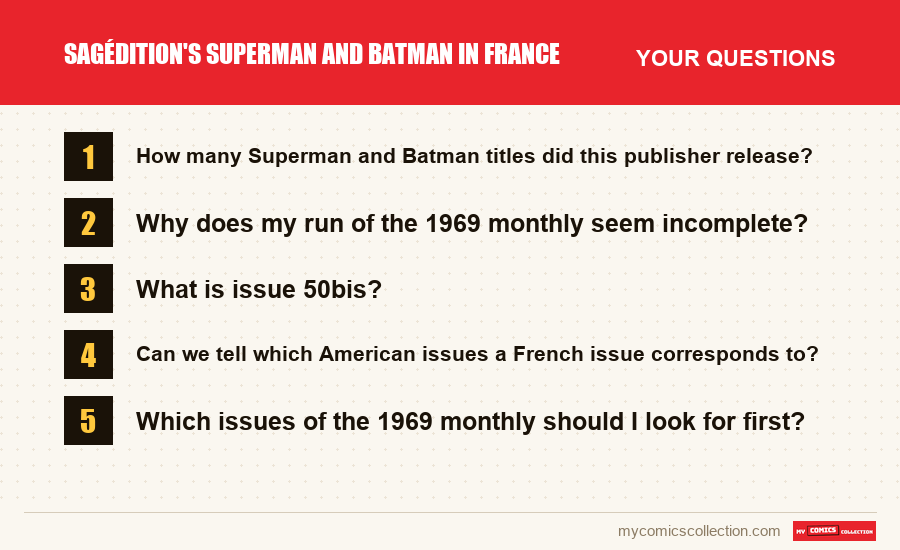
The catalog records four series under this publisher name, including the monthly launched in January 1969. The other three start from 1976 and each has its own guide. In total, the presence on the newsstands runs until issues dated March 1987, eighteen consecutive years of publication devoted to these characters.
Because the labels run up to 75 for seventy-four objects. Two issues carry a joined number, in May and then December 1974, which uses four labels for two issues. Count your physical objects rather than the printed numbers, or you will search indefinitely for issues that never appeared separately.
An extra issue dated February 1973, the same month as issue 50, carrying a label that does not fit in a sequence of whole numbers. Sales tools file it wrongly and sellers often leave it out in good faith. Always check whether it is present before accepting the word "complete" on a lot.
Not from the catalog. It keeps only one story title per issue, while three teams are usually credited, so the full contents are missing. Any claimed correspondence without photos of the internal title pages is a deduction. Record the contents yourself from the copy: that is the only reliable method.
The window running from issue 19, dated July 1970, to issue 70, dated October 1974: that is where the most sought-after credits cluster, Neal Adams on art and Denny O'Neil on writing. It also overlaps the period when circulation had shrunk, which is when good-condition copies are least often found.