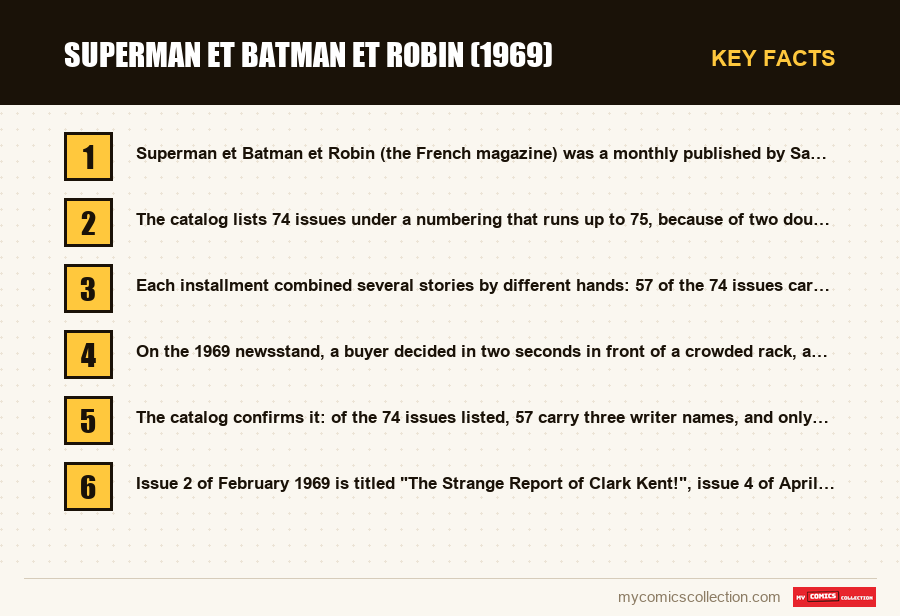
Superman et Batman et Robin (the French magazine) was a monthly published by Sagédition from January 1969 to March 1975. The catalog lists 74 issues under a numbering that runs up to 75, because of two double issues and one 50bis. Each installment combined several stories by different hands: 57 of the 74 issues carry three writer credits, which tells you plainly that the contents never came in a single story.
You have a stack of comics bearing the three-headed logo, bought in bulk or inherited, and you do not know whether you hold a complete run or the remains of a larger set. The numbering of this magazine does not read like a sequence of integers, and two copies can legitimately carry the same number on the cover. Before you hunt for the missing issues, you need to know what you are looking for.
As always in this guide, only verified details (creators, issue numbers, dates) are stated as fact; the analysis is our own, with no reproduction of panels or protected dialogue.
A title that stacks three names, and what that says about the newsstand
Read the title aloud: Superman, and Batman, and Robin. Three names, two conjunctions, no hierarchy. This is not a writing clumsiness, it is a sales argument printed on the masthead. On the 1969 newsstand, a buyer decided in two seconds in front of a crowded rack, and a title announcing three heroes instead of one promised three times the content for the same gesture: it was not selling a character, it was selling a volume.
This commercial grammar has a direct consequence for what you have in your hands: a magazine that promises three headliners has to deliver an anthology, so it lined up several stories drawn from several original series. The catalog confirms it: of the 74 issues listed, 57 carry three writer names, and only one issue, number 47 of December 1972, is credited to a single author. The multi-story contents were the rule, the single story the exception.
What the magazine actually published, beyond the three names in the title
The story titles recorded in the catalog tell a different story from the masthead. Issue 2 of February 1969 is titled "The Strange Report of Clark Kent!", issue 4 of April 1969 "Lois Lane's Betrayal", and issue 21 of September 1970 "Hyper-Olsen vs. Superman". Neither Lois Lane nor Jimmy Olsen appears in the magazine's title, yet they hold the cover or the lead story.
The phenomenon extends further still. Superboy takes the lead story of issue 3 in March 1969 with "The Secret Hideout of Superboy", then returns in issue 36 of December 1971 with "Here Lies Superboy". Supergirl leads issue 67 in July 1974. The reader who bought three names received the full Metropolis entourage, plus the Gotham duo. This changes how you search: a seller will readily list these comics under the name of the character featured on the cover, not under the magazine's name.
A warning belongs here, and it applies to every line of this guide. The catalog gives only one story title per issue, while the three signatures recorded imply at least three stories. The rest of the contents is therefore unknown from the data: never conclude from a single title that an issue contains a particular French first appearance or corresponds to a particular American comic. That match can only be verified with the copy in hand, page by page. It is slow work, and it is the only honest method.
Six years of monthly publication, and three numbering accidents
The basic rhythm is clear: one issue a month, from January 1969 to the end of 1973, with no gap in the sequence of cover dates. This regularity lets you date a copy whose cover is damaged where the date is printed: knowing the number tells you the month, counting from January 1969.
The end of the run is more eventful, and that is where the pitfalls lie. The catalog lists an issue 50 dated 5 February 1973 and, in the same month, an issue identified as 50bis. Two distinct objects, two distinct contents, one number displayed: "The Future Is... Giant Batman" marks one, "The Super Heat Wave Over Metropolis" marks the other. Then come two double issues, 65-66 of May 1974 and 71-72 of December 1974: each counts as one physical comic but consumes two slots of the numbering and absorbs the skipped month, since June and November 1974 have no issue of their own. That arithmetic explains the gap between the 74 issues listed and the 75 printed on the last cover, the one for "Super-Sauvage, the Master of Metropolis", in March 1975.
The catalog also keeps an inconsistency that should be pointed out rather than smoothed over: issue 68 is dated August 1974 and issue 69 July 1974, so a later issue carries an earlier date. Sources diverge on cases like this, which are common near the end of a run when cover dates and actual on-sale dates fall out of sync. Check the copy itself before building a timeline on this particular point.
The credits: Curt Swan everywhere, Neal Adams intermittently
An anthology magazine has no single author, it has a statistic: Curt Swan appears in the credits of 53 of the 74 issues. His presence in nearly three quarters of the collection explains the visual uniformity the stack gives once shelved, even though the stories come from scattered sources. If you are looking for graphic consistency in this series, that is where you will find it, and nowhere else.
The second statistic matters more for value. Neal Adams is credited on 19 issues, his first occurrence being issue 19 of July 1970, "Jimmy the Bad Hippie", and his signature returns in stretches until 1974. This name creates its own demand, independent of the magazine: buyers are looking for the pages, not the issue. It remains to be checked that the signed story is really the one you are buying, and not another from the same contents.
On the writing side, the dominant trio is Frank Robbins (36 issues), Leo Dorfman (33) and Cary Bates (31), followed by Denny O'Neil (18). Two transcription details deserve your attention when you search by name: the catalog most often writes "Denny O'Neil" but "Dennis O'Neil" on issue 37 of January 1972, and it alternates "Robert Kanigher" with "Bob Kanigher" on issue 19. An internal search engine will not match these two spellings. Search for both.
The issues that matter, and why
The first issue, dated January 1969, already carries the series' mark in its main contents, "The Baffling Madness of Batman": three credited writers and three artists, including Irv Novick. Its demand comes as much from its status as from its content, and good-condition copies are scarce because nobody in 1969 bought a comic to keep it.
At the other end, issue 75 of March 1975 closes the series, and issue 74 of February 1975, "The Birth of Young Batman", belongs to the same difficult zone: print runs drop at the end of a run and unsold copies get destroyed. Between the two, the four singular slots already described block collections more often than the real rarities do, simply because sellers and buyers do not describe them the same way.
Some contents attract a thematic demand, useful to know if you sell by the unit. Issue 16 of April 1970 announces "The Prisoner of the Phantom Zone", issue 18 of June 1970 "The Legion of Super-Villains!", issue 44 of August 1972 "The World of M.Mxyzptlk", issue 58 of October 1973 "Menace of Kandor". These are elements of the Superman universe that have their own fans, and an explicit French title is easier to find than a bare issue number.
Do you collect this series?
Track what you own, what you are missing and what your collection is worth. 7-day trial.
Start my trial →
Recognizing the edition, and not confusing the magazines
First check, the most profitable: read the full title on the cover. The three names must appear there in this order, separated by the conjunctions; an issue that shows only two belongs to a different title. It is the simplest filter against bulk-buying mistakes, where sellers happily group together everything wearing a blue cape.
Second check, the date. Two entries in the catalog carry a date down to the day rather than the month: issue 40 is dated 5 April 1972 and issue 50 is dated 5 February 1973. The others show only a month and a year. This formatting detail serves as a marker when a listing shows only a partial photo: a date to the day immediately narrows the field of possibilities.
Third check, the transcription of titles. The catalog keeps the spellings as recorded, with their irregularities: "Zône Fantôme" on issue 16, "Magicien Mysterieux" on issue 23, "dédruisit" on issue 46. Do not correct these forms in your records before you have looked at the printed copy: a typo present on the cover is part of the object's description, and reproducing it will help you find listings that the correct spelling would miss.
The condition of a newsstand copy, and what to examine
A stapled comic from this period has three weak spots, to be checked in this order. The spine, which suffers from every flat opening, and whose rusted staples leave a halo on the center pages. The corners, which blunt at the simple passage through a rack. And the paper, whose yellowing is normal for a 1969 to 1975 print run and does not in itself count as a defect, unlike a clean break along the fold.
A point specific to anthology magazines adds to this list: count the pages. A contents list of three stories lends itself to removing one, and it is not rare for a former owner to have cut out the pages of an artist they liked. The comic looks presentable until you open it in the middle.
Buying pitfalls specific to this series
The main pitfall carries a number: 50. A seller who lists this number without specifying whether it is the 50 or the 50bis probably does not know that both exist. Ask for the title of the lead story before you pay, and if you buy both, store them side by side with a note, or you will later take them for a duplicate.
The second pitfall is the reverse: the double issues 65-66 and 71-72 create the illusion of a gap. Someone checking the sequence by eye will see a missing 66 and a missing 72 that never existed separately, and will spend months hunting for issues that cannot be found. If your inventory flags these slots as empty when you own the doubles, the fault lies in your record, not in your collection.
The third pitfall is documentary. Because the magazine mixes Gotham and Metropolis in the same issue, a lot sold under the label "Batman 1970s" may contain several numbers without the exact title being mentioned even once. This disorder works in your favor when buying and against you when reselling: describe the issue number, cover date and lead story title precisely.
Completing the series, estimating, and keeping the inventory
To complete the run, work in blocks of twelve using the correspondence between number and month, valid through the end of 1973: an annual block sells better than an isolated issue, because flea-market dealers think in stacks, not in missing slots. Keep the four singular slots, 50, 50bis, 65-66 and 71-72, on a separate list with their story titles.
For value, reason in ratios rather than absolute prices. A copy with an intact spine and clean staples sits well above the same issue that has been read and folded, and the gap widens on the difficult slots: issue 1, the end of the run in 1974 and 1975, and the issues where Neal Adams's signature is actually present. The uniform yellowing of the paper, by contrast, counts for little, since all comparable copies share it.
For the inventory, finally, plan for two fields that sequences of integers cannot handle: a free field for the number as printed, and another for the title of the lead story. The 50bis then stops being a problem and the doubles stop being gaps. The hubs for Robin and Supergirl will help you connect these issues to the characters who run through them.
What to remember
This magazine is an unapologetic newsstand object: a title that adds three heroes together to sell volume, a multi-story contents that the catalog records under a single entry, a regular monthly for five years followed by an end of run patched together with double issues. Anyone who approaches it as a linear series gets it wrong twice, on the content and on the count. Approach it as an anthology and everything falls into order: 74 issues from January 1969 to March 1975, a numbering that goes up to 75, four slots to handle by hand, and the name of Curt Swan to hold the whole visually together. The rest is verified with the copy in hand.
Frequently asked questions
The catalog lists 74 issues, from January 1969 to March 1975, under a numbering that goes up to 75 on the covers. The gap comes from two double issues, 65-66 and 71-72, which each consume two slots, and from one additional issue identified as 50bis in February 1973.
Both are recorded for February 1973, with different contents: "The Future Is... Giant Batman" for issue 50, dated 5 February, and "The Super Heat Wave Over Metropolis" for the 50bis. Always ask for the title of the lead story before buying, or you risk an unintended duplicate.
Far more than three. The recorded story titles feature Clark Kent as early as issue 2, Lois Lane in issue 4, Jimmy Olsen in issue 21, Superboy in issues 3 and 36, and Supergirl in issue 67. The publisher was selling a volume to read, not a lineup limited to the three names printed on the masthead.
Not from the available data. The catalog gives only one story title per issue, while 57 of the 74 issues carry three writer credits, meaning at least three stories. The correspondence can only be verified with the copy in hand, story by story, and any conclusion drawn from a single title is hazardous.
Curt Swan clearly dominates, credited on 53 issues, which explains the visual unity of the collection. He is followed by Bob Brown and Irv Novick, then Neal Adams on 19 issues, starting with issue 19 of July 1970. That last name creates its own demand, independent of the magazine itself.