
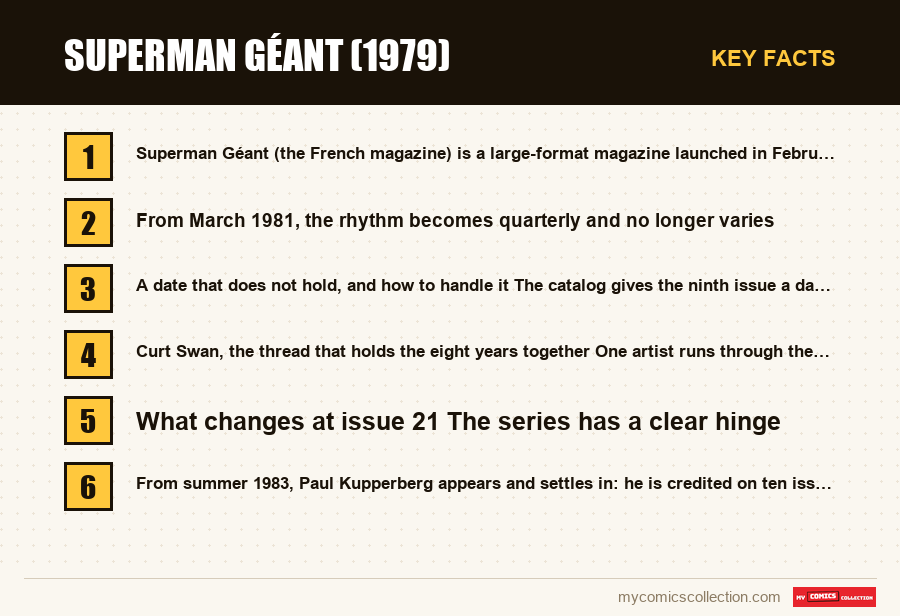
Superman Géant (the French magazine) is a large-format magazine launched in February 1979 and discontinued in January 1987, after thirty-five numbered issues published without interruption from 1 to 35. The catalog records no gap and no double issue. Its interest for a collector rests on three things: a short numbering that can therefore actually be finished, a rhythm that settles after two floating years, and a format that imposes its own storage and preservation constraints.
You may have shelved your Supermen by number without noticing that two spine heights sit side by side in the stack. From this publisher, the same hero appeared in the same period in a different format, and the two series ended up next to each other on the shelves of most readers of the time. Superman Géant is the wide branch: thirty-five issues whose height fits almost none of the storage boxes sold today for comics. It is a short series, and therefore tempting, and a bulky object, and so often damaged where nobody looks.
As always in this guide, only verified details (creators, issue numbers, dates) are stated as fact; the analysis is our own, with no reproduction of panels or protected dialogue.
A short series, and that is its first quality
The highest number on record is thirty-five, and the catalog counts exactly as many installments. This equality is the only piece of information that matters before buying: it means no number was skipped, no cover carries a double figure, and your list of gaps can be read directly off the spines without any concordance table.
This comfort is rare: many magazines of this period have numbering full of holes left by canceled releases or specials slipped into the run. Here, the checklist is trivial, and the effort shifts to the condition of the copies and the availability of the very first installments.
Two years of floating rhythm, then six years of metronome
The first year follows no readable cadence. The launch is dated February, the second installment May, the third July and the fourth August, an interval that tightens from a quarter to a month before opening up again. Such a start usually betrays a schedule still being adjusted, and for you it has a practical consequence: the first four issues were not printed in the same volumes nor distributed in the same way, and their relative scarcity does not follow the order of the numbers.
From March 1981, the rhythm becomes quarterly and no longer varies. The dates line up on March, June, September and December for two years, then slide by a month to settle on January, April, July and October until the end. This shift is easy to spot when you line up the spine dates: it marks the boundary between the two halves of the series.
For secondhand hunting, this regularity works as a method. Once you know the date of a copy from the second half, you can deduce its number without opening it, and vice versa. A lot sold as "complete from one year to another" can be checked with a simple count of quarters, before you even have the comics in hand.
A date that does not hold, and how to handle it
The catalog gives the ninth issue a date of September 1981, while the eighth is dated May 1980 and the tenth November 1980. The value falls out of chronological order, and it is also identical to that of the fourteenth issue. Two readings are possible: a data-entry typo, or a cover date that was actually wrong at printing.
We do not settle this, and you should not either on the strength of a list. The check is made on the copy: look at what is printed on the cover and, where applicable, the printer's imprint line. If you keep a personal database, record the date you read and flag that it diverges from the source, rather than copying either one.
Caution has a market value here: a seller who lists a comic by its date may be mistaken in good faith about that installment. Ask for the number printed on the spine.
Curt Swan, the thread that holds the eight years together
One artist runs through the series from start to finish: Curt Swan is credited from the February 1979 installment and still on the January 1987 one. In between, he appears in the credits of twenty-five of the thirty-five issues, which makes him the graphic signature of the magazine and a useful reference point when you sort loose pages whose cover has disappeared.
His absence is also a clue. The few issues where he does not appear correspond to contents entrusted to other teams, and among them the seventh installment lists Bob Oksner, José Luis García-López and Neal Adams. For a selective buyer, these issues stand out because they break the uniformity of the series, not because they are rarer.
On the writing side, Cary Bates plays the same role of constancy: credited on the first issue, he returns up to the last, with seventeen appearances spread across the whole run. When a magazine keeps the same names for eight years, the reader buys a continuity of tone, and the collector can treat the whole as a coherent object rather than as an accumulation of contents.
What changes at issue 21
The series has a clear hinge. Up to the twentieth installment, the recorded scripts revolve around Cary Bates, Elliot S! Maggin and Gerry Conway. From summer 1983, Paul Kupperberg appears and settles in: he is credited on ten issues, from that installment through the one of January 1986, that is almost the whole second half. Marv Wolfman joins him on several issues.
This same twenty-first issue is the only one where Pérez is credited both for writing and for art. It is a documented oddity, and it deserves your attention at the time of purchase: a single occurrence among thirty-five credit lists is exactly the kind of detail that raises demand for an issue without anything signaling it on the cover.
Do not over-interpret the shift, however: Cary Bates reappears after it, including on the last two installments. The center of gravity moves, but the series does not break.
Stories much older than the cover date
Alongside authors active in the eighties, the credits list names from a completely different generation: Bill Finger, Otto Binder, Leo Dorfman, David Vern on writing, Dick Sprang on art. Their presence in issues dated from 1980 to 1987 indicates that the contents mixed recent stories with reprints from much earlier.
The consequence is important and often overlooked: the date printed on the cover dates the French installment, not its contents. A single issue can gather stories separated by several decades. If you are looking for a specific story, the magazine's number is a better starting point than the year.
This guide cannot go further, and it should say so plainly. The catalog retains only one story title per issue, whereas a magazine of this format published several. The full contents are therefore not available here: they must be read off the copy, page by page. That is also why no correspondence with a foreign edition is asserted in this entry.
Do you collect this series?
Track what you own, what you are missing and what your collection is worth. 7-day trial.
Start my trial →
The issues that attract attention
The recorded titles suggest a few leads. The third installment is titled "The Super-Sons of the Super-Heroes" and the sixteenth "The Ultimate Secret of the Super-Sons": two issues that answer each other, separated by nearly three years. A reader who wants to follow this thread has to hunt for two non-adjacent numbers, which is counterintuitive when you buy in small consecutive lots.
The fourth installment is titled "Supergirl's Gang", a sign that the magazine opened its contents to the hero's circle and not only to the main character. The twenty-sixth, "The Scoop of Perry White's Life", confirms this taste for the newspaper's supporting cast. These issues interest thematic collections as much as series collections.
Two issues, the twenty-first and the twenty-third, have no recorded story title: the catalog carries only the mention of the contents page for them. This says nothing about their content, only that the data is missing. Treat them as issues to record yourself, and be wary of sale listings that assign them an authoritative title.
The large format, and what it demands of your shelves
This is where the series stands out most concretely. A wide cover has a larger corner surface, and that is the first thing to give way: all four corners take the shock at every handling, while the center stays intact. A copy described as "fine condition" in a tightly framed photo can have all four corners blunted. Ask for a view of the corners, not a view of the cover.
The second point is vertical storage. A wide, flexible comic standing upright sags under its own weight as soon as it is not held tight by its neighbors, and the fold sets in within a few months. On a series of thirty-five, the problem concentrates at both ends of the shelf, where lateral pressure is missing. Bookends or a full box cost less than restoring a warped spine.
The third point is the most mundane and the most costly: the standard sleeves and boxes on the market are sized for another format. If you force a wide copy into a sleeve that is too short, you create a clear and permanent edge mark. Measure a comic before ordering protection, and store the rest of the series flat in low stacks rather than upright in an unsuitable container.
Finally, two spine heights in the same collection complicate filing. Since the same hero was published in another format by the same publisher at the same time, an inherited stack often mixes the two. Separate them physically before you inventory: you will avoid counting twice an issue that carries the same number in the other series.
Buying pitfalls
The first pitfall is the lot listing. "Superman Sagédition collection, about twenty issues" tells you neither which numbers nor which format. Ask for the list of numbers before committing, and compare it with your list of gaps: on a series with no holes, this check takes one minute.
The second is damp from the bottom of the stack: a wide comic stored at the bottom of a pile absorbs moisture through its lower edge, and the stain rises in a regular halo, invisible head-on and obvious at an angle in the light.
The third concerns the first installments. Because the rhythm of the first year is irregular, the first four or five issues are less often found in good condition than the rest of the series, and their prices follow that scarcity. Nothing requires you to buy them first: start with the second half, which is abundant and regular, and keep the top of the numbering for last, when you will know how to recognize a good copy.
Completing the series and tracking progress
The most effective method for a continuous numbering is the negative list: note not what you have, but what is missing, and take it with you. Across thirty-five entries, it fits on a phone screen, and it spares you the duplicate purchase that wastes the budget meant for a real gap.
Add a condition column beside each number. On a series where the format weakens corners and edges, the priority is not "I am missing such a number" but "such a number needs replacing".
For value, reason in ratios rather than absolute figures. A copy with four sharp corners and a straight spine trades at a multiple of a worn copy of the same number, and the gap widens on the first installments more than on the last. Follow sales actually concluded over several months, not asking prices: on a series that is scarce online, a single optimistic listing distorts your whole perception.
What to remember before you hunt
Superman Géant is a finishable series: thirty-five issues, a numbering without holes, and a quarterly cadence that makes the second half predictable. The effort lies in condition, not in the scarcity of the numbers.
Keep two reflexes. Check the corners and the bottom edge before anything else, because the format exposes them. And always ask for the printed number, never the date alone, because at least one installment carries a date that does not fit its place in the sequence.
Frequently asked questions
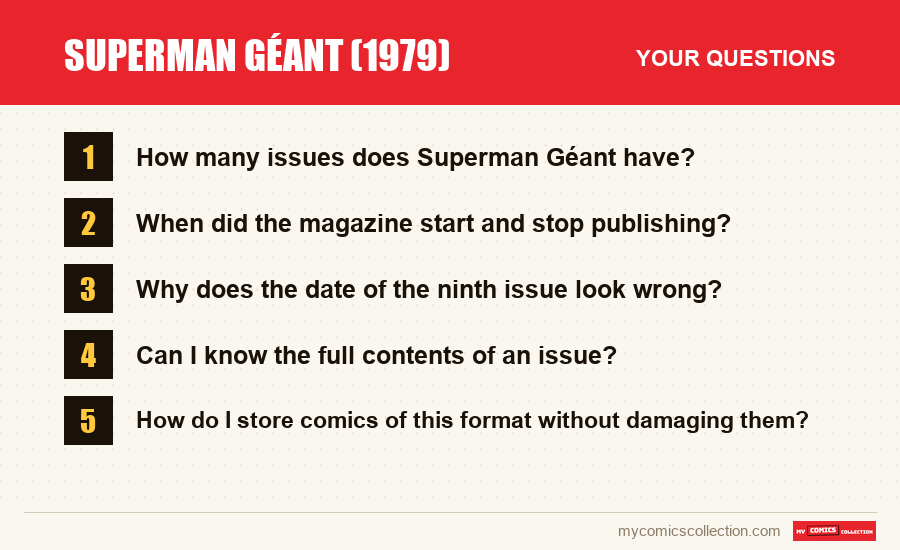
Thirty-five, numbered from 1 to 35. The highest number recorded in the catalog equals the number of installments on record, which indicates a continuous numbering with no holes and no double issues. Your list of gaps can therefore be read directly off the spines, with no concordance table to consult beforehand.
The first installment is dated February 1979 and the last January 1987, eight years on the newsstand. In between, the rhythm goes from an irregular cadence during the first two years to a strict quarterly schedule, first aligned on March, June, September and December, then shifted by one month until the end.
Because it falls out of chronological order: it sits after the date of the tenth issue and coincides with that of the fourteenth. It may be a typo in the source, or a cover date that was actually wrong at printing. We do not settle it: record what is printed on your copy and note the discrepancy.
Not from this entry. The catalog retains only one story title per installment, whereas a magazine of this format published several. Two issues do not even have a recorded title. The contents must be read off the copy, which is also why no correspondence with a foreign edition is asserted here.
Measure a copy before buying protection: standard sleeves are cut for another format and leave a permanent edge mark. Standing upright, use bookends so nothing sags, especially at both ends. Otherwise, prefer low flat stacks, and separate the two spine heights in your collection.